
Quicker, easier interface for DataVault

We are delighted to report that Edinburgh DataVault now has a quicker and easier process for users. The team have been working hard to overhaul the form for creating a new ‘vault’ to improve the user experience. The changes allow us to gather all the information we need from the user directly through a DataVault web page. The users no longer need to first login to Pure and create a separate dataset record there. Instead, that bit will be automated for them.

I have explained the new process and walked users through the new form in a new and updated how-to video, now combining the getting started information with the demo of how to create a vault:

Get started and create your vault! (8 mins)

The new streamlined process for users is represented and compared to our open research data repository DataShare in this workflow diagram. DataVault is designed for restricted access, but can also handle far larger datasets than DataShare.
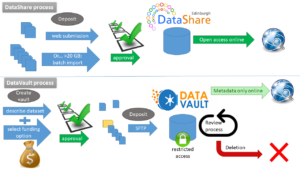
The diagram shows the steps users go through in DataShare and DataVault. Common steps are deposit and approval.

The DataVault process includes the gathering of funding information, and review and deletion none of which are present in the DataShare workflow since they would not be relevant to that open research data repository.

The arrow showing DataVault metadata going to the internet represents the copying of selected metadata fields into Pure, where they are accessible as dataset records in the university’s Edinburgh Research Explorer online portal.

Our new course “Archiving Your Research Data”, featuring Sara Thomson, Digital Archivist, provides an introduction to digital preservation for researchers, combined with practical support on how to put digital preservation into practice using the support and systems available here at University of Edinburgh such as the DataVault. For future dates and registration information please see our Workshops page.

A recording of an earlier workshop (before the new interface was released) is also available: Archiving Your Research Data Part 1: Long-term Preservation.

If you are a University of Edinburgh principal investigator, academic, or support professional interested in using the Edinburgh DataVault, please get in touch by emailing data-support@ed.ac.uk.

Pauline Ward
Research Data Support Assistant
Library and University Collections
University of Edinburgh
It Is Our Mantra

Last week I was honoured to accept an invitation to speak at the Library Technology Conclave at Somaiya Vidyavihar University in Mumbai, India, organised by Informatics Limited and the University. A prelude the day before the event included a half-day “Research Data Management (RDM) Basics” tutorial for about 50 attending librarians, which I delivered based on adaptations of our Research Data Support team’s training materials for PhD students and staff. The training exercises, developed from a few other external librarian training sessions I’ve done, focused on building librarians’ confidence in supporting researchers with data management planning and data sharing. Doing the training in person helped me to overcome communication barriers and foster deeper engagement than could have happened online only.

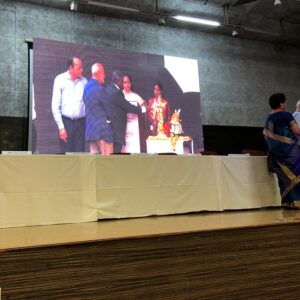
Lighting the flame of the conference

Lighting the flame of the hybrid conference

The conference was on the theme of “Research Data Management and Stewardship: Building Blocks for Open Science,” with a number of eminent librarians, scientists, and educators speaking in keynotes and on panels in six thematic sessions, in-person and remotely. There was a palpable sense of urgency to the proceedings, as those in the room were concerned that India’s scientific institutions, without funder mandates, national open infrastructure, nor observable changes in cultural norms for RDM and Open Science, might be left behind, given this emerging new, more transparent way of conducting research. Questions focused not on the What or Why of Open Science, but how to instigate behavioural change of scientists and researchers, and how librarians could create demand for new services such as data repositories and quickly skill themselves up.

I have some empathy for their position. A decade or so ago I attended conferences which felt more like hand-wringing than change-making, with endless talk of carrots and sticks (and carrot-stick jokes), with researchers explaining over and again their reluctance to be ‘scooped’ by giving access to their data. I am not sure what caused the tipping point to talking about the potential of data sharing and open science to the exciting reality of it happening, but it seems to have come round (more or less). I do still harbour concerns that our own researchers will be left out of participation in the shared infrastructure that is the European Open Science Cloud because of Brexit-related barriers here.

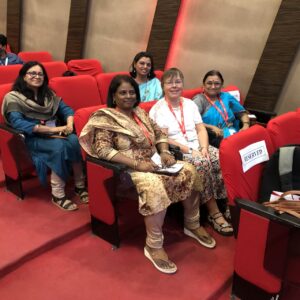
Robin with attendeesOne talk that piqued my interest involved a survey of librarians in Gujarat about RDM and their capacity to deliver new types of service, by Dr. Bhakti Gala. As the Indian LIS (library and information science) curriculum was apparently seen to not be delivering RDM training to any great extent yet, the researcher had asked how the librarians had acquired knowledge of RDM. She said that about half the librarians who had pursued self-training had learned from the free, online MANTRA course (which stands for Research Data Management Training), offered by the University of Edinburgh.

The Chair of the panel, Prof Shalini Urs, with whom I had had a conversation over dinner with about the name of the course, said [naming me, as I sat in the audience] that I would be happy to hear that was the case, to which I of course smiled and nodded. Alluding to our prior conversation about whether the name was a cultural [mis-]appropriation or not, she looked me in the eye and said, “It is Our MANTRA, now.” Which is, of course, the great thing about Openness.

Simon Smith joins the Research Data Support Team

It has been a long pandemic, and some bright spots are beginning to appear on the horizon. One of them is that we have a new professional joining our team, to work with Kerry Miller in the role of Research Data Support Officer – Simon Smith.

The University’s Digital Research Services programme makes it possible to fund this post for the Research Data Service – deemed an essential addition following a period of reduced resource, because of the need to increase outreach, training and awareness, and take-up of services in the light of the new Research Data Management Policy.

portrait of Simon SmithSimon has worked in Research Data Management since 2015, when he joined the Open Research Team at the University of Surrey. He has spent his time helping to develop a range of research data management (RDM) services, implementing two repositories, and learning to love data management planning. He is genuinely interested in issues around data licencing and sensitive/personal data. His teaching and research background is in philosophy, in the service of which he edited a scholarly journal. Now, however, he is slightly obsessed with James Joyce’s Ulysses.

Simon has been in post for nearly 2 weeks, and is keen to meet researchers and their supporters from all corners of the university – please send any and all invitations to come chat about RDM to data-support@ed.ac.uk! We look forward to gaining from Simon’s insights and experience.

Robin Rice & Simon Smith
Library & University Collections

Edinburgh Open Research Conference – Call for Contributions

The University’s Library Research Support Team and grassroots organisations Edinburgh ReproducibiliTea and Edinburgh Open Research Initiative (EORI) are joining forces to launch the first Edinburgh Open Research Conference.  Which will be held in the John McIntyre Conference Centre and Online on the 27th May 2022. If you would like to participate in this exciting new event then This Call for Contributions is your invitation to get involved.

Introduction

Open research (a.k.a. “open science” or “open scholarship”) refers to a collection of practices and principles around transparency, reproducibility and integrity in research.

As an active member of the League of European Research Universities (LERU) and a signatory of DORA, Edinburgh is committed to making open research the new normal by supporting and encouraging the adoption of good open research practice throughout the University. This represents a significant change in the way research will be conducted, and how the next generation of researchers will be trained. That is why we are launching this new conference.

You will hear about the work the University is doing to support your move towards Open Research, but more than that it will be a chance for you to discuss the challenges and opportunities that Open Research will bring to your work, and to network with colleagues from other disciplines and institutions who will be facing those too.

We are also excited to announce that our keynote speaker for this conference will be Professor Stephen Curry from Imperial College London, who also is the Chair of DORA.

The conference will be free to attend and is open to those within the University of Edinburgh as well as external attendees, from all disciplines, backgrounds, and roles. In particular, we are hoping to welcome undergraduate and postgraduate students to this event.

The schedule will consist of talks, workshops and poster sessions, both with internal and external presenters.

Further Information about the conference can be accessed from the Edinburgh Open Research Conference 2022 | The University of Edinburgh webpage which will be updated regularly.

How to Contribute

If you would like to participate in this conference submit an abstract of maximum 500 words using the submission form at http://journals.ed.ac.uk/eor/index. Please make sure your contribution is accessible to those from different disciplines and backgrounds.

The deadline for contributions 31 March 2pm, except for posters which is 15 April 2pm.

Visit the Edinburgh Open Research Conference 2022 | The University of Edinburgh for more details on the themes and types of contribution.