
By popular demand, the Research Data Service is pleased to announce the arrival of a brand new feature: the DataVault Outward Staging Area (DOSA), a free-of-charge benefit to DataVault depositors.
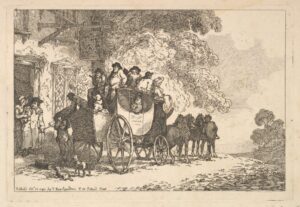
What is a staging area? Somewhere your data can be held temporarily, on the way to somewhere else. Just like a traditional staging post for stagecoaches, as shown in this engraving.
Imagine: your multi-terabyte dataset is safe-and-sound in your vault, you’ve cited it in a paper you’ve just published, and an external researcher has asked you for a copy. What will you do?
Simple: send a request to IS Helpline (or data-support@ed.ac.uk) asking us to create a DOSA folder for your data.
We’ll then use DOSA to give temporary (two months) external access to a copy of your deposit, using a Globus FTP endpoint. We’ll retrieve a copy of your data to the folder. And we’ll provide you with the Globus endpoint, which you send to the researcher. They may need to install some software to get the data. Alternatively, for datasets under 500 GB, we suggest a DataSync link will be more suitable. We set that up and provide it to you in the same way as the Globus endpoint. The difference for the end user is they can use the DataSync link (+ password) from their browser. Let us know if you have a preference for a Globus endpoint or a DataSync link (otherwise we’ll decide automatically based on the size).
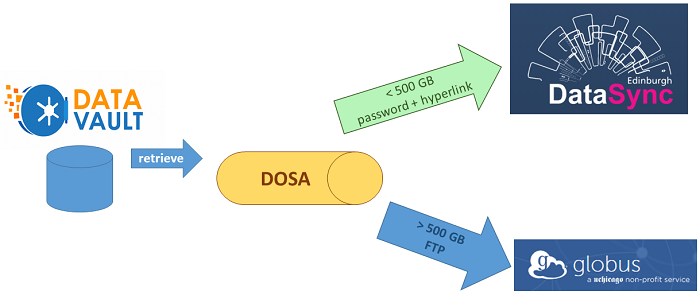
Workflow: We retrieve your deposit to your DOSA folder. We provide you with either a Globus endpoint or a DataSync link, to provide to your external person who made the request.
The DOSA is part of our networked active data storage, DataStore, but separate from the other staging area we provide for users making a new deposit (‘the DataVault staging area’), for the inward route.
Since 2016 researchers have been archiving data in Edinburgh DataVault. The DOSA is available for any DataVault deposit, old or new.
DataVault Outward Staging Area (DOSA): Sharing data with an external user
Not sure you’ll remember the name of the service? Worry not! I have a mnemonic device for you: just remember that a ‘dosa’ is an Indian savoury pancake. What’s not to like?

Pauline Ward
Data Repository Operations Officer
University of Edinburgh
 Thirdly,what services are provided to researchers to make their work public? Most universities provide support like a data repository (except for LSE), Research Data Management support, Open Access to publications and thesis and guidance on sharing research software. A few provide support on protocols sharing. Some universities have started hosting an open research conference. For example, UCL Open Science Conference 2021, 2022,
 One of the ambitions for the EOR conference held in March, 2022, when we first started planning it was to make it as open and accessible as possible. To achieve this we made the whole event hybrid so that plenary talks, posters, and workshops were all accessible on the day to both in person and remote attendees. While this generally worked very well for both remote and in-person attendees, we also wanted to make it available to people who couldn’t attend on the day – so we recorded everything, and the recordings of the talks and posters can now be openly accessed through our Edinburgh Open Research journal at
 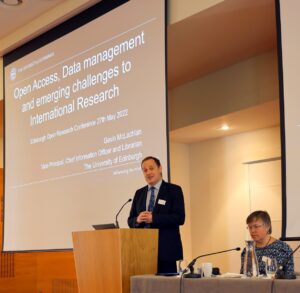 Attendees online and in person were treated to a fine and varied selection of talks. To begin with, topics ranged from Gavin McLachlan’s overview of current national and international political contexts and Dominic Tate’s review of the University’s Open Research Roadmap, to the latest in open access publishing from Rebecca Wojturska and Dominique Walker, FAIR principles from Susanna-Assunta Sansone, and Eugenia Rodrigues on inclusivity and Citizen Science.
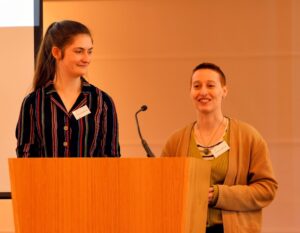 Nicely complementing Madeleine’s study, Emma MacKenzie and Felicity Anderson gave us the benefit of hands-on experience. Speaking from either side of the student-supervisor relation, they described their use of open source tools, materials, and mind-sets in student projects. Here, too, we saw the development of core competencies, this time including the documentation, discussion, and resolution of errors.
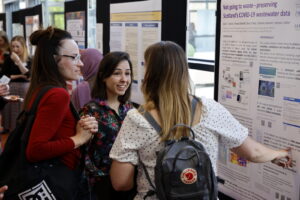 There were also poster sessions, culminating in first prize for Livia Scorza’s ‘Not going to waste – preserving Scotland’s COVID-19 waste water data,’ and there were workshops covering everything from public engagement to Open Research and AI.