Edinburgh Open Research Conference 2023: in summary

This is a guest post by the Library’s new Citizen Science Engagement Officer, Neil Coleman. All of the materials from the conference may be found on the Edinburgh Open Research Journal page.

After a wonderful three days of talks, workshops, and connecting, we can now call a close to a second successful open research conference. This year, the collaborative efforts of members from the Library Research Support teams (led by the wonderful Kerry Miller) and Edinburgh ReproducibiliTea (facilitated by the talented Emma Wilson) brought together speakers and attendees from all over – allowing connections to be forged with representatives across the UK (and further afield!).

On Monday we were treated to a number of intimate workshops, ranging from a targeted discussion on the future of our very own Edinburgh Diamond, to some practical guidance on how to support good Open Research practices in the Arts and Humanities. We even had the privilege of hosting Edinburgh’s very first ‘Research Café’, where Marshall Dozier, Ruth McQuillan and Lauren Hall Hew spoke about their experiences with Open Research, leading to a delightful discussion about the future of their work, and, importantly, how we might all improve. It was a great first step in this new initiative – a chance to have an in person chat about the trials and tribulations, but also the joy and excitement found in research.

Tuesday was ‘the big day’, with over a hundred in-person tickets sold, and more than 300 online attendees throughout the day. We began with a keynote from Kirsty Wallis (Head of Research Liaison at UCL). Her talk painted a detailed picture of some of the amazing work taking place. This included some stand out discussions of the progress they have been making with their support for citizen science and community connectedness with research; the Euston Voices/Euston Young Voices were really stand out case studies of the impact open research practices can have on the world beyond research.

A table of people in conversation with a fold out board and post-it notes on the left hand side.

In depth discussions taking place at the Monday Arts and Humanities workshop.


The remainder of the day allowed us to explore the themes of the conference in depth: looking for tangible solutions to global challenges. Our lunchtime keynotes, Daisy Selematsela and Lazarus G Matizirofa gave us a tour of the current status of Open Research in South Africa and the University of Pretoria in particular. Later, Will Cawthorn (our LERU Open Science Ambassador) spoke about the structures and initiatives that are helping to realise the potential of open science. Sandwiched between these fabulous lectures, a diversity of perspectives were offered in formats including lightning talks – from a community representative of a data-focussed environmental initiative (Pauline Ward, Data 4 Climate Action​) through to workflows from Xiaoli Chen (DataCite). Throughout, it was inspiring to see the levels of engagement – with a seemingly unending stream of questions and comments from the room and our online community following on from many of the talks, which continued for the in-person group in a drinks reception.

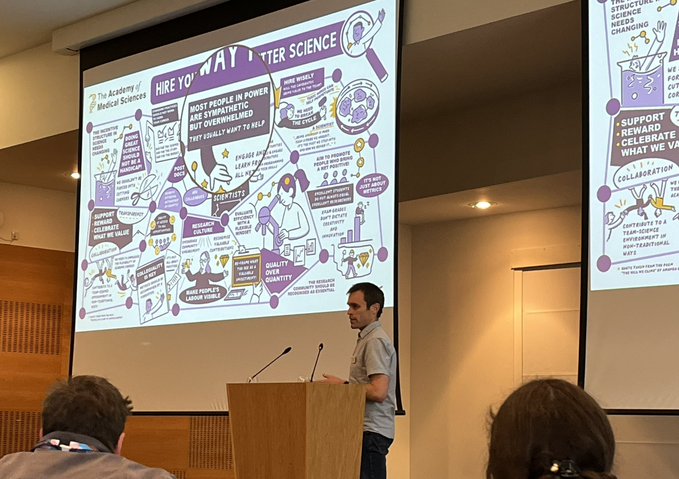
Photograph of William Cawthorne standing in front of an illustrated PowerPoint presentation.

Will Cawthorne presenting on research culture, with perhaps the most beautifully illustrated slide of the day!

The Wednesday closed the workshop sandwich. Gillian Currie and Charlotte Brady worked with attendees to develop ‘Bingo’ cards to promote good academic questioning at conferences. At the same time in the Pentland Suite, the focus was on the 9th Pillar: citizen science and participatory research. Lightning talks from project leads across the colleges were followed by in-depth discussions of the challenges faced by this unique but exciting collection of approaches.

The day and the conference drew to a close in the best possible way: engaging talk with pizza. Facilitated by a wonderful team of early career researchers, the final workshop focused on the relationship between PhD researchers and open research practices. As is typical in all cases of culture change – it has to happen at every level, and there is a risk of early career researchers being left behind. The future of research is open, and so ensuring that those at the start of their careers are well equipped is at the heart of all of the work we do.

With that in mind, then, we can now look forward, where the lessons learned, discussions had, and connections made will ground our work for the coming year. With two successful conferences behind us, this will surely become a tradition with Open Research 2024!

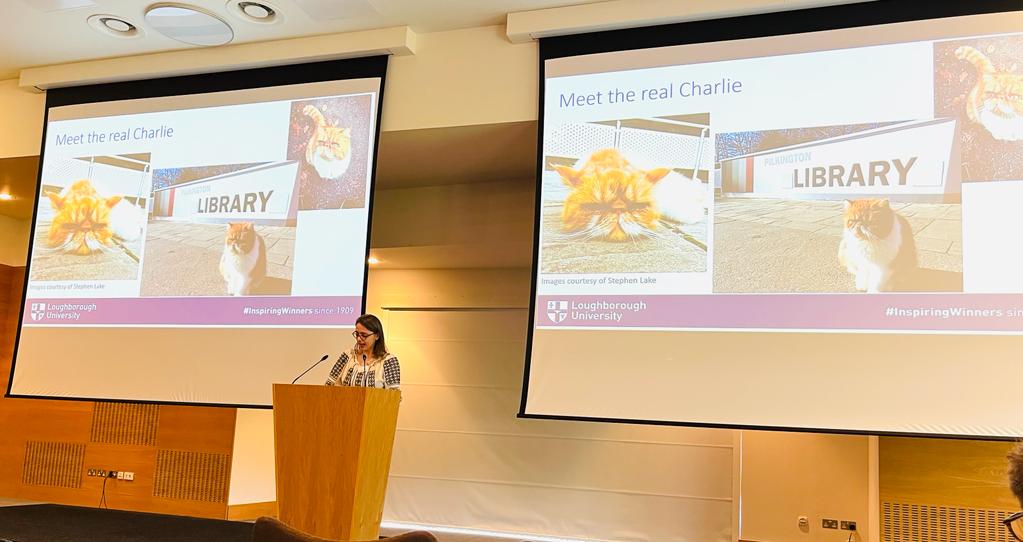
Photograph of Cristina Rusu presenting in front of a PowerPoint slide with an image of Charlie the cat.

While I would of course never admit to playing favourites, I will admit to being a huge fan of Charlie the cat from Loughborough University who was an unticketed virtual attendee.

New feature: Sharing DataVault data with an external user

By popular demand, the Research Data Service is pleased to announce the arrival of a brand new feature: the DataVault Outward Staging Area (DOSA), a free-of-charge benefit to DataVault depositors.

Engraving depicting a stagecoach with people in front of a building

What is a staging area? Somewhere your data can be held temporarily, on the way to somewhere else. Just like a traditional staging post for stagecoaches, as shown in this engraving.

Imagine: your multi-terabyte dataset is safe-and-sound in your vault, you’ve cited it in a paper you’ve just published, and an external researcher has asked you for a copy. What will you do?

Simple: send a request to IS Helpline (or data-support@ed.ac.uk) asking us to create a DOSA folder for your data.

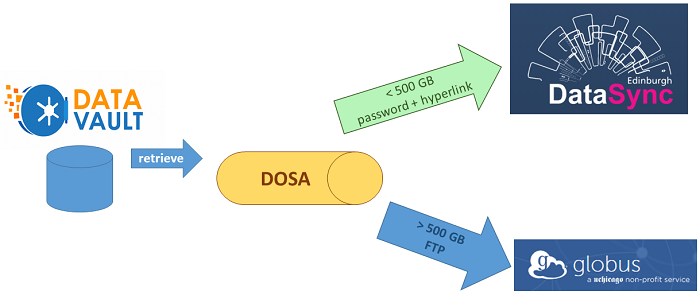
We’ll then use DOSA to give temporary (two months) external access to a copy of your deposit, using a Globus FTP endpoint. We’ll retrieve a copy of your data to the folder. And we’ll provide you with the Globus endpoint, which you send to the researcher. They may need to install some software to get the data. Alternatively, for datasets under 500 GB, we suggest a DataSync link will be more suitable. We set that up and provide it to you in the same way as the Globus endpoint. The difference for the end user is they can use the DataSync link (+ password) from their browser. Let us know if you have a preference for a Globus endpoint or a DataSync link (otherwise we’ll decide automatically based on the size).


Workflow diagram showing data moving from DataVault into DOSA, and from DOSA out to DataSync or globus

Workflow: We retrieve your deposit to your DOSA folder. We provide you with either a Globus endpoint or a DataSync link, to provide to your external person who made the request.

The DOSA is part of our networked active data storage, DataStore, but separate from the other staging area we provide for users making a new deposit (‘the DataVault staging area’), for the inward route.

Since 2016 researchers have been archiving data in Edinburgh DataVault. The DOSA is available for any DataVault deposit, old or new.

DataVault Outward Staging Area (DOSA): Sharing data with an external user

Not sure you’ll remember the name of the service? Worry not! I have a mnemonic device for you: just remember that a ‘dosa’ is an Indian savoury pancake. What’s not to like?

Photo of a folded dosa pancake on a tray with dishes of savoury sauces.

Pauline Ward
Data Repository Operations Officer
University of Edinburgh

Community of Edinburgh Research Software Engineers (CERSE): Reflections on the 7th meeting

In this blog Dr Eleni Kotoula, Lead Research Facilitator at the University of Edinburgh, writes about the CERSE and their most recent event.

What is CERSE?

CERSE is a community like no other! It offers an excellent opportunity for Research Software Engineers  (RSE) to get support and recognition for their work. In addition to Research Software Engineers, the CERSE welcomes those interested in the development, use, support or management of research software. Hence, researchers, research support and research data professionals can get involved, expand their network and broaden their understanding of research software engineering. To find out more, have a look at the CERSE Meeting Handbook.

A summary of CERSE’s 7th meeting

Members of the CERSE community across Edinburgh came together earlier this month in the Bayes Centre for the first post-pandemic meeting. After a long break from activities, the organisers from the University of Edinburgh Digital Research Services, EPCC, Sofware Sustainability Institute and the Centre of Data, Culture and Society were keen to resurrect meetings.

Mario Antonioletti opened the meeting, briefly referring to the RSE movement and its previous meetings in Edinburgh. Mike Wallis, Research Services Lead at the University of Edinburgh, gave an overview of the Edinburgh Compute and Data Facility, highlighting data storage, cloud and high performance computing services. Andrew Horne provided an update on EDINA’s ongoing project for the development of Automatic Systematic Reviews. Then, Mario Antonioletti presented EPCC and services such as Archer2 and Cirrus, as well as the important work of the Software Sustainability Institute. After the short talks, Felicity Anderson, PhD candidate in Informatics and Software Sustainability Institute Fellow, led an ice-breaking activity, followed by a networking session. All presentations are available here.

Next steps

The CERSE community has the potential to grow and flourish in a region so rich in research-intensive institutions and academic excellence. We aim to continue by alternating face-to-face and virtual meetings monthly. To do so, we need active participation from those interested in the RSE community. There are different ways to get involved; attending meetings, talking about your relevant work or volunteering to help organize one of the following meetings. For us in Digital Research Facilitation, CERSE offers the opportunity to meet and connect with researchers, RSEs, IT and research support staff. Moreover, we share the same passion for best practices in data-intensive and computational research. That’s why we have been heavily involved in supporting this community in practice and strongly encourage those interested to join us. We are looking forward to meeting you in one of the following CERSE meetings, either in person or online.

How to get involved?

Join the Joint Information Systems Committee (JISC) mailing list: http://www.jiscmail.ac.uk/ed-rse-community

Follow the CERSE on Twitter: https://twitter.com/cerse7

Join the RSE: https://society-rse.org/join-us/

Dr Eleni Kotoula
Digital Research Facilitation

ERASMUS work placement visitor from Germany

Judith DaehneMy name is Judith Dähne (Daehne). I am the Research Data Support Officer of RheinMain University of Applied Sciences.

When I started to think about research data management (RDM) around 2015, MANTRA   provided my first opportunity learn about RDM and how to handle data correctly. I also discovered DMPonline, delivered by the Digital Curation Centre, and it therefore seemed to me that Edinburgh was somehow the cradle of RDM.

When I heard of the final opportunity to visit the UK with the EU’s ERASMUS programme (it will stop in May 2023) I was keen to apply for a visit with the Research Data Support team of the University of Edinburgh… I am really happy that I landed this wonderful opportunity of a short job shadowing visit.

I attended several meetings and training sessions of the Research Data Service team. I am impressed how much support and aid is provided for the researchers. The infrastructure of storage and exchange like DataStore, DataSync, DataShare, DataVault forms the technical basis of the support.

Even more important, in my opinion, is the personal backing and advice of the data management team.You might just ask your questions by pressing one of the “Contact us” buttons  and there you find email and phone numbers of the research data team at your finger tips.

And the team really takes care over every single dataset that is loaded in DataShare: how to enhance the metadata and how to make it more visible for the scientific community. Not many institutional repositories are curated in such a detailed way – I will take home some precious tips and workflows!

One sticking point, however, is the same as with us: How do we make the services known? How do we reach as many researchers as possible? And how can the transformation to more open science then succeed? Perhaps to just carry on with talking and teaching seems the only way…

3 at lunch table

Robin, Simon and Judith enjoy a working lunch at Howie’s

Research data are a social good and data management supports the verification and replication in science. Ultimately transparency, openness and good data management strengthen the credibility of science and help to counter climate change deniers and conspiracy theorists.  To emphasise this argument, like here in Edinburgh, is also a very important take home message for me.

I would like to thank Robin & her team for sharing their knowledge and their hospitality! I hope we stay in touch.

Guest blog post by Judith Dähne
RheinMain University of Applied Sciences