Research Data Training – Semester 1

*UPDATE* – We have just added two new and exciting courses to our training schedule:

  • Assessing Disclosure Risk in Quantitative Data (RDS006)
  • Assessing Data Quality in Quantitative Data (RDS007)

To find out more about these courses just visit our training page.

Each semester the Research Data Support team puts together a training programme for researchers and research support staff in all schools, and at all points in their career. Our programme this year introduces a number of new courses, including one designed especially for Undergraduates planning their final year dissertation. We have also reviewed and refreshed all of our existing courses to ensure that they are not only up-to-date but also more engaging and interactive.

Full Course list:

  • Realising the Benefits of Good Research Data Management (RDS001)
  • Writing a Data Management Plan for your Research (RDS002)
  • Working with Personal and Sensitive Data (RDS003)
  • Data Cleaning with OpenRefine (RDS004)
  • Handling Data Using SPSS (RDS005)
  • Assessing Disclosure Risk in Quantitative Data (RDS006)
  • Assessing Data Quality in Quantitative Data (RDS007)
  • Data Mindfulness: Making the Most of your Dissertation (RDS009)
  • Introduction to Visualising Data in ArcGIS (RDS011)
  • Introduction to Visualising Data in QGIS (RDS012)

Full details of all these courses, with direct booking links, can be found on our training webpage https://www.ed.ac.uk/information-services/research-support/research-data-service/training

Courses can also be found and booked via the MyEd Events page.

We are always happy to deliver tailored versions of these courses suitable for a specific school, institute or discipline. Just contact us at data-support@ed.ac.uk to let us know what you need!

Kerry Miller
Research Data Support Officer
Library and University Collections

Announcing our new “Quick Guides” series

Earlier this week we bid farewell to our intern for the past four weeks, Dr Tamar Israeli from the Western Galilee College Library. Tamar spent her time with us carrying out a small-scale study on the collaborative tools that are available to researchers, which ones they use in their work, and what support they feel they need from the University. One of Tamar’s interviewees expressed a view that “[the University’s tools and services] all start with ‘Data-something’, and I need to close my eyes and think which is for what,” a remark which resonated with my own experience upon first starting this job.

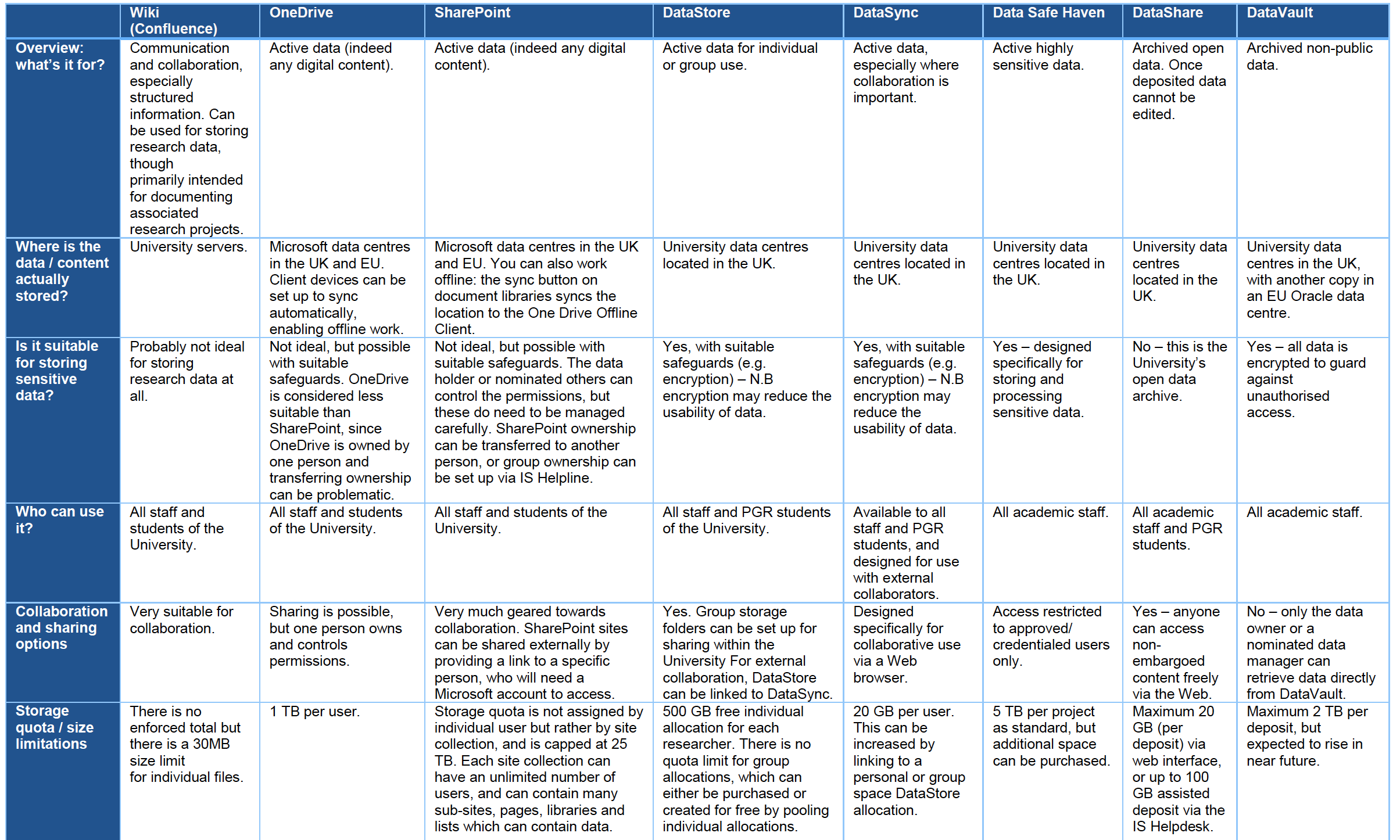
When I joined the University’s Library and University Collections as Research Data Support Manager in Summer 2018, I was initially baffled by the seemingly vast range of different data storage and sharing options available to our researchers. By that point I had already worked at Edinburgh for more than a decade, and in my previous role I had little need or obligation to use institutionally-supported services. Consequently, since I rarely if ever dealt with personal or sensitive information, I tended to rely on freely-available commercial solutions: Dropbox, Google Docs, Evernote – that sort of thing. Finding myself now in a position where I and my colleagues were required to advise researchers on the most appropriate systems for safely storing and sharing their (often sensitive) research data, I set about producing a rough aide memoire for myself, briefly detailing the various options available and highlighting the key differences between them. The goal was to provide a quick means or identifying – or ruling out – particular systems for a given purpose. Researchers might ask questions like: is this system intended for live or archived data? Does it support collaboration (increasingly expected within an ever more interconnected and international research ecosystem)? Is it suitable for storing sensitive data in a way that assures research participants or commercial partners that prying eyes won’t be able to access their personal information without authorisation? (A word to the wise: cloud-based services like Dropbox may not be!)
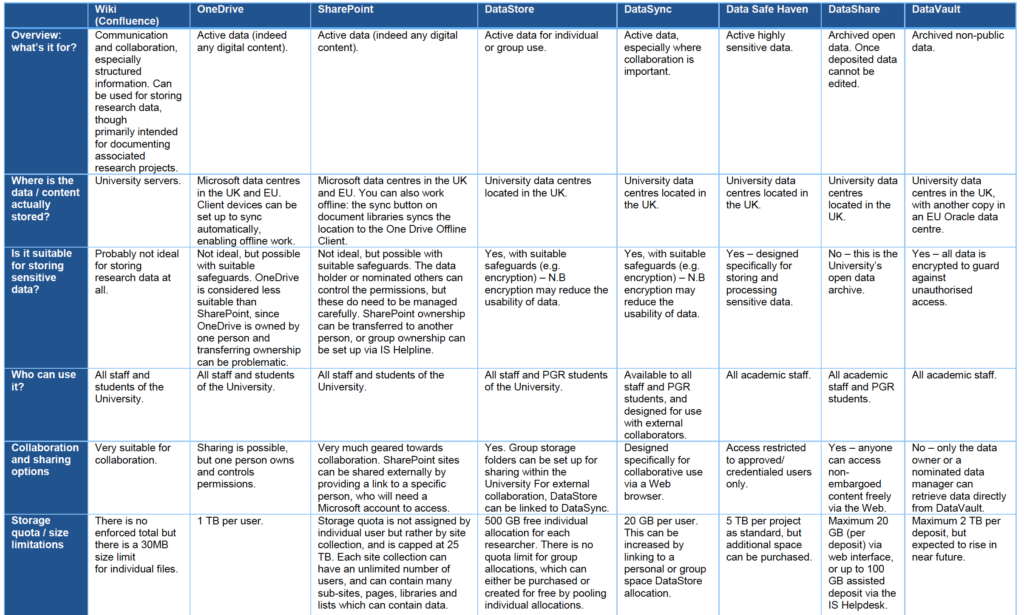

[click the image for higher resolution version]

Upon showing early versions to colleagues, I was pleasantly surprised that they often expressed an interest in getting a copy of the document, and thought that it might have a wider potential audience within the University. In the months since then, this document has gone through several iterations, and I’m grateful to colleagues with specific expertise in the systems that we in the Research Data Service don’t directly support (such as the Wiki and the Microsoft Office suite of applications) for helping me understand some of the finer details. The intention is for this to be a living document, and if there are any inaccuracies in this (or indeed subsequent) versions, or wording that could be made clearer, just let us know and we’ll update it. It’s probably not perfect (yet!), but my hope is that it will provide enough information for researchers, and those who support them, to narrow down potential options and explore these in greater depth than the single-page table format allows.

With Tamar’s internship finishing up this week, it feels like a timely moment to release the first of our series of “Quick Guides” into the world. Others will follow shortly, on topics including Research Data Protection, FAIR Data and Open Research, and we will create a dedicated Guidance page on the Research Data Service website to provide a more permanent home for these and other useful documents. We will continue to listen to our researchers’ needs and strive to keep our provision aligned with them, so that we are always lowering the barriers to uptake and serving our primary purpose: to enable Edinburgh’s research community to do the best possible job, to the highest possible standards, with the least amount of hassle.

And if there are other Guides that you think might be useful, let us know!

Martin Donnelly
Research Data Support Manager
Library and University Collections

Updated MANTRA content: Research data in context

The Research Data Support team is pleased to announce the launch of the first in a series of updates to MANTRA, the free and open online research data management training course.

The first updated module ‘Research data in context’ (previously ‘Research data explained’) is now live on the MANTRA site and provides an introduction to research data, alongside detail on the contexts in which data are generated, and the challenges presented by big data in society.

MANTRA is designed to give post-graduate students, early career researchers, and information professionals the knowledge and skills needed to work effectively with research data.

Since launching in 2011, MANTRA has been through a number of significant rewrites to keep up with current trends, and over 10,000 different learners have visited MANTRA in the last academic year.

The ‘Research data in context’ module has been substantially revised in order to:

  • remove dated and obsolete content;
  • simplify and improve the readability of existing material;
  • add information on data literacy and data science.

The changes in this module include:

  • Revised pages: Introduction; Why is research data management important?; What are data?; What are research data?; Data as research output; Module Summary; Next & further reading.
  • New pages: Data in society; Data Science; Video: machine learning; Data literacy and skills.

A change log detailing all changes in this release is available on request from the Research Data Support team (data-support@ed.ac.uk).

We hope you find this update interesting and useful and welcome any feedback you may have.

Further MANTRA updates are forthcoming, focusing on FAIR data and newer data protection legislation and we will announce these in future blog posts.

Bob Sanders
Research Data Support

RDM Training for Undergraduate Students

Link

RDM Training for Undergraduate Students

The Research Data Service at the University of Edinburgh provides research data support and training for staff and postgraduate students. Yet, over the last year through an Innovation Grant  – we have decided to branch out and produce training materials to support our undergraduate students as well.

thumbnail

The result is a new handbook called ‘Data Mindfulness: Making the most of your dissertation’, along with a set of face-to-face workshops that we have delivered during the spring semester and will be delivering again this autumn. The idea behind this handbook and the workshops is to take UG students through all the stages of their dissertation journey: from choosing their question to dealing with literature and data to preserving their data after submission.

Unlike existing material for postgraduates and researchers, this handbook has been written by one of our PhD interns from the perspective of a student; and it places data management tips within the broader experience of conducting a UG dissertation. We believe this student perspective is what makes this handbook unique and particularly innovative.

Download Data Mindfulness-Making the Most of your Dissertation handbook for your own use or to customise for your own UG students.

Candela Sanchez-Rodilla Espeso
UG Research Data Management Skills Co-ordinator