DataShare Spotlight: A photographic record of a divided Berlin in the 1980’s

Some of the most widely used datasets in DataShare are the collections of photographs of tower blocks and mass housing, both in the UK and internationally, created by Miles Glendinning, Professor of Architectural Conservation in the Edinburgh School of Architecture and Landscape Architecture (ESALA). Recently, Miles deposited a number of new datasets to the DOCOMOMO International Mass Housing Archive collection, including recent research data-gathering exercises in Belgium, China, Chile, Italy and Morocco. Further to this, are two archives of photos documenting Berlin in the 1980’s. Covering both East and West Berlin, these images provide striking visual representations of the buildings, transport infrastructure and general urban environment of the time, revealing a fascinating glimpse into the DDR (Deutsche Demokratische Republik), the BRD (Bundesrepublik Deutschland) and the enforced division between them.

To help shine a light on this special set of images, I asked Miles to answer three questions regarding the creation of this dataset.
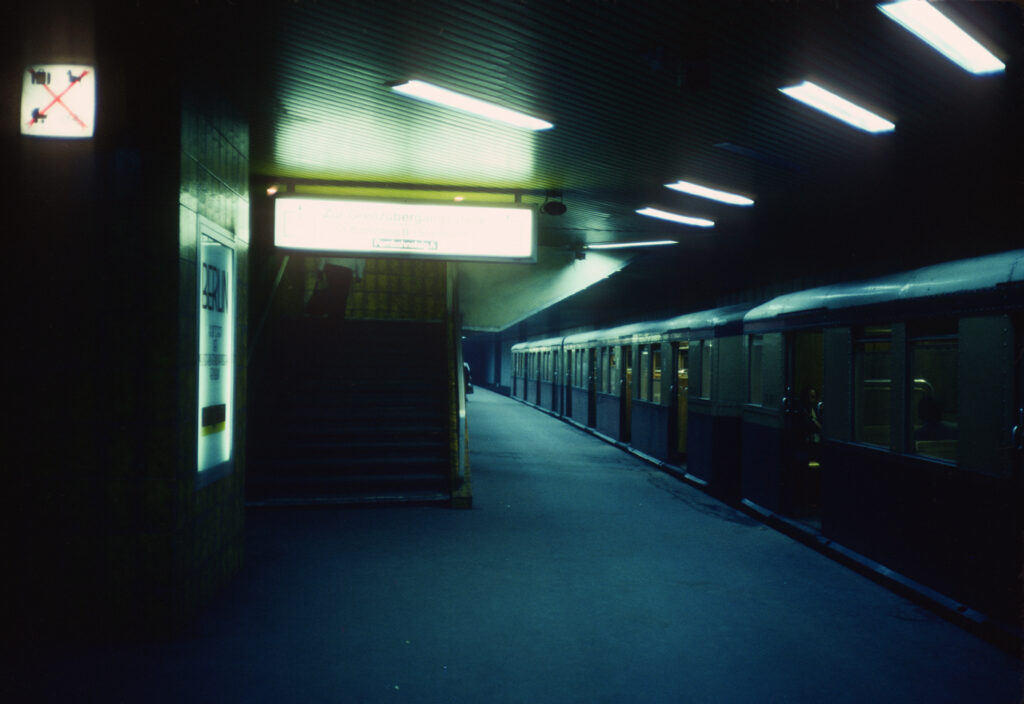
Mitte - Friedrichstrasse. (Nord-Sud S-Bahn), Sept 1982

Mitte – Friedrichstrasse. (Nord-Sud S-Bahn), Sept 1982 Photo credit: Miles Glendinning https://doi.org/10.7488/ds/8062

1 – What drew you to Berlin during this period?

I was drawn to visit East and West Berlin in 1982 by a curiosity to see first-hand what the Wall was like in its ‘mature’ state, and to experience, however briefly, the contrasting ways of life in the two parts of the city – East Berlin a would-be capital city with an alien entity adjoining its city core, and West Berlin a somewhat peaceful, even backwater-like island city-state divorced from the mainstream hubbub of West German life: at that stage, in the pre-Gorbachev era, there was no suspicion that the Iron Curtain only had a few more years of life, and the situation all seemed irreversibly settled in a strange sort of stagnant air immobility.

What particularly interested me were the quirky anomalies thrown up by the makeshift character of the division-line, including strange ‘exclaves’ such as Steinstücken – a few houses accessible by its own bus route through a narrow extrusion in the Wall), and the strange status of the S-Bahn (the local suburban rail network), whose lines in West Berlin were run indirectly by the DDR authorities, and had fallen into seemingly terminal decay and dereliction following many years of boycotts by West Berliners.

Several S-Bahn stations also featured bizarre border anomalies, such as the ‘door in the Wall’ that gave access to Wollankstraße station, and the underground/overground West-Berlin interchange and border crossing in the centre of East Berlin at Friedrichstraße.

Other infrastructural monuments of division and decay included the enormous DDR customs checkpoints complex newly built just north of ‘Checkpoint Charlie’, and later demolished immediately in 1990, or the disused Olympic Stadium bequeathed by the Nazi regime.
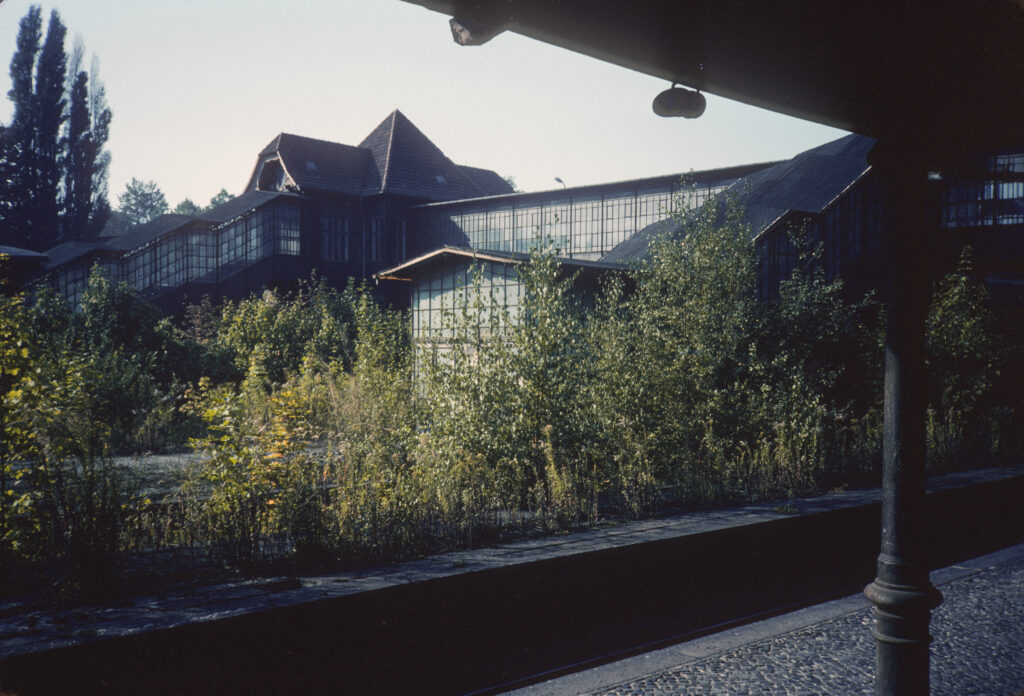
Gesundbrunnen station in Sept 1982

Wedding – Bf Gesundbrunnen – Sept 1982 view A – Photo credit: Miles Glendinning https://doi.org/10.7488/ds/8063

2 – Your images are documented with metadata of where they were taken, but beyond that, does looking at any of the photos bring back any particular memories?

The strongest memory brought back by looking at the photos is the sense of ‘suspended animation’ that was pervasive throughout the city, with some bustle in the ‘Ku’damm’ and ‘Alex’, but significant areas of dereliction and disuse everywhere, especially near the border, plus stereotypical ‘communist greyness’ throughout East Berlin, and a general feeling of relative lack of population and urban energy in both halves of the city.

The images of quiet decay and dereliction seem to evoke feelings akin to the ‘deploratio urbis’, or lamentation for lost greatness, felt by Renaissance and Romantic visitors among the ruins of classical Rome: looking at a 1982 photo such as that of the spectacularly overgrown wasteland of Gesundbrunnen station, what one saw was a vista of apparently irreversible decay, with no hint of the spectacular reversal that lay only a decade ahead.

From a modernist heritage perspective, however, many of the structures built during the division today seem of growing historical interest, including West-Berlin’s outer modern social housing complexes such as the Märkisches Viertel, or the extensive ‘Plattenbau’ complexes ubiquitous throughout East Berlin (on which see also the more recent images in the Docomomo International Mass Housing Archive, https://datashare.ed.ac.uk/handle/10283/2927 ).
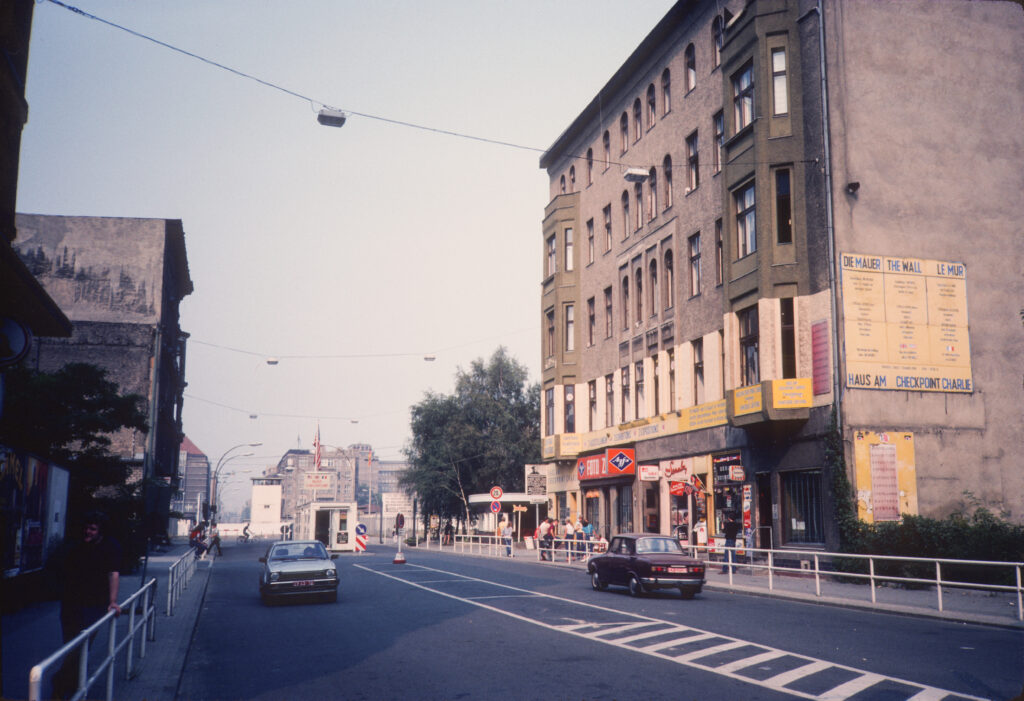
Kreuzberg - Friedrichstrasse, Checkpoint Charlie, Sept 1982

Kreuzberg – Friedrichstrasse, Checkpoint Charlie, Sept 1982 Photo credit: Miles Glendinning https://doi.org/10.7488/ds/8063

3 – How do you envisage the images in the dataset being used?

As always, it’s rather difficult to predict the very varied ways in which images such as these could be used, but I imagine that they could be useful for scholarly exploitation by historians of 20th-century Germany or of its post-war built environments, or as a more popular level, by enthusiasts for ‘Cold War heritage’ or ‘Ostalgie’?

Many thanks to Miles for taking the time to respond so insightfully to the questions.

The items containing the Berlin photos can be found at the following links:

Berlin (East)

Berlin (West)

The wider collections of tower blocks in the UK and mass housing internationally can be found at:

Tower Block UK

DOCOMOMO International Mass Housing Archive

Keith Munro,
Research Data Support Assistant

DataShare spotlight: Human MotionLess Dataset (HuMoLs) and the creative potential of research data

For the second installment of the spotlight on DataShare blog posts, I would like to showcase a fascinating item containing videos of people not doing anything!

The dataset in question is titled “Human MotionLess Dataset (HuMoLs)” and was created by researchers Longfei Chan, Muhammad Ahmed Raza and Robert Fisher, who are based in the School of Informatics’ Institute of Perception Action and Behaviour. While on the face of it, people being still might not seem very dynamic, the research behind this dataset is trying to solve a difficult problem with a very useful outcome. Simply put, how do you tell when someone is lying still because they are doing something like sleeping, or if it is because they are unwell or have fallen? The videos in this dataset aim to try and train healthcare monitoring systems to help determine whether it is the former or the latter of these possibilities, with the priority being to uncover any critical medical conditions or to analyse chronic conditions.

A selection of still images taken from the videos in the dataset.

What struck me while reviewing the videos for submission was that beyond the usefulness of these videos to the research project, there was the potential for them to be adapted creatively. The videos have a deliberately “uncanny valley” aspect, due to using AI to deepfake participant’s faces in order to preserve their anonymity. The amusingly odd character to the videos made me imagine them being used in an Adam Curtis documentary, or in an Aphex Twin music video. Possibly even in an Adam Curtis documentary with Aphex Twin music over the top of it.

This raises the fascinating idea that there are rich sources of research data stored in open access repositories that could have a life beyond being reproducible, but could also be reused, repurposed and remixed into creative new pieces, adding value to both the research itself, and to the repositories where the affiliated data is stored. To demonstrate this possibility, I have edited some of the videos together, see below, and set them to music. The piece of music, “Redolescence” by Other Lands, has a dreamlike quality to it which both complements and recontextualises the videos into something beyond their originally intended use.

What other audio and visual materials are there contained in research data repositories waiting to be repurposed in a creative manner? Time (and much more talented creators than me) will tell!

The full dataset can be found on DataShare: Human MotionLess Dataset (HuMoLs)

The paper which the dataset supports: OPPH: A Vision-Based Operator for Measuring Body Movements for Personal Healthcare

Permission to use the music featured in this video was kindly granted by Gavin Sutherland, performing here under his artist name of Other Lands. The album which contains this track can be purchased on Bandcamp: Other Lands – Riddle of the Mode 

DataShare spotlight: History, Classics and Archaeology in DataShare

To celebrate World Digital Preservation Day 2024, this is the first in a series of occasional blog posts which seek to shine a light on some interesting examples of datasets uploaded to DataShare, the University of Edinburgh’s open access data repository.

Research data that is deposited in DataShare comes from across the Colleges and Schools and can relate to cutting-edge scientific research or exploration of under-studied social worlds, however, we also receive valuable historical research data too!

A prime example of this is an item submitted by Professor Charles West, who is based in the School of History, Classics and Archaeology, titled “Autun List of Local Churches, c. 1000”. As neatly described in the title, it contains a list of 144 churches in the diocese of Autun, France, which was made around the year 1000. An example of one of the churches, the Church of Saint Martin in Cordesse, can be seen in the photo below.

Photo of the Church of Saint Martin in Cordesse, France.

According to the item’s description: “The dataset provides the names in the list, the modern place-names, the departement these places are located in, their order in the original list, whether each church is attested in earlier documentation or not, and if so, approximately when.”

The item took on a new life when it was shared on Twitter (now known as X), where a user, William J.B. Mattingly, took the dataset and added latitudinal and longitudinal data to create a mapped visualisation shown in a video. This reuse is documented in the Altmetrics of the item, which details how a DataShare item has been shared or cited. It is also a neat demonstration of how data shared on DataShare can be reused in useful and creative ways!

The DataShare item can be found here: https://doi.org/10.7488/ds/7774

The Tweet with the data visualisation can be found here: https://x.com/wjb_mattingly/status/1813587749905072497

Keith Munro,
Research Data Support Assistant

New feature in Edinburgh DataShare: the REST API

Ever wanted to get a table of the details of all the datasets on DataShare to do with Scottish history? Or matching some other criteria, possibly on specified fields? If so, the new API (Application Programming Interface) can help.

DataShare now has a REST API, which you can use to query our metadata. An API makes the database’s contents accessible for requests from external servers, through a command-line, which allows external users to script such requests. The DSpace API also provides its own web-based query client and report client. These pages allow users to use a graphical interface to quickly build a query and see the results in a table, all in the browser.

The DataShare REST API page starts with a link to our plain-English explanation of how the API can be used:

Edinburgh DataShare DSpace REST API 

We would like to hear from anyone who wants to use the API. Please try it out and let us know what you find useful! Email us at data-support@ed.ac.uk .

Examples using the graphical query builder

I wanted to find datasets where I could add a link to the associated publication. This is a bit of a challenge for us, since users typically deposit their data with us under embargo before the associated paper has been published, and we do not have an automatic way to detect when or whether an associated publication has appeared.  I used the query builder to find the IsReferencedBy value for deposits accessioned in 2017. The plain-English guide on the wiki provides the steps I went through to do so:

How to use the DataShare REST API 

This feature may be of use to colleagues who support organisational units at University of Edinburgh which don’t align precisely with the Collections structure of DataShare – the API lets you query on multiple collections through the reporting tool. We’d love for colleagues to contact us if their teams have published a new paper containing a data citation of their DataShare deposit, so we can add the details of the publication to the DataShare Item’s metadata, resulting in a hyperlink appearing on the dataset landing page.

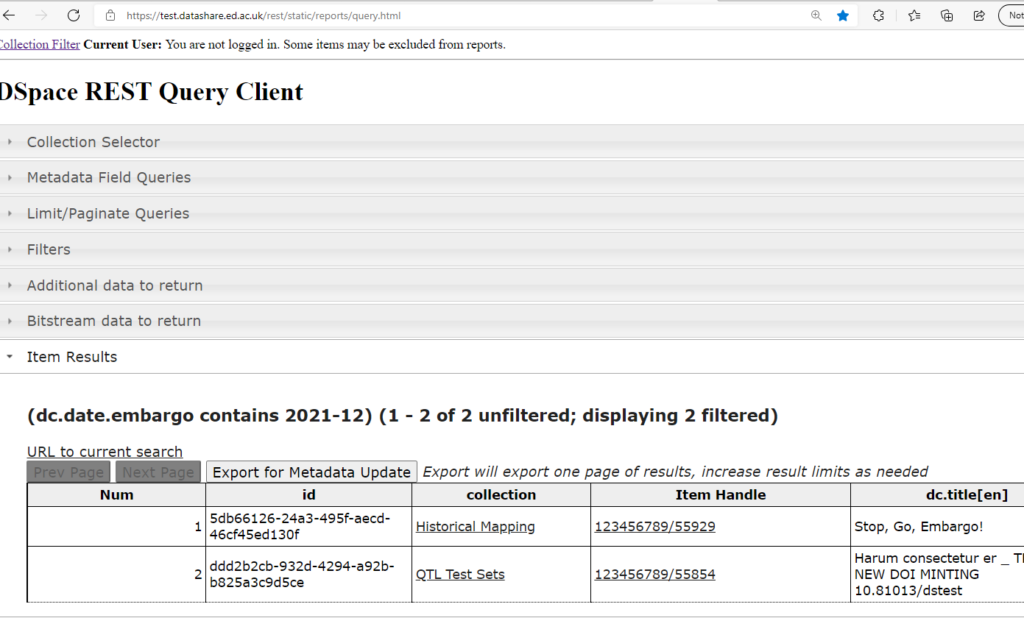
I wanted to find datasets with an embargo date in December. This is a challenge for us because users often set their embargo expiry date to Hogmanay, which means their one-week reminder would arrive on Christmas Day right in the middle of the university’s winter break. But many other fields contain dates with December in them, so it has not been practical for me to search for this using the graphical interface. So I used the API to search specifically in the dc.date.embargo field. See the screenshot below. The API helped me find the datasets whose embargo date we needed to extend, or else lift the embargo outright, allowing us to contact the depositors in good time to ask them whether a paper had been published or more time was needed.

Screenshot of the output of the REST API

Results showing datasets with an embargo date in December 2021

Thirdly, to demonstrate the power of this tool relative to the non-specific Search I chose a topic with very common words to show how to use the query builder to focus in on results avoiding spurious matches.

Using the existing ‘Search’ function on the homepage I searched for ‘history Scotland’. This produced 39 matches, some of which have nothing to do with historical research or Scotland, but merely mention a funder “NHS Research Scotland”, and mention the history of the research field in passing to provide a little context. Most of the matches are interesting, but some are not relevant.

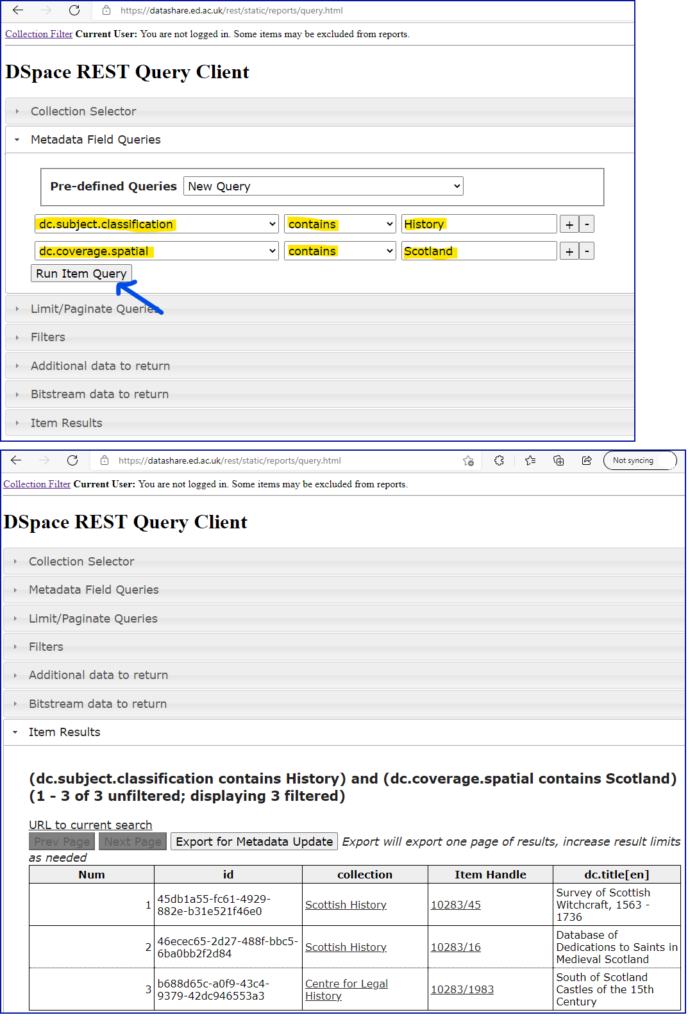
Whereas when I set the API query builder to search for ‘history’ in the research area (subject classification), and ‘Scotland’ in the field for geographical metadata ie dc.coverage.spatial. This provided me with a short list of high quality matches, three datasets of historical research to do with Scotland – see the screenshot. This is a useful tool for narrowing a search.

Screenshot showing the input, and the output on the API query builder webpage

A search for two very common words in specific fields produces high quality results

Enabling the API

The REST API is a feature of the underlying DSpace repository software. Our sysadmins configured the API with great care to block certain commands and enable only the ‘GET’ commands that are needed for appropriate queries using DSpace config settings (further info DSpace 6 Documentation on the Lyrasis wiki ).

The Future

In the international DSpace repository community, we’re aware the API is used for integration with at least one CRIS (Current Research Information System) and quality tool applications (Andrea Bollini, 4Science, private communication). We understand the API of the newer DSpace 7 contains significant changes compared to that of DSpace 6, which we’re using for Edinburgh DataShare.

We’re aware of only a few examples of the API being used by individuals for occasional metadata queries. But we will watch with interest to see how the DSpace 7 API will be used.


Pauline Ward
Research Data Support Assistant
Library and University Collections
University of Edinburgh