Research Data Alliance – report from the 6th Plenary

The Research Data Alliance or RDA is growing about as fast as the data all around us. It got off the ground in 2012 with the support of major research funders in Europe, the US and Australia and has since grown to over 3,000 members. The latest plenary in Paris set a new registration record of ~700 ‘data folk’ including data scientists, data managers, librarians and policy-makers. The theme was Enterprise Engagement with a focus on Research Data for Climate Change.

Not an ordinary conference

What sets RDA apart from other data-related organisations is not just the size of its gatherings, but its emphasis on making change. Parallel sessions are not filled with individual presentations of research papers, but of collaborative activities that lead to outputs that can be used in the real world. Working groups are approved by governance structures that coalesce around actual problems that cannot be solved by individual organisations but require new top-level approaches. They are required to produce their deliverables and close shop after an 18 month period. Interest groups are allowed to exist longer, but are encouraged to spin off working groups to address changes as they are identified through group discussion.

Hard-working groups

Since 2012, these working groups have produced some impressive deliverables and pilots that if implemented across the Web and across organisations and countries could speed up research and improve reproducibility. They are governed by an elected group of experts, worldwide. Some current active projects are:

  • Data Foundation and Terminology WG: defining harmonised terminology for diverse communities used to their own data ‘language’
  • Data Type Registries WG: building software to implement a DTR that can automatically match up unknown dataset ‘types’ with relevant services or applications (such as a viewer)
  • PID Information Types WG: Creating a single common API for delivering checksums from multiple persistent identifier service providers (DataCite and others)
  • Practical policy WG: building on a previous WG that collected various machine-actionable policies practiced by different data centres and repositories, this group will register the policies to move repository managers to move towards a harmonised set.
  • Scalable Dynamic Data Citation WG: to solve the difficulty of properly citing dynamic data sources, the recommended solution allows users to re-execute a query with the original time stamp and retrieve the original data or to obtain the current version of the data.
  • Data Description Registry Interoperability WG: to solve the problem of scattered datasets across repositories and data registries, the group build Research Data Switchboard linking datasets across platforms.
  • Metadata Standards Directory WG: By guiding researchers towards the metadata standards and tools relevant to their discipline, the directory drives up adoption of those standards, improving the chances of future researchers finding and using the data.

Members of the RDM team have been involved in library and repository-related interest groups and Birds of a Feather groups, where surveys of current practice have circulated.

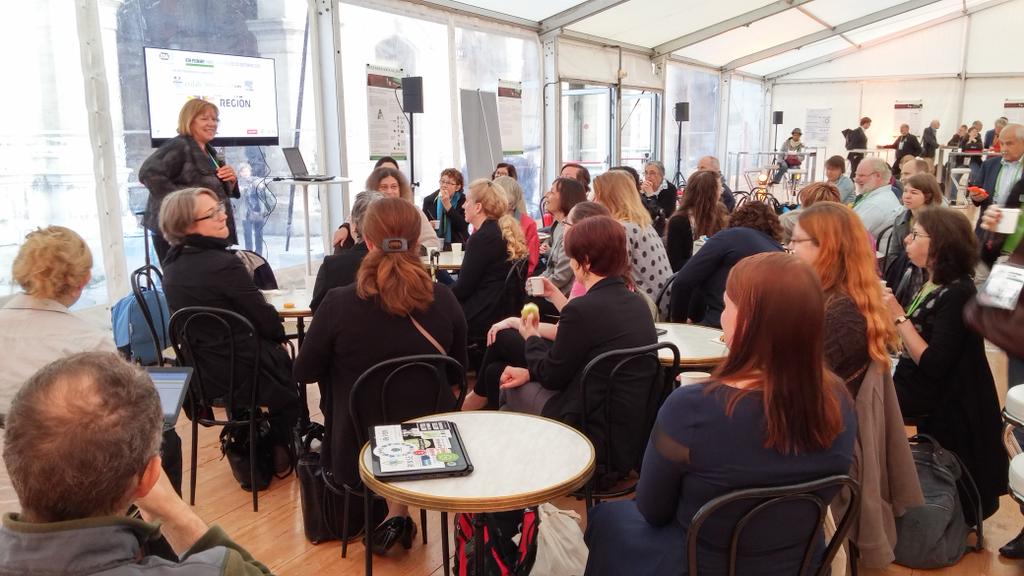
Not all men at RDA! Dame Wendy Hall from the Web Science Institute leads a Women's Networking Breakfast

Not all men at RDA! Dame Wendy Hall from the Web Science Institute leads a Women’s Networking Breakfast – photo courtesy of @RDA_Europe

RDA and climate change

Climate science was prominent in the 6th RDA plenary. This was not only due to the imminent Paris-based United Nations COP talks, but indeed due to issues of critical importance for the world today. For some years, driven by the climate model inter-comparison work underpinning Intergovernmental Panel on Climate Change (IPCC) reports and the massive datasets from Earth observation climate science has been located at an intersection of high performance computing, big data management, and services to support and stimulate research, commerce, and governmental initiatives.

Assessment of the risks posed by climate change, and strategies for adaptation and mitigation sharpens the need to solve not only the technical problems of bringing together diverse data (social, soil, climate, land-use, commercial,…) but also to address the policy challenges, given the diverse organisations needing to cooperate. This is a domain that builds on services to give access to data, for computation close to data enabled by e-infrastructure (such as EGI), and one that requires ever stronger approaches to brokering these resources and services, to permit their orchestration and integration.

Among initiatives presented in the climate-related sessions were:

  • GEOSS – The GEOSS Common Infrastructure allows the user of Earth observations to access, search and use the data, information, tools and services available through the Global Earth Observation System of Systems
  • Global Agricultural Monitoring (GEOGLAM) initiative in response to the growing calls for improved agricultural information.
  • An RDS group focused on wheat – the volatility in prices, in part driven by climate unpredictability, has become a major concern.
  • The IPSL Mesocentre
  • IS-ENES developing services for climate modelling especially
  • Copernicus, seeking to “support policymakers, business, and citizens with improved environmental information. Copernicus integrates satellite and in-situ data with modeling to provide user-focused information services”
  • CLIPC will provide access to climate datasets, and software and information to assess indicators for climate impact.

Dr. Mike Mineter, School of GeoSciences and Robin Rice, EDINA and Data Library


Dealing with Data 2015 – Presentations now available

On the 31st August, over one hundred researchers from across the breadth of the University of Edinburgh met together in the Informatics Forum to discuss the challenges of dealing with the research data. Following-on from the 2014 conference of the same title, the event consisted of twenty presentations on this subject.

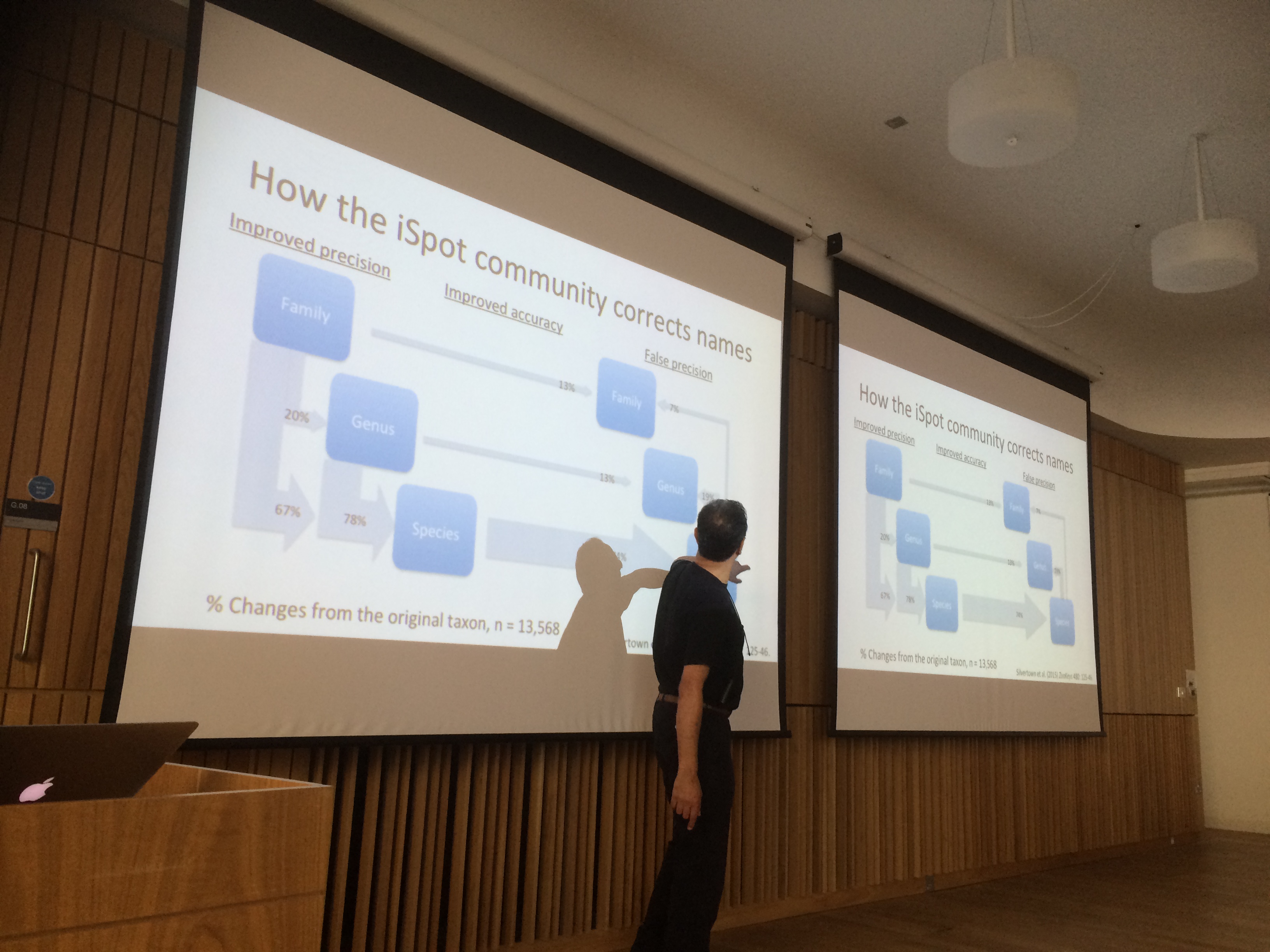
The event was opened by a keynote given by Prof Jonathan Silvertown, talking about his experiences of using crowd-sourced data from citizen scientists, and how to build mechanisms to ensure the quality of the data.
The rest of the day was filled with presentations addressing a wide range of data challenges, including topics such as data from the Large Hadron Collider, working with large data sets from China, and data derived from social media. At the end of the event, the topics were pulled together in a closing talk by Kevin Ashley, Director of the Digital Curation Centre.

If you attended Dealing with Data 2015, and have not already done so, could you please complete our brief survey at DwD2015 Feedback. It should only take 5 minutes and will help us to improve future events.

Programme with presentations

10:00 Welcome. Download PDF
10:05 Opening keynote: The Alchemy of Volunteered Data: turning base metal into gold, Prof Jonathan Silvertown, Institute of Evolutionary Biology. Download PDF

Session 1 – Informatics Forum
10:45 – 11:05: University data, open data and the Smart Data Hack, Ewan Klein, Informatics.
11:05 – 11:25: Edinburgh Data Science and Managing National Data Services at Edinburgh. Mark Parsons, EPCC. Download PDF
11:25 – 11:45: Channel shift – using data analysis to improve service delivery at the City of Edinburgh Council. Michal Wasilewski, Informatics. Download PDF

Session 2 – Informatics Forum
12:00 – 12:20: What are the challenges of collecting and analysing data in primary care? Lessons learned from a feasibility study in six general practices in Lothian, Scotland. Natalia Calanzani, Debbie Cavers, Gaby Vojt, David Weller, Christine Campbell, Population Health Sciences and Informatics. Download PDF
12:20 – 12:40: Facilitating the reuse of brain imaging and clinical data from completed studies across the life course: the Brain Images of Normal Subjects (BRAINS) Imagebank. Samuel Danso, Dominic E. Job, David Alexander Dickie, David Rodriguez, Andrew Robson, Cyril Pernet, Susan D. Shenkin, Joanna M. Wardlaw, Brain Sciences. Download PDF
12:40 – 13:00: Scottish Neighbourhood Statistics and R: Adding value to a public data resource with the ‘tidy data’ paradigm. Jon Minton, AQMeN. Download PDF

Session 3 – Appleton Tower
12:00 – 12:20: Data ecosystems and wicked problems; supporting “students as researchers” in complex data environments. Arno Verhoeven, ECA; James Stewart, SPS; Ewan Klein, Informatics. Download PDF
12:20 – 12:40: Networked learning analytics: Studying the association between learner generated discourse and learning. Srećko Joksimović, Dragan Gašević, Education. Download PDF
12:40 – 13:00: Automated Content Analysis of Discussion Transcripts. Vitomir Kovanovic, Dragan Gašević, Informatics and Education. Download PDF

Session 4 – Informatics Forum
13:45 – 14:05: Exploring Digital Divides in China, Ashley Lloyd, Business School; Mario A. Antonioletti, Terence M. Sloan, EPCC.
14:05 – 14:25: Gone Fishing: The Creation of the Comparative Agendas Project Master Codebook, Shaun Bevan, SSPS. Download PDF
14:25 – 14:45: Electronic lab notebooks and research data management at Edinburgh Experience to date and challenges and opportunities going forward. Rory Macneil, RSpace. Download PDF

Session 5 – Appleton Tower
13:45 – 14:05: Tweeting Jonson’s “Foot Voyage”: deeply mapped data, Anna Groundwater, HCA. Download PDF
14:05 – 14:25: University of Edinburgh Reid Concerts Database Project, Fiona Donaldson, Music. Download PDF
14:25 – 14:45: Encountering feminism on Twitter, Prof Viviene Cree, and Dr Steve Kirkwood, Social and Political Science, with Dr Daniel Winterstein, Sodash. Download PDF

Session 6 – Informatics Forum
15:00 – 15:20: The VELaSSCo framework: a software platform for end user analytics and visualization of large simulation datasets, G. Filippone, A. Janda, K.J. Hanley, S. Papanicolopulos and J.Y. Ooi, IIE, Engineering.
15:20 – 15:40: From raw data to new fundamental particles: The data management lifecycle at the Large Hadron Collider, Andrew Washbrook, Physics. Download PDF
15:40 – 16:00: Tipping the balance – introducing data management on a centre-wide level, Tomasz Zieliński, Eilidh Troup, Andrew Millar, Biology. Download PDF

16:00 Closing talk: Kevin Ashley, Director, Digital Curation Centre
Kerry Miller
RDM Service Coordinator
Highlights from the RDM Programme Progress Report: June – July 2015

May 2015 saw the end of the current Roadmap period and we are now into a period of consolidating work that has already been done and organising future work for the next phase of the RDM programme. The draft Roadmap 2.0 has been submitted to the steering group for approval and should be published soon.

The RDM services brochure is now almost complete and should be printed and distributed to Schools soon.

A meeting was held between the RDM team and the DCC to decide on the best approach for offering school level customisation of DMPonline. It was decided that customisation would be offered to all schools and undertaken as and when requests were made.

The Infrastructure upgrades have been procured and physically installed for the IGMM storage capacity expansion and the Research Computing Infrastructure DataStore integration servers.

Upgrades for backup/DR infrastructure have been procured and physically installed.

A 2 part workshop sponsored by EU FOSTER programme, “Good practice in data management & data sharing with social research” and “Overcoming obstacles to sharing data about human subjects” was delivered at the Scottish Graduate School of Political and Social Science Summer School.

A new series of awareness raising presentations and training courses for researchers, committees, and support staff in CHSS, CSE, and CMVM are currently being organised for 2015/16.

The RDM website has been successfully migrated to the new content management system, this included reviewing and revising all content, links, and images to fit with the new structure and layout. All schools in CHSS and CSE now have links on their own webpages to the RDM webpages, and CHSS will be placing a link from their new college pages when they go live.

An EAHIL workshop on ‘Managing research data’ was held on the 10th June and the report of the

Met with RDM staff from University of Lisbon who were visiting the University (via James Toon).

Met with Jennifer Warburton, University of Melbourne, as part of Library visit.

Met with French delegation (INIST-CNRS) as part of Library visit.

Kerry Miller
RDM Service Coordinator


Dealing with Data 2015 – Programme

Date:                     Monday 31 August 2015, 9:30 – 16:30
Location:             Informatics Forum and Appleton Tower, University of Edinburgh

Bookings for the Dealing with Data conference are now closed.  The event is full!

Draft Programme

09:30 Refreshments
10:00 Welcome
10:05 Opening keynote: The Alchemy of Volunteered Data: turning base metal into gold, Prof Jonathan Silvertown, Institute of Evolutionary Biology.


10:45 Session 1 – Informatics Forum
10:45 – 11:05: University data, open data and the Smart Data Hack, Ewan Klein, Informatics.
11:05 – 11:25: Edinburgh Data Science and Managing National Data Services at Edinburgh. Mark Parsons, EPCC.
11:25 – 11:45: Channel shift – using data analysis to improve service delivery at the City of Edinburgh Council. Michael Wasilewski, Informatics.


11:45 Break


12:00 – 13:00 Session 2 – Informatics Forum
12:00 – 12:20: What are the challenges of collecting and analysing data in primary care? Lessons learned from a feasibility study in six general practices in Lothian, Scotland. Natalia Calanzani, Debbie Cavers, Gaby Vojt, David Weller, Christine Campbell, Population Health Sciences and Informatics.
12:20 – 12:40: Facilitating the reuse of brain imaging and clinical data from completed studies across the life course: the Brain Images of Normal Subjects (BRAINS) Imagebank. Samuel Danso, Dominic E. Job, David Alexander Dickie, David Rodriguez, Andrew Robson, Cyril Pernet, Susan D. Shenkin, Joanna M. Wardlaw, Brain Sciences.
12:40 – 13:00: Scottish Neighbourhood Statistics and R: Adding value to a public data resource with the ‘tidy data’ paradigm. Jon Minton, AQMeN.


12:00 – 13:00 Session 3 – Appleton Tower
12:00 – 12:20: Data ecosystems and wicked problems; supporting “students as researchers” in complex data environments. Arno Verhoeven, ECA; James Stewart, SPS; Ewan Klein, Informatics.
12:20 – 12:40: Networked learning analytics: Studying the association between learner generated discourse and learning. Srećko Joksimović, Dragan Gašević, Education
12:40 – 13:00: Automated Content Analysis of Discussion Transcripts. Vitomir Kovanovic, Dragan Gašević, Informatics and Education.


13:00 Lunch


13:45 – 14:45 Session 4 – Informatics Forum
13:45 – 14:05: Exploring Digital Divides in China, Ashley Lloyd, Business School; Mario A. Antonioletti, Terence M. Sloan, EPCC.
14:05 – 14:25: Gone Fishing: The Creation of the Comparative Agendas Project Master Codebook, Shaun Bevan, SSPS.
14:25 – 14:45: Electronic lab notebooks and research data management at Edinburgh Experience to date and challenges and opportunities going forward. Rory Macneil, RSpace.


13:45 – 14:45Session 5 – Appleton Tower
13:45 – 14:05: Tweeting Jonson’s “Foot Voyage”: deeply mapped data, Anna Groundwater, HCA.
14:05 – 14:25: University of Edinburgh Reid Concerts Database Project, Fiona Donaldson, Music.
14:25 – 14:45: Encountering feminism on Twitter, Prof Viviene Cree, and Dr Steve Kirkwood, Social and Political Science, with Dr Daniel Winterstein, Sodash.


14:45 Break


15:00 – 16:00 Session 6 – Informatics Forum
15:00 – 15:20: The VELaSSCo framework: a software platform for end user analytics and visualization of large simulation datasets, G. Filippone, A. Janda, K.J. Hanley, S. Papanicolopulos and J.Y. Ooi, IIE, Engineering.
15:20 – 15:40: From raw data to new fundamental particles: The data management lifecycle at the Large Hadron Collider, Andrew Washbrook, Physics.
15:40 – 16:00: Tipping the balance – introducing data management on a centre-wide level, Tomasz Zieliński, Eilidh Troup, Andrew Millar, Biology.


16:00 Closing talk: Kevin Ashley, Director, Digital Curation Centre
16:30 End