Digital Scholarship Day of Ideas: Data

The theme of this year’s ‘Digital Scholarship Day of Ideas’ (14th May) focused on ‘data’ and what data is for the humanities and social sciences. This post summarises the presentation of Prof Annette Markham, the first speaker of the day. She started her presentation with an illustration of Alice in Wonderland. She then posed the question: What does data mean anyway?
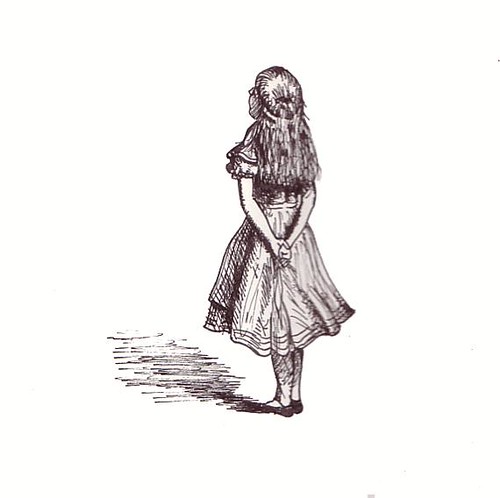
Markham then explained how she had quit her job as a professor in order to enquire into the methods used in different disciplines. Since then, she has thought a lot about method and methodologies, and run many workshops on the theme of ‘data’. In her view, we need to be careful when using the term ‘data’ because although we think we are talking about the same thing we have different understandings of what the term actually means. So, we need to critically interrogate the word and reflect upon the methodologies.

Markham talked about the need to look at ‘methods’ sideways, we need to look at them from above and below. We need to collate as many insights into these methods as possible; we might then understand what ‘data’ means for different disciplines. Sometimes, methods are related to funding, which can be an issue in the current climate, because innovative data collection procedures that might not be suitable for archival aren’t that valuable to funders. The issue is that not all research can be added to digital archives. For an ethnographer, a stain of coffee in a fieldwork notebook has meaning, but this subtle meaning cannot be archived or be meaningful to others unless digitised and clearly documented.

Drawing on Gregory Bateson’s Steps to an Ecology of Mind (1972), she asked us to think about ‘frames’ and how these draw our attention to what is inside and dismiss what lays outside. If you change the frame with which you look, it changes what you see. She showed and suggested using different frames. For example there are: traditional frames, structures like the sphere, molecular structures. Different structures afford different ways of understanding, and convey themes and ideas that are embedded within them.


Empty-framesphere-296433_1280Azithromycin_3d_structure


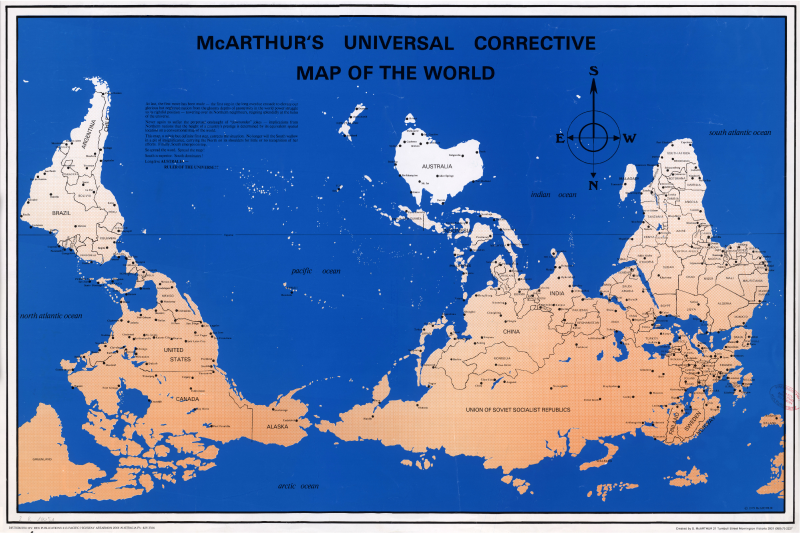
To use another example, she used an image of McArthur’s Universal Corrective Map of the World to illustrate how our understanding of our environment changes when information is shown and structured in a different and unexpected way.

  • What happens when we change the frame?
  • How does the structure shape the information and affect the way we engage with it?

Reversed Earth map 1000x500
Satellite image of McArthur’s Austral-centric view of the world [Public domain]

1. How do we frame culture and experiences in the 21st Century? How has our concept of society changed since the internet?
Continuing the discussion on frames, she spoke about how the internet has brought on a significant frame shift. This new frame has influenced the way we interact with media and data. To illustrate this, she showed work by Sparacino, Pentland, Davenport, Hlavac and Obelnicki, who in the project the ‘City of News’ (Sparacino, 1997) addressed this frame shift caused by the internet. The MIT project (1996) presented a 3D information browsing system, where buildings were the information spaces where information would be stored and retrieved. Through this example, Markham emphasized how our interaction with information and the methods we use for looking at social culture are changing, and so are the visual-technical frames we use to enquire into the world.

2. How do we frame objects and processes of enquiry?
She argued that this framing of objects and processes hasn’t changed enough. If we were to draw a picture or map of what research is and how the data in any research project is structured, we would end up with a multi-dimensional mass of connected blobs and lines instead of with a neatly composed bi-dimensional picture frame (research looks more like a molecular structure than like a rectangular frame). However, we still associate qualitative research with traditional ethnographic methods and we see quite linear and “neat and tidy” methods as legitimate. There is a need to look at new methods of collecting and analysing research ‘data’ if we are to enquire into socio-cultural changes.

3. How do we frame what counts as proper legitimate enquiry?
In order to change the frame, we have to involve the research community. The frame shift can happen, even if slowly, when established research methods are reinvented. Markham used 1960s feminist scholars as an example, for they approached their research using a frame that was previously inconceivable. This new methodological approach was based on situated knowledge production and embodied understanding, which challenged the way in which scientific research methods had been operating (more on the subject, (Haraway 1988). But in the last decade at least we are seeing an upsurge of to scientific research methods – evidence based, problem solving approaches – dominating the funding and media understanding of research.

So, what is DATA?
‘Data’ is often an easy term to toss around, as it stands for unspecified stuff. Ultimately, ‘data’ is “a lot of highly specific but unspecified stuff”, that we use to make sense of the world around us, a phenomenon. The term ‘data’ is a arguably quite a powerfully rhetorical word in humanities and social sciences, in that it shapes what we see and what we think.

The term data comes from the Latin verb dare, to give. In light of this, ‘data’ is something that is already given in the argument – pre-analytical and pre-semantics. Facts and arguments might have theoretical underpinnings, but data is devoid of any theoretical value. Data is everywhere. Markham referring to Daniel Rosenberg‘s paper ‘Data before the fact’, pointed out that facts can be proved wrong, and then they are no longer a facts, but data is always data even when proven wrong. In the 80s, she was trained not to use the term ‘data,’ they said:

“we do not use it, we collect material, artifacts, notes, information…”

Data is conceived as something that is discrete, identifiable, disconnected. The issue, she said was that ‘data’ poorly represents a conversation (gesture and embodiment), the emergence of meaning from non verbal information, because when we extract things from their context and then use them as a stand-alone ‘data’, we loose a wealth of information.

Markham then showed two ads (Samsung Galaxy SII and Global Pulse) to illustrate her concerns about life becoming data-fied. She referenced Kate Crawford’s perspective on “big data fundamentalism”, because not all human experiences can be reduced to big data, to digital signals, to data points. We have to trouble the idea of thinking about “humans (and their data) as data”. We don’t understand data as it is happening, and “data has never been raw”. Data is always filtered, transformed. We need to use our strong and robust methods of enquery, and that these do not necessarily focus on data as the centre stage, it may be about understanding the phenomenon of what we have made,this thing called data. We have to remember that that’s possible.

Data functions very powerfully as a term, and from a methodological perspective it creates a very particular frame. It warrants careful consideration, especially in an era where the predominant framework is telling us that data is really the important part of research.

References

  • Image of Alice in Wanderland after original illustration by Danny Pig (CC BY-SA 2.0)
  • Sparacino, Flavia, A. Pentland, G. Davenport, M. Hlavac and M. Obelnicki (1997). ‘City of News’ in Proceedings of Ars Electronica Festival, Linz, Austria, 8-13 Sep.
  • Bateson, Gregory (1972). Steps to an ecology of mind: collected essays in anthropology, psychiatry, evolution, and epistemology. Aylesbury: Intertext.
  • Frame by Hubert Robert [Public domain], via Wikimedia Commons
  • Sphere by anonymous (CC 1.0) [Public Domain]
  • Image of 3D structure (CC BY-SA 3.0)
  • Map by Poulpy, from work by jimht[at]shaw[dot]ca, modified by Rodrigocd, from Image Earthmap1000x500compac.jpg, [Public domain], via Wikimedia Commons
  • Rosenberg, Daniel (2013). ‘Data before the fact’ in Lisa Gitelman (ed.) “Raw data” is an oxymoron. Cambridge, Mass.: MIT Press, pp. 15–40.

More about

Rocio von Jungenfeld
Data Library Assistant
Data and ethics

As an academic support person, I was surprised to find myself invited onto a roundtable about ‘The Ethics of Data-Intensive Research’. Although as a data librarian I’m certainly qualified to talk about data, I was less sure of myself on the ethics front – after all, I’m not the one who has to get my research past an Ethics Review Board or a research funder.

The event was held last Friday at the University of Edinburgh as part of the project Archives Now: Scotland’s National Collections and the Digital Humanities, a knowledge exchange project funded by the Royal Society of Edinburgh. This event attracted attendees across Scotland and had as its focus “Working With Data“.

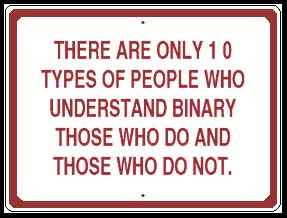
I figured I couldn’t go wrong with a joke about fellow ‘data people’ with an image from flickr that we use in our online training course, MANTRA.

Binary-by-Xerones-CC-BY-NC

‘Binary’ by Xerones on Flickr (CC-BY-NC)

Appropriately, about half the people in the room chuckled.

So after introducing myself and my relevant hats, I revisited the quotations I had supplied on request for the organiser, Lisa Otty, who had put together a discussion paper for the roundtable.

“Publishing articles without making the data available is scientific malpractice.”

This quote is attributed to Geoffrey Boulton, Chair of the Royal Society of Edinburgh task force which published Science as an Open Enterprise in 2012. I have heard him say it, if only to say it isn’t his quote. The report itself makes a couple of references to things that have been said that are similar, but are just not as pithy for a quote. But the point is: how relevant is this assertion for scholarship that is outside of the sciences, such as the Humanities? Is data sharing an ethical necessity when the result of research is an expressive work that does not require reproducibility to be valid?

I gave Research Data MANTRA’s definition of research data, in order to reflect on how well it applies to the Humanities:

Research data are collected, observed, or created, for the purposes of analysis to produce and validate original research results.

When we invented this definition, it seemed quite apt for separating ‘stuff’ that is generated in the course of research from stuff that is the object of research; an operational definition, if you will. For example, a set of email messages may just be a set of correspondences; or it may be the basis of a research project if studied. It all depends on the context.

But recently we have become uneasy with this definition when engaging with certain communities, such as the Edinburgh College of Art. They have a lot of digital ‘stuff’ – inputs and outputs of research, but they don’t like to call it data, which has a clinical feel to it, and doesn’t seem to recognise creative endeavour. Is the same true for the Humanities, I wondered? Alas, the audience declined to pursue it in the Q&A, so I still wonder.

“The coolest thing to do with your data will be thought of by someone else.”                          – Rufus Pollock, Cambridge University and Open Knowledge Foundation, 2008

My second quote attempted to illustrate the unease felt by academics about the pressure to share their data, and why the altruistic argument about open data doesn’t tend to win people over, in my experience. I asked people to consider how it made them feel, but perhaps I should have tried it with a show of hands to find out their answers.

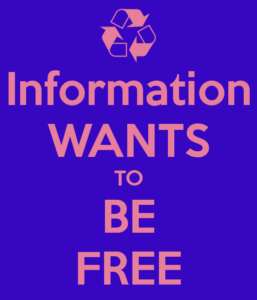
Information Wants to Be Free

Quote by John Perry Barlow, image by Robin Rice

I swiftly moved on to talk about open data licensing, the choices we’ve made for Edinburgh DataShare, and whether offering different ‘flavours’ of open licence are important when many people still don’t understand what open licences are about. Again I used an image from MANTRA (above) to point out that the main consideration for depositors should be whether or not to make their data openly available on the internet – regardless of licence.

By putting their outputs ‘in the wild’ academics are necessarily giving up control over how they are used; some users will be ‘unethical’; they will not understand or comply with the terms of use. And we as repository administrators are not in a position to police mis-use for our depositors. Nevertheless, since academic users tend to understand and comply with scholarly norms about citing and giving attribution, those new to data sharing should not be unduly alarmed about the statement illustrated above. (And DataShare provides a ‘suggested citation’ for every data item that helps the user comply with the attribution requirements.)

Since no overview of data and ethics would be complete without consideration given to confidentiality obligations of researchers towards their human subjects, I included a very short video clip from MANTRA, of Professor John MacInnes speaking about caring for data that contain personally identifying information or personal attributes.

For me the most challenging aspect of the roundtable and indeed the day, was the contribution by Dr Anouk Lang about working with data from social media. As an ethical researcher one cannot assume that consent is unnecessary when working with data streams (such as twitter) that are open to public viewing. For one thing, people may not expect views of their posts outside of their own circles – they treat it as a personal communication medium. For another they may assume that what they say is ethereal and will soon be forgotten and unavailable. A show of hands indicated only some of the audience had heard of the Twitter Developers and API, or Storify, which can capture tweets and other objects in a more permanent web page, illustrating her point.

While this whole area may be more common for social researchers – witness the Economic and Social Research Council’s funding of a Big Data Network over several years which includes social media data – Anouk’s work on digital culture proves Humanities researchers cannot escape “the plethora of ethics, privacy and risk issues surrounding the use (and reuse) of social media data.” (Communication on ESRC Big Data Network Phase 3.)

Robin Rice
Data Librarian

Standing on the shoulders of giants: Phonetics Recording Archive

The University of Edinburgh’s proud heritage of academic and research achievements is underpinned by the calibre of the outstanding staff that have worked and taught within its walls.

One such individual of note was the late Elizabeth Theodora Uldall, a pioneering phonetician who spent over 30 years at the University.  Elizabeth, or as she was more commonly known as, Betsy, came to work at the University in 1949, after postings for the British Council both during and after the Second World War.  Indeed these postings and her subsequent academic work meant that by the time she came to Edinburgh, she had already worked on five continents.

The primary interest of her research was phonetics and at her time in Edinburgh made many valuable contributions to this field, both through her research and teaching, and a touching obituary was published in the Scotsman, when she sadly passed away in 2004.

The Data Library are very happy to announce that recently, with the co-operation from the Linguistics and English Language department, we were able to gather for preservation and sharing, some of the recently digitised research outputs from Betsy Uldall, David Abercrombie, and other distinguished researchers’ work into The University of Edinburgh Phonetics Recording Archive, mid-late 1900s collection on DataShare.

This collection contains five items, containing phonetic and linguistic research including the research outputs and recordings from Betsy Uldall:

Although DataShare was not available for University staff at the time of Betsy Uldall’s retirement in 1983, it would seem that right up until the end, she remained conscious of her responsibilities and the value of her work to other researchers:

“Betsy Uldall, spoke to me before she died asking for this archive to be preserved, and with your help it will be preserved and accessible to people who can use it. – Many many thanks”

We are of course very happy to have played a part in meeting her request, and that her research data is now available to all who wish to study and build upon it.

David Girdwood
EDINA & Data Library

Welcome to the new Research Data Management Service Coordinator: Kerry Miller

We have great pleasure in welcoming a new member of staff to the research data management programme.  Kerry Miller has joined us in the role of Research Data Management Service Coordinator.

Kerry Miller

Kerry is featured in the latest BITS magazine, sharing details of her new role:

What’s your background?
I’ve undertaken research for various organisations, in industry and charity sectors –
including what is now GlaxoSmithKline and Cancer Research UK as well as the
Ministry of Defence and the British Council. I then joined the Digital Curation
Centre (DCC) in 2011 as an Institutional Support Officer. This involved working
with Higher Education institutions across the UK to help them improve their
Research Data Management policy and practice, in response to Research
Councils UK and other similar requirements.

Tell us about the new position.
My new post, RDM Service Co-ordinator, is a newly-created post, aiming to
bring together and co-ordinate all the different aspects of the research data
management work that’s currently being undertaken throughout the University: lots of
infrastructure improvements, and new tools and support for researchers. There
are things like DataShare, which has been active for a while now, but which we’re
promoting, so more researchers are aware of it and know when to use it. There
are also a few more services that are still in the design phases. You can read all
about the RDM work that is going on via the RDM Blog: datablog.is.ed.ac.uk

What particularly excites you about the new role?
The work we do at the DCC is in many ways quite theoretical; we go out and talk
to institutions about what they ought to be doing, what they need to do to meet
requirements, and that sort of thing, but this new role will be going from talking
the talk to walking the walk; I’ve got to actually do what I’ve been telling people at
other institutions to do! It’s quite scary but also quite exciting; just to see whether
or not I can actually turn that into a real, successful service.

Where exactly will you be based?
I’m within the Research and Learning Section of Library & University Collections, on the lower ground floor of the Main Library. There is a huge number of people involved in the area, but the RDM team itself is small and there aren’t that many people full-time at the moment. RDM is part of a lot of people’s jobs – people like Stuart Lewis and John Scally from the library side, Tony Weir in IT Infrastructure and Robin Rice in the Data Library, but I’ll be one of the few people for whom it’s a full-time, dedicated role.

What do you enjoy doing outside work?
I watch a lot of films, and do a lot of cooking and baking. I’ve been doing a recipe
a week from The Great British Bake Off, with greater or lesser success. I often use
my office colleagues as a waste disposal system!