
About Robin Rice

Data Librarian and Head, Research Data Support Library & University Collections

Data Management Training – Autumn 2025

University of Edinburgh courses are now available to book on all topics dealing with research data management. Aimed at postgraduate research students and academic staff, these four courses are taught by experts from the Library’s Research Data Support team, and cover all aspects of managing digital data for a research project. Each course is offered multiple times during the term, at different campus locations and online.Young man with laptop on table with Edinburgh Castle seen through the window.

If you are new to concepts of research data management (RDM) you may wish to take the “Data Management for your Research” overview course (1.5 hours). You will be able to apply basic RDM skills to your daily research practices and understand what the FAIR principles (Findable, Accessible, Interoperable, and Reusable) mean and why they matter.

“Writing a Data Management Plan for Your Research”: in this interactive two-hour workshop you will understand the basic components of good DMP, and will produce a first draft Data Management Plan (DMP) for your research project using a tool called DMPonline.

Building on the University’s online Data Protection training, “Working with Personal and Sensitive Data” will prepare you for the challenges of dealing with human subject and other types of confidential data: how to collect, share, store and protect your data safely and securely, and what university services are available to help you (two hours).

“Archiving Your Research Data” (1.5-2 hours) helps you to plan ahead to when your logo datashare_edinburghresearch project is approaching completion and it is time to find an appropriate repository to share or safeguard the underlying data for your paper, thesis or dissertation for the long-term. You will gain familiarity with using the University’s open acess data repository, DataShare, and know about an alternative restricted access solution, DataVault, as well as how to identify other appropriate repositories. If you are unable to attend any of these scheduled Archiving Your Research Data workshops, you can request additional sessions via our online form: Request training: Archiving your Research Data.

All of the above courses are available to book through our scheduled workshops web page: Research Data Service – Scheduled workshops.

Robin Rice
Data Librarian and Head, Research Data Support

US Government Data: Lost and Found

Image of rescue tube with floppy desk and words Data Rescue ProjectActions by the current US Trump administration (and others, including Trump’s first term) have spurred archivists, librarians and activists to archive, capture, collect, crawl, hoard, mirror, preserve, rescue, track and save datasets produced at taxpayer expense and until recently made available on government websites.

For example, just as US federal research into climate change, or even mentioning climate, has been paused and government agencies defunded, so the datasets produced from these activities have been removed from public reach or disappeared. The same is true for health data around vaccine research (National Institutes of Health, Centres for Disease Control and Prevention), human subject data deemed to be furthering EDI – equality, diversity, and inclusion – (USAID), and longitudinal educational data measuring attainment and social mobility (Department of Education). In some cases, as on this US government web page from the National Environmental Satellite, Data, and Information Service of the National Oceanic and Atmospheric Administration (NOAA), there are both items that are being decommissioned and archived, and others that are simply being decommissioned and deleted.

Particular challenges to archiving such data are capturing whole databases from scraping techniques, metadata loss, loss of provenance tracking (audit trail of changes), and the inability to add records or collect further data without massive government investment. Also, isolated efforts mean the data cannot easily be discovered.

Fortunately, the Data Rescue Project is coming to the rescue (along with other initiatives). It is a coordinated effort among data organisations and individuals, including librarians and data professionals. It serves as “a clearinghouse for data rescue-related efforts and data access points for public US governmental data that are currently at risk.” The web page provides a host of pointers to current efforts, resources, a tracker tool, and press coverage – including the New Yorker and Le Monde.

Researchers at University of Edinburgh who find that data they require for their research is being removed from publicly available sites may contact the Research Data Support team to discuss potential actions to take.

Robin Rice
Data Librarian and Head of Research Data Support
Library and University Collections

Knowledge Exchange with Japan

Two members of the Research Data Support team recently had an adventure visiting Japan in order to provide practical lessons to library students and librarians studying in a research data management (RDM) course.

When Professor Emi Ishita had visited the team in 2023, she was preparing a new syllabus for research data management for her library students at the Kyushu University iSchool. Struck by the strong engagement our team members had with researchers through training, supporting data management plans, and moderating data deposits, she returned in August, 2024 with a delegation of practicing librarians to learn from the Universities of Edinburgh, Leeds, and Oxford. The group spent a full day with various members of Library Research Support, going over a question list they had sent in advance, about Open Access (OA) and RDM support, and our approach to training researchers.Staff and visitors eating lunch

At the end of the session, Emi revealed that a grant was available to pay for two RDM practitioners from UoE to come to Kyushu University in Fukuoka to contribute to an October, 2024 public symposium and a two day-long in-person training sessions for her students. The students would include Masters students enrolled in the iSchool at Kyushu, as well as practicing librarians looking to reskill themselves following government policy directives embracing immediate open access and data sharing for research publications.

bento boxThe speakers for the hybrid symposium on OA and RDM in Japan were myself with Dr Simon Smith, along with long-time RDM service provider Jake Carlson from the University of Buffalo (New York), and the Library Director from Chiba University, and the Research Data Service Director at Kyushu University providing a Japanese context for OA and RDM. Dr Ishita introduced the symposium and chaired the panel session – her team also provided all the speakers with beautifully presented bento boxes tailored to each person’s diet for lunch.

While the symposium was exciting, with about 60 people in attendance and about 130 more watching and listening online, it was the practical training that myself and Simon found truly inspirational. The students overcame their customary reserve to answer Simon’s open-ended questions about supporting researchers with data management planning in a classroom setting. Later, they formed into small groups to try out depositing data in DataShare, and evaluate each other’s metadata for quality. The technology worked, the students were curious and engaged, and the Kyushu instructors were pleased with the outcome.

library trainers at Kyushu University, Oct 2024

Japanese hospitality lunchDuring the week of the event, Simon and I visited prior and new contacts at Tokyo University, Chiba University, Kyoto University, Nagoya University and NII. In addition to the excellent company, we were pleased to be visiting such a beautiful country and eating the wonderful food.

NII staff outside restaurant

Mount Aso volcano

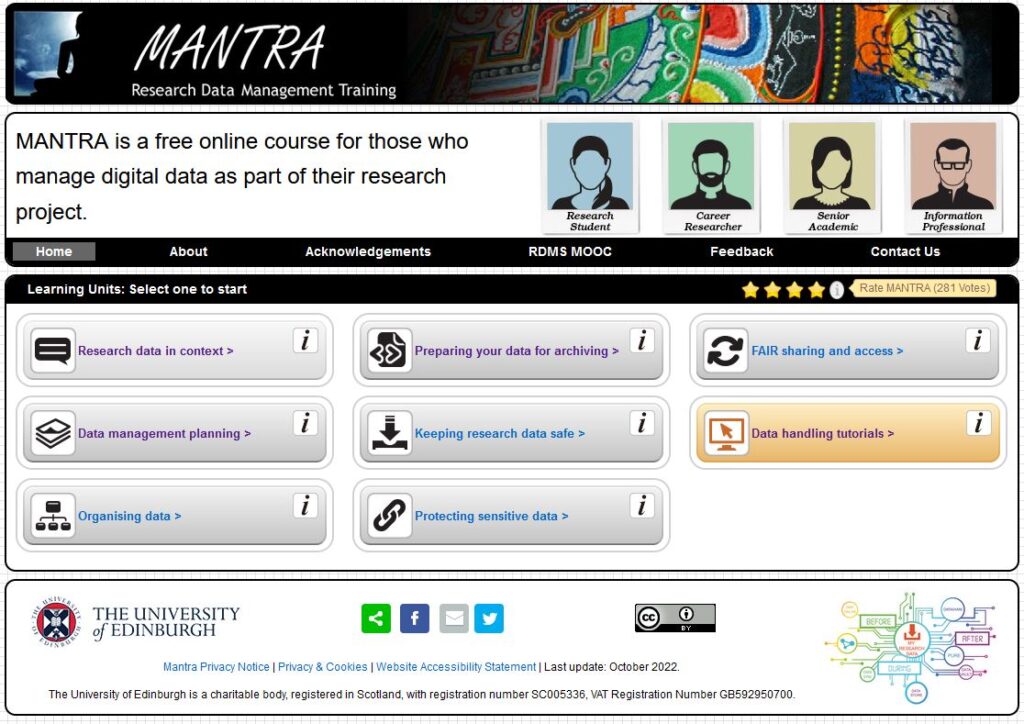
Commissioning data handling modules for MANTRA

We are seeking to commission new software-specific data handling modules in the Research Data MANTRA training resource (https://mantra.ed.ac.uk/), as the ones there have become outdated (https://mantra.ed.ac.uk/softwarepracticals.html). The online modules have been refreshed more regularly by the Research Data Support team. There will be a short turnaround for the commissioned works, which will be incorporated into MANTRA and the Research Data Service.

There is £2,000 available per module for new modules to be authored by end of July, 2024.

Screenshot of the MANTRA resource

What are the software modules in DataShare?

As an extension to the overall MANTRA resource which covers good practice in research data management, each software module contains a one to one a half hour practical to work through which will teach skills needed to handle data properly within the software environment. It is not intended to be an introduction to the software, and a certain level of proficiency with the software may be assumed (any prerequisite knowledge should be stated).

Each module contains:

  • a PDF document stepping through the practical so the learner can work at their own pace;
  • and a publicly available dataset that can be used within the practical, such as a UK government dataset or an open access dataset from a repository. The dataset can be based in any discipline but should not require discipline-specific skills to understand and use.

Currently, we have a module for SPSS, R, ArcGIS and Nvivo.

How do I submit my proposal to author a software module?

We are interested in proposals for authoring accessible data handling tutorials in specific modern software environments, including potentially SPSS, R, Python, QGIS, and Nvivo.

To be considered for this commissioned work, please send a one to two page outline of what the practical will entail in a PDF document to R.Rice@ed.ac.uk by end of Friday 28th June, 2024. Interested parties are welcome to get in touch before the outline is complete, stating their intention. The outline must include the author’s name, email address, and postal address, with or without telephone number. The outline may also contain:

  • prerequisite knowledge that the learner is assumed to have in order to complete the module successfully, such as familiarity with a particular type of software or experience of coding;
  • specific learning objectives of what the learner will gain by working their way through the module;
  • headings indicating sections of the tutorial;
  • descriptions of what will be covered beneath each heading and what the learner is expected to do, using the software of interest;
  • a citation of the dataset to be used with the practical, including the name and location.

The commissioning process

The Research Data Support team will evaluate the proposals and select the authors to proceed with the commissioned works. Notification will be by email. Authors will be expected to comply with the University of Edinburgh’s terms and conditions for suppliers, which includes transfer of any IPR to the University. Upon evaluating the material, we may choose to make edits for purposes of clarity or accessibility. Current members of staff of the University may need to receive payment through their associated unit (to be determined).

All materials for the full software modules must be passed to the University by Friday 26th July. Progress before that date will be assessed through email correspondence. An invoice for work completed must be submitted after the team confirms the content is complete and to specification before 31 July in order to be paid in full.

Robin Rice
Data Librarian and Head of Research Data Support
Library and University Collections