MANTRA shortlisted

Research Data MANTRA (http://datalib.edina.ac.uk/mantra/) is a free, non-credit course designed for postgraduate students and early career researchers which provides guidelines for good practice in research data management.

Image depicting a shortlist
(Flickr Image by Soilse – CC BY-NC-ND 2.0)

In recognition of the work done by Edinburgh University Data Library in developing this open educational resource, MANTRA has been evaluated and shortlisted in a report by the Research Information Literacy and Digital Scholarship (RILADS) project as one of 15 good practice examples designed to enhance information literacy skills of postgraduate students and early career researchers in UK Higher Education

RILADS aims to investigate and report on support available to students, staff and researchers to enhance digital literacy. There are two strands to the project. One is co-ordinated by Research Information Network (RIN) on behalf of Research Information and Digital Literacies Coalition (RIDLs), the other by SCONUL under the JISC Developing Digital Literacies (DDL) programme.

The RIN strand focuses on the identification and promotion of good practice in information handling and data management training and development across the HE and research sectors. The SCONUL strand aims to identify, harvest, and use materials to progress the development of digital professional expertise.

The full report and shortlist are available on the RILADS website: http://rilads.wordpress.com/2013/06/10/rilads-report/

MANTRA, the sole resource on the shortlist that is dedicated to research data management skills, has also been upgraded to Version 2 of the Xerte Online Toolkit, the e-learning development environment used by MANTRA to create the learning materials. This has the ability to deliver content using HTML5 rather than the Flash Player. This has a number of advantages in that you can deliver content to a much wider range of devices, and specifically you can deliver content to devices that do not support Flash.

Watch out for further MANTRA enhancements!

Stuart Macdonald
EDINA & Data Library

New RDM tools and services: awareness raising sessions

The University is investing in a new research driven research data management (RDM) service to cover all the Schools/Research Institutes and Centres in three Colleges. This will allow researchers to comply with funding councils’ requirements for the preservation and dissemination of research data, help them with grant application process, make their research visible and boost citations.

We have already begun talking to research staff in Schools and Research Institutes / Centres to explain these tools and services and how they can benefit from them.

The first School who invited us for a talk was the School of Philosophy, Psychology and Language Sciences. The talk was followed by a lively discussion with some helpful comments and suggestions from them.

We are looking forward to talking to research staff in all Schools and Research Institutes / Centres. If you would like us to introduce you to these new tools and services please get in touch with Cuna Ekmekcioglu at cekmekci@staffmail.ed.ac.uk

Cuna Ekmekcioglu
Research Computing Support
Information Services

Dabbling in data visualisation

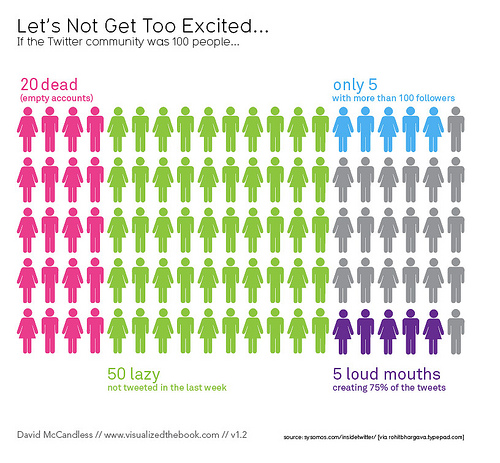
image by David McCandless

Data visualisation is a powerful method to either explore or explain your data. A number of online tools have emerged in recent years making it easier for lay people to make their information beautiful, in the words of dataviz guru David McCandless.

Martin Hawksey from CETIS at University of Strathclyde gave a talk to Information Services staff last week on this popular topic. Following the talk, a small group including the Data Library team had a discussion about what sort of training course might be of interest to the University research community.

Martin’s abstract:

There are a number of examples throughout history where visualisations have been used to explore or explain problems. Notable examples include Florence Nightingale’s ‘Mortality of the British Army’ and John Snow’s Cholera Map of London. Recently the increased availability of data and software for analyzing and generating various views on this data has made it easier to generate data visualisations. In this presentation Martin Hawksey, advisor at the Jisc Centre for Educational, Technology and Interoperability Standards (Cetis), will demonstrate simple techniques for generating data visualisations: using tools (including MS Excel and Google Spreadsheets), drawing packages (including Illustrator and Inkscape) and software libraries (including d3.js and timeline.js). As part of this participants will be introduced to basic visual theories and the concepts of exploratory and explanatory analytics. The presentation will also highlight some of the skills required for discovering and reshaping data sources.

Martin Hawksey’s presentation and blog post

Would you be interested in a data visualisation training course? We’d love to hear from you at datalib@ed.ac.uk or in the comments below.

Robin Rice, Data Library

An insight into institutional RDM

I attended the Jisc Managing Research Data Programme Workshop in Birmingham on 25-26 March on behalf of the University of Edinburgh and gained a real insight into how other institutions are addressing Research Data Management (RDM) and how well our work has been received. It had participants from all areas of RDM, with good presentations sharing progress made on the subject at their institutions.

What clearly stood out was the compliments on the work we have done so far … this was
mentioned numerous times over the weekend where presenters commented on using our work (such as RDM policy and training) as a starting point for their projects. The ‘Business Cases’ session was particularly interesting highlighting all the important non-technical issues (funding, stakeholders, politics, local culture, etc) that need to be handled sensitively in planning and implementing RDM.

Sarah Jones presented our new DIY toolkit for librarians in the ‘RDM Training’ session. The
toolkit is a self-directed training course, intended to be used by a group of librarians to
build confidence in supporting researchers with RDM. MANTRA modules are used as pre-reading and reflective questions and exercises are used to guide discussion at each face-to-face session. The training materials were well received and are already being reused by other Universities.

It was interesting to discover there was lack of training for IT folk in RDM and a desire to
have this addressed … I reported that we were in the process of producing this at our
University. One institution sent all their RDM staff (IT, librarian, research services, etc)
to the workshop so ‘all’ get a real feel for what is required and appreciate best practices
at other institutions. It was somewhat comforting, but not entirely surprising, to learn
that other institutions have similar challenges to us with RDM.

While the sessions over the two days were informative, the opportunity to network with peers at other places and discuss issues/challenges at the round table sessions and evenings was invaluable and perhaps the biggest plus in attending the workshop. I enjoyed the experience and learnt a lot from it.

You can find out more about the event and access all the presentations and event reports on the event web page.

Abdul Majothi
Head of IS Consultancy for CHSS
User Services Division
Information Services