Digital Research Services: What’s on This Semester

This a guest blog post written by Dr Eleonora Mameli, Research Facilitator in the Digital Research Services team.

To help the research community get the best out of the University’s digital resources, the Research Facilitation Team has organised a diverse programme of events for the 2025–2026 academic year.

From research planning to high-performance computing, there is something for everyone interested in using digital tools in research.

Digital Research Conference

The University of Edinburgh’s Digital Research Conference will take place on 26 February 2026, bringing together researchers, students and staff working with digital and data-intensive methods.

Poster for the Digital Research Conference

This year’s themes include:

  • AI in Research: Promise, Pitfalls & Practice
  • Digital Research Infrastructure & the Future of Research Computing
  • Interdisciplinary Digital Research: From Humanities to Medicine
  • Ethics, Security & Integrity in Digital Research
  • Green Digital Research Practices & Sustainability
  • Embedding Digital Tools in Research, Innovation, Teaching & Learning

Abstract submissions are invited for posters, lightning talks, and oral presentations. The deadline for submissions is October 20th at 5pm.

Find out more on the Digital Research Conference webpage.

Event Series

Spotlight on Research Planning

Join this bite-sized online seminar series, running every Tuesday from 21 October to 25 November at 12 pm. Open to academics, research support staff and postgraduate researchers, the sessions will cover:

  • Data and computing cost estimation
  • Research data management
  • DMPOnline
  • Project management
  • Copyright and licensing
  • Open Science Framework

More information at Spotlight on: Research Planning.

Introduction to Digital Research Services

The introduction to Digital Research Services (DRS) webinar runs on various dates throughout the semester.

It is perfect for newcomers, early career researchers (ECRs), or anyone who wants to get started with the University’s digital research tools and services.

HPC in Focus

Explore High-Performance Computing (HPC) through a mix of online and in-person sessions.
These events showcase the University’s research infrastructure, services and support, featuring expert insights, hands-on training, and networking opportunities.

Upcoming sessions will spotlight ARCHER2, the national supercomputer, and Eddie, the University’s local HPC cluster.

More details at HPC in focus training.

On-demand resource: Induction Video Series

If you would like to explore the University’s digital tools and services at your own pace, our Induction Video Series is a great place to start.

This collection of short videos is designed to help you navigate and make the most of the University’s digital tools, services, and resources.
Each video supports a stage of the research lifecycle, from planning and design to publishing and sharing data.

Watch the induction videos here.

If you would like to stay up to date with upcoming events and resources, keep an eye on the Digital Research Services website!


Data Management Training – Autumn 2025

University of Edinburgh courses are now available to book on all topics dealing with research data management. Aimed at postgraduate research students and academic staff, these four courses are taught by experts from the Library’s Research Data Support team, and cover all aspects of managing digital data for a research project. Each course is offered multiple times during the term, at different campus locations and online.Young man with laptop on table with Edinburgh Castle seen through the window.

If you are new to concepts of research data management (RDM) you may wish to take the “Data Management for your Research” overview course (1.5 hours). You will be able to apply basic RDM skills to your daily research practices and understand what the FAIR principles (Findable, Accessible, Interoperable, and Reusable) mean and why they matter.

“Writing a Data Management Plan for Your Research”: in this interactive two-hour workshop you will understand the basic components of good DMP, and will produce a first draft Data Management Plan (DMP) for your research project using a tool called DMPonline.

Building on the University’s online Data Protection training, “Working with Personal and Sensitive Data” will prepare you for the challenges of dealing with human subject and other types of confidential data: how to collect, share, store and protect your data safely and securely, and what university services are available to help you (two hours).

“Archiving Your Research Data” (1.5-2 hours) helps you to plan ahead to when your logo datashare_edinburghresearch project is approaching completion and it is time to find an appropriate repository to share or safeguard the underlying data for your paper, thesis or dissertation for the long-term. You will gain familiarity with using the University’s open acess data repository, DataShare, and know about an alternative restricted access solution, DataVault, as well as how to identify other appropriate repositories. If you are unable to attend any of these scheduled Archiving Your Research Data workshops, you can request additional sessions via our online form: Request training: Archiving your Research Data.

All of the above courses are available to book through our scheduled workshops web page: Research Data Service – Scheduled workshops.

Robin Rice
Data Librarian and Head, Research Data Support

Highlights from the 2024-25 Digital Research programme at the University of Edinburgh

This is a guest blog from Dr Eleni Kotoula, Lead Digital Research Facilitator, Digital Research Services

Researchers at the University of Edinburgh have access to a wide range of digital research services, resources, tools, and support throughout the research lifecycle. Research Facilitators are dedicated to helping the university community make the most of Digital Research Services. To support this goal, they have developed a programme of activities for researchers, research students, and professional staff supporting research, with contributions from the Library, Research Services, EPCC (formerly Edinburgh Parallel Computing Centre), and members of the wider University community. 

Photograph of mountains on the horizon with the following text: Explore What's on the Horizon - Stay ahead in your research journey with the latest events, workshops and opportunities available across the University of Edinburgh. Whether you're looking to enhance your skills, connect with fellow researchers, or explore new tools, there's something for everyone. There is also a link for: digitalresearchservices.ed.ac.uk/news-and-updates

Boost Your Digital Research Skills 

In addition to training offered by service providers, schools, and colleges, Digital Research Services have scheduled ten 30-minute webinars from September until the end of the calendar year. 

An “Introduction to Digital Research Services” webinar will be offered on various dates throughout Semester 1, tailored for newcomers, early career researchers (ECRs), and anyone who needs help navigating the Digital Research Services. 

The “Spotlight on Research Planning” webinar series will address key considerations when planning a research project, including topics such as copyright, research websites, research computing, and data management. These webinars will provide valuable information to help researchers be better prepared for planning and designing their next research project. 

Expand Your Network 

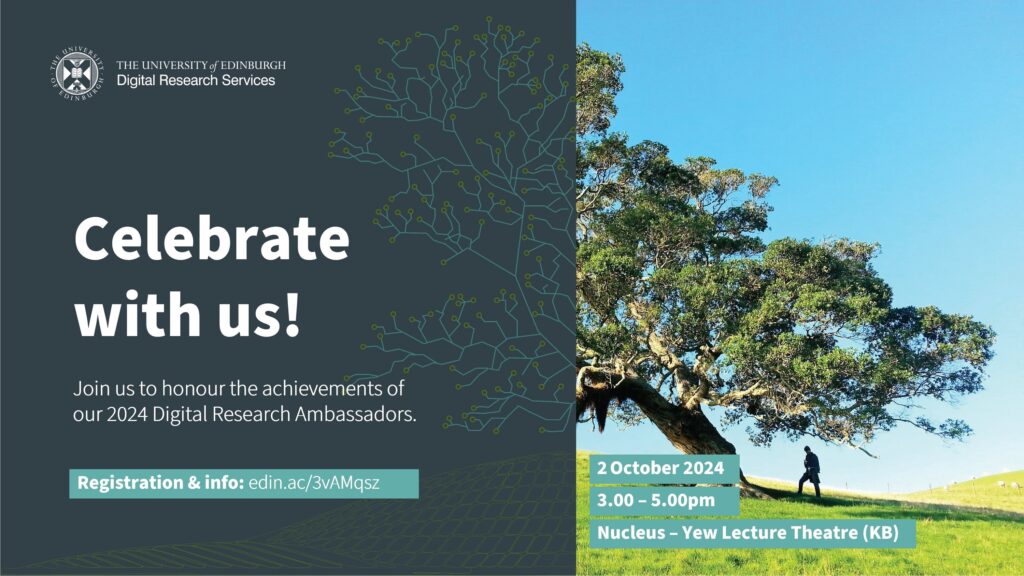
Image of a tree with a figure standing underneath it in the shade, accompanied by the following text: Celebrate with us! Join us to honour the achievements of our 2024 Digital Research Ambassadors. Registration & info: edin.ac/3vAMqsz 2 October 2024, 3:00-5:00pm, Nucleus - Yew Lecture Theatre (KB)

The Digital Research Services programme also offers networking opportunities during all hybrid and in-person events. Networking receptions will take place on: 

  • 24th October during the HPC communities gathering event. Find out more and register here 
  • 29th January at the Digital Research Conference. More details available here. 

All in-person attendees of lunchtime seminars and hands-on training sessions are invited to join us for a networking lunch. 

 Hands-on Computing Training 

With a growing demand from the University of Edinburgh community to enhance research computing skills, Digital Research Services have scheduled three full days of hands-on HPC training: 

  • “Introduction to Archer2” on 30th October and 6th November. Book your place here 
  • “How to Work on Eddie” on 14th November. Find out more and register here 

To stay updated on upcoming events, training and opportunities relevant to data and computational research subscribe to the digital research mailing list. For further queries, contact digitalreseacrhservices@ed.ac.uk.

Keep connected with the team at https://linktr.ee/digitalresearchservices  

Research Data Workshops: DataVault Summary

Having soft-launched the DataVault facility in early 2019, the Research Data Support team -with the support of the project board – held five workshops in different colleges and locations to find out what the user community thought about it. This post summarises what we learned from participants, who were made up roughly equally of researchers (mainly staff) and support professionals (mainly computing officers based in the Schools and Colleges).

Each workshop began with presentations and a demonstration by Research Data Service staff, explaining the rationale of the DataVault, what it should and should not be used for, how it works, how the University will handle long-term management of data assets deposited in the DataVault, and practicalities such as how to recover costs through grant proposals or get assistance to deposit.

After a networking lunch we held discussion groups, covering topics such as prioritisation of features and functionality, roles such as the university as data asset owner, and the nature of the costs (price).

The team was relieved to learn that the majority (albeit from a somewhat self-selecting sample) agreed that the service fulfilled a real need; some data does need to be kept securely for a named period to comply with research funders’ rules, and participants welcomed a centralised platform to do this. The levels of usability and functionality we have managed to reach so far were met with somewhat less approval: clearly the development team has more work to do, and we are glad to have won further funding from the Digital Research Services programme in 2019-2020 in order to do it.

Attitudes toward university ownership of data assets was also a mixed bag; some were sceptical and wondered if researchers would participate in such a scheme, but others found it a realistic option for dealing with staff turnover and the inevitability of data outlasting data owners. Attitudes toward cost were largely accepting (the DataVault provides a cheaper alternative than our baseline DataStore disk storage), but concerns about the safekeeping of legacy and unfunded research data were raised at each workshop.

A sample of points raised follows:

  • Utility? “Everyone I know has everything on OneDrive.”
  • Regarding prioritisation of features – security first; file integrity first; putting data from other sources than DataStore; facilitating larger deposit sizes; ease of use.
  • Quickness of deposit and retrieval? Deposit was deemed more important to be quick than retrieval.
  • University as data asset owner?
    • Under GDPR the data are already university assets (because the Uni is the data controller).
    • People who manage the data should be close to the research; IT people can manage users but shouldn’t be making decisions about data. Danger that because it’s related to IT it gets dumped on IT officers. The formal review process helps to ensure decisions will be made properly. Include flexibility into the review hierarchy to allow for variation in school infrastructure.
    • When I heard that I was – not shocked – but concerned. If I move to another university how do I get access? This might be a problem. Researchers might prefer to retain three copies themselves.
  • Is the cost recovery mechanism valid?
    • Vault costs are legitimate costs.
    • Ideally should come from grant overheads, until then need to charge.
    • Possible to charge for small / medium/large project at start rather than per TB?
  • Is the 100 GB threshold sufficient for unfunded research? How else could unfunded or legacy data be covered (who pays)?
    • Alumni sponsor a dataset scheme?
    • There will be people with a ‘whole bunch of data somewhere’ that would be more appropriately stored in DataVault.

The team is grateful to all of the workshop participants for their time and thoughts; the report will be considered further by the project board and the Research Data Service Steering Group members. The full set of workshop notes are colour-coded to show comments from different venues and are available to read on the RDM wiki, for anyone with a University log-in (EASE).


Robin Rice
Data Librarian and Head, Research Data Support
Library & University Collections