Curriculum development for digital curators

The Framing the Digital Curation Curriculum Conference, held in the grand surroundings of Banca CR Firenze, Florence on 6-7 May 2013, was organised by the DigCurV project funded by the European Commission’s Leonardo da Vinci programme to establish a curriculum framework for vocational training for digital curators in the library, archive, museum and cultural heritage sectors.

The aim of the conference was to promote discussion and consensus-building amongst stakeholders about criteria and requirements necessary to develop training courses for professionals in digital curation and preservation in the cultural heritage sector.

It is possible to argue that digital curation curriculum development in North American library schools is at a more advanced stage than their UK equivalents nevertheless there was a strong Scottish presence at the conference with thought-provoking presentations by William Kilbride (Executive Director, Digital Preservation Coalition) – A future with no history meets a history with no future: how much do we need to know about digital preservation and by Laura Molloy and Ann Gow (HATII, University of Glasgow) – the Curriculum Framework as well as a presentation on the ‘DIY’ RDM Training Kit for Librarians, developed at EDINA & Data Library in conjunction with User Services Division, given by yours truly.

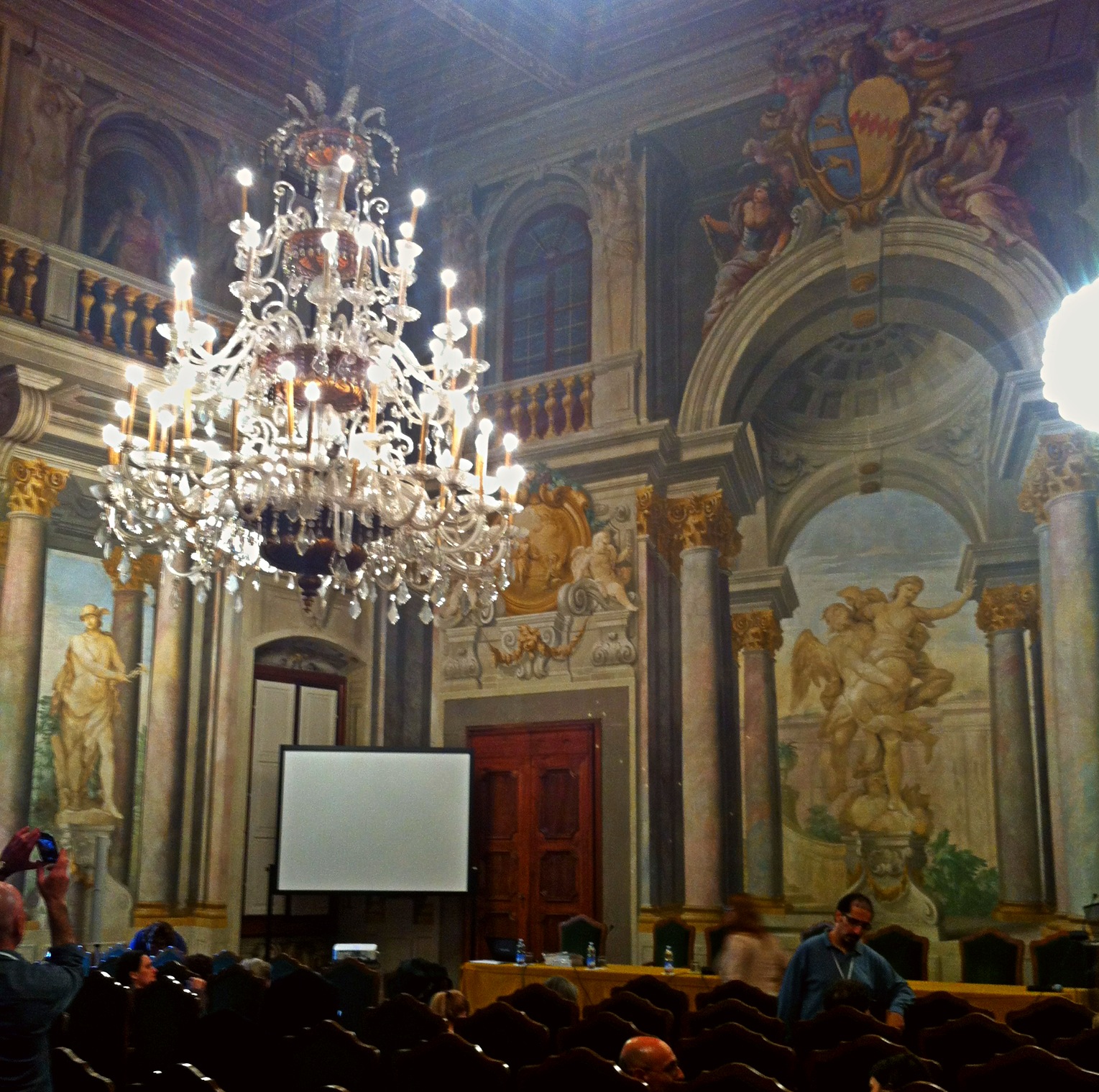
Chandelier in Banca CR Firence, Florence

In keeping with this preservation theme there’s a commonly accepted theory that you will not find the British royal family in the same place at the same time in case of an assasination attempt, terrorist attack, or natural disaster. With this, and the threateningly large, heavy yet impressive chandelier in mind (see picture above), it was encouraging to observe that the assembled digital curation curriculum and preservation expertise was dispersed throughout the auditorium lest a loose ceiling screw could have resulted in all existing knowledge in this area being lost in one fell swoop!!

All presentations are available on the conference website: http://www.digcur-education.org/eng/International-Conference/Programme

Stuart Macdonald
Associate Data Librarian

Where the data people meet: IASSIST

Last week I had the pleasure of attending IASSIST 2013 in Cologne, the annual conference of an international membership organisation of data librarians and data archivists, hosted by GESIS, the German social science data archive. Since 1974 this close-knit but dispersed community has been sharing knowledge and experience of provision of academic data services. Data Library staff have served in various elected and appointed posts over the years, and have hosted the conference twice in Edinburgh.

Corresponding with new jobs for data curators, data scientists and data managers, IASSIST has grown from an intimate group of regulars (such as those of us working in the Data Library and the UK Data Archive) to a conference of nearly 300 delegates from 29 countries, with three or four parallel tracks of presentations running across three days plus a training day for workshops.

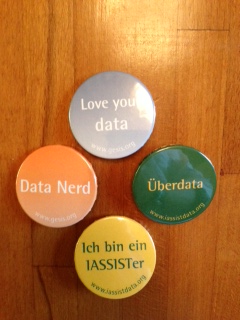
data nerdWhatever the conference theme–this time it was Data Innovation: Increasing Accessibility, Visibility, and Sustainability— the programme never fails to be an indicator of the latest trends, albeit with a slant towards whichever European or North American country is hosting the conference. One speaker noted that Big Data may have seen its peak, as it was no longer necessary to cram the term into every presentation.

This year there was a noticeable increase in talks about data enclaves and means of providing access to sensitive personal and corporate data, including a keynote by Tim Mulcahy of NORC on record linkage. Tim set up the first data enclave in the US in 2004. After returning home I learned of a new proposal from the ESRC to fund four administrative data centres in the four UK countries, affirming this important trend towards secure access of sensitive data. As Tim pointed out, it’s much better for researchers than the status quo of not getting access at all.

The most number of talks appeared in the Research Data Management strand (RDM), including my colleague Stuart Macdonald’s presentation of our RDM Roadmap work here at UoE. Attention to RDM has exploded in recent years as research funders have applied more stringent rules to how data is created, managed and shared, to get the most value out of publicly funded research for themselves, researchers and the public. It was gratifying to hear praise by other speakers for MANTRA – our online course for PhD students to learn RDM basics—which has become well-known as an RDM primer.

Another strand covered more long-standing interest in data standards and tools – especially those around the DDI (Data Documentation Initiative) standard used in archiving social science data, which was invented and developed by IASSIST-ers. Data libraries serving a single institution were amply represented by a strand called Data Public Services/Librarianship. As part of a Pecha Kucha set of lightning talks I presented our work in training liaison librarians in RDM and outlined an openly licensed “training kit” that other small groups of librarians anywhere can use to train themselves.

IASSIST has been branching out from the social sciences as institutions such as ours grapple with how to support the data lifecycle across the University and its multitude of disciplines. As I sat on a panel discussing how data libraries and national data archives such as the UKDA can work together, I wondered what the future would bring for a mature set of data-related services that interoperate across an institution (as we’re trying to create through the RDM Roadmap work) and across institutions and the internet. The future for data – and data nerds – seem bright.

Robin Rice
Data Librarian

Background to the Edinburgh Research Data Blog

Since the University Senate passed the Research Data Management Policy in May, 2011, Information Services has been working with others across the University to determine how best to implement the policy so that it serves the needs of researchers, their funders, and the University.

Subsequently, several other UK universities (such as the Universities of Essex, Nottingham, Exeter and Manchester) have used the Edinburgh policy as a model to develop their own policies, adopting much of the same language. The Digital Curation Centre (DCC) used Edinburgh as a case study for an online publication, How to Develop RDM Services – a guide for HEIs.

In the same period, new policies have emerged from funding agencies. The RCUK Common Principles on Data Policy assert that publicly funded research data are public goods which should be openly shared whenever possible. The EPSRC Policy Framework on Research Data obliges research institutions to provide support infrastructure for research data management and storage.

A governance structure for the rollout of services and infrastructure has been agreed, with the formation of a Research Data Management and Storage (RDMS) Steering Group with cross-College representation led by Professor Peter Clarke (Physics), and an RDMS Implementation Group chaired by Dr John Scally (Library and University Collections), including key IS service managers. This work is made transparent through a wiki open to all University members.

Funding has now been secured to establish infrastructure for the secure storage, management, sharing and preservation of research data in the University. A Roadmap which communicates strategy and milestones for planning over the short and medium term has been approved by the Steering Group which will guide IS service managers in building streamlined services that are fit for purpose across research areas. Roadmap timelines will be revised in the coming weeks and announced here.

The new funding adds to momentum that has been building since the passage of the policy. The DCC has conducted pilot work with University researchers on services to aid data management planning. IT Infrastructure is procuring high-capacity storage, and pilot work has been completed to inform the storage architecture. The Data Library has been engaging with User Services in IS to conduct training in RDM for librarians. Further training for IT consultants is planned. An online course – Research Data MANTRA – designed for PhD students and early career researchers, is available for self-paced training. The data repository, Edinburgh DataShare, is available for dataset deposits, and further pilot activity is informing work on user enhancements.

Upcoming Roadmap milestones will tackle interoperability between systems and ways to capture information about where datasets are stored for a University-wide register.

With the advent of big data, open data, the long tail of (small) data, and data-driven research, data management is a hot topic for academic support groups across the UK and beyond. IS staff are monitoring developments coming from the Jisc-funded Managing Research Data programme, the new international Research Data Alliance and elsewhere, and participating in events and discussions about standards, tools and best practice, through experience gained working with research groups across the University.

This blog has been set up to share the latest news and views on this exciting activity. The primary audience is the researchers of the University, but it will no doubt be read by peers in other institutions equally engaged in RDM work, just as we will be attuned to their developments.

Robin Rice, on behalf of the RDM Implementation Committee