Non-standard research outputs

I recently attended (13th May 2014) the one-day ‘Non-standard Research Outputs’ workshop at Nottingham Trent University.

[ 1 ] The day started with Prof Tony Kent and his introduction to some of the issues associated with managing and archiving non-text based research outputs. He posed the question: what uses do we expect these outcomes to have in the future? By trying to answer this question, we can think about the information that needs to be preserved with the output and how to preserve both, output and its documentation. He distinguished three common research outcomes in arts-humanities research contexts:

  • Images. He showed us an image of a research output from a fashion design researcher. The issue with research outputs like this one is that they are not always self explanatory, and quite often open up the question of what is recorded in the image, and what the research outcome actually is. In this case, the image contained information about a new design for a heel of a shoe, but the research outcome itself, the heel, wasn’t easily identifiable, and without further explanation (description metadata), the record would be rendered unusable in the future.
  • Videos. The example used to explain this type of non-text based research output was a video featuring some of the research of Helen Storey. The video contains information about the project Wonderland and how textiles dissolve in water and water bottles disintegrate. In the video, researchers explain how creativity and materials can be combined to address environmental issues. Videos like this one contain both, records of the research outcome in action (exhibition) and information about what the research outcome is and how the project ideas developed. These are very valuable outcomes, but they contain so much information that it’s difficult to untangle what is the outcome and what is information about the outcome.

  • Statements. Drawing from his experience, he referred to researchers in fashion and performance arts to explain this research outcome, but I would say it applies to other researchers in humanities and artistic disciplines as well. The issue with these research outcomes is the complexity of the research problems the researchers are addressing and the difficulty of expressing and describing what their research is about, and how the different elements that compose their research project outcomes interact with each other. How much text do we need to understand non-text-based research outcomes such as images and videos? How important is the description of the overall project to understand the different research outcomes?

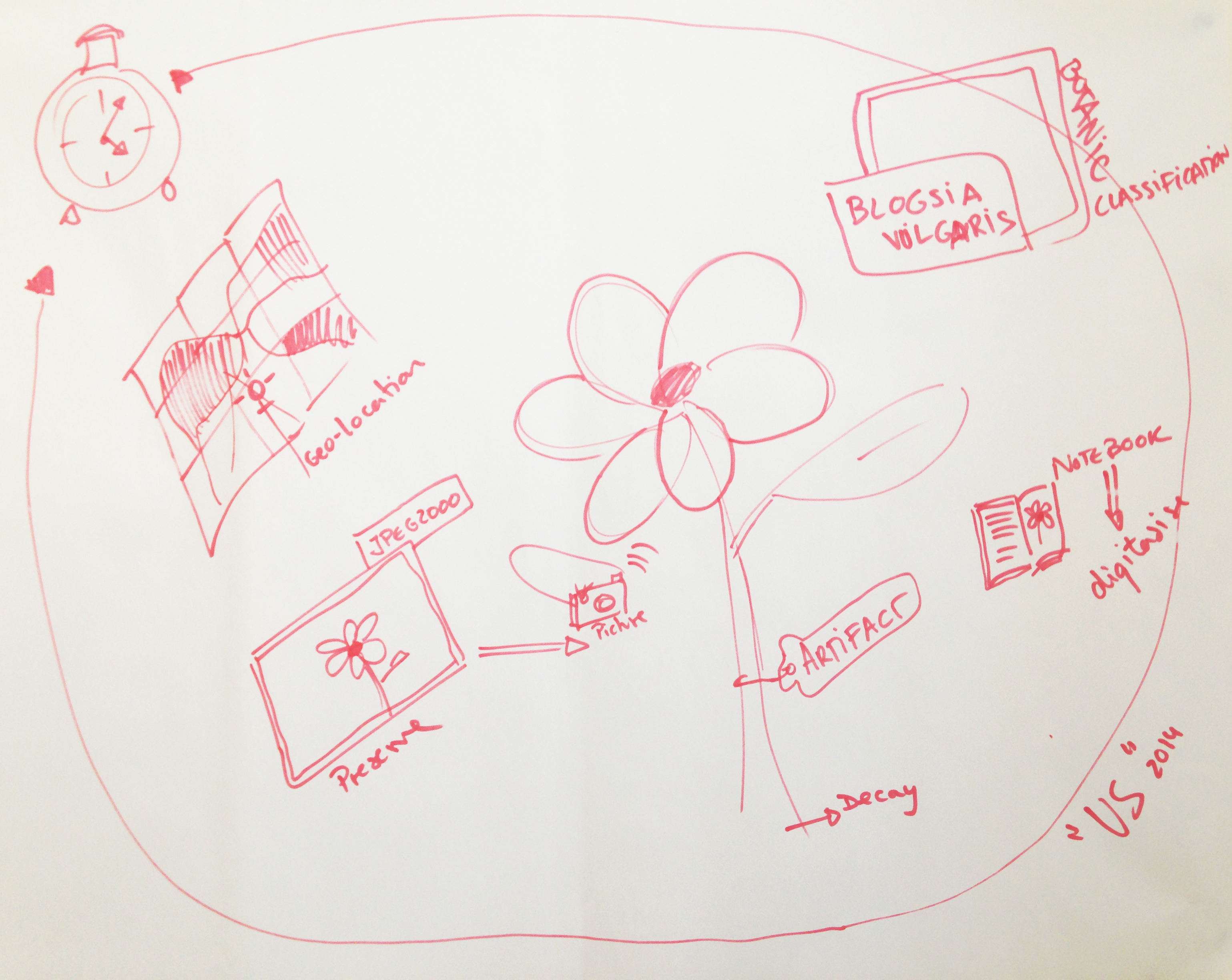
Other questions that come to mind when thinking about collecting and archiving non-standard research outputs such as exhibitions are: ‘what elements of the exhibition do we need to capture? Do we capture the pieces exhibited individually or collectively? How can audio/visual documentation convey the spatial arrangements of these pieces and their interrelations? What exactly constitutes the research outputs? Installation plans, cards, posters, dresses, objects, images, print-outs, visualisations, visitors comments, etc.? We also discussed how to structure data in a repository for artefacts that go into different exhibitions and installations. How to define a practice-based research output that has a life in its own? How do we address this temporal element, the progression and growth of the research output? This flowchart might be useful. Shared with permission of James Toon and collaborators.

Non-standard_research_outputs

Sketch from group discussion about artefacts and research practices that are ephemeral. How to capture the artefact as well as spatial information, notes, context, images, etc.

[ 2 ] After these first insights into the complexity of what non-standard research outcomes are, Stephanie Meece from the University of the Arts London (UAL) discussed her experience as institutional manager of the UAL repository. This repository is for research outputs, but they have also set up another repository for research data which is currently not publicly available. The research output repository has thousands of deposits, but the data repository has ingested only one dataset in its first two months of existence. The dataset in question is related to a media-archaeology research project where a number of analogue-based media (tapes) are being digitised. This reinforced my suspicion that researchers in the arts and humanities are ready and keen to deposit final research outputs, but are less inclined to deposit their core data, the primary sources from which their research outputs derive.

The UAL learned a great deal about non-standard research outputs through the KULTUR project, a Jisc funded project focused on developing repository solutions for the arts. Practice-based research methods engage with theories and practices in a different way than more traditional research methods. In their enquiries about specific metadata for the arts, the KULTUR project identified that metadata fields like ‘collaborators’ were mostly applicable to the arts (see metadata report, p. 25), and that this type of metadata fields differed from ‘data creator’ or ‘co-author.’ Drawing from this, we should certainly reconsider the metadata fields as well as the wording we use in our repositories to accommodate the needs of researchers in the arts.

Other examples of institutional repositories for the arts shown were VADS (University of the Creative Arts) and RADAR (Glasgow School of Art).

[ 3 ] Afterwards, Bekky Randall made a short presentation in which she explained that non-standard research outputs have a much wider variety of formats than standard text-based outputs. She also explained the importance of getting the researchers to do their own deposits, as they are the ones that know the information required for metadata fields. Once researchers find out what is involved in depositing their research, they will be more aware of what is needed, and get involved earlier with research data management (RDM). This might involve researchers depositing throughout the whole research project instead of at the end when they might have forgotten much of the information related to their files. Increasingly, research funders require data management plans, and there are tools to check what they expect researchers to do in terms of publication and sharing. See SHERPA for more information.

[ 4 ] The presentation slot after lunch is always challenging, but Prof Tom Fisher kept us awake with his insights into non-standard research outcomes. In the arts and humanities it’s sometimes difficult to separate insights from the data. He opened up the question of whether archiving research is mainly for Research Excellence Framework (REF) purposes. His point was to delve into the need to disseminate, access and reuse research outputs in the arts beyond REF. He argued that current artistic practice relates more to the present context (contemporary practice-based research) than to the past. In my opinion, arts and humanities always refer to their context but at the same time look back into the past, and are aware they cannot dismiss the presence of the past. For that reason, it seems relevant to archive current research outputs in the arts, because they will be the resources that arts and humanities researchers might want to use in the future.

He spent some time discussing the Journal for Artistic Research (JAR). This journal was designed taking into account the needs of artistic research (practice-based methodologies and research outcomes in a wide range of media), which do not lend themselves to the linearity of text-based research. The journal is peer-review and this process is made as transparent as possible by publishing the peer-reviews along with the article. Here is an example peer-review of an article submitted to JAR by ECA Professor Neil Mulholland.

[ 5 ] Terry Bucknell delivered a quick introduction to figshare. In his presentation he explained the origins of the figshare repository, and how the platform has improved its features to accommodate non-standard research outputs. The platform was originally thought for sharing scientific data, but has expanded its capabilities to appeal to all disciplines. If you have an ORCID account you can now connect it to figshare.

[ 6 ] The last presentation of the day was delivered by Martin Donnelly from the Digital Curation Centre (DCC) who gave a refreshing view into data management for the arts. He pointed out the issue of a scientifically-centred understanding of research data management, and that in order to reach the arts and humanities research community, we might need to change the wording, and change the word ‘data’ for ‘stuff’ when referring to creative research outputs. This reminded me of the paper ‘Making Sense: Talking Data Management with Researchers’ by Catharine Ward et al. (2011) and the Data Curation Profiles that Jane Furness, Academic Support Librarian, created after interviewing two researchers at Edinburgh College of Art, available here.

Quoting from his slides “RDM is the active management and appraisal of data over all the lifecycle of scholarly research.” In the past, data in the sciences was not curated or taken care of after the publication of articles; now this process has changed and most science researchers already actively manage their data throughout the research project. This could be extended to arts and humanities research. Why wait to do it at the end?

The main argument for RDM and data sharing is transparency. The data is available for scrutiny and replication of findings. Sharing is most important when events cannot be replicated, such as performance or a census survey. In the scientific context ‘data’ stands for evidence, but in the arts and humanities this does not apply in the same way. He then referred to the work of Leigh Garrett, and how data gets reused in the arts. Researchers in the arts reuse research outputs but there is the fear of fraud, because some people might not acknowledge the data sources from which their work derives. To avoid this, there is the tendency to have longer embargoes in humanities and arts than in sciences.

After Martin’s presentation, we called it a day. While, waiting for my train at Nottingham Station, I noticed I had forgotten my phone (and the flower sketch picture with it), but luckily Prof Tony Kent came to my rescue, and brought the phone to the station. Thanks to Tony and Off-Peak train tickets, I was able to travel back home on the day.

Rocio von Jungenfeld
Data Library Assistant
Data and ethics

As an academic support person, I was surprised to find myself invited onto a roundtable about ‘The Ethics of Data-Intensive Research’. Although as a data librarian I’m certainly qualified to talk about data, I was less sure of myself on the ethics front – after all, I’m not the one who has to get my research past an Ethics Review Board or a research funder.

The event was held last Friday at the University of Edinburgh as part of the project Archives Now: Scotland’s National Collections and the Digital Humanities, a knowledge exchange project funded by the Royal Society of Edinburgh. This event attracted attendees across Scotland and had as its focus “Working With Data“.

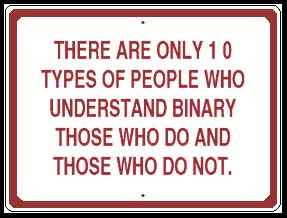
I figured I couldn’t go wrong with a joke about fellow ‘data people’ with an image from flickr that we use in our online training course, MANTRA.

Binary-by-Xerones-CC-BY-NC

‘Binary’ by Xerones on Flickr (CC-BY-NC)

Appropriately, about half the people in the room chuckled.

So after introducing myself and my relevant hats, I revisited the quotations I had supplied on request for the organiser, Lisa Otty, who had put together a discussion paper for the roundtable.

“Publishing articles without making the data available is scientific malpractice.”

This quote is attributed to Geoffrey Boulton, Chair of the Royal Society of Edinburgh task force which published Science as an Open Enterprise in 2012. I have heard him say it, if only to say it isn’t his quote. The report itself makes a couple of references to things that have been said that are similar, but are just not as pithy for a quote. But the point is: how relevant is this assertion for scholarship that is outside of the sciences, such as the Humanities? Is data sharing an ethical necessity when the result of research is an expressive work that does not require reproducibility to be valid?

I gave Research Data MANTRA’s definition of research data, in order to reflect on how well it applies to the Humanities:

Research data are collected, observed, or created, for the purposes of analysis to produce and validate original research results.

When we invented this definition, it seemed quite apt for separating ‘stuff’ that is generated in the course of research from stuff that is the object of research; an operational definition, if you will. For example, a set of email messages may just be a set of correspondences; or it may be the basis of a research project if studied. It all depends on the context.

But recently we have become uneasy with this definition when engaging with certain communities, such as the Edinburgh College of Art. They have a lot of digital ‘stuff’ – inputs and outputs of research, but they don’t like to call it data, which has a clinical feel to it, and doesn’t seem to recognise creative endeavour. Is the same true for the Humanities, I wondered? Alas, the audience declined to pursue it in the Q&A, so I still wonder.

“The coolest thing to do with your data will be thought of by someone else.”                          – Rufus Pollock, Cambridge University and Open Knowledge Foundation, 2008

My second quote attempted to illustrate the unease felt by academics about the pressure to share their data, and why the altruistic argument about open data doesn’t tend to win people over, in my experience. I asked people to consider how it made them feel, but perhaps I should have tried it with a show of hands to find out their answers.

Information Wants to Be Free

Quote by John Perry Barlow, image by Robin Rice

I swiftly moved on to talk about open data licensing, the choices we’ve made for Edinburgh DataShare, and whether offering different ‘flavours’ of open licence are important when many people still don’t understand what open licences are about. Again I used an image from MANTRA (above) to point out that the main consideration for depositors should be whether or not to make their data openly available on the internet – regardless of licence.

By putting their outputs ‘in the wild’ academics are necessarily giving up control over how they are used; some users will be ‘unethical’; they will not understand or comply with the terms of use. And we as repository administrators are not in a position to police mis-use for our depositors. Nevertheless, since academic users tend to understand and comply with scholarly norms about citing and giving attribution, those new to data sharing should not be unduly alarmed about the statement illustrated above. (And DataShare provides a ‘suggested citation’ for every data item that helps the user comply with the attribution requirements.)

Since no overview of data and ethics would be complete without consideration given to confidentiality obligations of researchers towards their human subjects, I included a very short video clip from MANTRA, of Professor John MacInnes speaking about caring for data that contain personally identifying information or personal attributes.

For me the most challenging aspect of the roundtable and indeed the day, was the contribution by Dr Anouk Lang about working with data from social media. As an ethical researcher one cannot assume that consent is unnecessary when working with data streams (such as twitter) that are open to public viewing. For one thing, people may not expect views of their posts outside of their own circles – they treat it as a personal communication medium. For another they may assume that what they say is ethereal and will soon be forgotten and unavailable. A show of hands indicated only some of the audience had heard of the Twitter Developers and API, or Storify, which can capture tweets and other objects in a more permanent web page, illustrating her point.

While this whole area may be more common for social researchers – witness the Economic and Social Research Council’s funding of a Big Data Network over several years which includes social media data – Anouk’s work on digital culture proves Humanities researchers cannot escape “the plethora of ethics, privacy and risk issues surrounding the use (and reuse) of social media data.” (Communication on ESRC Big Data Network Phase 3.)

Robin Rice
Data Librarian

IDCC 2014 – take home thoughts

A few weeks ago I attended the 9th International Digital Curation Conference in San Francisco.  The conference was spread over four days, with two days for workshops, and two for the main conference.  The conference was jointly run by the Digital Curation Centre and the California Digital Library.  Unsurprisingly it was an excellent conference with much debate and discussion about the evolving needs for digital curation of research data.

San Francisco

The main points I took home from the conference were:

Science is changing: Atul Butte gave an inspiring keynote that contained an overview of the ways in which his own work is changing.  In particular he explained how it is now possible to ‘outsource’ parts of the scientific process. The first is the ability to visit a web site to buy tissue samplesfor specific diseases which were previously used for medical tests, but which have now been anonymised and collected rather than being discarded.  Secondly it is also now possible to order mouse trials to be undertaken, again via a web site.  These allow routine activities to be performed more quickly and cheaply.

Big Data: This phrase is often used and means different things to different people.  A nice definition given by Jane Hunter was that curation of big data is hard because of its volume, velocity, variety and veracity.  She followed this up by some good examples where data have been effectively used.

Skills need to be taught: There were several sessions about the role of Information Schools in educating a new breed of information professionals with the skills required to effectively handle the growing requirements of analysing and curating data.  This growth was demonstrated by how we are seeing many more job titles such as data engineer / analyst / steward / journalist.  It was proposed that library degrees should include more technical skills such as programming and data formats.

The Data paper: There was much discussion about the concept of a ‘Data Paper’ – a short journal paper that describes a data set.  It was seen as an important element in raising the profile of the creation of re-usable data sets.  Such papers would be citable and trackable in the same ways as journal papers, and could therefore contribute to esteem indicators.  There was a mix of traditional and new publishers with varying business models for achieving this.  One point that stood out for me was that publishers were not proposing to archive the data, only the associated data paper.  The archiving would need to take place elsewhere.

Tools are improving: I attended a workshop about Data Management in the Cloud, facilitated by Microsoft Research.  They gave a demo of some of the latest features of Excel.  Many of the new features seem to nicely fit into two camps, but equally useful and very powerful to both.  Whether you are looking at data from the perspective of business intelligence or research data analysis, tools such as Excel are now much more than a spreadsheet for adding up numbers.  They can import, manipulate, and display data in many new and powerful ways.

I was also able to present a poster that contains some of the evolving thoughts about data curation systems at the University of Edinburgh: http://dx.doi.org/10.6084/m9.figshare.902835

In his closing reflection of the conference, Clifford Lynch said that we need to understand how much progress we are making with data curation.  It will be interesting to see the progress made and what new issues are being discussed at the conference next year which will be held much closer to home in London.

Stuart Lewis
Head of Research and Learning Services
Library & University Collections, Information Services

Using an electronic lab notebook to deposit data into Edinburgh DataShare

This is heads up about a ‘coming attraction’.  For the past several months a group at Research Space has been working with the DataShare team, including Robin Rice and George Hamilton, to make it possible to deposit research data from our new RSpace electronic notebook into DataShare.

I gave the first public preview of this integration last month in a presentation called Electronic lab notebooks and data repositories:  Complementary responses to the scientific data problem  to a session on Research Data and Electronic Lab Notebooks at the American Chemical Society conference in Dallas.

When the RSpace ELN becomes available to researchers at Edinburgh later this spring, users of RSpace will be able to make deposits to DataShare directly from RSpace using a simple interface we have built into RSpace.  The whole process only takes a few clicks, and starts with selecting records to be deposited into DataShare and clicking on the DataShare button as illustrated in the following screenshot:b2_workspaceHighlightedYou are then asked to enter some information about the deposit:

c2_datashareDialogFilledAfter confirming a few details about the deposit, the data is deposited directly into DataShare, and information about the deposit appears in DataShare.

h2_viewInDatashare2We will provide details about how to sign up for an RSpace account in a future post later in the spring.  In the meantime, I’d like to thank Robin and George for working with us at RSpace on this exciting project.  As far as we know this is the first time an electronic lab notebook has ever been integrated with an institutional data repository, so this is a pioneering and very exciting experiment!  We hope to use it as a model for similar integrations with other institutional and domain-specific repositories.

Rory MacNeil
Chief Executive, Research Space