
Research Data Spring – blooming great ideas !

The University of Edinburgh have been busy putting ideas together for Jisc’s Research Data Spring project, part of the research at risk co-design challenge area, which aims to find new technical tools, software and service solutions, which will improve researchers’ workflows and the use and management of their data (see: http://researchdata.jiscinvolve.org/wp/2014/11/24/research-data-spring-let-your-ideas-bloom/).

Library and University Collections in collaboration with colleagues from the University of Manchester have submitted an idea to prototype and then develop ann open source data archive application that is technology agnostic and can sit on top of various underlying storage or archive technologies – see: http://researchatrisk.ideascale.com/a/dtd/Develop-a-DataVault/102647-31525)

EDINA & Data Library have submitted two ideas, namely:

A ‘Cloud Work Bench’ to provide researchers in the geospatial domain (GI Scientists, Geomaticians, GIS experts) with the tools, storage and data persistence they require to conduct research without the need to manage the same in a local context that can be fraught with socio-technical barriers that impede the actual research (see: http://researchatrisk.ideascale.com/a/dtd/Cloud-Work-Bench/101899-31525)

An exploration of the use of Mozilla Open Badges as certification of completion of MANTRA (Research Data Management Training), a well-regarded open educational resource (see: http://researchatrisk.ideascale.com/a/dtd/Open-Badges-for-MANTRA-resource/102084-31525)

Please register with ideascale (http://researchatrisk.ideascale.com/) and VOTE for our blooming great ideas!!

Stuart Macdonald
RDM Service Coordinator
Sustainable software for research

In an earlier blog post (October 2013) Stuart Lewis discussed the 4 aspects of software preservation as detailed in a paper by Matthews et al, A Framework for Software Preservation, namely:

      1. Storage: is the software stored somewhere?


      2. Retrieval: can the software be retrieved from wherever it is stored?


      3. Reconstruction: can the software be reconstructed (executed)?


    4. Replay: when executed, does the software produce the same results as it did originally?

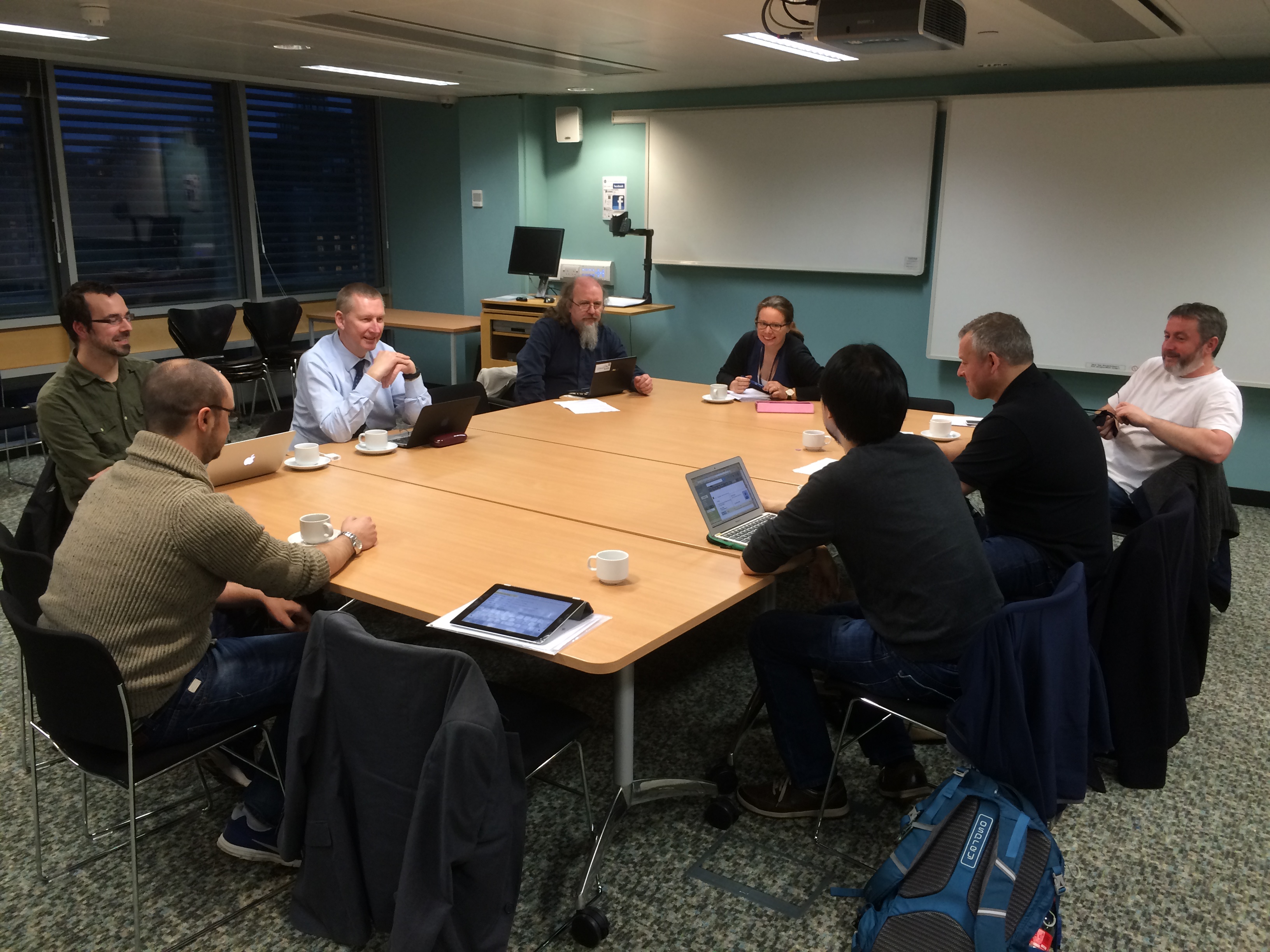
It is with these thoughts in mind that colleagues (1 December 2014) from across IS (Applications Division, EDINA, Research and Learning Services, DCC, IT Infrastructure) met with Neil Chue Hong (Director of the Software Sustainability Institute) (SSI) to discuss how the University of Edinburgh could move forward on the thorny issue of software preservation.

SSI_and_IS_software meeting_dec2014

The take home message agreed by all at the meeting was that it will be easier to look after software in the future if software is managed well just now.

In terms of progressing thinking in this regard there were more questions than answers.

Matters to investigate include:

  • defining what we mean by research software: a spectrum from single R analysis scripts through to large software platforms
  • capturing descriptions of locally created research software products in the Pure Data Asset Registry
  • understanding the number of local research projects that are creating software
  • creating high-level guidance around software development and licensing (with links to SSI and OSS Watch)
  • providing skills and training for early carrer researchers (such as through the Software Carpentry initiative)
  • tools to measure software uptake/usage in local research
  • institutional use of GitLab and other software development tools
  • ascertaining instances and spend on GitHub across the University

“It’s impossible to conduct research without software, say 7 out of 10 UK researchers” or so says an SSI report surveying software generation as part of the research process in Russell Group institutions. Published in Times Higher Education (THE) the report and data that underpins the report are now available.

Much food for thought and further discussion!

Stuart Macdonald
RDM Service Coordinator

Dancing with Data

I went to an interesting talk yesterday by Prof Chris Speed called “Dancing with Data”, on how our interactions and relationships with each other, with the objects in our lives and with companies and charities are changing as a result of the data that is now being generated by those objects (particularly smartphones, but increasingly by other objects too). New phenomena such as 3D printing, airbnb, foursquare and iZettle are giving us choices we never had before, but also leading to things being done with our data which we might not have expected or known about. The relationships between individuals and our data are being re-defined as we speak. Prof Speed challenged us to think about the position of designers in this new world where push-to-pull markets are being replaced by new models. He also told us about his research collaborations with Oxfam, looking at how technology might enhance the value of the second-hand objects they sell by allowing customers to hear their stories from their previous owners.   Logo for the Tales of Things project

All very thought-provoking, but what about the implications for academic research, aside from those working in the fields of Design, Economics or Sociology who must now develop new models to reflect this changing landscape? Well, the question arises, if all this data is being generated and collected by companies, are the academics (and indeed the charity sector) falling behind the curve? Here at the University of Edinburgh, my colleagues in Informatics are doing Data Science research, looking into the infrastructure and the algorithms used to analyse the kind of commercial Big Data flowing out of the smartphones in our pockets, while Prof Speed and his colleagues are looking at how design itself is being affected. But perhaps academics in all disciplines need to be tuning their antennae to this wavelength and thinking seriously about how their research can adapt to and be enhanced by the new ways we are all dancing with data.

For more about the University of Edinburgh’s Design Informatics research and forthcoming seminars see www.designinformatics.org. Prof Chris Speed tweets @ChrisSpeed.

Pauline Ward is a Data Library Assistant working at the University of Edinburgh and EDINA.

RDM Surgery!

Do you have a query about storing, sharing or preserving your research data? Do you need assistance with a Data Management Plan?

RDM Service staff will be in the Pop-up library space on the first floor of the Main Library on Monday 29 September (2pm-4pm) to answer any questions you may have about our services including:

For further information please also visit:

So please pop by and pay us a visit and let us answer your Research Data Management queries.

Stuart Macdonald
RDM Service Coordinator
email: stuart.macdonald@ed.ac.uk