
Updated MANTRA content: Research data in context

The Research Data Support team is pleased to announce the launch of the first in a series of updates to MANTRA, the free and open online research data management training course.

The first updated module ‘Research data in context’ (previously ‘Research data explained’) is now live on the MANTRA site and provides an introduction to research data, alongside detail on the contexts in which data are generated, and the challenges presented by big data in society.

MANTRA is designed to give post-graduate students, early career researchers, and information professionals the knowledge and skills needed to work effectively with research data.

Since launching in 2011, MANTRA has been through a number of significant rewrites to keep up with current trends, and over 10,000 different learners have visited MANTRA in the last academic year.

The ‘Research data in context’ module has been substantially revised in order to:

  • remove dated and obsolete content;
  • simplify and improve the readability of existing material;
  • add information on data literacy and data science.

The changes in this module include:

  • Revised pages: Introduction; Why is research data management important?; What are data?; What are research data?; Data as research output; Module Summary; Next & further reading.
  • New pages: Data in society; Data Science; Video: machine learning; Data literacy and skills.

A change log detailing all changes in this release is available on request from the Research Data Support team (data-support@ed.ac.uk).

We hope you find this update interesting and useful and welcome any feedback you may have.

Further MANTRA updates are forthcoming, focusing on FAIR data and newer data protection legislation and we will announce these in future blog posts.

Bob Sanders
Research Data Support
RDM Training for Undergraduate Students

Link

RDM Training for Undergraduate Students

The Research Data Service at the University of Edinburgh provides research data support and training for staff and postgraduate students. Yet, over the last year through an Innovation Grant  – we have decided to branch out and produce training materials to support our undergraduate students as well.

thumbnail

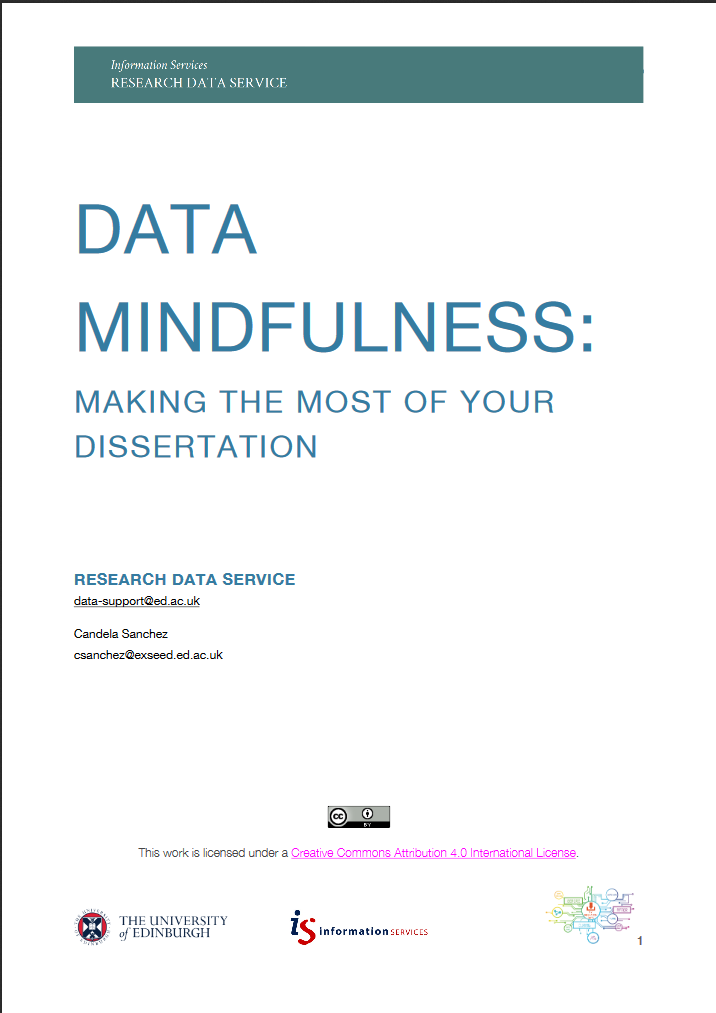
The result is a new handbook called ‘Data Mindfulness: Making the most of your dissertation’, along with a set of face-to-face workshops that we have delivered during the spring semester and will be delivering again this autumn. The idea behind this handbook and the workshops is to take UG students through all the stages of their dissertation journey: from choosing their question to dealing with literature and data to preserving their data after submission.

Unlike existing material for postgraduates and researchers, this handbook has been written by one of our PhD interns from the perspective of a student; and it places data management tips within the broader experience of conducting a UG dissertation. We believe this student perspective is what makes this handbook unique and particularly innovative.

Download Data Mindfulness-Making the Most of your Dissertation handbook for your own use or to customise for your own UG students.

Candela Sanchez-Rodilla Espeso
UG Research Data Management Skills Co-ordinator

Dealing with Data 2019- Call for Contributions *Deadline Extended*

*We have had several requests for an extension to the submission deadline, so, we have decided to extend it until 12 noon on Friday 11th October!*

Dealing with Data 2019 will take place on the 27th of November in the Informatics Forum. This year our theme is “Collaboration Across the Nations: Managing, sharing and securing research data across space and time” and we are now inviting contributions from research staff and students at the University of Edinburgh.

In previous years DwD has attracted over 100 attendees from across the university to hear contributions by research staff and students at all stages of their careers and from diverse disciplines. You can view the presentations from 2017 & 2018 now on MediaHopper (https://media.ed.ac.uk/channel/Dealing+With+Data+2017+Conference/82256222)

The full Call for Contributions is below. If you have any questions please get in touch using on dealing-with-data-conference@mlist.is.ed.ac.uk

Dealing with Data Conference 2019 – Call for Contributions

Date:                     Wednesday 27th November 2019

Location:             Informatics Forum, George Square, Central Area

Theme:                Collaboration Across the Nations: Managing, sharing and securing research data across space and time

Possible Contributions: Presentation; Lightning talk; Poster; Demonstration of a tool or method supporting collaboration; Stall or exhibit, panel.

Call for contributions:

Collaboration is vitally important to academic and commercial research in all areas as it enables the pooling of resources to answer increasingly complex, or interdisciplinary research questions.

The effective collection, processing, and sharing of research data is integral to successful collaborations, but it can also present many challenges. In particular the practicalities of co-ordinating data management across large multi-centre collaborations, sharing large data, or handling sensitive data, can present difficulties if not planned for appropriately.

Dealing with Data 2019 is your opportunity to share with the UoE research community how you have addressed these issues to build successful collaborations, or the lessons you have learned which will enable you to be more successful in the future.

Contributions should be aimed principally at an academic audience, but the programme will seek to represent a wide range of scholarly disciplines.

Possible themes may include (but are by no means limited to):

  • Data sharing within research groups or labs;
  • Challenges of data sharing across the University or with external partners;
  • Managing and securing sensitive data across distributed research projects;
  • Interdisciplinary issues;
  • Tools for enabling or simplifying collaborative data collection, management or analysis;
  • Data sharing at scale;
  • Interoperability of (meta)data;
  • Legal and licensing issues;
  • Credit and contributions for data use and reuse, including after a project has ended.

For all contributions please send an abstract detailing the content and proposed format (maximum 500 words) to dealing-with-data-conference@mlist.is.ed.ac.uk by Friday 11th october.  Posters should be A0 in size, portrait orientation.

Proposals will be reviewed, and the event programme announced by Friday 25th October 2019.

Dealing with Data is an annual event sponsored and organised by the Research Data Service to provide a forum for University of Edinburgh researchers to discuss how they are benefiting from, or experiencing struggles with, the fast-changing research data environment.

Kerry Miller
Research Data Support Officer

University of Edinburgh Data Safe Haven: a new facility for sensitive data

Information Services has implemented a remote-access “Safe Haven” environment to protect data confidentiality, satisfy concerns about data loss and reassure Data Controllers about the University’s secure management and processing of their data in compliance with Data Protection Legislation.

The Data Safe Haven (DSH) provides a secure storage space and a secure analytic environment that is appropriate for all research projects working with different kinds of sensitive data. It has its own firewall and is isolated from the University network. It is located in a secure facility with controlled access. All traffic between the DSH and the user’s computer is encrypted and no internet access is available. Access to the DSH is only for authorized users via an assigned ‘Yubikey’ and secure VMware Horizon Client, and will only be available from the managed desktops that are white listed for access to the DSH.

Provision of a range of analytic and supporting applications (e.g., SPSS, STATA, SAS, MATLAB, and R) is available. These are delivered dynamically and are assigned to the project. The applications that are available to the users will depend on the type of arrangement that has been made with the DSH technical team prior to the project registration and on the licensing arrangements with the software provider.

The DSH initial security review (penetration test) was carried out by a CREST accredited organisation in August 2018. The DSH exhibited an overall good security stance and demonstrated resilience against the various types of tests performed by the consultants. This was the initial review that formed part of our ongoing drive towards ISO 27001 certification. We expect to complete this phase of the project and obtain the certificate by November 2019.

We have successfully closed the pilot phase of the DSH with five projects in October 2018, and softly launched the service at our “Dealing with Data” conference in November 2018. At present, the DSH Technical team has been migrating Centre for Clinical Brain Sciences – National CJD Research and Surveillance project data from the walled garden into the DSH.

The DSH operates on a cost recovery basis and this cost should be included in grant applications. We welcome enquiries from researchers as early as possible in their project planning. Costing is based on bespoke project requirements (see DSH Overview for users at https://www.ed.ac.uk/is/data-safe-haven.

The DSH Operations team also provides:

  • advice and input for funding and permissions applications;
  • guidance on meeting Approved Researcher requirements;
  • advice about meeting data sharing requirements and archiving of data.

We can set up a demo environment for researchers on request to explore the use of the DSH for their projects. If you need further information, please contact the RDS Team via data-support@ed.ac.uk.

Cuna Ekmekcioglu, Data Safe Haven Manager, Research Data Service