Dabbling in data visualisation

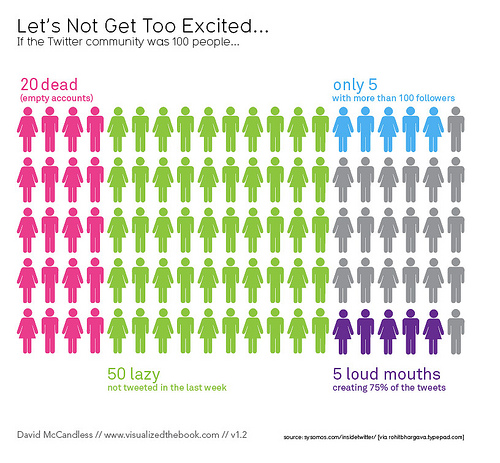
image by David McCandless

Data visualisation is a powerful method to either explore or explain your data. A number of online tools have emerged in recent years making it easier for lay people to make their information beautiful, in the words of dataviz guru David McCandless.

Martin Hawksey from CETIS at University of Strathclyde gave a talk to Information Services staff last week on this popular topic. Following the talk, a small group including the Data Library team had a discussion about what sort of training course might be of interest to the University research community.

Martin’s abstract:

There are a number of examples throughout history where visualisations have been used to explore or explain problems. Notable examples include Florence Nightingale’s ‘Mortality of the British Army’ and John Snow’s Cholera Map of London. Recently the increased availability of data and software for analyzing and generating various views on this data has made it easier to generate data visualisations. In this presentation Martin Hawksey, advisor at the Jisc Centre for Educational, Technology and Interoperability Standards (Cetis), will demonstrate simple techniques for generating data visualisations: using tools (including MS Excel and Google Spreadsheets), drawing packages (including Illustrator and Inkscape) and software libraries (including d3.js and timeline.js). As part of this participants will be introduced to basic visual theories and the concepts of exploratory and explanatory analytics. The presentation will also highlight some of the skills required for discovering and reshaping data sources.

Martin Hawksey’s presentation and blog post

Would you be interested in a data visualisation training course? We’d love to hear from you at datalib@ed.ac.uk or in the comments below.

Robin Rice, Data Library
An insight into institutional RDM

I attended the Jisc Managing Research Data Programme Workshop in Birmingham on 25-26 March on behalf of the University of Edinburgh and gained a real insight into how other institutions are addressing Research Data Management (RDM) and how well our work has been received. It had participants from all areas of RDM, with good presentations sharing progress made on the subject at their institutions.

What clearly stood out was the compliments on the work we have done so far … this was
mentioned numerous times over the weekend where presenters commented on using our work (such as RDM policy and training) as a starting point for their projects. The ‘Business Cases’ session was particularly interesting highlighting all the important non-technical issues (funding, stakeholders, politics, local culture, etc) that need to be handled sensitively in planning and implementing RDM.

Sarah Jones presented our new DIY toolkit for librarians in the ‘RDM Training’ session. The
toolkit is a self-directed training course, intended to be used by a group of librarians to
build confidence in supporting researchers with RDM. MANTRA modules are used as pre-reading and reflective questions and exercises are used to guide discussion at each face-to-face session. The training materials were well received and are already being reused by other Universities.

It was interesting to discover there was lack of training for IT folk in RDM and a desire to
have this addressed … I reported that we were in the process of producing this at our
University. One institution sent all their RDM staff (IT, librarian, research services, etc)
to the workshop so ‘all’ get a real feel for what is required and appreciate best practices
at other institutions. It was somewhat comforting, but not entirely surprising, to learn
that other institutions have similar challenges to us with RDM.

While the sessions over the two days were informative, the opportunity to network with peers at other places and discuss issues/challenges at the round table sessions and evenings was invaluable and perhaps the biggest plus in attending the workshop. I enjoyed the experience and learnt a lot from it.

You can find out more about the event and access all the presentations and event reports on the event web page.

Abdul Majothi
Head of IS Consultancy for CHSS
User Services Division
Information Services

Sharing Edinburgh’s RDM lessons with other Scottish HEIs

In the interest of sharing Research Data Management (RDM) lessons with the wider community, Edinburgh University hosted a seminar for Higher Education Information Directors Scotland (HEIDS) and Scottish Confederation of University and Research Libraries (SCURL) in April, bringing together IT directors and librarians from Scottish universities.

The presentations (with links below) covered the range of RDM activities that Edinburgh University is currently engaged in:

Much of the discussion covered the potential for collaboration, from sharing lessons and models in these early stages to potentially offering shared services in the future. Senior managers emphasised that IS would need to look after its own users as a primary concern.

The audience appeared to take a lot of ideas away from the day and were keen for a follow-up session later in the year. Since the event, the University of Edinburgh has approved a business case, committing significant resource to invest in RDM infrastructure and staffing. Watch this space for further updates!

Sarah Jones, DCC

Curriculum development for digital curators

The Framing the Digital Curation Curriculum Conference, held in the grand surroundings of Banca CR Firenze, Florence on 6-7 May 2013, was organised by the DigCurV project funded by the European Commission’s Leonardo da Vinci programme to establish a curriculum framework for vocational training for digital curators in the library, archive, museum and cultural heritage sectors.

The aim of the conference was to promote discussion and consensus-building amongst stakeholders about criteria and requirements necessary to develop training courses for professionals in digital curation and preservation in the cultural heritage sector.

It is possible to argue that digital curation curriculum development in North American library schools is at a more advanced stage than their UK equivalents nevertheless there was a strong Scottish presence at the conference with thought-provoking presentations by William Kilbride (Executive Director, Digital Preservation Coalition) – A future with no history meets a history with no future: how much do we need to know about digital preservation and by Laura Molloy and Ann Gow (HATII, University of Glasgow) – the Curriculum Framework as well as a presentation on the ‘DIY’ RDM Training Kit for Librarians, developed at EDINA & Data Library in conjunction with User Services Division, given by yours truly.

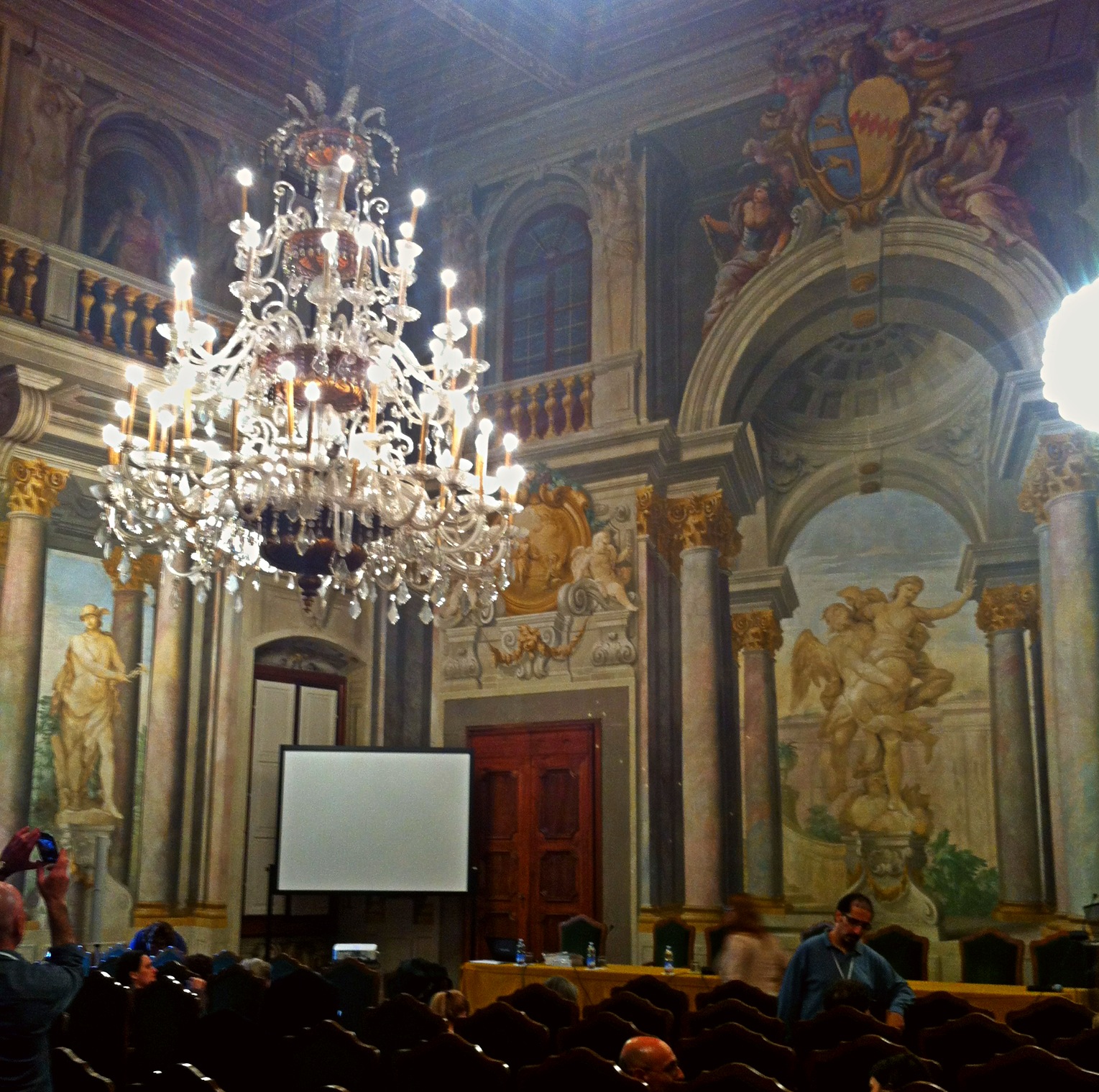
Chandelier in Banca CR Firence, Florence

In keeping with this preservation theme there’s a commonly accepted theory that you will not find the British royal family in the same place at the same time in case of an assasination attempt, terrorist attack, or natural disaster. With this, and the threateningly large, heavy yet impressive chandelier in mind (see picture above), it was encouraging to observe that the assembled digital curation curriculum and preservation expertise was dispersed throughout the auditorium lest a loose ceiling screw could have resulted in all existing knowledge in this area being lost in one fell swoop!!

All presentations are available on the conference website: http://www.digcur-education.org/eng/International-Conference/Programme

Stuart Macdonald
Associate Data Librarian