
About Robin Rice

Data Librarian and Head, Research Data Support Library & University Collections

New release of Research Data MANTRA (Management Training) online course

The Research Data MANTRA course is an open, online training course that provides instruction in good practice in research data management. There are nine interactive learning units on key topics such as data management planning, organising and formatting data, using shared data and licensing your own data, as well as four data handling tutorials with open datasets for use in R, SPSS, NVivo and ArcGIS.

This fourth release of MANTRA has been revised and systematically updated with new content, videos, reading lists, and interactive quizzes. Three of the data handling tutorials have been rewritten and tested for newer software versions too.

New content in the online learning modules with the September, 2014 release:

  • New video footage from previous interviewees and introducing Richard Rodger, Professor of Economic and Social History and Stephen Lawrie, Professor of Psychiatry & Neuro-Imaging
  • Big Data now in Research Data Explained
  • Data citation and ‘reproducible research’ added to Documentation and Metadata
  • Safe password practice and more on encryption in Storage and Security
  • Refined information about the DPA and IPR in Data Protection, Rights and Access
  • Linked Open Data and CC 4.0 and CC0 now covered in Sharing, Preservation & Licensing
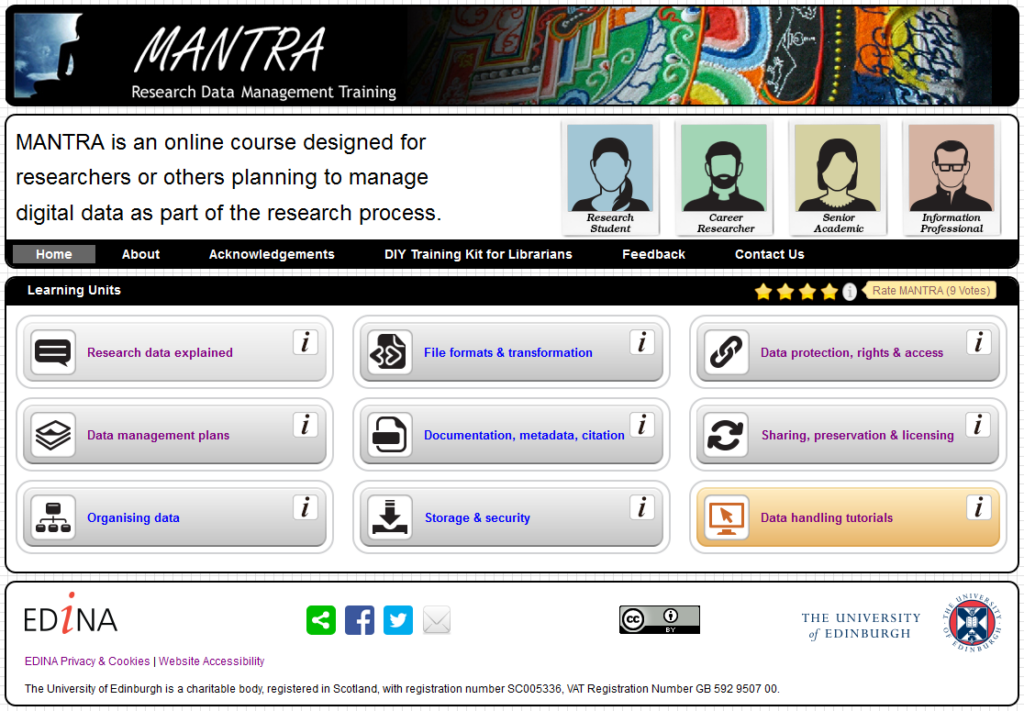
MANTRA home pageThis release will also be more stable and more accessible due to back-end enhancements. The flow of the learning units and usability of quizzes have been improved based on testing and feedback. We have simplified our feedback form and added a four-star rating button to the home page. A YouTube playlist for each unit is available on the Data Library channel.

MANTRA was originally created with funding from Jisc and is maintained by EDINA and Data Library, a division of Information Services, University of Edinburgh. It is an integral part of the University’s Research Data Management Programme and is designed to be modular and self-paced for maximum convenience; it is a non-assessed training course targeted at postgraduate research students and early career researchers.

Data management skills enable researchers to better organise, document, store and share data, making research more reproducible and preserving it for future use. Researchers in 144 countries used MANTRA last year, which is available without registration from the website. Postgraduate training organisations in the UK, Canada, and Australia have used the Creative Commons licensed material in the Jorum repository to create their own training. The website also hosts a ‘training kit’ for librarians wishing to increase their skills in supporting Research Data Management.

Visit MANTRA and consider recommending it to your colleagues and research students this term! http://datalib.edina.ac.uk/mantra/

Usage Statistics

According to Google Analytics, the following organisation’s websites were the top ten referrers to the MANTRA website for the academic year 2013-2014 (discounting Data Library, EDINA and Information Services):

  • Institute for Academic Development, University of Edinburgh
  • LIS Links (India)
  • Digital Curation Centre
  • eScience Portal for New England Libraries at University of Massachusetts Medical Library
  • Oxford University
  • University of Nebraska-Lincoln (USA)
  • Carleton University (Canada)
  • Glasgow University
  • Food and Agriculture Organization of the United Nations
  • Jisc

Social media sites Facebook, Twitter and Slideshare provided a large number of referrals; several more came from other UK institutions, and HEIs in Australia, the rest of Europe, and North America—University Library pages especially. Forty percent of sessions came  from a referring website.

Visitors to MANTRA over the year came from 144 countries. Google searches accounted for 4,000 sessions, 25% of the total. Nearly ten thousand visits were from new users (based on IP addresses) over the year from 22nd August, 2013 – 23rd August, 2014. Here is a link to a Google Analytics summary spreadsheet extracted from our account.

We expect to have more detailed usage statistics over the forthcoming year due to moving the learning units out of the authoring software (Xerte Online Toolkits) onto the main MANTRA website.

Postscript, 15 Sept: See my Storify story, “Research Data MANTRA Buzz” to find out who’s been talking about MANTRA on twitter!

Robin Rice
Data Librarian


Upcoming Dealing with Data Conference and RDM Service Launch

The Edinburgh RDM team is a-buzz this week with preparations for the launch of our services, which will be carried out by the University’s Principal, Sir Timothy O’Shea in the Library next Tuesday morning, 26th August, 2014 with 120 stakeholders in attendance.

rdm-logo-finalAlthough the RDM Policy was passed by the University Court in May, 2011, and our RDM Roadmap work began in earnest in August 2012, it has taken until now to be sure our core services are ready for a formal launch. See this post by the RDM Services Coordinator for a recent snapshot of Roadmap progress.

The launch will be short and sweet–lasting no more than half an hour. But the event is enhanced by a mini-conference, featuring researchers discussing Dealing with Data from across the disciplinary spectrum. If they mention any of our services that will be a bonus for us! The programme is available now, and a summary will be posted after the event.

For those who want to follow live tweets, the hashtag will be #DWD2014. For those who attend, be sure and fill out the feedback form at https://www.survey.ed.ac.uk/dealing_data-feedback!

Robin Rice on behalf of Cuna Ekmekcioglu (RDM team)

Edinburgh supports trial data publication

I recently read in a Sense about Science tweet that a lone student asked the Principal of the University of Edinburgh if it would join the AllTrials Campaign and it became the first Scottish University to do so. Here’s his story – [Editor]

As a Nurse I frequently talk with patients about the treatments and medications they receive. These are often difficult conversations as it relies on the clinician having a library of background knowledge coupled with the most up-to-date data. Despite the wealth of knowledge that exists within the medical community there is an increasing body of research that highlights the large amount of clinical trial data that has gone unshared for many decades. This is the origin of the AllTrials campaign.

AllTrials logo

The best estimate is that around half of clinical trials have never been published. Recognising the need for change a group of academics founded AllTrials. AllTrials is an initiative headed by leading academic bodies such as the British Medical Journal, the Oxford Centre for Evidence-based Medicine and the Cochrane Collaboration. AllTrials calls for all past and present clinical trials to be registered and their full methods and summary results reported.

As a Nursing graduate of The University of Edinburgh and a current masters student within the Nursing department I felt I should engage with my University about the issue of clinical trial data sharing and about the AllTrials campaign. I wrote to Professor Sir Timothy O’Shea, the Principal of the University, who gave his support for AllTrials. As of July 2014 The University of Edinburgh became the first Scottish University to register its support for AllTrials. This move is inherently positive for Edinburgh, both as a global leader in health care and as an institution with a longstanding Edinburgh Data Library history. The campaign has had nearly 80,000 people sign its petition as well as just under 500 organisations register support.

This is an issue important issue for all of us. Show your support by signing the AllTrials petition.

Adam Lloyd
Nurse
Masters of Nursing in Clinical Research student
The University of Edinburgh

The views expressed are my own and do not reflect the views of The University of Edinburgh, the AllTrials campaign or any of its affiliates.

New data curation profile in History

Margaret Forrest, Academic Liaison Librarian for the School of History, Classics and Archaeology, is the latest to contribute a data curation profile. She has interviewed researcher Graham J. Black, who is a PhD candidate in the School. His subject is the aerial bombing during the Vietnam War and he has thousands of government documents, articles and pictures to manage.

The profile has been added to previous ones on the DIY RDM Training Kit for Librarians web page created by other librarians participating in the RDM librarian training. The librarians covered five RDM topics in separate two-hour sessions,where they reinforced what was learned in MANTRA through group discussion, exercises from the UK Data Archive, and listening to local experts.

Each librarian was encouraged to complete an independent study as part of the training: interview a researcher and write up a data curation profile. This was designed to test their self-confidence at talking to researchers about RDM, as well as give them the opportunity to ‘share their data’ by publishing the profile on the website.

Margaret described her experience to Anne Donnelly, one of the trainers:

This was definitely the most enjoyable part of the training and I learned so much from this interview process and the writing up (mainly because of the value of what I had learned from the MANTRA course).

The final group of eight academic service librarians completed their training this summer. This completes a deliverable in the University’s RDM Roadmap. More curation profiles are welcome; we may put them in a collection in Edinburgh DataShare. They could be useful learning objects for others doing training in research data support, in terms of thinking critically about RDM practices.

Robin Rice
Data Librarian