DwD2018 – Videos now on Media Hopper

Dealing with Data 2018 was once again a great success in November last year with over 100 university staff and Post-Graduate students joining us to hear presentations on topics as diverse as sharing data in clinical trials and embedding sound files in linguistics research papers.

As promised the videos of each presentation have now been made publicly available on Media Hopper (https://media.ed.ac.uk/channel/Dealing%2BWith%2BData%2BConference/82256222), while the PDFs can be found on https://www.era.lib.ed.ac.uk/handle/1842/25859. You can also read Martin Donnelly’s reflections on the day https://libraryblogs.is.ed.ac.uk/2018/11/28/dealing-with-data-2018-summary-reflections/.

We hope that these will prove both useful and interesting to all of our colleagues who were unable to attend.

We look forward to seeing you at Dealing with Data 2019.

We’re hiring!

Information Services has a new vacancy for a Data Safe Haven Operations Assistant to work directly with the Data Safe Haven Manager in the Research Data Support Team in providing operational support for the Data Safe Haven and its users across the University. This is an excellent opportunity for an enthusiastic researcher or professional to apply their academic and support skills to a growing service area, and to help build and raise awareness of our new Data Safe Haven.

You will have research experience and knowledge of current data protection regulations and other relevant legislation in the context of research. You will have an understanding of university structures and norms. You will know how to work methodically and transparently, following and documenting standard operating procedures. You will document and present the service for different audiences to ensure high levels of uptake and engagement with the service.

The Data Safe Haven Operations Assistant is a key role in the development and delivery of the new Data Safe Haven component of the Research Data Service, delivered by Library Research Support together with other sections of Information Services. The role allows the post-holder to contribute to defining the way the Data Safe Haven service will operate within the University, including achieving standards-based certifications.

This is a fixed-term full-time position for two years. Funded by the Digital Research Services programme, you will be part of a collaborative, engaging, and innovative working environment within Information Services. There are many advantages to working at the University. Benefits include flexible working, an excellent pension, career prospects and generous holiday provision.

Closing date: 15th February, 2019

Full details are available at: https://www.vacancies.ed.ac.uk/pls/corehrrecruit/erq_jobspec_version_4.jobspec?p_id=046776

On behalf of Cuna Ekmekcioglu
Data Safe Haven Manager

DataVault is now live

After extended development, the Research Data Service’s DataVault system is now operational, adding value to research data for principal investigators and their funders alike by offering a long-term retention solution for important datasets.

DataVault is a companion service to DataShare, the institutional digital repository for researchers to openly license and share datasets and related outputs via the Web. DataVault comprises an online interface connected to the university’s data centre infrastructure and cloud storage.

Each research project can store data in a single vault made up of any number of deposits. DataVault is currently able to accept individual deposits (groups of files) of up to 2 TB each; this will increase over time as project development continues.
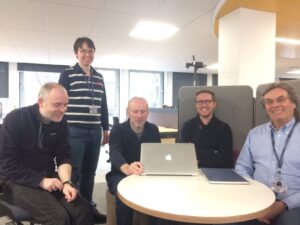
DataVault sprint meeting before launch

Immutable

DataVault is designed for long-term retention of research data, to meet funder requirements and ensure future access to high value datasets. It meets digital preservation requirements by storing three copies in different locations (two on tape, one in the cloud) with integrity checking built-in, so that the data owner can retrieve their data with confidence until the end of the retention period (typically ten years).

Secure

The DataVault interface helps to guide users in how to deposit personal and sensitive data, using anonymisation or pseudonymisation techniques whenever possible, as prescribed by the University’s Data Protection Officer (DPO). Because all data are encrypted before deposit, they are protected from unauthorised disclosure. Only the data owner or their nominated delegate is allowed to retrieve data during the retention period. Any decisions about allowing access to others are made by the data owner and are conducted outside the DataVault system, once they have been retrieved onto a private area on DataStore and decrypted.

Discoverable

Although DataVault offers a form of closed archive, the design encourages good research data management practice by requiring a metadata record for each vault in Pure. These records are discoverable on the Web, and linked to the respective data creators, projects and publications.

In exchange for creating this high level public metadata record, the Principal Investigator benefits from the assignment of a unique digital object identifier (DOI) which can be used to cite the data in publications.

The open nature of the metadata means that any reader may make a request to access the dataset. The data owner decides who may have access and under what conditions. Advice can be provided by the Research Data Support team and the DPO.

University data assets

DataVault’s workflow takes into account the possibility/likelihood that the original data owner will have left the university when the period of retention comes to an end. Each vault will be reviewed by representatives of the university in schools, colleges or the Library, acting as the data owner, to make decisions on disposal or further retention and curation. If kept, the vault contents become university data assets.

Plan ahead for data archiving

The Research Data Support team encourages researchers to plan ahead for data archiving, right from the earliest conception stages of the project, so that appropriate costs are included in bids, and enabling the appropriate steps to be carried out to prepare data for either open or closed long-term archiving.

The team can be contacted through the IS Helpline and offers assistance with writing data management plans and making archival decisions. See our service website and contact information at https://www.ed.ac.uk/is/research-data-service or go straight to the DataVault page to learn more about it, get instructions for use, or look up charges. An introductory demo video is available  at  https://media.ed.ac.uk/media/Getting+started+with+the+DataVault/1_h4r4glf7 .

Robin Rice
Data Librarian and Head, Research Data Support
Library & University Collections

Research Data Management Training for University of Edinburgh staff and students, Spring 2019

Following on from our blog post on the benefits of RDM training which was posted on the 15th of November, we have scheduled our in-person training courses for the Spring 2019 semester. A description of each course and its intended audience can be found on our Training and support resources webpage, alongside details of online training offerings. Courses can usually be booked through MyEd Event Booking approximately four weeks beforehand.

Course Dates & Times Location
Creating a Data Management Plan 16/01/2019@10:30-12:30 Seminar Room 3, Chancellor’s Building (Little France) Map
28/02/2019@14:00-16:00 Murchison House, Room G.12 (Kings Buildings) Map
27/03/2019@14:00-16:00 Appleton Tower, Room 2.07 (Central Area) Map
Working with Personal and Sensitive Data 13/02/2019@14:00-16:00 Seminar Room 3, Chancellor’s Building (Little France) Map
21/03/2019@10:00-12:00 G.69 Joseph Black Building (Kings Buildings) Map
01/05/2019@14:00-16:00 High School Yards, Classroom 4 (Central Area) Map
Good Practice in Research Data Management 24/01/2019@13:30-16:30 Murchison House, Room G.12 (Kings Buildings) Map
22/02/2019@ TBC TBC
05/03/2019@13:30-16:30 EW11, Argyle House, 3 Lady Lawson Street (Central Area) Map
05/04/2019@09:30-12:30 Seminar Room 6, Chancellor’s Building (Little France) Map
Managing Your Research Data 17/01/2019@10:00-12:00 Room B.09, Institute for Academic Development, 1 Morgan Lane, (Holyrood) Map
05/02/2019@10:00-12:00 Lister Learning and Teaching Centre – Room 1.3 (Central Area) Map
15/03/2019@10:00-12:00 Seminar Room 5, Chancellor’s Building (Little France) Map
12/04/2019@10:00-12:00 Room B.09, Institute for Academic Development, 1 Morgan Lane, (Holyrood) Map
25/04/2019@14:00-16:00 G.69 Joseph Black Building (Kings Buildings) Map
18/06/2019@10:00-12:00 Room B.09, Institute for Academic Development, 1 Morgan Lane, (Holyrood) Map
Handling Data Using SPSS 12/02/2019@13:30-16:30 Room 1.08, First Floor, Main Library, George Square (Central Area) Map
02/04/2019@13:30-16:30 EW10, Argyle House, 3 Lady Lawson Street (Central Area) Map
Data cleaning with OpenRefine 07/02/2019@13:30-16:30 Lister Learning and Teaching Centre ,2.14 – Teaching Studio, (Central Area) Map

Kerry Miller
Research Data Support Officer
Research Data Service
Library and University Collections