The annual Dealing With Data conference has become a staple of the University’s data-interest calendar. In this post, Martin Donnelly of the Research Data Service gives his reflections on this year’s event, which was held in the Playfair Library last week.
One of the main goals of open data and Open Science is that of reproducibility, and our excellent keynote speaker, Dr Emily Sena, highlighted the problem of translating research findings into real-world clinical interventions which can be relied upon to actually help humans. Other challenges were echoed by other participants over the course of the day, including the relative scarcity of negative results being reported. This is an effect of policy, and of well-established and probably outdated reward/recognition structures. Emily also gave us a useful slide on obstacles, which I will certainly want to revisit: examples cited included a lack of rigour in grant awards, and a lack of incentives for doing anything different to the status quo. Indeed Emily described some of what she called the “perverse incentives” associated with scholarship, such as publication, funding and promotion, which can draw researchers’ attention away from the quality of their work and its benefits to society.
However, Emily reminded us that the power to effect change does not just lie in the hands of the funders, governments, and at the highest levels. The journal of which she is Editor-in-Chief (BMJ Open Science) has a policy commitment to publish sound science regardless of positive or negative results, and we all have a part to play in seeking to counter this bias.
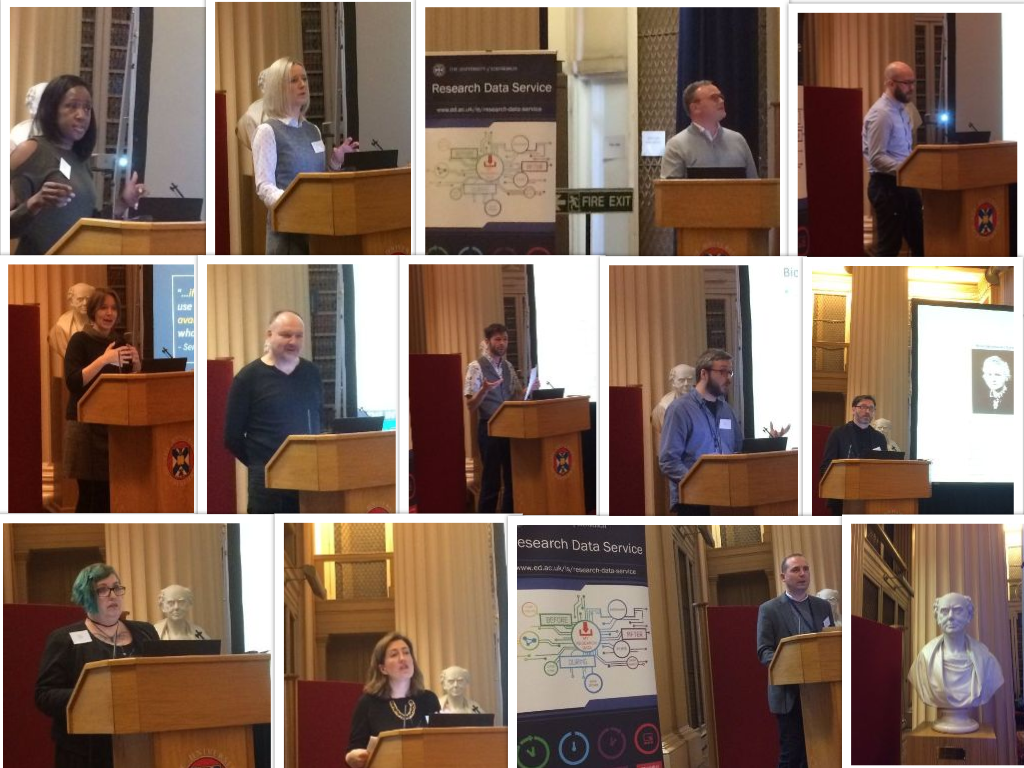
A collage of the event speakers, courtesy Robin Rice (CC-BY)
In terms of other challenges, Catriona Keerie talked about the problem of transferring/processing inconsistent file formats between heath boards, causing me to wonder if it was a question of open vs closed formats, and how could such a situation might have been averted, e.g. via planning, training (and awareness raising, as Roxanne Guildford noted), adherence to the 5-star Open Data scheme (where the third star is awarded for using open formats), or something else? Emily earlier noted a confusion about which tools are useful – and this is a role for those of us who provide tools, and for people like myself and my colleague Digital Research Services Lead Facilitator Lisa Otty who seek to match researchers with the best tools for their needs. Catriona also reminded us that data workflow and governance were iterative processes: we should always be fine-tuning these, and responding to new and changing needs.
Another theme of the first morning session was the question of achieving balances and trade-offs in protecting data and keeping it useful. And a question from the floor noted the importance of recording and justifying how these balance decisions are made etc. David Perry and Chris Tuck both highlighted the need to strike a balance, for example, between usability/convenience and data security. Chris spoke about dual testing of data: is it anonymous? / is it useful? In many cases, ideally it will be both, but being both may not always be possible.
This theme of data privacy balanced against openness was taken up in Simon Chapple’s presentation on the Internet of Things. I particularly liked the section on office temperature profiles, which was very relevant to those of us who spend a lot of time in Argyle House where – as in the Playfair Library – ambient conditions can leave something to be desired. I think Simon’s slides used the phrase “Unusual extremes of temperatures in micro-locations.” Many of us know from bitter experience what he meant!
There is of course a spectrum of openness, just as there are grades of abstraction from the thing we are observing or measuring and the data that represents it. Bert Remijsen’s demonstration showed that access to sound recordings, which compared with transcription and phonetic renderings are much closer to the data source (what Kant would call the thing-in-itself (das Ding an sich) as opposed to the phenomenon, the thing as it appears to an observer) is hugely beneficial to linguistic scholarship. Reducing such layers of separation or removal is both a subsidiary benefit of, and a rationale for, openness.
What it boils down to is the old storytelling adage: “Don’t tell, show.” And as Ros Attenborough pointed out, openness in science isn’t new – it’s just a new term, and a formalisation of something intrinsic to Science: transparency, reproducibility, and scepticism. By providing access to our workings and the evidence behind publications, and by joining these things up – as Ewan McAndrew described, linked data is key (this the fifth star in the aforementioned 5-star Open Data scheme.) Open Science, and all its various constituent parts, support this goal, which is after all one of the goals of research and of scholarship. The presentations showed that openness is good for Science; our shared challenge now is to make it good for scientists and other kinds of researchers. Because, as Peter Bankhead says, Open Source can be transformative – Open Data and Open Science can be transformative. I fear that we don’t emphasise these opportunities enough, and we should seek to provide compelling evidence for them via real-world examples. Opportunities like the annual Dealing With Data event make a very welcome contribution in this regard.
PDFs of the presentations are now available in the Edinburgh Research Archive (ERA). Videos from the day are published on MediaHopper.
Other resources
—
Martin Donnelly
Research Data Support Manager
Library and University Collections
University of Edinburgh