
Research Data Service achieves ISO 27001 accreditation for Data Safe Haven facility

Following a five day on-site audit by Lloyd’s Register, the Information Security Management System (ISMS) which forms the basis for the Data Safe Haven facility for University of Edinburgh researchers has been officially certified to the ISO/IEC 27001:2013 standard. In a few weeks we will receive a certificate from UKAS (United Kingdom Accreditation Service).

The Data Safe Haven (DSH) team, comprised of members of Research Data Support in L&UC and Research Services in ITI, and with input from the Information Security team and external consultants, has been working toward certification since 2016. The system, designed by ITI’s Stephen Giles, has been extensively and successfully ‘white box penetration tested’ by external experts, one of the many forms of proof provided to the auditor. (White box means the testers were given access to certain layers of the system, as opposed to a black box test where they are not.)
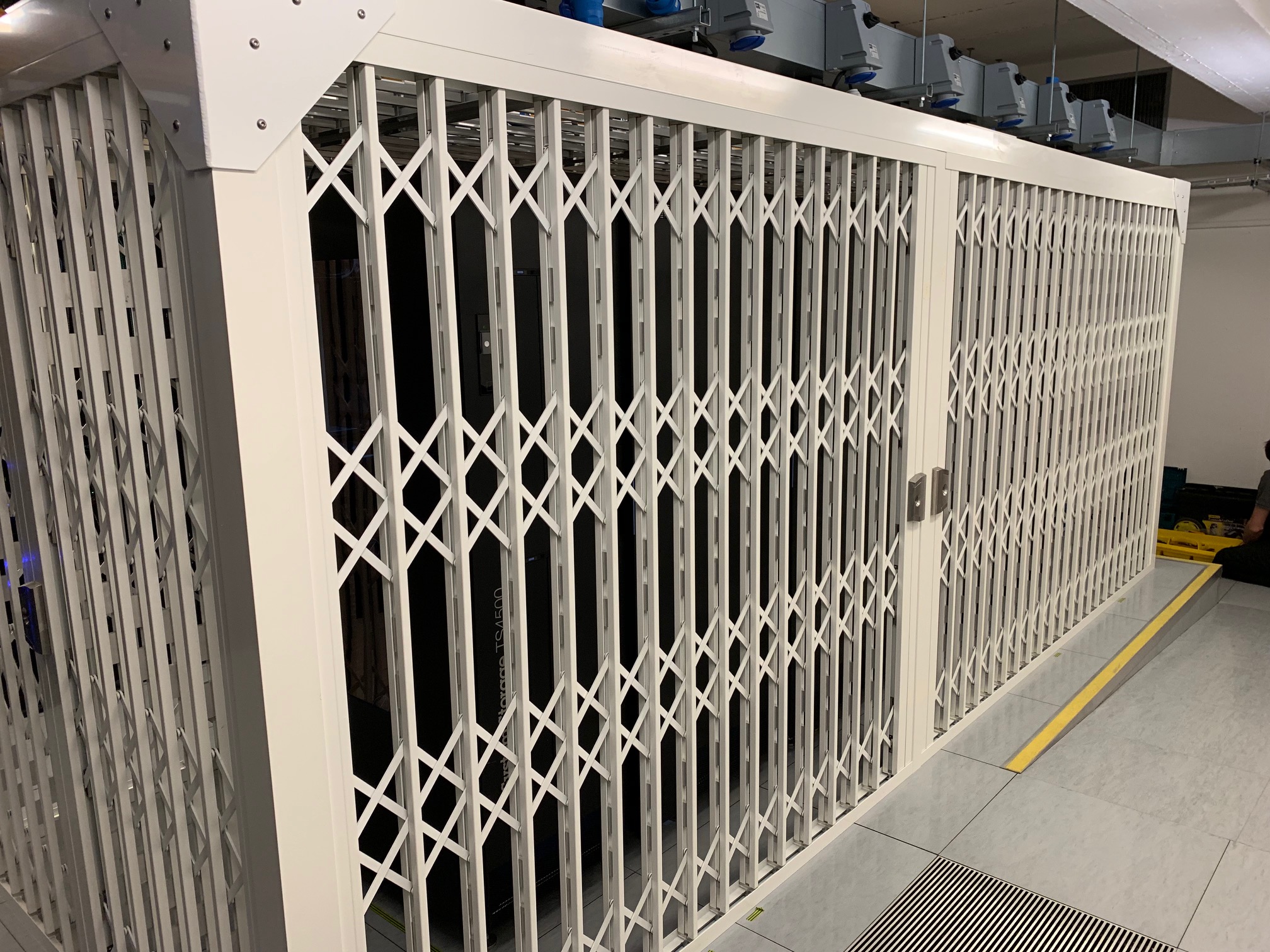
The steel cage surrounding Data Safe Haven equipment in one of the University data centres.

In addition to infrastructure, a proper ISMS is made up of people who perform roles and manage procedures, based on organisational policies. The Research Data Support team work with research project staff to ensure their practices comply with our standard operating procedures. The ISMS is made up of all the controls needed to ensure that it is sensibly protecting the confidentiality, availability, and integrity of assets from threats and vulnerabilities. Over 150 managed and versioned documents covering every aspect of the ISMS were written, discussed, practiced, reviewed and signed off before being examined and questioned by the auditor.

The auditor stated in the final report, “The objectives of the assessment were achieved and with consideration to any noted issues or raised findings, the sampled areas of the management system demonstrated a good level of conformance and effectiveness. The management system remains supportive of the organisation and its business and service management objectives.” On a slightly more upbeat note, Gavin Mclachlan, Vice-Principal and Chief Information Officer, and Librarian to the University said by email, “Congratulations to you and the whole team on the ISO 27001 certification. That is a great achievement.”

The Digital Research Services programme has invested in the Data Safe Haven to allow University researchers to conduct cutting edge research, access sensitive data from external providers and facilitate new research partnerships and innovation. Researchers are expected to include Data Safe Haven costs in funded grant proposals to achieve some cost recovery for the University. To find out if your project is a candidate for use of the Data Safe Haven contact data-support@ed.ac.uk or the IS Helpline.

Robin Rice
Data Librarian and Head, Research Data Support
L&UC

Collaborating on data in a modern way

Between mid-September and mid-October, the Research Data Support team hosted an international visitor. Dr Tamar Israeli, a librarian from Western Galilee College in Israel, spent four weeks in Edinburgh to increase her experience and understanding around research data management. As part of this visit, Tamar conducted a study into our researchers’ collaborative requirements, and how well our existing tools and services meet their needs. Tamar’s PhD thesis was on the topic of file sharing, and she has recently published another study on information loss in Behaviour & Information Technology: “Losing information is like losing an arm: employee reactions to data loss” (2019). Tamar is also a representative of the Israeli colleges on the University Libraries’ Research Support Committee.

Tamar carried out a small-scale study in order to gain a better understanding of the tools that researchers use to collaborate around data, and to explore the barriers and difficulties that prevent researchers from using institutional tools and services. Six semi-structured interviews were conducted with researchers from the University of Edinburgh, representing different schools, and all of whom collaborate with other researchers on a regular basis on either small- or large-scale projects. She found that participants use many different tools, both institutional and commercial, to collaborate, share, analyse and transfer documents and data files. Decisions about which tools to use are based on data types, data size, usability, network effect and whether their collaborators are in the same institution and country. Researchers tend to use institutional tools only if they are very simple and user friendly, if there is a special requirement for this from funders or principal investigators (PIs), or if it is directly beneficial for them from a data analysis perspective; sharing beyond the immediate collaboration is only a secondary concern. Researchers are generally well aware of the need to keep their data where it will be safe and backed-up, and are not concerned about the risk of data loss. A major issue was the need for tools that answer projects’ particular needs, therefore customisability and scope for interlinking with other systems is very important.

We’d like to thank Tamar for the great work she did, and for the beautiful olive oil and pistachios that she brought with her! Tamar’s findings will key into our ongoing plans for the next phase of the Research Data Service’s continual development, helping us assist researchers to share and work on their data collaboratively, within and beyond the University’s walls.

—

Martin Donnelly
Research Data Support Manager
Library and University Collections