
Edinburgh Open Research Conference 2024

This is a guest blog post from Emma Wilson, Emma is a final year PhD student in the Centre for Clinical Brain Sciences. She is currently interning with the Library Open Research Team.

On 29th May 2024, we held the third annual Edinburgh Open Research Conference online and in person at the John McIntyre Conference Centre. Over 300 people attended the hybrid event, from Edinburgh and further afield, to listen to a jam-packed programme of talks and posters on all things open research.

This year’s theme was culture change, and thinking about how open research principles can steer us towards healthy and inclusive research environments.
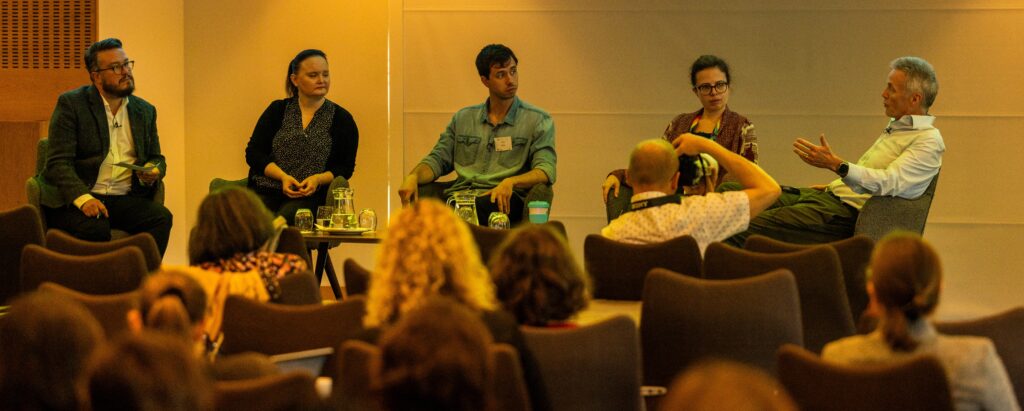
Panel host Dominic and panel speakers Rowena, Nick, Katie, and Malcolm sit on a stage in front of the conference audience

Plenary panel – photo credit: Eugen Stoica

The events kicked off with a plenary panel featuring Nick Wise (University of Cambridge), Rowena Lamb, Malcolm Macleod, and Katie Nicoll Baines (all University of Edinburgh) discussing the ways in which we can drive healthy and sustainable culture change and how this applies in the context of open research.

Marisa de Andrade delivering her keynote

Marisa de Andrade delivering her keynote – photo credit: Eugen Stoica

Presentations and lightning talks touched on the topics of education and skills, research culture change, and next generation metrics. We heard from a diverse range of perspectives including technicians, researchers in both STEM and the humanities, and professional services staff. Equality, diversity, and inclusion (EDI) was a strong theme running throughout each of the presentations.

The keynote lecture was delivered by Marisa de Andrade on ‘The Madness of Metrics and Possibilities of Pause in Open Research’, which offered perspective on research metrics, what they really mean, and what really matters.
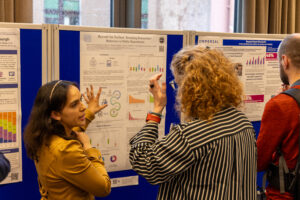
Maria Juliana Rodriguez Cubillos presenting her poster during the drinks reception

Poster session – Photo credit: Eugen Stoica

Following a busy day, the conference closed with a drinks reception and posters. Each presenter gave a quick-fire summary of their poster in a round of ‘Minute Madness’.

We want to thank everyone who attended the conference, our fantastic presenters, and of course our organisers Kerry Miller and Nel Coleman for making the day enjoyable and insightful. And if you missed it, be sure to come along next year!

Stay up to date on open research activities and future conference announcements by signing up to the Edinburgh Open Research Newsletter and joining our Edinburgh Open Research Initiative Microsoft Teams group.
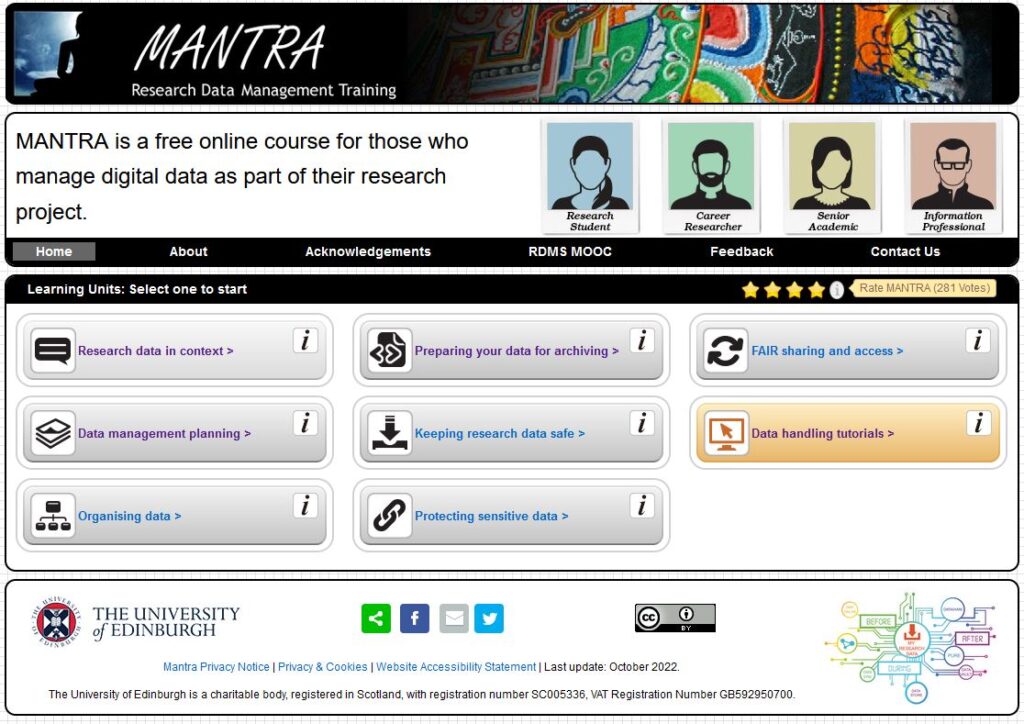
Commissioning data handling modules for MANTRA

We are seeking to commission new software-specific data handling modules in the Research Data MANTRA training resource (https://mantra.ed.ac.uk/), as the ones there have become outdated (https://mantra.ed.ac.uk/softwarepracticals.html). The online modules have been refreshed more regularly by the Research Data Support team. There will be a short turnaround for the commissioned works, which will be incorporated into MANTRA and the Research Data Service.

There is £2,000 available per module for new modules to be authored by end of July, 2024.

Screenshot of the MANTRA resource

What are the software modules in DataShare?

As an extension to the overall MANTRA resource which covers good practice in research data management, each software module contains a one to one a half hour practical to work through which will teach skills needed to handle data properly within the software environment. It is not intended to be an introduction to the software, and a certain level of proficiency with the software may be assumed (any prerequisite knowledge should be stated).

Each module contains:

  • a PDF document stepping through the practical so the learner can work at their own pace;
  • and a publicly available dataset that can be used within the practical, such as a UK government dataset or an open access dataset from a repository. The dataset can be based in any discipline but should not require discipline-specific skills to understand and use.

Currently, we have a module for SPSS, R, ArcGIS and Nvivo.

How do I submit my proposal to author a software module?

We are interested in proposals for authoring accessible data handling tutorials in specific modern software environments, including potentially SPSS, R, Python, QGIS, and Nvivo.

To be considered for this commissioned work, please send a one to two page outline of what the practical will entail in a PDF document to R.Rice@ed.ac.uk by end of Friday 28th June, 2024. Interested parties are welcome to get in touch before the outline is complete, stating their intention. The outline must include the author’s name, email address, and postal address, with or without telephone number. The outline may also contain:

  • prerequisite knowledge that the learner is assumed to have in order to complete the module successfully, such as familiarity with a particular type of software or experience of coding;
  • specific learning objectives of what the learner will gain by working their way through the module;
  • headings indicating sections of the tutorial;
  • descriptions of what will be covered beneath each heading and what the learner is expected to do, using the software of interest;
  • a citation of the dataset to be used with the practical, including the name and location.

The commissioning process

The Research Data Support team will evaluate the proposals and select the authors to proceed with the commissioned works. Notification will be by email. Authors will be expected to comply with the University of Edinburgh’s terms and conditions for suppliers, which includes transfer of any IPR to the University. Upon evaluating the material, we may choose to make edits for purposes of clarity or accessibility. Current members of staff of the University may need to receive payment through their associated unit (to be determined).

All materials for the full software modules must be passed to the University by Friday 26th July. Progress before that date will be assessed through email correspondence. An invoice for work completed must be submitted after the team confirms the content is complete and to specification before 31 July in order to be paid in full.

Robin Rice
Data Librarian and Head of Research Data Support
Library and University Collections