By Abigail Hartley, Appraisal Archivist and Archive Collections Manager
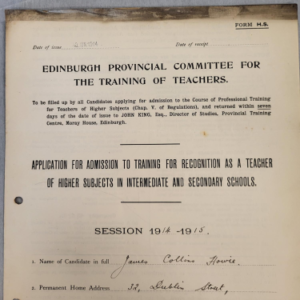
The strip along the top of the page showing years of soot and dirt collecting on the pages
Moray House School of Education has a long and often complicated history. Formed in 1907 as part of a merger between the Church of Scotland Training College and the Free Church of Scotland’s Normal and Sessional School, creating the Edinburgh Provincial Training Centre. They later changed their name to some variant of Moray House College/Institute/School of Education throughout the 20th and 21st Centuries and absorbed Dunfermline College of Physical Education and Callendar Park College of Education along the way. It is this history, with the school’s connections to both Heriot Watt and now the University of Edinburgh, that has led to a large and interconnected series of records that now reside at Heritage Collections.
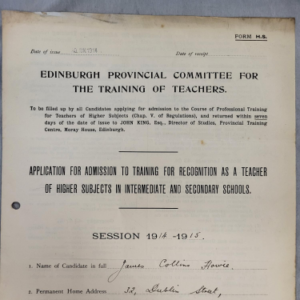
Whereas after cleaning, whilst no perfect, shows a marked improvement
Documenting the early and modern history of the training of educators, the collection demonstrates not just the changing standards of education, but also those who became teachers themselves. It features the growing presence of women, students of the British Empire then Commonwealth, introductions of new technologies and new approaches to teaching, childcare and early learning.
It is also – at times – quite dirty.