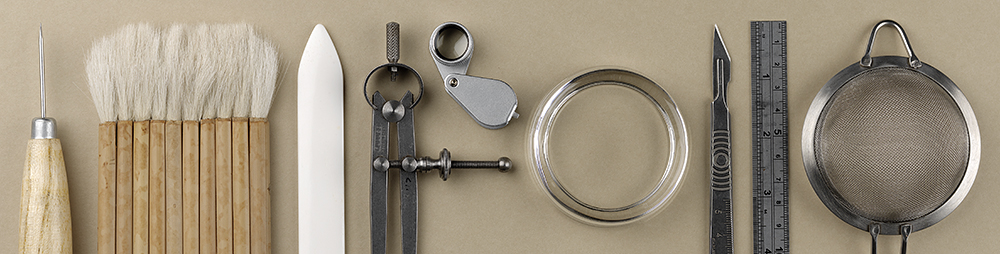
By Abigail Hartley, Appraisal Archivist and Archive Collections Manager
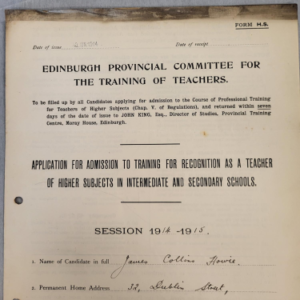
The strip along the top of the page showing years of soot and dirt collecting on the pages
Moray House School of Education has a long and often complicated history. Formed in 1907 as part of a merger between the Church of Scotland Training College and the Free Church of Scotland’s Normal and Sessional School, creating the Edinburgh Provincial Training Centre. They later changed their name to some variant of Moray House College/Institute/School of Education throughout the 20th and 21st Centuries and absorbed Dunfermline College of Physical Education and Callendar Park College of Education along the way. It is this history, with the school’s connections to both Heriot Watt and now the University of Edinburgh, that has led to a large and interconnected series of records that now reside at Heritage Collections.
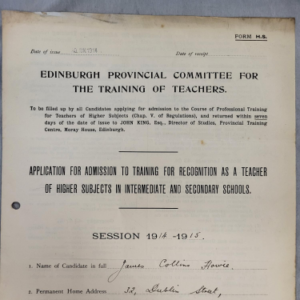
Whereas after cleaning, whilst no perfect, shows a marked improvement
Documenting the early and modern history of the training of educators, the collection demonstrates not just the changing standards of education, but also those who became teachers themselves. It features the growing presence of women, students of the British Empire then Commonwealth, introductions of new technologies and new approaches to teaching, childcare and early learning.
It is also – at times – quite dirty.
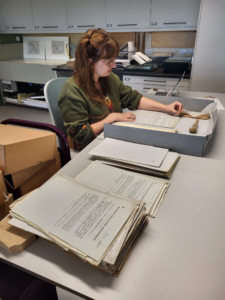
The set up of a smoke sponge cleaning day
As appraisal archivist, I am often reviewing collections which have remained unprocessed for some time. When it came to these forms, submitted to the Scottish Education Department in the early part of the 20th century, it was quickly clear that they were covered in soot and general dirt. Likely, they were held in a room where smoking and fires were common place.
The forms themselves note when they received their degrees or act as applications to allow them to formally pursue teaching. They include descriptions of any events that may have held up the student from graduating that year. For the years I was working on, the most common cause for a break in studying was conscription during the First and Second World Wars.
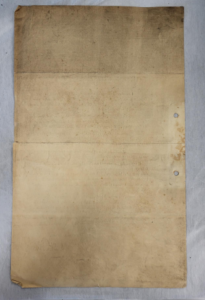
Again, the before of a dirty page
Smoke sponges are one of the most used items in a conservator and archivists kit – they are excellent at picking up dirt and dust without damaging the paper. To do this, we set up layers of card and tissue to help prevent potentially snagging or sliding issues, and as a way to collect the little bits of dirt. Using a smoke sponge requires small strokes, always going towards the edge of the page and not inwards. You should also resist the urge to scrub! Again, this is to prevent pages snagging and creasing or tearing.
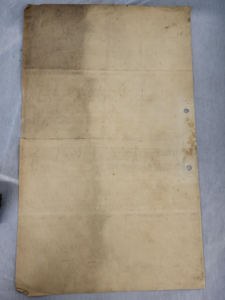
And a work in progress! Such a sharp line is infinitely satisfying…
It is early days yet for the processing of Moray House’s archives, but cleaning these forms is a crucial step. Easier handling without dirtying your hands and the surface they rest on means easier identification of their contents and any more intense conservation needs which expert hands.