This week’s post comes from Works on Paper Conservator, Emily Hick, who is currently working to conserve a collection of palm leaf manuscripts…
When you imagine the archives held at the Centre for Research Collections, you might think about parchment, paper, or illuminated books from the Western world. However, we also have approximately 180 manuscripts originating from across South and Southeast Asia which are written in a variety of scripts, including Thai, Burmese, Tamil, and Tibetan. These are mostly palm leaf manuscripts, however there are also examples written on paper, textile, and even metal.
Palm leaf manuscripts have been used for centuries in regions such as India, Sri Lanka, Nepal, and Indonesia. They are made from the leaves of specific palm trees, most commonly the Palmyra and Talipot palms. Far from being simple plant material, these leaves are carefully processed to create durable writing surfaces.
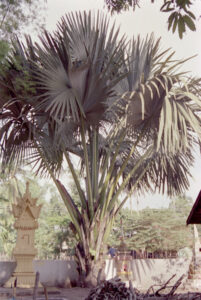
A Palm Leaf Tree © PLMP, National Library of Laos
The process begins with harvesting mature, unblemished leaves. These are then boiled or soaked, sometimes with herbs and spices, and dried in the sun to strengthen the fibres and deter insects. Once dried, the leaves are cut into long, narrow strips and polished smooth using shells or stones.
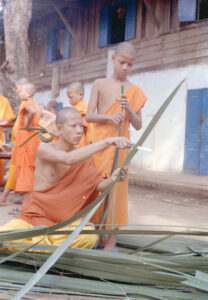
Cutting Palm Leaves © PLMP, National Library of Laos
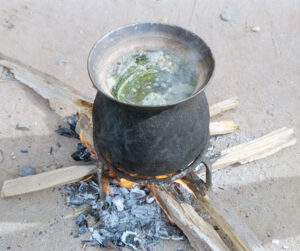
Boiling the leaves © PLMP, National Library of Laos
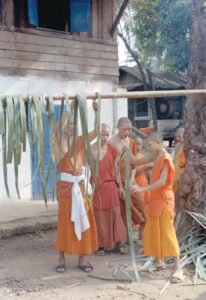
Drying the leaves © PLMP, National Library of Laos
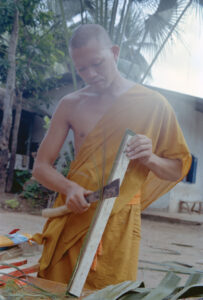
Cutting the leaves into final shape © PLMP, National Library of Laos
Instead of ink, scribes use a sharp stylus to etch letters into the surface. A dark pigment, often a mixture of soot and oil, is then rubbed over the leaf, settling into the grooves to make the writing visible. Finally, the leaves are stacked, holes punched through them, and then bundle is tied together with a cord, and protected by wooden covers.
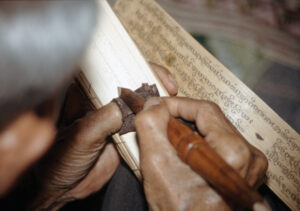
Using a stylus to inscribe the script © PLMP, National Library of Laos
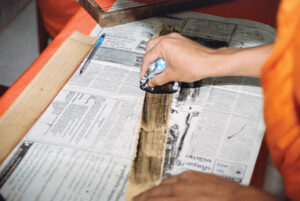
Applying ink to the leaves © PLMP, National Library of Laos
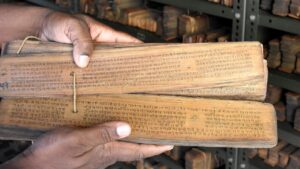
Binding the leaves © PLMP, National Library of Laos
These manuscripts are used to record a broad range of subjects: religious texts, literature, music, medicine, mathematics, and even astrology.
A survey of the material that I carried out in 2020 revealed that the collection was in poor condition. Many of the manuscripts were covered in layers of surface dirt, and around half showed signs of splitting or tearing. This is a common problem for palm leaves, which tend to crack along their natural grain.
Storage conditions were also a concern. Larger manuscripts were wrapped in tissue and placed in heavy boxes that were difficult to handle safely, while smaller items often lacked adequate internal protection.
Work on the collection began in Autumn 2025, starting with research into best practices. Guidance from recent studies, alongside conversations with subject specialists, helped shape a treatment plan that respected both the physical and cultural aspects of the manuscripts.
One important consideration was whether to remove the cords binding the leaves together. While this step can reduce stress on the material and allow better access for treatment, it was essential to ensure it didn’t conflict with any spiritual or cultural meanings. Consultation with experts working at the University of Edinburgh confirmed that removing the cords was appropriate and even reflected a meaningful concept in Tibetan culture associated with gaining knowledge.
The first stage of the practical work involved surface cleaning. I was surprised to find that even within a single box, the types of dirt varied widely, from sticky, soot-like deposits to sandy, orange residues. Samples have been kept for future analysis, as they may offer clues about the manuscripts’ origins.
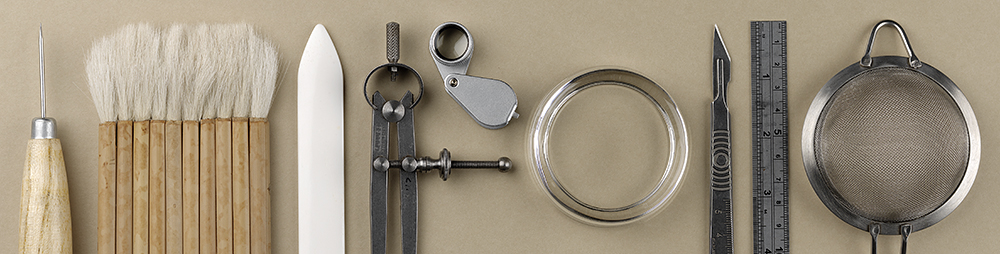
Cleaning is a slow and careful process. Soft brushes are first used to remove loose dirt, followed by smoke sponge to remove ingrained dirt. In some cases, lightly dampened cotton swabs are used to lift ingrained grime. The results can be striking, revealing details of the script that were previously obscured.
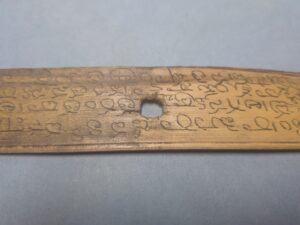
A palm leaf mid-way through surface cleaning
One unexpected challenge for me is not being able to read the text. Without understanding the scripts, it can be difficult to determine the correct orientation and order of the leaves. To avoid mistakes, I have to rely on small visual clues and sometimes photographs to ensure everything is returned exactly as it was.
To stabilise tears and splits, I have used a lightweight Japanese paper adhered with wheat starch paste. This method provides support without adding bulk or stress to the leaves. Importantly, only plant-based adhesives are used, avoiding animal-derived materials out of respect for the religious nature of some texts.
After cleaning and repair, the next step is rehousing. The goal is to make storage both safer and more practical. Smaller manuscripts will be placed between rigid boards and wrapped in Tyvek before being stored together in boxes. Larger items will be housed individually in custom-made enclosures, making them easier to handle and better protected from damage.
This project is time-consuming, but necessary to ensure that these important collections can be easily and safely accessed. I am very grateful to have the assistance of our Collection Care Assistants, Ciara Weber, Ivy Allen, Mieke Shaw and Digitisation Operator, Gaby Cortes on this project.