Cleaning Dirty Pages – The Power of the Smoke Sponge

By Abigail Hartley, Appraisal Archivist and Archive Collections Manager
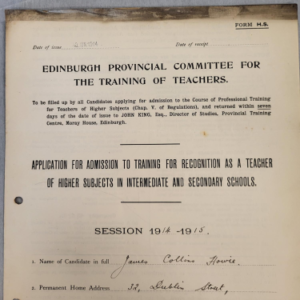
Photograph of discoloured paper form for the Edinburgh Provincial Committee for the Training of Teachers from 1915. The top border is nearly black with soot.

The strip along the top of the page showing years of soot and dirt collecting on the pages

Moray House School of Education has a long and often complicated history. Formed in 1907 as part of a merger between the Church of Scotland Training College and the Free Church of Scotland’s Normal and Sessional School, creating the Edinburgh Provincial Training Centre. They later changed their name to some variant of Moray House College/Institute/School of Education throughout the 20th and 21st Centuries and absorbed Dunfermline College of Physical Education and Callendar Park College of Education along the way. It is this history, with the school’s connections to both Heriot Watt and now the University of Edinburgh, that has led to a large and interconnected series of records that now reside at Heritage Collections.
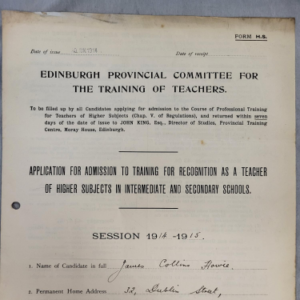
Photograph of discoloured paper form for the Edinburgh Provincial Committee for the Training of Teachers from 1915. The top border is now clean showing a clear of the cleaning process.

Whereas after cleaning, whilst no perfect, shows a marked improvement

Documenting the early and modern history of the training of educators, the collection demonstrates not just the changing standards of education, but also those who became teachers themselves. It features the growing presence of women, students of the British Empire then Commonwealth, introductions of new technologies and new approaches to teaching, childcare and early learning.

It is also – at times – quite dirty.
 

Continue reading

Documentation Challenges in Practice: Art Collection Barcoding Project

In this week’s blog, our Art Collection Documentation Assistant Gaby Cortes discusses some of the challenges involved in auditing the Art Collection and how the addition of barcode labels is helping to tackle this.

Continue reading

An Explorer’s Legacy: The Journey of the John Rae Collection

As part of ongoing work on the University’s historic loans, Collections Registrar, Morven Rodger, investigates the history and provenance of the University’s John Rae collection.

In July 1926, the University Court agreed to lend the “John Rae Collection of Arctic and Other Relics” to the Royal Museum of Scotland. Almost a century later, The Royal Museum is now the National Museum of Scotland, and John Rae’s items remain on loan, but how and why did the University come to have these items in the first place?

Continue reading

Art Collection Audit Spotlight: Edinburgh College of Art Works on Paper

In this week’s blog our Art Collection Documentation Assistant Gaby Cortes discusses the work she has been undertaking for the first phase of a campus-wide audit of the Art Collection, highlighting our student artworks on paper from the Edinburgh College of Art.

Continue reading

It’s audit time!

Anyone who has attended a meeting, had a conversation in the corridor, or bumped into me in one of our stores, knows that one of my main talking points for at least the past 5 years has been my ambition to undertake a campus-wide audit of the Art Collection. Obviously, there have been a few major world events that have hindered this, but it’s finally happening!

With over 8000 works in the collection, and at least 31% of them on display around campus (1845 works over 415 separate locations!), it’s not a straightforward job. We will have to gain access to office spaces, lecture halls, corridors, and seminar rooms, as well as taking a deep dive into the artworks held in storage.

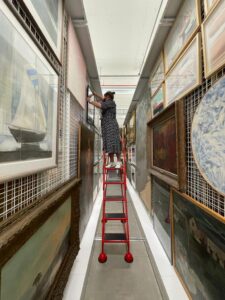
Woman at the top of a red ladder placing a framed artwork on picture racking

Anna checking artworks in store

As usual, we rely on a spreadsheet to keep us in check. Although the most important detail is updating the location, we are also looking at the condition of the artworks, whether they need to be photographed, and what fixings are installed on the back. All of this will make it easier for us to provide access (online, for exhibition, teaching, or loan) or identify artworks that need further work to make them available. This information will be uploaded to our Collections Management Database (Vernon CMS) to enable greater location control and improve overall information on each of the artworks.

Lots of framed artworks of different sizes hanging on art racking

Artworks in store

The audit has begun in earnest, with 2313 works in storage listed and locations updated as of the beginning of this month. Alongside this work, our Documentation Assistant Gaby is also running trials on the use of barcodes on artworks for location control, which I’m sure you’ll be able to read about in a future blog post! We’ll be out and about on campus for the next year, so please say hello if you spot us.

Anna Hawkins
Museum Collections Manager

The Art of Asking: Requesting Loans for Exhibition

By Morven Rodger, Collections Registrar, Heritage Collections

As the Collections Registrar, one of my core responsibilities is coordinating loans from the University’s Heritage Collections to external exhibitions. Whenever an item from our collections is requested by another institution, I work with our conservators, curators, and technicians, while liaising with the borrowing institution, to manage the risks and help make the process as smooth as possible.

I am always excited by new loan requests, and the prospect of sharing our collections with broader audiences, but no loan is without risk, and lenders must balance the risks and benefits to justify their decision to lend. The loan request is a borrower’s opportunity to make their case, explain why they want to borrow, show that they understand the practicalities, and demonstrate the value our items will add to their exhibition.

Continue reading

CRC: A Space Odyssey – Day in the Life of a Collections Management Technician 

My name is Jasmine, and I’ve been working here at the University for five and a bit months as the Collections Management Technician. I’m the other half to Robyn Rogers’ role as Collections Care Technician, whose fantastic blog post about her recent work you can read here, and I work directly with the Appraisal Archivist and Archives Collection Manager, Abigail Hartley, whose equally wonderful blog post was featured last month.  

Abigail did a great job of defining appraisal and the challenges to the archivist when it comes to choosing what material to preserve. The archivist is often put in the position of assessing the ‘value’ of the record, a thorny process which comes with a number of ethical challenges. Thinking through these problems, it might seem easier to suggest that we simply keep everything we receive. If we get to keep everything, we don’t have to think through complicated questions, like what is the purpose of the record? And what is the purpose of the archivist? After all, if something has found its way into the archive, isn’t that an implicit statement of its value? Why appraise at all? 

Continue reading