
First data curation profile created at Edinburgh

Following our involvement in the pilot presentation of the “RDM Training for Liaison Librarians” course, and taking inspiration from the existing model at Purdue University in the U.S., three liaison colleagues (Marshall Dozier, Angela Nicholson, Nahad Gilbert) and I took up the challenge to create some data curation profiles here at Edinburgh.  As at Purdue, it is intended that the creation of such research profiles here will enable us to gain insight into aspects of data management and assist in the assessment of information needs across the disciplines.

To this end I contacted Dr Bert Remijsen, a researcher in linguistics in the School of Philosophy, Psychology & Language Sciences, for which I currently provide liaison support. He had recently deposited a dataset in Edinburgh DataShare and very kindly agreed to be my case study for this pilot.

Drawing on materials at Purdue and Boston Universities, Marshall, Nahad, Angela and I collaborated at some length on the creation of a manageable data curation profile questionnaire for our own use. This was then forwarded by each of us to our respective interviewees ahead of our scheduled meetings with them.

Although I had been involved with RDM issues for some time, I nevertheless approached my own interview with some trepidation. However, I need not have worried, as all went very smoothly indeed!  Sending the questionnaire ahead of our meeting ensured that Dr Remijsen had to hand all appropriate information that we might need to consult in the course of the interview.

Although I consigned each of his responses to my iPad as we worked through the questionnaire, Dr Remijsen also supplied a good deal of additional information which I captured in my recording of our meeting. The ability to listen to this a couple of times after the event greatly assisted me both in my later preparation of the final profile and my general understanding of his research and its associated dataset.

Finally, and in contrast to the apprehension that attended this pilot interview, I can honestly say that am now rather looking forward to the next one!

Anne Donnelly, Liaison Librarian, Colleges of Medicine & Veterinary Medicine AND Humanities & Social Science


We have a new MANTRA!

Normal
0

false
false
false

EN-GB
X-NONE
X-NONE

/* Style Definitions */
table.MsoNormalTable
{mso-style-name:”Table Normal”;
mso-tstyle-rowband-size:0;
mso-tstyle-colband-size:0;
mso-style-noshow:yes;
mso-style-priority:99;
mso-style-parent:””;
mso-padding-alt:0cm 5.4pt 0cm 5.4pt;
mso-para-margin-top:0cm;
mso-para-margin-right:0cm;
mso-para-margin-bottom:10.0pt;
mso-para-margin-left:0cm;
line-height:115%;
mso-pagination:widow-orphan;
font-size:11.0pt;
font-family:”Calibri”,”sans-serif”;
mso-ascii-font-family:Calibri;
mso-ascii-theme-font:minor-latin;
mso-hansi-font-family:Calibri;
mso-hansi-theme-font:minor-latin;
mso-fareast-language:EN-US;}

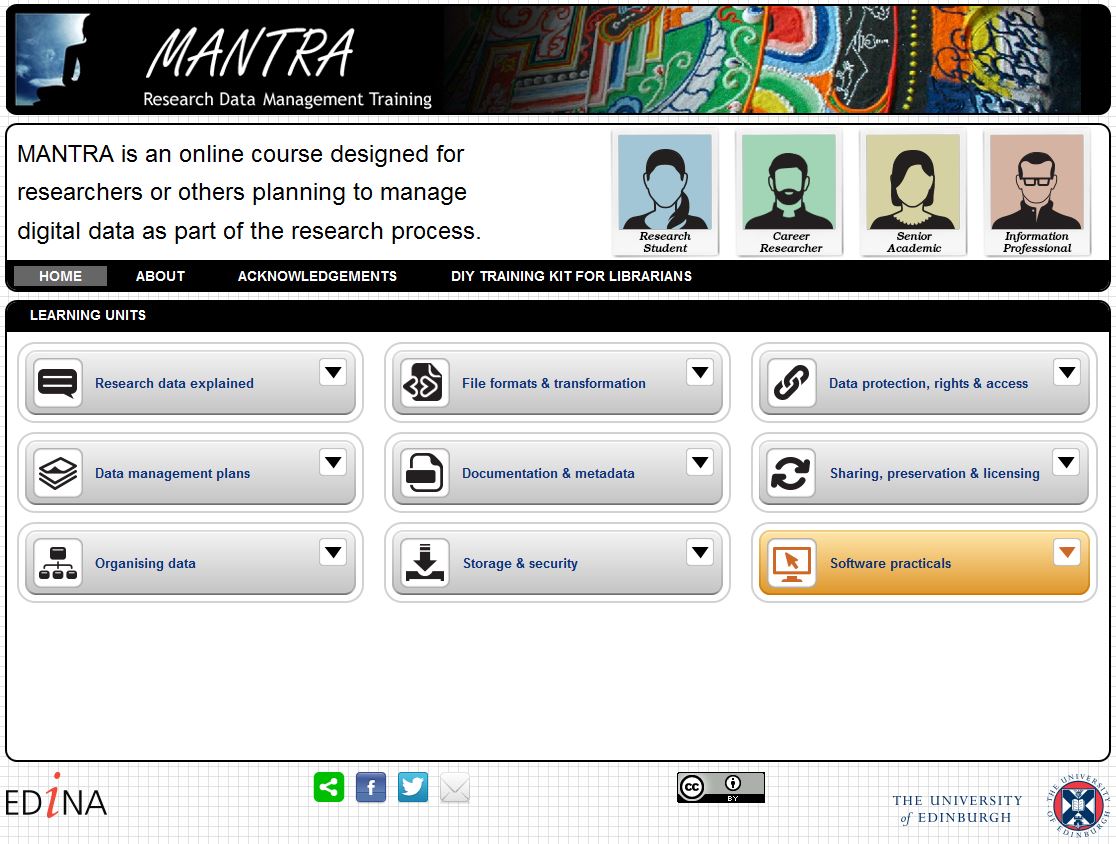
Research Data MANTRA (http://datalib.edina.ac.uk/mantra/) , the free online course hosted at Edinburgh University Data Library and designed for researchers or others planning to manage digital data as part of the research process has been refreshed!

MANTRA Homepage

Normal
0

false
false
false

EN-GB
X-NONE
X-NONE

/* Style Definitions */
table.MsoNormalTable
{mso-style-name:”Table Normal”;
mso-tstyle-rowband-size:0;
mso-tstyle-colband-size:0;
mso-style-noshow:yes;
mso-style-priority:99;
mso-style-parent:””;
mso-padding-alt:0cm 5.4pt 0cm 5.4pt;
mso-para-margin-top:0cm;
mso-para-margin-right:0cm;
mso-para-margin-bottom:10.0pt;
mso-para-margin-left:0cm;
line-height:115%;
mso-pagination:widow-orphan;
font-size:11.0pt;
font-family:”Calibri”,”sans-serif”;
mso-ascii-font-family:Calibri;
mso-ascii-theme-font:minor-latin;
mso-hansi-font-family:Calibri;
mso-hansi-theme-font:minor-latin;
mso-fareast-language:EN-US;}

Shortlisted recently as one of 15 good practice examples designed to enhance information literacy skills MANTRA has been upgraded to Version 2 of Xerte Online Toolkits, the e-learning development environment used to create the MANTRA learning materials. This allows delivery of the MANTRA units to a much wider range of devices using HTML5 rather than Flash.

The new MANTRA also highlights the utility of the learning materials for 4 discreet personas:

  • Research student
  • Career researcher
  • Senior academic
  • Information professional
3 things you might want to use MANTRA for:

We hope you enjoy the new MANTRA experience. Please get in contact with us at the Data Library with your comments or suggestions.

Stuart Macdonald
EDINA & Data Library

MANTRA shortlisted

Research Data MANTRA (http://datalib.edina.ac.uk/mantra/) is a free, non-credit course designed for postgraduate students and early career researchers which provides guidelines for good practice in research data management.

Image depicting a shortlist
(Flickr Image by Soilse – CC BY-NC-ND 2.0)

In recognition of the work done by Edinburgh University Data Library in developing this open educational resource, MANTRA has been evaluated and shortlisted in a report by the Research Information Literacy and Digital Scholarship (RILADS) project as one of 15 good practice examples designed to enhance information literacy skills of postgraduate students and early career researchers in UK Higher Education

RILADS aims to investigate and report on support available to students, staff and researchers to enhance digital literacy. There are two strands to the project. One is co-ordinated by Research Information Network (RIN) on behalf of Research Information and Digital Literacies Coalition (RIDLs), the other by SCONUL under the JISC Developing Digital Literacies (DDL) programme.

The RIN strand focuses on the identification and promotion of good practice in information handling and data management training and development across the HE and research sectors. The SCONUL strand aims to identify, harvest, and use materials to progress the development of digital professional expertise.

The full report and shortlist are available on the RILADS website: http://rilads.wordpress.com/2013/06/10/rilads-report/

MANTRA, the sole resource on the shortlist that is dedicated to research data management skills, has also been upgraded to Version 2 of the Xerte Online Toolkit, the e-learning development environment used by MANTRA to create the learning materials. This has the ability to deliver content using HTML5 rather than the Flash Player. This has a number of advantages in that you can deliver content to a much wider range of devices, and specifically you can deliver content to devices that do not support Flash.

Watch out for further MANTRA enhancements!

Stuart Macdonald
EDINA & Data Library