Completion of the Thomson-Walker Project

In this week’s blog our final Thomson-Walker Intern, Giulia, talks about the completion of the Thomson-Walker project and her experience of working at the CRC…

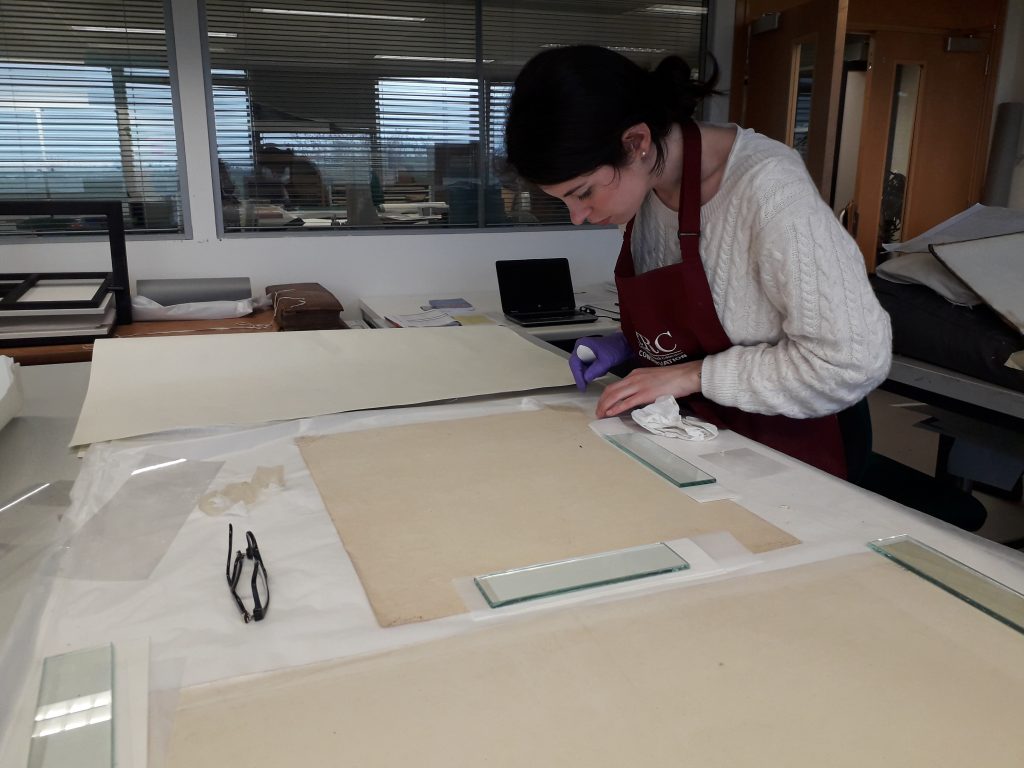
A woman works on a large piece of papers. Glass weight keeps the page flat.

Giulia working in the studio

We did it! The conservation of the Thomson-Walker collection of medical portraits is finally complete! It took four years, five interns, dozens of batches of carboxymethylcellulose (CMC), several metres of lens tissue, and an indefinite number of acid-free paper sheets, but the 3,000 prints are finally free from acidic secondary supports, adhesive residues and tape hinges, and are now ready to be fully catalogued and digitized. At the beginning of my internship, I wasn’t sure I was going to be able to get through the final boxes in the collection. The previous interns’ fantastic work (you can read all about here, here, here and here) left me with 600 prints to conserve, from portraits classed under letter “P” to the ones under “Z”, with two jam-packed boxes labelled “S” in between. I really wanted to do my best to complete the project, since I was going to be the last intern to work on the Thomson-Walker collection, and also because I was determined to challenge myself, testing the workload I was able to carry out in a short period of time.

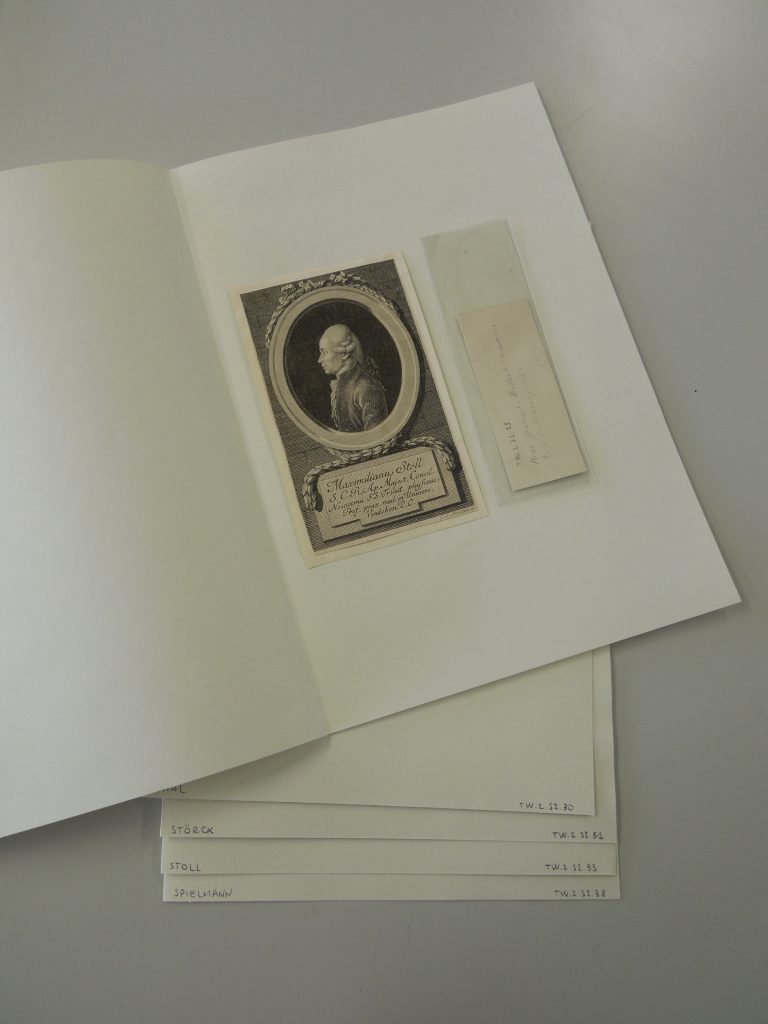
Print of an engraving laying in white folder.

Print, after conservation, rehoused in a single crease acid-free folder

Continue reading

Session Paper Project Internship

My name is Claire and I am the first intern to work with Nicole on the Session Papers Project.  I am due to graduate with a master’s degree in paper conservation this year, but I am starting this internship to broaden my knowledge of book conservation. Methods and skills within conservation tend to overlap, and this is especially true with books and paper. My role within this pilot project is to assist in the conservation of 300 books. Conservation treatments include structural repairs, consolidation, and board reattachment. The volumes need to be in a good enough condition to withstand digitisation and further handling following the project.

A woman stands at a large white table working through a pile of paper on a grey back board.

Claire working in the conservation studio

Continue reading

The Good, the Fair and the Unusable. Conservation of Session Papers at the CRC.

This week, Projects Conservator Nicole introduces a brand new project she is working on at the CRC…

I am currently working on a 6-month pilot project to conserve three collections of Scottish Session Papers prior to digitisation. The collections are held across three institutions: the Advocate’s Library, the Signet Library and here at the Centre for Research Collections. These collections consist of around 6,500 volumes, comprising of multiple case papers in one volume. The case papers of the Scottish Court of Session are the most significant untapped printed source for the history, society and literature of Scotland from 1710-1850.  They cover an extraordinary period in the nation’s history from the immediate aftermath of the Union of 1707 through the Jacobite wars, the Enlightenment, the agricultural and industrial revolutions and the building of Walter Scott’s Edinburgh.

Continue reading

Thomson-Walker Internship – Round 5!

Our final Thomson-Walker intern introduces herself in this week’s blog post….

“I feel like a pastry chef!”: this was my first thought while trying to smear an even layer of a carboxymethylcellulose (CMC) poultice on a strip of lens tissue to remove a very thick residue of what distinctively smelled like coccoina (a marzipan-scented Italian glue, made from potato starch and almond paste). Being Italian, I couldn’t help but recognise the fragrance bringing back so many childhood memories. I didn’t imagine, back then, how difficult it actually is to remove this adhesive from the back of a 17th century print!

Continue reading

Thomson-Dunlop Research and Conservation Internship

Our blog this week comes from Michela Albano, who recently spent four weeks working with our Musical Instrument Conservator, Jonathan Santa Maria Bouquet…

Thanks to the Thomson-Dunlop Research and Conservation Internship, I had the opportunity to spend four weeks in the autumn of 2017 at St Cecilia’s Hall: Concert Room and Music Museum. This provided me with an amazing experience in an energetic and supportive environment where the deep knowledge of musical instruments preservation is fruitfully combined with a welcoming and enthusiastic team.

Continue reading

Problem Photographs in the Patrick Geddes Collection

This week’s blog comes from Project Conservator, Nicole Devereux, who has come across a sticky situation with some photographs during the ‘Evergreen: Patrick Geddes and the Environment in Equilibrium’ project…

The Patrick Geddes collection has a wide variety of material including large maps, photographs, bound volumes and letters, all of which have their unique conservation challenges. One interesting problem I have come across in this collection is a photograph stuck to glass. This is usually caused by humidity and can be prevented by stable environmental conditions or by placing a mount or spacer between the photograph and the glass so they don’t come in contact.

Continue reading

Thompson-Walker Internship

This week, we have a final blog post from Irene, our fourth Thomson-Walker Intern….

Times goes by so quickly, and I am already reaching the last week of my internship at the Centre for Research Collections (CRC). The main purpose of this internship was to conserve a collection of medical portraits in the Thomson-Walker collection. This mainly involved removing prints from acidic backings and rehousing them. Some of the prints were adhered completely to the backing board, so the verso of the print could not be seen. When removing the backing from one print, I found that there was writing on the back which was previously hidden. This means that as well as improving its condition, more information can be learned about the print.

Continue reading

Store Room Surprises!

Project Conservator, Helen Baguley, describes some of the more unusual objects she has found in our store rooms, and how she has conserved them, in this week’s blog…

One of the most exciting aspects of my role is surveying the collections housed at the Main Library and the University Collection Facility (UCF). This gives me to opportunity to look at collections I would not usually come into contact with, and I get to discover what is in the University’s vast collections. The purpose of these surveys is to determine any conservation work which needs to be carried out to safely house the collections and preserve them for future use. Some of these collections have already been appraised by archivists and some are awaiting appraisal. I create the surveys in Excel and write a report of my findings. The report records the current condition of the collection, lists the types of materials found, gives recommendations for future housing, and provides a cost estimate for the materials needed to carry out the work.

Continue reading

Thomson-Walker Internship – Round 4!

This week’s blog comes from our newest Thomson-Walker intern, Irene García Bustos. Irene is the fourth in the series of interns to conserve the Thomson-Walker collection of medical portraits. You can read about previous intern experiences here, here and here!

Firstly, let me introduce myself! My name is Irene, and I have a degree in Conservation and Restoration of Cultural Heritage and a master’s degree in Preventive Conservation at Complutense University of Madrid, graduating in 2017. Since finishing my studies, I have had the opportunity to spend over a year doing several internships in photograph and paper conservation at different institutions in Madrid.

Photograph of a young woman wearing a maroon apron looking down and working on paper on a large white table.

Irene working in the conservation studio

Continue reading

Crowdsourcing Conservation 2018

Due to the success of last year’s ‘Crowdsourcing Conservation’ event, we are repeating the session on 19 and 20 February 2018! You can read more about last year’s event here.

This year, we will continue to work with the Laing collection, this time rehousing section IV. Over the two-day period we aim to rehouse 96 boxes, completing the boxing of the Laing manuscript material.

Two photographs of brown and grey archival boxes on white metal shelving.

Boxes from the Laing II collections, before (left) and after (right) rehousing

Damage has been caused to these collections due to the current storage in vertical boxes. Folders have slumped in under-filled boxes, and caused planar distortion of the papers. Tearing and creasing has occurred due to the lack of internal protection. To solve this problem, we want to rehouse the collection in acid-free folders and boxes.

Continue reading