Home University of Edinburgh Library Essentials
September 24, 2026
New year, new team members!
The Research Data Support team has had some noteworthy changes in the last few months.
 Longtime staff member Pauline Ward has embraced a new management role as Data Repository Operations Officer, where she will work with two Research Data Support Assistants, myself as service owner, and the Digital Library software engineers. The Digital Library hosts our open and restricted access repositories, DataShare and DataVault – to ensure smooth operations of these data archiving solutions into the future. The two new Research Data Support Assistants are Maeve McCann and Stefano Bordoni, who will be supporting users with our repositories Edinburgh DataShare and DataVault, among other activities with the team (time will tell!).
Maeve has previously worked for the IT team at the University of Edinburgh’s School of  Philosophy, Psychology & Language Sciences (PPLS), where she was responsible for the development and management of the student and volunteer research databases. She led the implementation of the Volunteer Panel – a bespoke system for researchers and participants to post and sign up for studies and Maeve also provided technical support for the PPLS Ethics system.
Prior to working for the university, Maeve has held roles with several children’s charities and management consultancy firms. In her free time, Maeve enjoys mountain biking, skiing and travel.
Stefano Bordoni has recently completed a Doctorate in Archaeology at The University of Edinburgh, with a thesis on historic masonry techniques and building materials in Umbria (Italy). During this experience, he took advantage of IT tools in exploring the informative potential stored in medieval and early modern constructions. In his years in academia, he has taken part in several archaeological projects and excavations. Among them, he established and supervised the Pietrarossa Archaeological Excavation (University of Perugia) and managed the GIS platform for the Water in Istanbul Project (British Institute at Ankara & partners).
 Prior to his current role, he has worked within the University of Edinburgh as a Tutor in the School of History, Classics & Archaeology, a CDCS Training Fellow (at the Centre for Data, Culture & Society), and EdHelp Information and Support Assistant, in Information Services. In his free time, he loves cooking traditional Umbrian food, foraging wild mushrooms and cycling.
Before the end of the year we bid goodbye to colleagues Dr Bob Sanders, now taking up a lead training role with the Scottish Centre for Administrative Data Research (SCADR) based in the School of Geosciences here, and Yue Gu, Research Data Steward, a PhD candidate in Econometrics who has taken an analyst role at Natwest.
Good luck to everyone in their new roles!
Robin Rice
Data Librarian and Head, Research Data Support
Finding key resources: Stair Memorial Encyclopaedia
For those rejoining us in January for Semester Two, welcome back! For those who are new to the Law School or just this blog, welcome! This is where we report news, updates and offer tips for training in library resources. The blog is currently written by SarahLouise, the Law Librarian who works Wednesdays to Fridays, as we have a vacancy for the other half of the post. We hope to have a new Law Librarian joining the team over the next few months and will introduce them when they start!
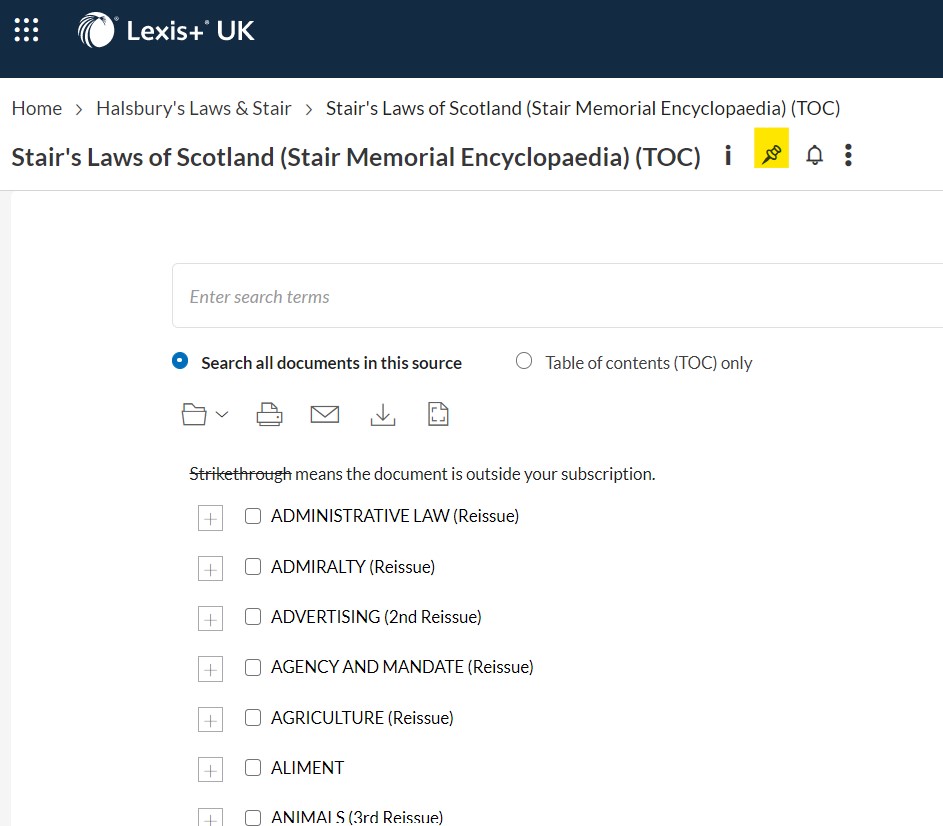
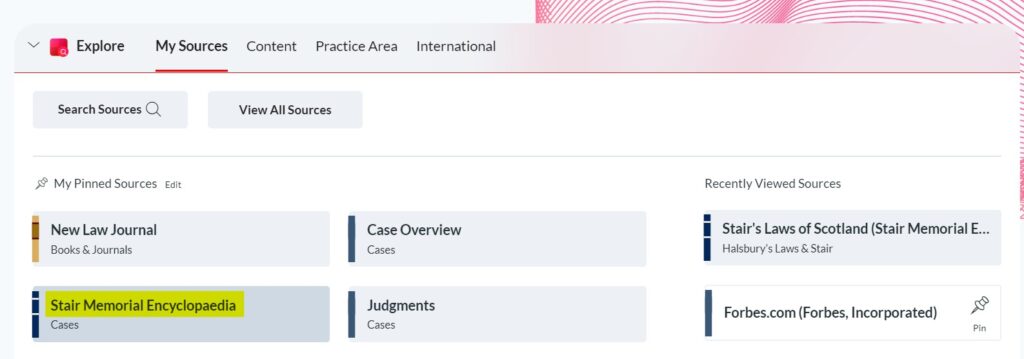
We’ve received quite a few queries about locating some key resources for research and study over the last few months so we wanted to clarify how best to access these. First up, the Stair Memorial Encyclopaedia. This is a resource which is core for our undergraduate students as they get to grips with Scots Law. We do have instructions listed on the Law Databases Help & Training page under ‘Resources for Scottish Legal System’, but we wanted to add some screenshots here for the visual learners.
- To log in to Lexis+, you will need to select ‘academic log in’. You may then be presented with a dropdown box to select ‘UK Access Federation’. Select ‘University of Edinburgh’ from the list, and you will be logged in. Alternatively you may have the option to select ‘University of Edinburgh from the front page – do this if available!
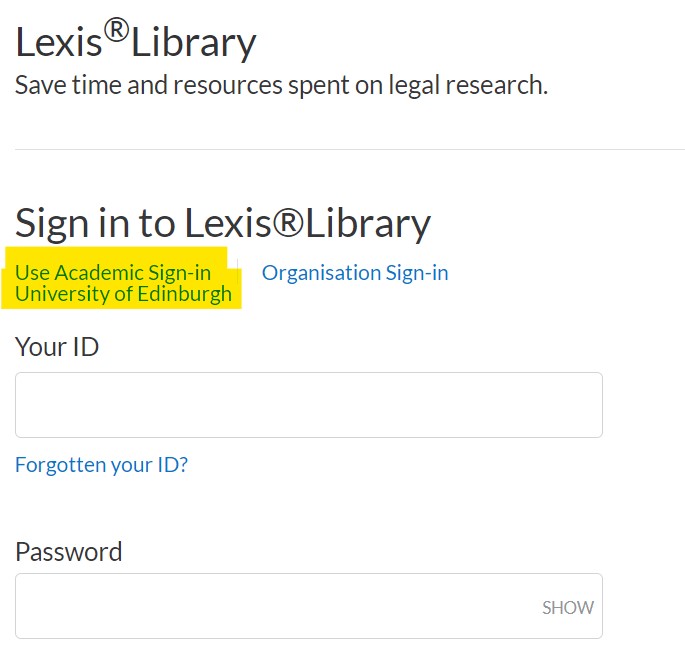
- You may be asked to log in with your UUN at this stage if you’re not on-campus. Use your usual student ID and password.
- In the middle panel in the centre of the page, select ‘content’ from the navigation menu.
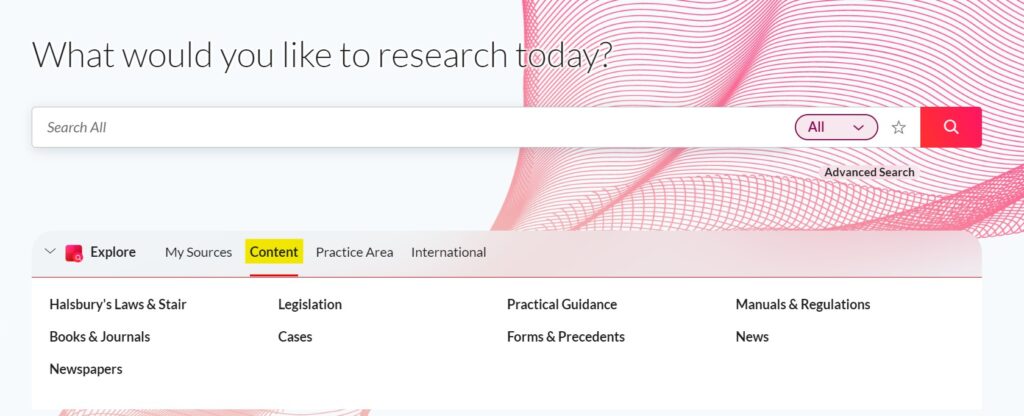
- The resource will be one of the first items listed as ‘Halsburys Laws and Stair’. Click this.
- Then you will see a link to Stair Memorial Encyclopaedia. Click the title, and use the plus and minus boxes to navigate through to find the section you need.
- If you want to, use the pushpin icon near the title to add this to your pinned sources. This bookmarking tool means that a shortcut will appear under ‘My Sources’ on the main panel when you log in to Lexis in future, which will save you a few steps.
We hope this is helpful. If you have a resource you’d like a little more advice on accessing, please let us know by email (law.librarian@ed.ac.uk) or by commenting on this post.
E-Resources trials from the library
Welcome back to all staff and students! This blog has been a bit quiet of late due to high workload and some understaffing in our team, but we wanted to start off the new year with some good news and thought we’d alert everyone to some of the excellent e-resource trials we have going on!
Did you know?
Before the library subscribes to a new database we often arrange for a trial free of charge and link them on the E-Resources Trials page. We then ask anyone who’s tested the resource out to fill in a short feedback form to let us know their thoughts so we can decide how useful it will be for our users. Some of the trials we have ongoing at the moment are listed below.

Image by deepakrit on Pixabay
Radical Irish Newspaper Archives
Radical Irish Newspaper Archives is an extraordinary collection of over 115 Irish radical and political newspapers, journals, pamphlets and bulletins. Fully searchable and consisting of more than 11,000 editions with a total page count of 102,755 these newspapers, according to Dr Ciarán Reilly of Maynooth University, ‘hold the key to understanding Ireland in the turbulent decades of the early twentieth century’. Spanning one of the most important periods in Irish history, from the Home Rule debates of the 1880s to Ireland on the eve of the Second World War, these somewhat obscure titles provide an insight into a myriad of opinions on Irish life.
Trial access until: 08/01/2023 (so have a look this weekend!)
SAGE Research Methods: Doing Research Online
This new multimedia collection has been designed to support novice or experienced social science researchers who are conducting research online. Whether conducting their first or their hundredth study online, users will find support to employ a variety of digital methods from online surveys, interviews to digital ethnography, social media, and text analysis, as well as learn how to manage, store and archive digital data. Privacy and other ethical considerations specific to conducting research online are also covered. Researchers will also get support with how to navigate the challenges of being supervised online.
Content & Features:
- ‘How to Guides’ (providing practical help with using digital research methods);
- Videos (tutorials, expert interviews, video case studies, etc.);
- Case studies (focused on challenges of designing and conducting research online);
- Teaching sets of data with a guide (suggesting a method to analyze both digitally created and existing online data, plus a step-by-step guide to how to do it so that students can practice data analysis);
Trial access until: 26/02/2023.
Archives of Sexuality and Gender: International Perspectives on LGBTQ Activism and Culture
Archives of Sexuality and Gender: International Perspectives on LGBTQ Activism and Culture examines diversity in underrepresented areas of the world such as southern Africa and Australia, highlighting cultural and social histories, struggles for rights and freedoms, explorations of sexuality, and organizations and key figures in LGBTQ history. It insures LGBTQ stories and experiences are preserved. Among many diverse and historical 20th century collections, materials include: the Papers of Simon Nkoli, a prominent South African anti-apartheid, gay and lesbian rights, and HIV/AIDS activist; Exit newspaper (formerly Link/Skakel), South Africa’s longest running monthly LGBTQ publication; Geographic Files, also known as “Lesbians in…” with coverage from Albania to Zimbabwe; and the largest available collection of digitized Australian LGBTQ periodicals.
NB The Library has purchased access to three other modules of the Archives of Sexuality and Gender database – these can be found on the A databases page.
Trial access until: 12/07/2023.
We actually have TWELVE trials currently running at the moment. You can find out more on the E-Resources Trials page of the library website, where we have links and descriptions for all items as well as a link to the feedback form (login required).
If there’s a resource you’d like us to get a quote and trial for, please let us know by contacting the relevant librarian for your subject area.
Warm wishes from your Law Librarian
Working in the Law Library today has been like night and day since the study space scramble of last week, and that’s because most students have now finished up for the term and are beginning their winter breaks. The Law Library is still open until 4.50pm tomorrow (Thursday 22nd December), and we will then close our doors until Wednesday 4th January 2022. If you are studying or conducting research over the winter break you will find our online resources remain accessible via the usual channels, but should you run into difficulties we will not be able to respond to any messages until we return in January. Alternatively the Main Library is available during the holidays, you can find out more on their page on the website.
It’s been a bit of a tricky year in the land of Law Libraries as we’ve been short staffed for much of Semester One both on the Helpdesk and in the Academic Support Librarian team. We appreciate your patience while we do what we can in the time available, and look forward to Semester Two where we hope we’ll be back up to a full complement before too long.
We wish you a pleasant and restful winter break and hope for your health and happiness during your time away from the University. See you next Semester!
– SarahLouise
Review 2022 and a look towards 2023
A lot has happened in 2022! Supported by both core and external funding, and with a return to more normal ways of working, we have been able to re-start and complete many of our plans.
Conservation
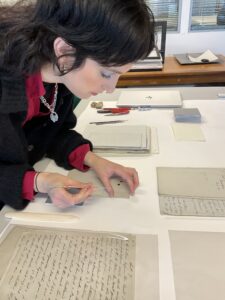
Sarah carefully treating minor folds
The care of the Lyell archives was our priority. Supported by external funding from the John R. Murray Charitable Trust, the National Manuscript Conservation Trust and others, professional Conservator Claire Hutchison worked on the collection from January – July 2022, along with two project interns, Joanne and Sarah M. We were able to slightly extend the conservation project, so a big thanks is due to Sarah P, who was able to clean Lyell’s Offprints and treat minor folds and tears found in his MS edits.
Digitisation
The University’s Cultural Heritage Digitisation Service have been making good headway, and we are 50% of the way there. At present, the digital images are hosted on the University’s image website Luna. You can use the left hand menu to select the Notebooks, select particular pages and zoom in on the detail – really helpful when deciphering Lyell’s handwriting. Mindful of any conservation needs, the team are able to also prioritise notebooks specially requested by researchers -so do get in touch – the team are very much bolstered by enthusiastic responses!
Charles Lyell’s World Online
Hosting the digital images online is one thing, but we also want to enhance digital access online. Funding provided by the International Association of Sedimentologists has enabled us to bring a Lyell Website Developer onboard. We know that Lyell’s Notebooks are packed with information; this information can jump around from topic to topic, but also builds, from observation to noting queries he needs answers to. The Web Team are currently working to apply the International Image Interoperability Framework (IIIF) that will allow the user to view the Notebooks, and flip seamlessly through the pages. Once this step is completed, we will explore what other functionality can be added to enhance the reader’s experience.
Cataloguing & transcription
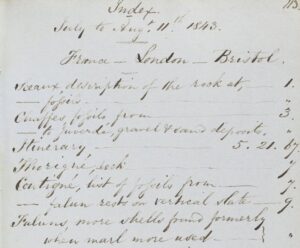
We are using the Notebook indexes to create a catalogue entry – they are often written by Mary, they can run to 6 or 7 pages – or missing entirely!
We have two cataloguing priorities – the Notebook indexes, and one set of Lyell’s correspondence. As we now have a large amount of Lyell’s handwriting digitised, we can start to share out the work to remotely transcribe the indexes using the AI platform Transkribus. The transcriptions are not completely accurate and need to be manually checked, so it’s time consuming, but the results produce rich descriptions that will enable good searching. A small group of remote online volunteers are working away on this (and doing a great job – thank you!). Please get in touch if you would like to join us!
We’ve also recruited on site volunteers, who are able to visit the CRC reading room, and view records that are not digitised. They are working away on one tranche of Lyell’s correspondence, identifying the senders and enhancing description. So far we’ve encountered some eminent correspondents, including Lucas Barrett and Samuel Beckles – yes, we are at the ‘B‘s!
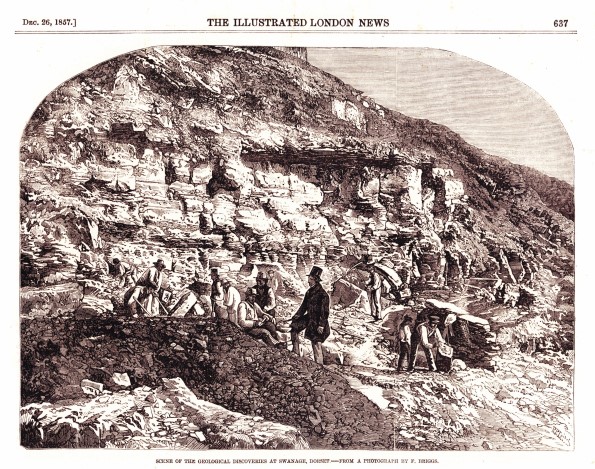
Beckles’ Pit at Durlston Bay, with Samuel Beckles wearing a top hat, directing operations. He is in touch with Lyell as soon as he starts finding specimens, Christmas 1856.
Looking ahead to 2023
As well as working on the website, plans are now in place for us to host what will be the first major exhibition on Lyell. This will be located in the Main Library Exhibition Gallery and will run from November 2023 to February 2024, so see you there! Lyell represents a huge topic – both in terms of scale and impact. The depth and breadth of the collection held at the University of Edinburgh offers a brilliant opportunity to show how he worked to develop and then promote his ideas. We’re also delighted to have secured funding to support a Lyell intern, who will focus on collating historical context and Lyell’s travels to populate both the exhibition and the website – more from them in 2023.
Thanks for all your support so far – enjoy the holidays when they come.
Pamela
Meet your LexisNexis Student Associate for 2022/23!
You may have seen that we’ve featured LexisNexis quite a lot on the blog this semester, due to the launch of their new platform, Lexis+. We’ve provided a fair bit of information about how to access items and how to get further training, but one person we have yet to mention is your Student Associate, Olivia Riddell. Lexis employ Olivia to provide peer support for students at the University of Edinburgh who want to work with Lexis and use it for their studies or research. We had a quick word with her to ask her more about what her role entails:
Tell us a little bit about yourself! Who are you and what do you study at Edinburgh?
My name is Olivia, and I am a fourth-year law student at Edinburgh. I am from the North of England but wanted to study at Edinburgh as a bid to broaden my horizons. It has been nice to experience the quieter life and scenery that Scotland offers before accessing work opportunities in the City.
Why did you apply to be the student representative for LexisNexis?
I wanted to have experience related to law. My previous experience working in retail taught me soft skills and resilience, but this role has truly developed other areas needed in a professional capacity such as marketing strategies, proactiveness and negotiations. This is especially necessary if students want to harness their skills in preparation for a role requiring good capacity of leadership and business relations. It also challenges me personally. For example, it has improved my confidence (in reaching out to students, and teaching sessions) and stretched my ability to form professional networks with students in the law school, and with faculty staff.
What do you think is the best feature that Lexis offers for students in the Law School?
The ability to type in key words and find related journal articles and added references for essays. It enables you to find related sources that have an affinity with your argument or essay title meaning your assignment will be much stronger based on accuracy and relevancy.
When students book a training session with you, what can they expect to get from the meeting?
There are different types of sessions. I will be organising certification sessions (Foundation and Advanced) which will enhance your professional profile and experience. These downloadable and professional certificates will make you stand out, and you can showcase these on LinkedIn. In addition, I will be running assignment training in December 2022 and Easter 2023 to ensure you know how to use LexisNexis to help in your upcoming assignments. In semester two, I will also be conducting commercial awareness sessions in 2023 to help with future internship and vacation scheme placement applications, and how you can access such material on the LexisNexis site.
You can reach Olivia by email with any queries or training requests: s1925406@ed.ac.uk.
If you need help with any other databases or would like to discuss other available training please let the law librarian team know by email: law.librarian@ed.ac.uk.
Study Spaces in the Law Library
One of the most common concerns for Law students at this time of year is finding study spaces in the library to help them get ready for assignments and exams. We know the Law Library is a favourite place to study, so here are some ways we’re trying to help manage during peak periods.
EXTRA STUDY SPACES:
Library Services book out other rooms in the University to help meet demand for study spaces during the revision and exam period. The spaces closest to the Law Library are the MacLaren Stuart and Quad Teaching rooms in Old College, and there are helpful signs pointing the way to these at the entrance to the Law Library:
G.158 Quad Teaching Room (seminar room, 15 seats) and G.159 MacLaren Stuart Room (large classroom, 55 seats)
Open daily from Saturday 3 December to Wednesday 21 December.
Opening hours as per Law Library opening hours: Monday to Thursday 09:00-21:50 ; Friday 09:00 to 18:50; Saturday 09:00 to 16:50 ; Sunday 12:00 to 18:50 on 4, 11, 18 December.
There are also temporary additional study spaces open at the Main Library and 40 George Square for study and revision; details can be found of these and many other study spaces across campus on the Study Spaces part of the website.
More information about opening hours for the Law Library specifically over the festive period can be found on the Law Library pages of the Library website. Please note that there are extended opening hours on Sundays in December (on 4th, 11th or 18th) until 18.50. Usual Sunday opening hours (open until 16.50) will resume in January.
STUDY MONITOR:
We’ve asked our student staff to work as study monitors from Monday 12th to Friday 16th December. They will be helping students find spaces, take counts and to monitor how the study space cards are being used.
STUDY BREAK CARDS:
Cards are situated around the library that can be used to keep your space while you take a short break. Turn the card to 15 minutes for a Short Break or fill out the time you intend to be away from your desk for longer breaks like lunch (up to one hour). This scheme has been shown to encourage healthy study patterns and help utilise the space we have available. We’ve used this system in the Law Library in the past and it’s gotten great feedback, so much so that it’s been extended to other libraries in our network.
RESERVE COLLECTION DESIGNATED DESKS (NEW):
One of the concerns we’ve heard from students is that at peak times there’s nowhere to consult Reserve (3-hour loan) materials as it’s impractical to take these items far from the library for use. We listened and are now trialling a system where the 18 desks nearest the Reserve collection on the ground floor are Designated Desks in order to use materials from the Law Library specifically. If students require use of these desks they should alert Helpdesk staff who will put out a call for those not using Law Library collections to vacate this bank of desks within 20 minutes. Signs indicating this procedure are posted on these desks.
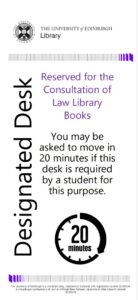
We believe this is a compromise that can work for students who need to use materials held specifically in this library without limiting who can work and study in the space. We understand Law students can feel that they should be prioritised when it comes to space in the Law Library, however the Law Library is part of a network of 13 site libraries – including the Main Library, which also houses high use law books – and limiting access to one of these is neither possible nor fair. Law students also benefit from being able to use any of the campus library facilities – for example, did you know that the new KB nucleus is directly connected to the Murray Library and is open to everyone (including Law students)?
While we can appreciate the issues with finding space in the Law Library we find it a great compliment that so many students want to study with us. We are limited in the number of seats available but we hope you’ll understand we’re doing what we can to maintain a pleasant and peaceful study environment; the fantastic Helpdesk team are always on hand to assist where they can.
If you have queries or want to speak to someone directly about our libraries and collections, you can contact us by email: law.librarian@ed.ac.uk. We’d love to hear from you.
Digital Witness
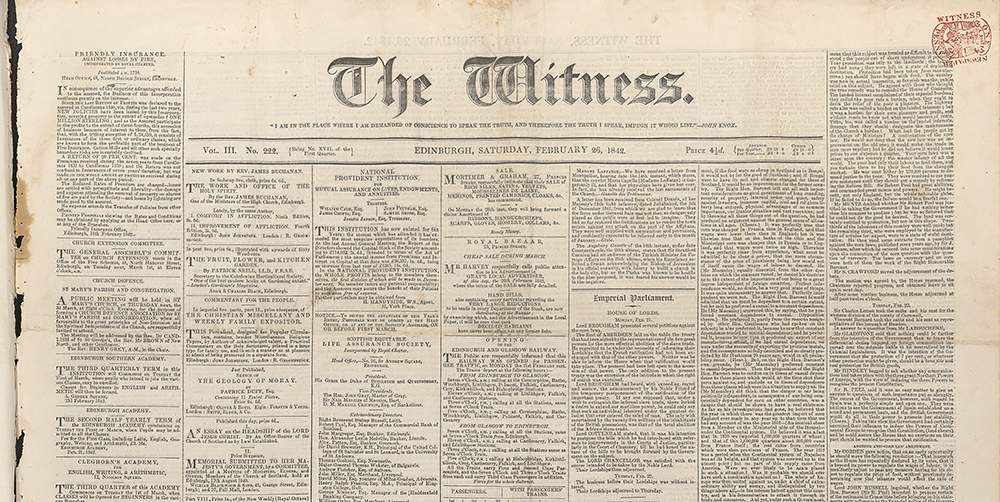
We have started digitising The Witness newspaper!
This twice weekly newspaper was created by the Church of Scotland in 1840 and edited by Hugh Miller (see https://en.wikipedia.org/wiki/Hugh_Miller ), an influential writer, geologist and stone mason. The Church of Scotland wanted a newspaper that reflected a Christian outlook, as well as news and comment from across Scotland. In 1843 The Church of Scotland was faced with 200 ministers walking out citing political interference, an event which came to be known as the Disruption, and led to the Free Church being established. Presbyterianism is founded on the basis that the people make the decisions, not an elite hierarchy, and the only head of the church, is God. This makes The Witness newspaper a fantastic primary source covering a significant event in Scotland’s social and religious history, and as such, a prime candidate for digitisation. Read More
On trial: Radical Irish Newspaper Archives
Thanks to a request from a researcher in HCA the Library currently has trial access to the Radical Irish Newspaper Archives, an extraordinary collection of over 115 Irish radical and political newspapers, journals, pamphlets and bulletins.

You can access the Radical Irish Newspaper Archives via the E-resources trials page.
Access is available directly on-campus or off-campus with VPN.
Trial access ends 8th January 2023. Read More
The Book Surgery is Open: Learning the Art of Book Spine Repairs
In this blog Project Conservator Mhairi Boyle discusses her new role within the One Health project at the CRC, and the training she has undertaken with Book Conservator Caroline Scharfenberg (ACR).
In August, I started a new role as the Project Conservator for the One Health project within the Heritage Collections team. One Health brings together three archival collections which chart the development of animal health and welfare in Scotland. The collections in question are from OneKind, an animal welfare charity; the Royal Zoological Society of Scotland (RSZZ); and the University of Edinburgh’s Royal Dick School of Veterinary Studies (R(D)SVS).
One of the challenges of this project is the variety of material I am working with. Whilst most of the material is loose leaf archival papers and photographs, we also have many bound volumes. On the opposite end of the spectrum, we have chicken skeletons, animal medicines, vet tools, and graduation robes. In these cases, I will stick to preventive measures such as handling instructions and appropriate rehousing to enable ease of access and prevent any further damage.
Collections
 Love, Loss, and Literature: Cataloguing the Papers of Irene Jessie Young
My name is Nancy Britten, and I’m in my fourth year of studying History at...
Hill and Adamson Collection: an insight into Edinburgh’s past
My name is Phoebe Kirkland, I am an MSc East Asian Studies student, and for...
Love, Loss, and Literature: Cataloguing the Papers of Irene Jessie Young
My name is Nancy Britten, and I’m in my fourth year of studying History at...
Hill and Adamson Collection: an insight into Edinburgh’s past
My name is Phoebe Kirkland, I am an MSc East Asian Studies student, and for...

Projects
Cataloguing the private papers of Archibald Hunter Campbell: A Journey Through Correspondence
My name is Pauline Vincent, I am a student in my last year of a...
Archival Provenance Research Project: Lishan’s Experience
Presentation My name is Lishan Zou, I am a fourth year History and Politics student....