This week, Projects Conservator Nicole introduces a brand new project she is working on at the CRC…
I am currently working on a 6-month pilot project to conserve three collections of Scottish Session Papers prior to digitisation. The collections are held across three institutions: the Advocate’s Library, the Signet Library and here at the Centre for Research Collections. These collections consist of around 6,500 volumes, comprising of multiple case papers in one volume. The case papers of the Scottish Court of Session are the most significant untapped printed source for the history, society and literature of Scotland from 1710-1850. They cover an extraordinary period in the nation’s history from the immediate aftermath of the Union of 1707 through the Jacobite wars, the Enlightenment, the agricultural and industrial revolutions and the building of Walter Scott’s Edinburgh.
Our final Thomson-Walker intern introduces herself in this week’s blog post….
“I feel like a pastry chef!”: this was my first thought while trying to smear an even layer of a carboxymethylcellulose (CMC) poultice on a strip of lens tissue to remove a very thick residue of what distinctively smelled like coccoina (a marzipan-scented Italian glue, made from potato starch and almond paste). Being Italian, I couldn’t help but recognise the fragrance bringing back so many childhood memories. I didn’t imagine, back then, how difficult it actually is to remove this adhesive from the back of a 17th century print!
Our blog this week comes from Michela Albano, who recently spent four weeks working with our Musical Instrument Conservator, Jonathan Santa Maria Bouquet…
Thanks to the Thomson-Dunlop Research and Conservation Internship, I had the opportunity to spend four weeks in the autumn of 2017 at St Cecilia’s Hall: Concert Room and Music Museum. This provided me with an amazing experience in an energetic and supportive environment where the deep knowledge of musical instruments preservation is fruitfully combined with a welcoming and enthusiastic team.
The Patrick Geddes collection has a wide variety of material including large maps, photographs, bound volumes and letters, all of which have their unique conservation challenges. One interesting problem I have come across in this collection is a photograph stuck to glass. This is usually caused by humidity and can be prevented by stable environmental conditions or by placing a mount or spacer between the photograph and the glass so they don’t come in contact.
This week, we have a final blog post from Irene, our fourth Thomson-Walker Intern….
Times goes by so quickly, and I am already reaching the last week of my internship at the Centre for Research Collections (CRC). The main purpose of this internship was to conserve a collection of medical portraits in the Thomson-Walker collection. This mainly involved removing prints from acidic backings and rehousing them. Some of the prints were adhered completely to the backing board, so the verso of the print could not be seen. When removing the backing from one print, I found that there was writing on the back which was previously hidden. This means that as well as improving its condition, more information can be learned about the print.
Project Conservator, Helen Baguley, describes some of the more unusual objects she has found in our store rooms, and how she has conserved them, in this week’s blog…
One of the most exciting aspects of my role is surveying the collections housed at the Main Library and the University Collection Facility (UCF). This gives me to opportunity to look at collections I would not usually come into contact with, and I get to discover what is in the University’s vast collections. The purpose of these surveys is to determine any conservation work which needs to be carried out to safely house the collections and preserve them for future use. Some of these collections have already been appraised by archivists and some are awaiting appraisal. I create the surveys in Excel and write a report of my findings. The report records the current condition of the collection, lists the types of materials found, gives recommendations for future housing, and provides a cost estimate for the materials needed to carry out the work.
This week’s blog comes from our newest Thomson-Walker intern, Irene García Bustos. Irene is the fourth in the series of interns to conserve the Thomson-Walker collection of medical portraits. You can read about previous intern experiences here, here and here!
Firstly, let me introduce myself! My name is Irene, and I have a degree in Conservation and Restoration of Cultural Heritage and a master’s degree in Preventive Conservation at Complutense University of Madrid, graduating in 2017. Since finishing my studies, I have had the opportunity to spend over a year doing several internships in photograph and paper conservation at different institutions in Madrid.
Due to the success of last year’s ‘Crowdsourcing Conservation’ event, we are repeating the session on 19 and 20 February 2018! You can read more about last year’s event here.
This year, we will continue to work with the Laing collection, this time rehousing section IV. Over the two-day period we aim to rehouse 96 boxes, completing the boxing of the Laing manuscript material.
Boxes from the Laing II collections, before (left) and after (right) rehousing
Damage has been caused to these collections due to the current storage in vertical boxes. Folders have slumped in under-filled boxes, and caused planar distortion of the papers. Tearing and creasing has occurred due to the lack of internal protection. To solve this problem, we want to rehouse the collection in acid-free folders and boxes.
This week’s blog comes from Special Collections Conservator, Emily, who recently took part in a training event in London on the conservation of parchment. This is the first in a two-part blog. It focuses on the introductory section of the workshop, consisting of a series of lectures to develop understanding of the material. The second post will look at practical techniques for the conservation of parchment…
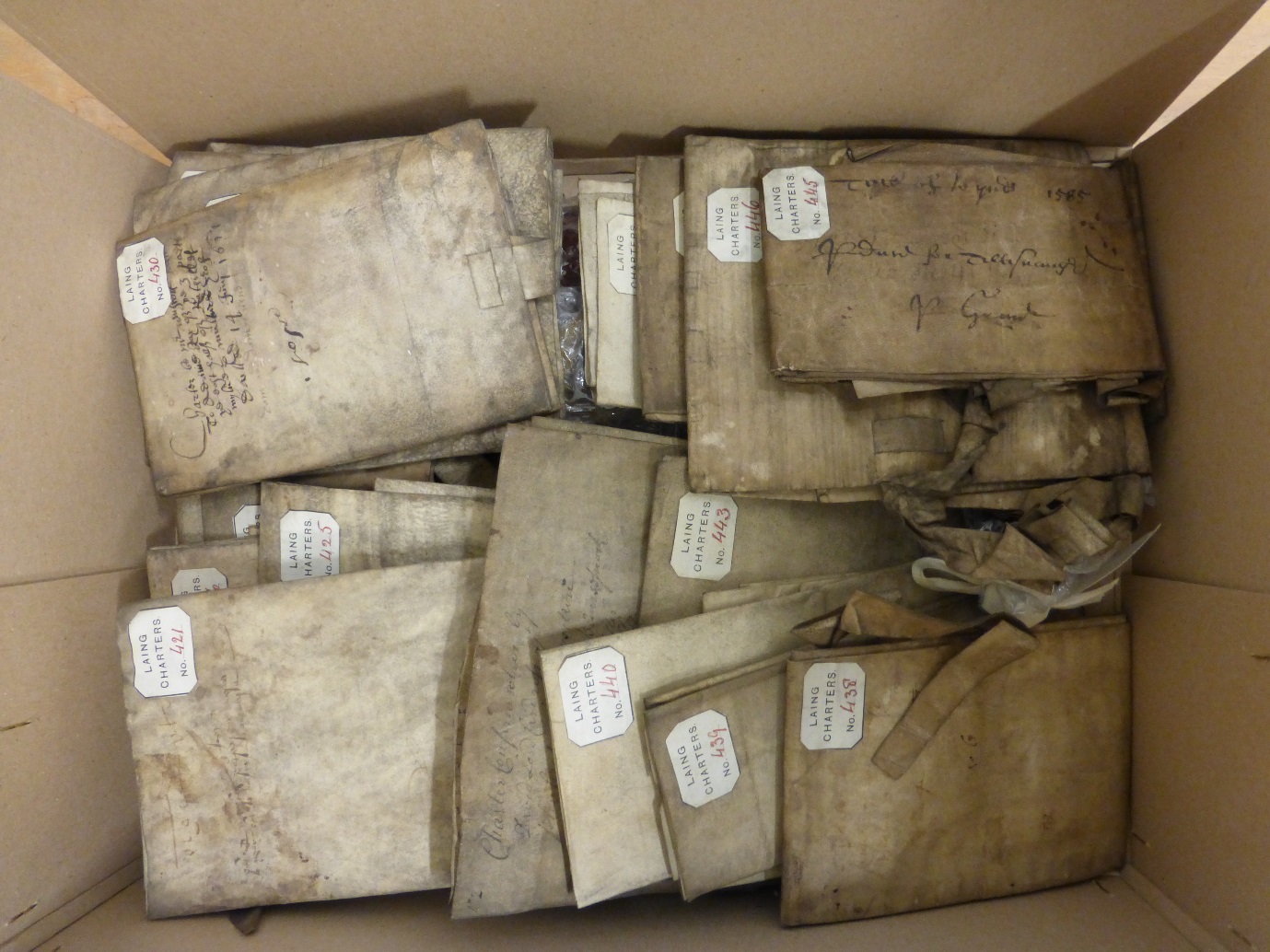
From 19 to 22 October, I attended a four-day training event on the conservation of parchment at the National Archives in Kew. Parchment can be a problematic material to work with as it highly sensitive to moisture. Since many of the treatments we use in paper conservation utilise water, we have to employ methods that use the smallest amount possible to avoid irreparable damage. We have a large amount of parchment in our collections at the CRC, including approximately 3000 parchment charters in the Laing collection, so I was keen to find out more about this material and learn the very latest techniques for its conservation and preservation.
Parchment charters in the Laing collection
The event consisted of two days of lectures, followed by a two-day practical session. The lectures were open to a large number of people, whereas the practical workshop was limited to a maximum of 15 attendees.
The talks during the first two days focused on the making and analysis of parchment. The first talk was by Theresa Lupi, freelance Book and Paper Conservator in Malta, who discussed aspects of codicology and how it can be helpful to conservators. By studying different elements of the manuscript, we can learn how the parchment was made, what tools and techniques were used to prepare it and how this might affect its longevity and the treatments we can use. Following this, Theresa also gave lecture on fragments of manuscripts. Parchment documents were often recycled and reused in the past, and fragments can be found in the bindings of later books or used a wrappers for other items. These fragments can give clues to the how manuscripts were historically used.
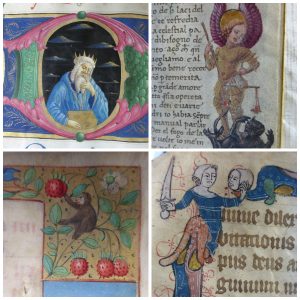
Drawings in manuscripts in the CRC collections
Next, Dr Fiona Brock, Lecturer in Applied Analytical Techniques at the Cranfield Forensic Institute presented a paper on the radiocarbon dating of parchment. Fiona first described the method of radiocarbon dating and discussed the advantages and disadvantages of using this method to estimated when the parchment was made.
After this, Professor Matthew Collins from the University of York presented his research which focuses on the identification of skins in our archive, and how this can tell us about the history of livestock management and craft. Matthew uses small eraser slithers which are gently rubbed against the parchment to remove a minute amount of material from the parchment. These tiny samples are analysed and the type of animal used to make the document can be identified. This service is offered for free and you can obtain a sample kit by emailing matthew@palaeome.org.
The day ended with a presentation by Jiří Vnouček, Conservator of Parchment and Paper at the Royal Library of Copenhagen. Jiří discussed the methods of parchment making and how it has changed over the centuries. Studying the production techniques can give conservators clues which help date and give provenance to the manuscript.
The next day began with another talk from Jiří, which followed on from his presentation the previous afternoon. He first focused on the methods of parchment making in the UK, and showed the below video of the methodologies used in Britain in 1939. He also discussed parchment making in Iceland and how the preparation can affect the final result.
The following talk by Angelica Bartoletti, Researcher in Conservation Science at the Tate, examined parchment on a nano-scale. Angelica states that not all damage to parchment is visible and by scrutinising the material on a micro-scale, we can detect damage before we can see it with the naked eye, and develop conservation techniques to reduce the effects of that damage.
The penultimate talk of the day was by Dr. David Mills, Microtomography Facilities Manager at Queen Mary University of London. The main focus of this talk was on the Apocalypto Project, a collaborative effort between conservators, scientists and computer vision experts to investigate how x-rays can be used to reveal obscured writing or text on parchment. David and his team used a CT scanner to take a 3D x-ray of a tightly rolled piece of parchment. Using a computer programme, they were able to digitally unravel the scroll and decipher the handwriting, without causing any detectable damage to the document. This technique has also been successfully used to view previously inaccessible archives, including glass plate negatives which have been stuck together, and a roll of film that was severely degraded by vinegar syndrome, which can be viewed in the video below. Amazingly, this service is offered for free! Email David (D.mills@quml.ac.uk) for more information.
The final talk of the day was by Edward Cheese, Conservator of Manuscripts and Printed Books at the Fitzwilliam Museum Cambridge. He gave a talk on the repair and binding of parchment manuscripts. Edward evaluated the balance between the risks of conservation treatment, against the benefits to collection items when they have been conserved. For example, Edward argued that although treatments such as humidification may have negative effects on the substrate, this is preferable to leaving the document unusable, or leaving the item in a state which encourages repeated stress on certain areas when handled. For example, a parchment charter that is difficult to open should be humidified and flattened, rather than repeatedly opened and closed which will eventually cause a split, even though the humidity may cause damage on a micro level.
Overall, I found the first two days of the event informative and inspiring, and it provided a great base for the practical session that followed. Read the second part of this blog to find out more about historic conservation of parchment, and up-to-date methods conservators use today – coming soon!
This week our Project Conservator, Helen, talks about the great work volunteers have done as a part of the Collections Rationalisation project…
Some of the main aims of the Collections Rationalisation project at Edinburgh University is to ensure that the library space is being used as efficiently as possible and that collections housed at the University Collections Facility (UCF) are stable and safe to be handled. For this project, priority collections which require conservation have been identified and highlighted. So far the main focus of the project has been on the special collections, in particular the rare books.