Home University of Edinburgh Library Essentials
September 26, 2026
SSSA in 70 Objects: Òganaich Dhuinn a Rinn M’ Fhàgail
Contributor: Barra Waulking Women
Fieldworker: Thorkild Knudsen
Reference: SA1965.109.004
Response: Louise Scollay
I have a lifelong love – some might say obsession – of textiles and craft and often this spills over into our collections. I am always seeking out the hand-made in our archives.
Whilst working from home, I have been listening to material from the sound collections related to wool and spinning. The song Òganaich Dhuinn a Rinn M’ Fhàgail, was performed in Barra as a waulking song – beat-driven songs, performed by women during the process of fulling the newly spun cloth . It is noted that this particular song was also used to accompany spinning and, upon reading that, I didn’t need much convincing to get my spinning wheel out and give it a go myself.
Accompanied by the Wauliking Women of Barra, I spun prepared Zwartbles fibre (a breed of sheep from the Netherlands, which is well established in the UK) and then plyed that yarn with Hebridean wool. These were the two kinds of wool I had to hand – I wouldn’t ordinarily spin two similarly coloured breeds together. It was a pleasing spinning experience doing it to music – although it was hard to keep time – some breeds of wool and different preparations prefer a slower tempo to others! That beat and the vocables though, stayed with me a long time after the spinning wheel was put away.
While the spinning was a pleasant experience, it was less easy to film oneself in the process at the same time. Nonetheless, here is my spun response to Òganaich Dhuinn a Rinn M’ Fhàgail.
Louise Scollay is Archive & Library Assistant at The School of Scottish Studies Archives.
Is there an ‘object’ or connection to the School of Scottish Studies or our archive that you would like to write about or respond to? It could be a recording, an image, a manuscript or something else! Find more information here: https://libraryblogs.is.ed.ac.uk/sssa/sssa-in-70-objects/
Three new things: Dissertations
It’s around the time where many of our students will be planning and beginning the research for their dissertations. If you’re at the start of this journey and looking for a bit of help we’ve got three new things which we hope will help you on your way.
1: Llm Dissertation : How to Maximise Marks for Your Practice Focused Dissertation by Suzanne Reece.
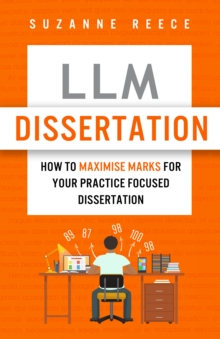
This book is brand new to the library and while it is focused on specifically LLM dissertations, it contains useful information about how to plan for any large research project in Law. Chapters include helping choose your topic, planning and timing, and #SurvivalTips. Reece identifies top tips and common mistakes in students’ work and suggests activities to help you explore your research thoroughly. As such it’s more of a handbook than a set of rules to follow, but we think it will help answer many of the frequently asked questions that students have early in the process.
We have this ebook on an unlimited user license, which means that there’s no waiting and no queue to take it out. Find access information via the DiscoverEd record for this item.
2: Dissertation Festival (Guide and Festival Bag)
You may have seen that Library Services ran our second Dissertation Festival for the year in March 2021. While the festival events don’t exactly line up with Law Dissertation timetable, the wonderful thing about hosting the festival online is that we can keep the resources around for you to access just when you need them most!
- Are you looking for some inspiration for which of the library collections can help you with your research?
- Do you need some support in constructing your search strategy, or managing your results?
- Would you like some tips from students who’ve previously completed their dissertation work?
The Dissertation Festival subject guide has all this and much more available with the click of a button! Recordings are available for our live sessions and slides have been added. Plus you can access my favourite part, the festival tote bag (not a real bag) via the link on the front page. We can’t furnish you with free pens and post-its for the next academic year, but we do have an image of a penguin and a bagpiper from our collection that you can use as your Zoom background…
3: A twitter thread on #EdLitSearchTips
Our Academic Support Librarian colleagues have been compiling a list of tips that will help you get started with literature searching. Although you may have used DiscoverEd or our Library Databases to find materials for your assignments before, click through to this series of tweets to get advice from information professionals whose business it is to help you find information!
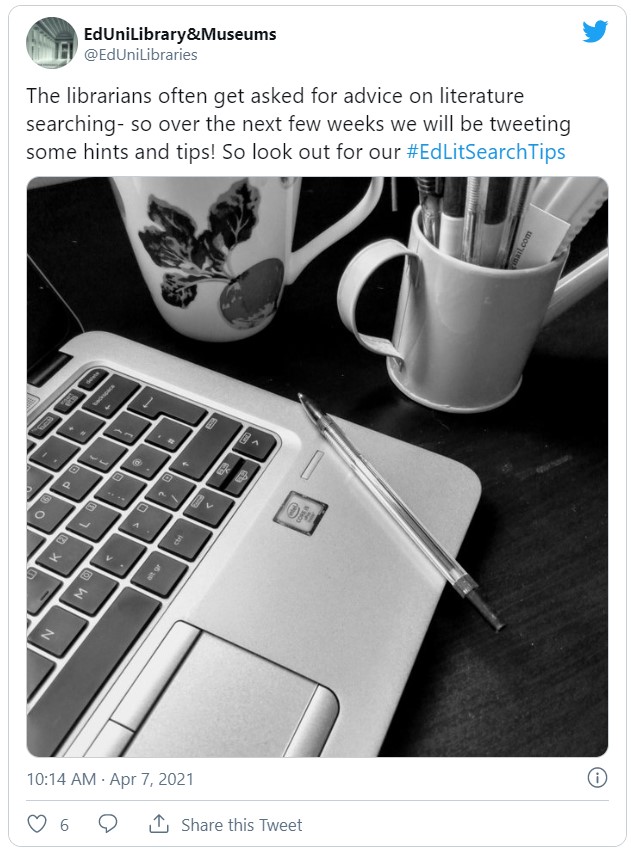
Click this image to find a list of #EdLitSearchTips
If you’re struggling to get started with your research, why not arrange a one-to-one with one of the Law Librarians to discuss your research question and which direction you’d like to go? We can help suggest resources or even just provide advice on the best way to go about searching. Look out for the next available ‘Literature search clinic’ appointment using the MyEd Booking System and find the option for ‘Law’. Further details on how to book can be found on this earlier post on our blog, or just email law.librarian@ed.ac.uk.
“Meet the…Special Collections Conservator” Podcast

Special Collections Conservator, Emily Hick
SSSA in 70 Objects: Borders Ba’ Games
‘They do it yet!’: The surprise of Borders ba’.
Dr Emily Lyle
When I was talking with an old man in Denholm about customs, I had been reading about the ball game there and I asked him if he remembered them playing. I was totally surprised when he told me ‘They do it yet!’, and that was the beginning of the recording for the archive of this living tradition of the Borders for, next time the game was played at Denholm, I was there with the archive photographer, Lesley Davenport. Before the game, she took photos of the balls that were displayed in the windows, and the surprise here was that the game was played with multiple balls which were decorated with ribbons. The balls were provided by couples who were married or had celebrated an anniversary in the previous year.
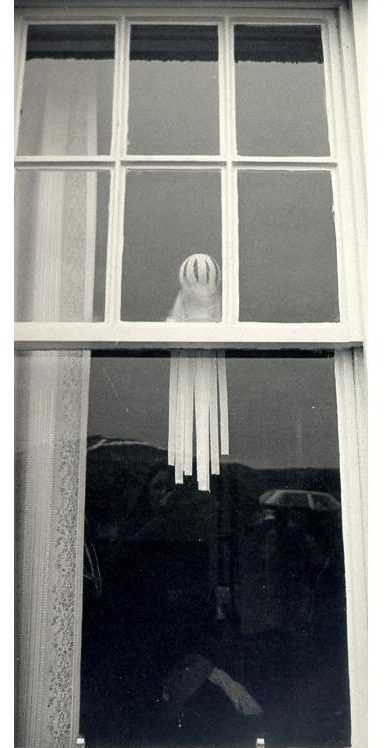
1 A silver wedding ball with white ribbons at Denholm.
The game is handball and when each ball is thrown up to start play, the person throwing announces the sum that will be paid when the ball is returned, like ‘There’s £5 on it!’. We watched the first ball being thrown up in Denholm that day and then observed the players lying in a heap (the ‘strow’) for half an hour or so until we had to leave for an evening engagement in Edinburgh.
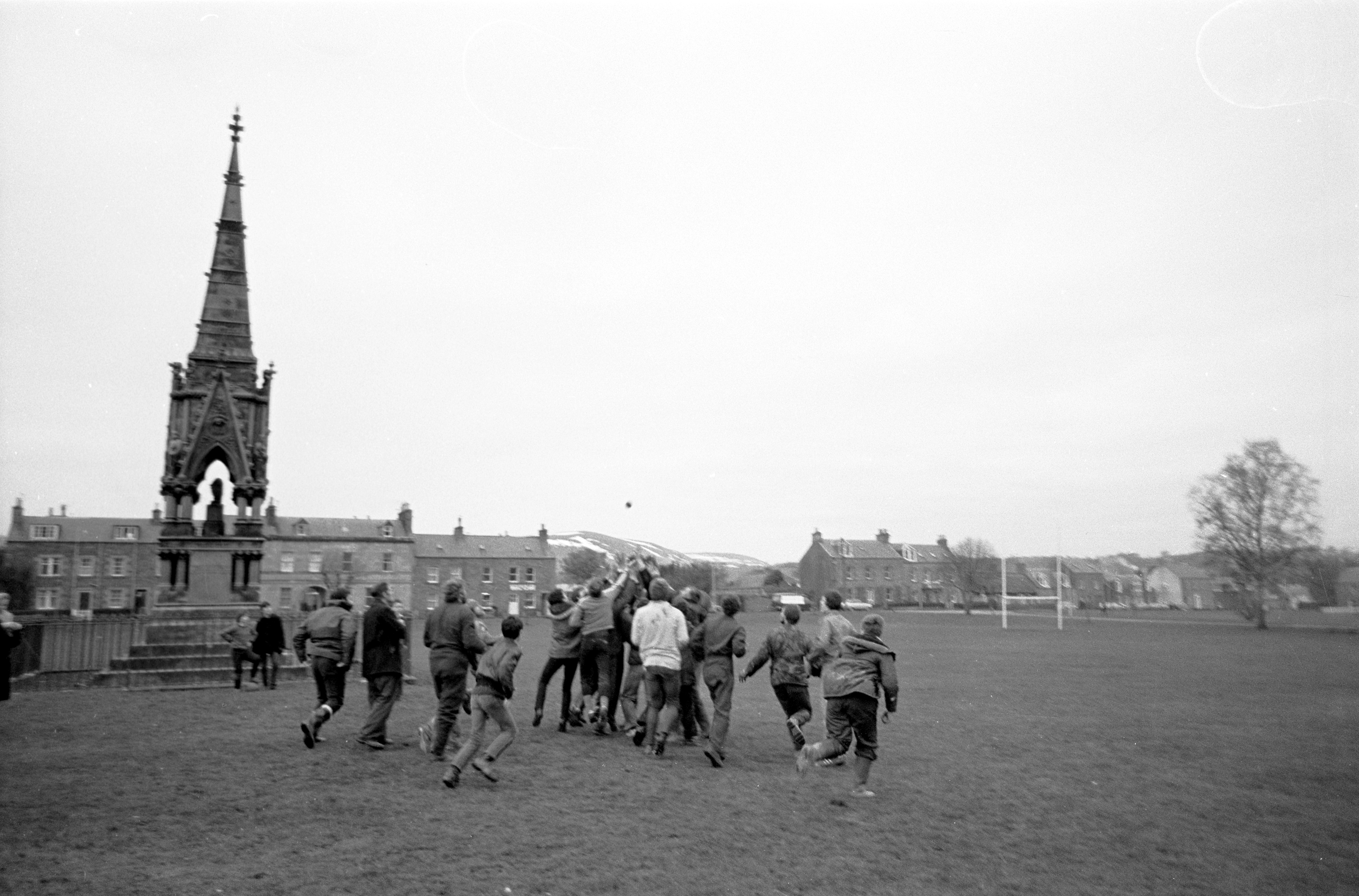
2. . The opening of play at Denholm.
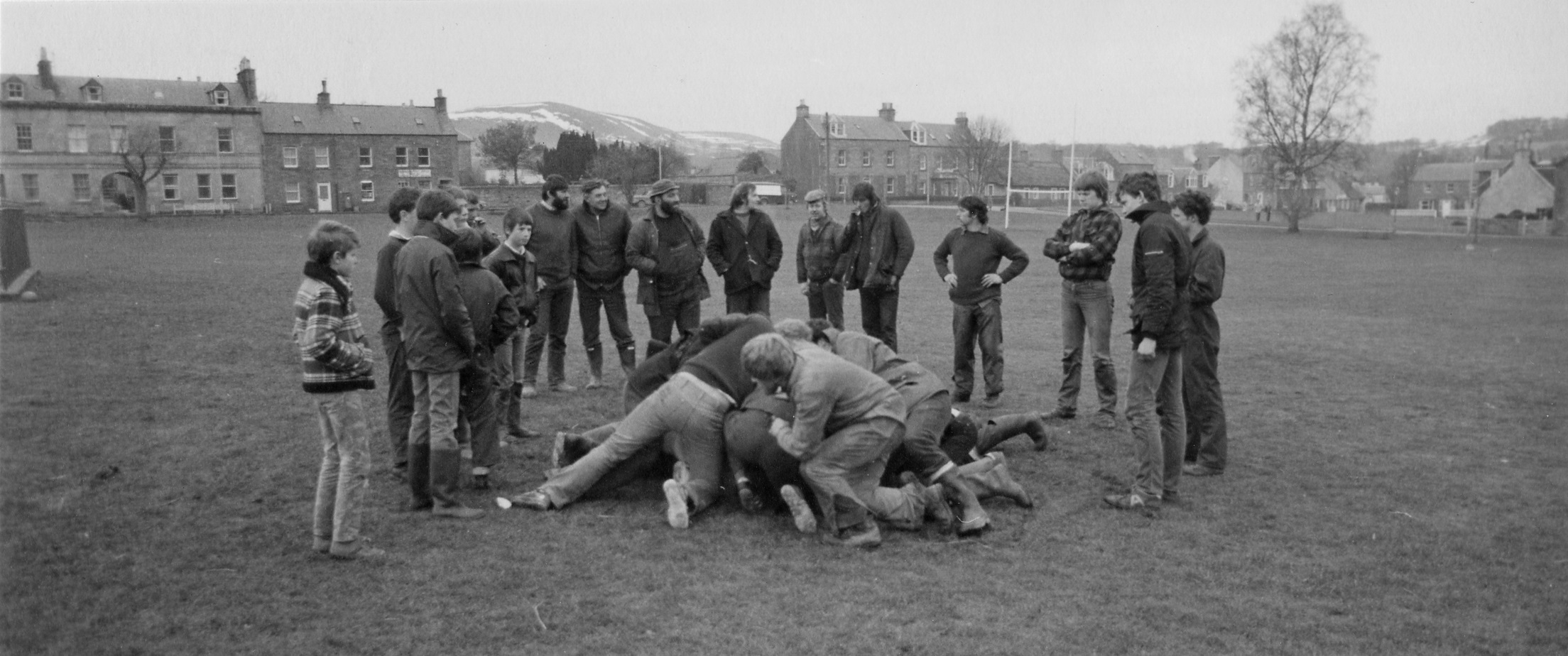
3. The strow at Denholm. This shows a heap of men on the ground with others standing round them.
The game does not require daylight but can continue after dark.
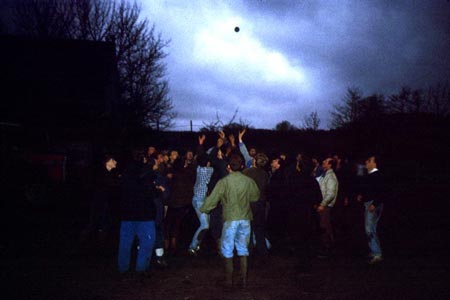
4. Playing in the twilight at Hobkirk.
The players are not distinguished by team colours. They are divided by geographical halves into ‘Uppies’ and ‘Doonies’ and they know each other. The goals, called ‘hails’, are natural or built features that can be more than a mile apart. The players do not drive the ball into the opposite hail but bring it into their own hail
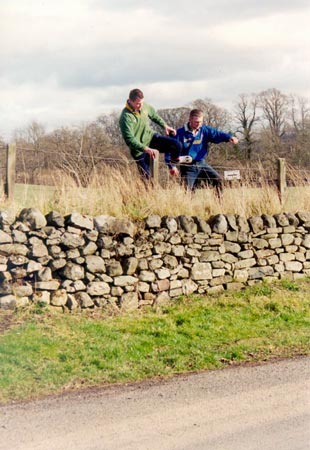
5. A Doonie player at Ancrum returning after hailing the ba’ over the dyke that forms the Doonie hail.
After a ball is hailed, another is thrown up, but not all balls reach the hails during play for they can be hidden (‘smuggled’) in such places as a milk churn, a rabbit burrow, or the player’s clothing, deliberately worn loose for this purpose.
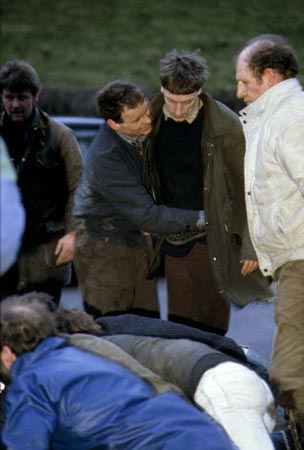
6. A player at Hobkirk being searched for a smuggled ba’.
When a player successfully smuggles a ba’, he is expected to take it to a hail before claiming the payment put on it and he does this when the action of the game is elsewhere.
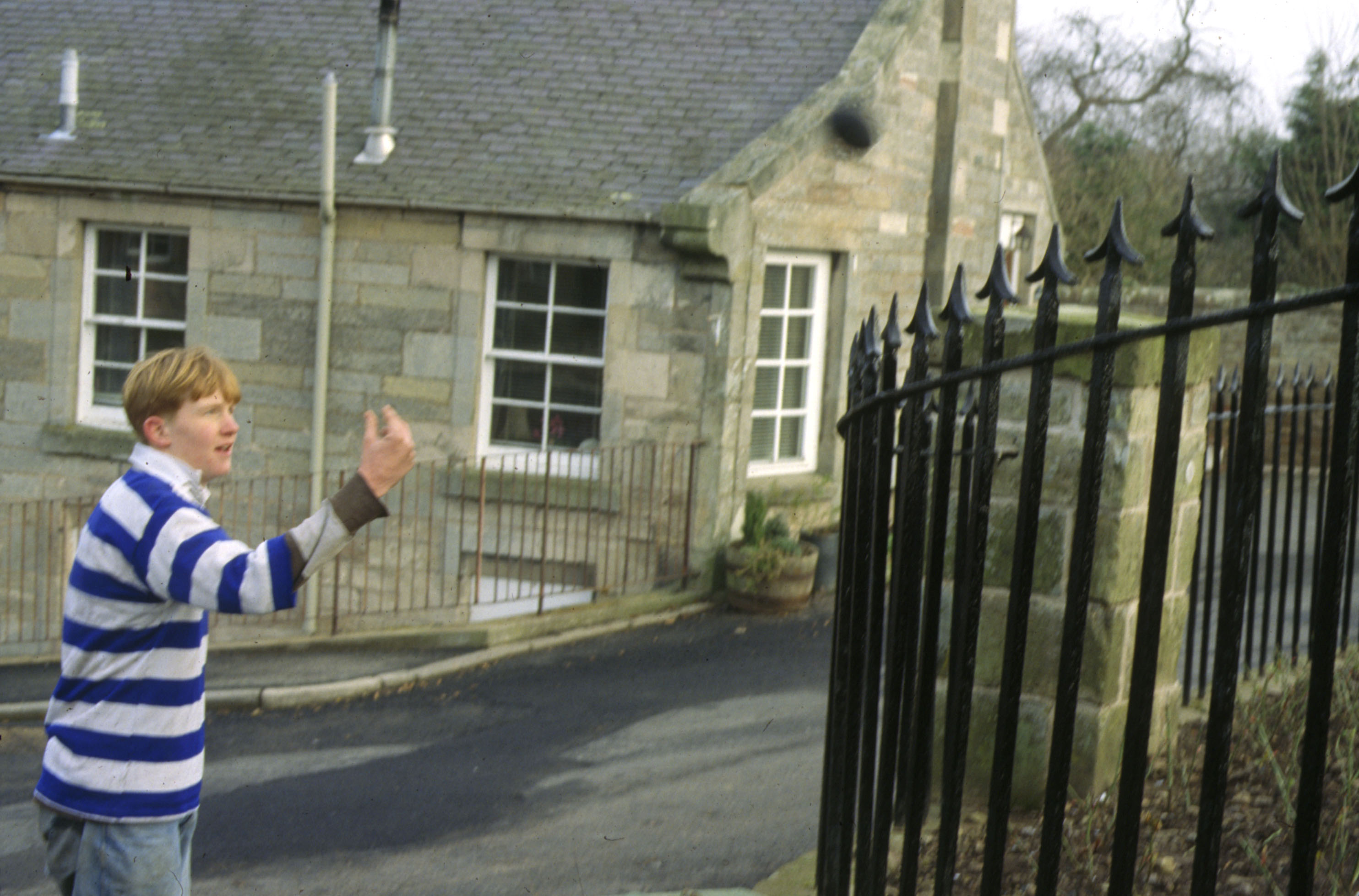
7. A player at Jedburgh hailing a smuggled ba’ at the Uppie hail.
In Jedburgh, the game is played in the streets of the town and the windows are barricaded to prevent damage.
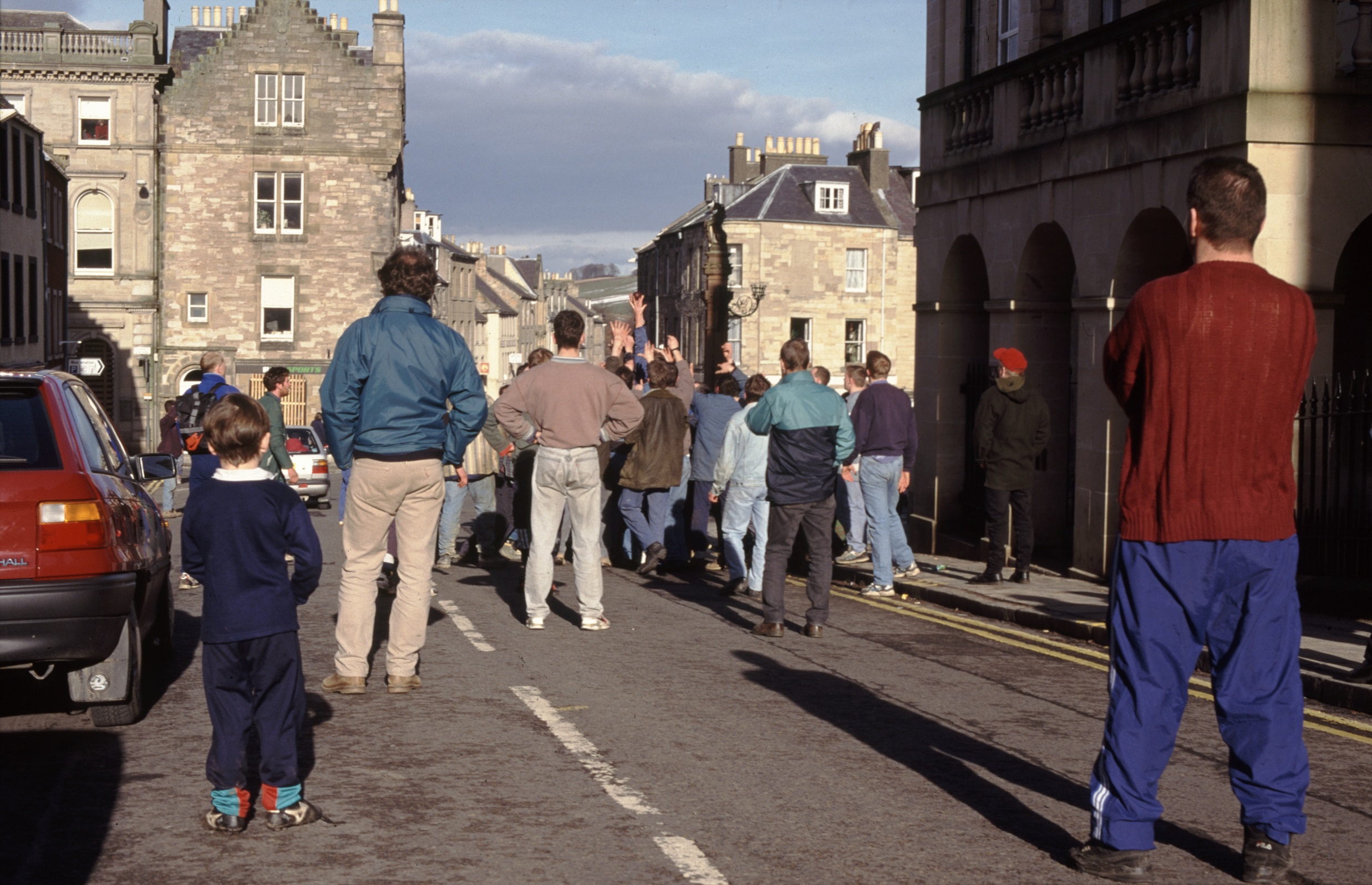
8. Players in a street in Jedburgh.
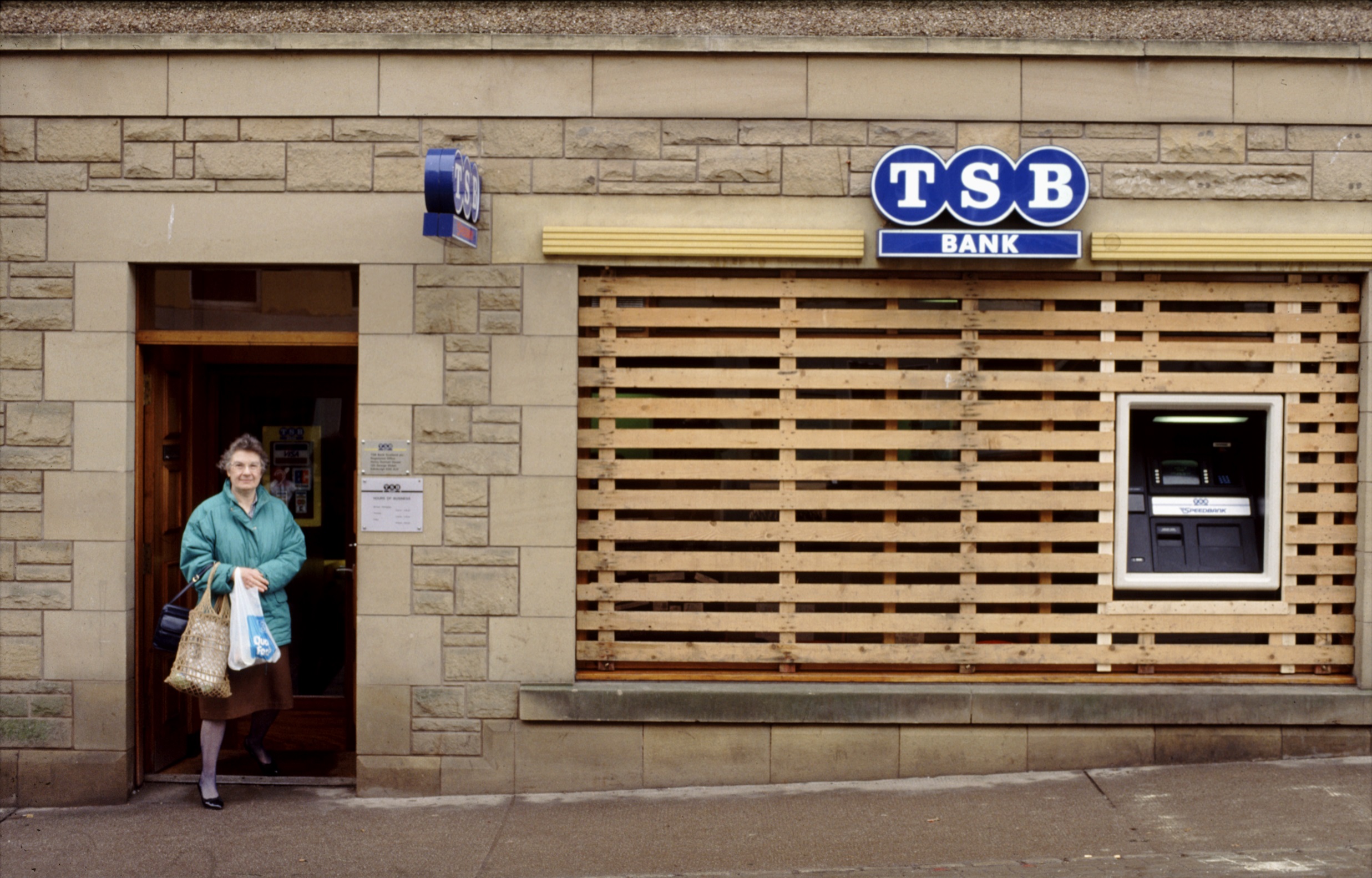
9. A boarded-up window in Jedburgh.
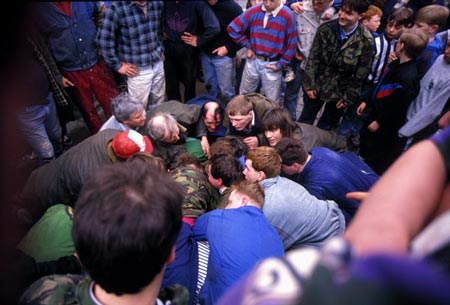
10: A Strow in Jedburgh
Sometimes there is a separate boys’ game before the men’s game.
.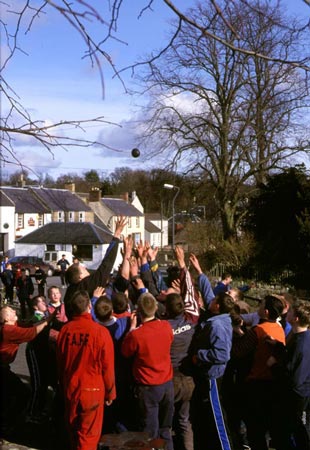
11. Boys playing at Ancrum
In Lilliesleaf the game is played in the fields by school children.
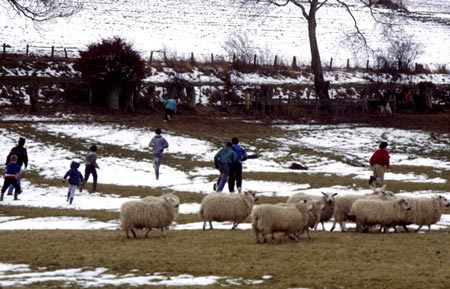
12. Children playing at Lilliesleaf in the snow.
Visitors can take part in these games and are Uppies or Doonies depending on the direction from which they come.
The cluster of games in these locations takes place on various dates following the first new moon after Candlemas (2 February) and it is always very cold. The game that was played at Duns ceased in the nineteenth century when there was a snowstorm one year and, when it was resumed in the 1940s, it was as part of the town’s summer festival with barrels in the town square as hails.
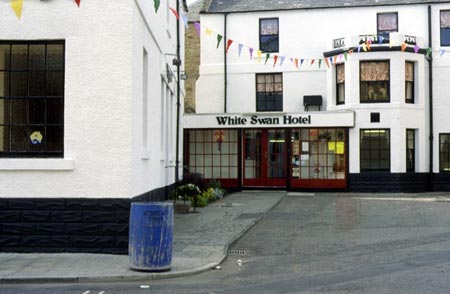
13. One of the hails in Duns.
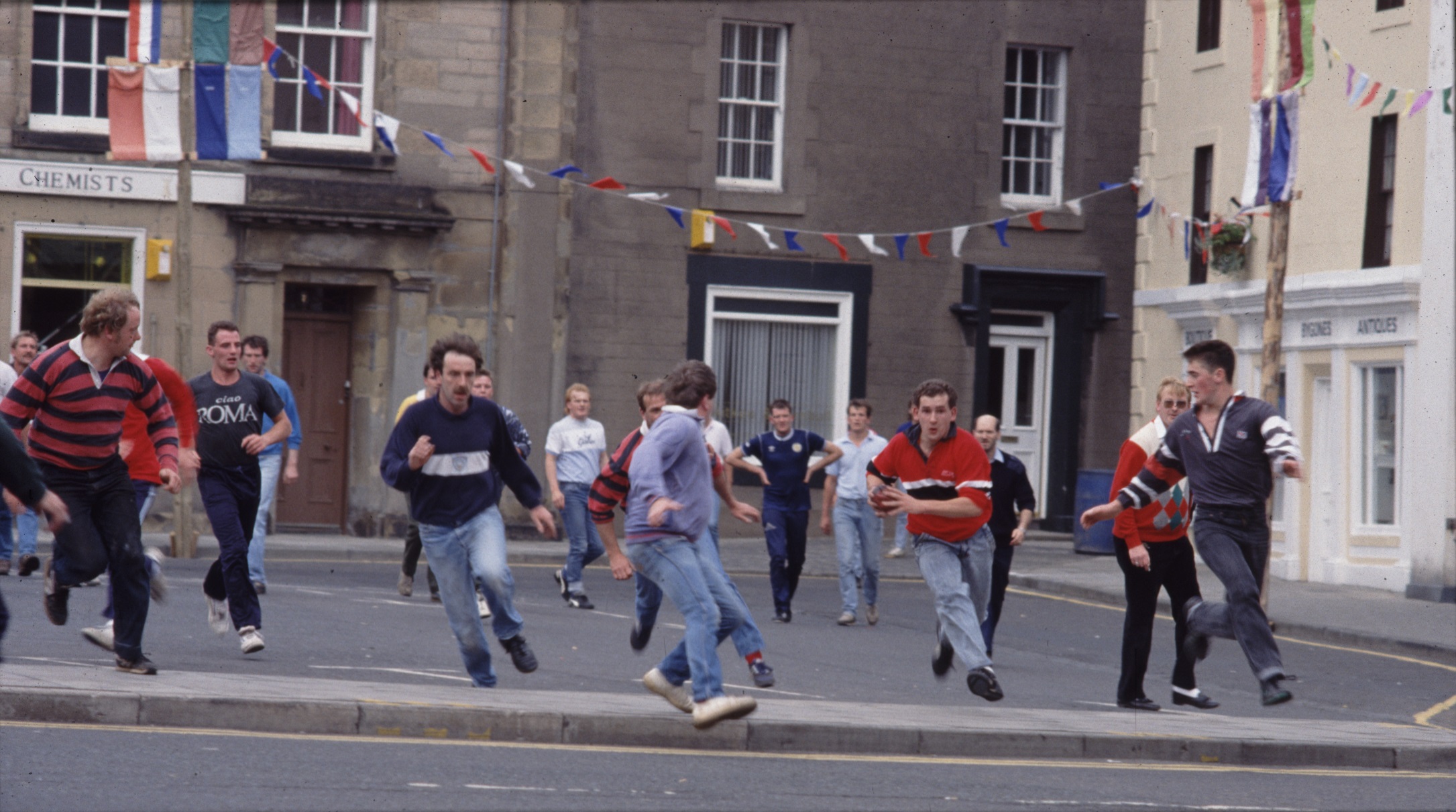
14. Players running through the square in Duns.
The game is generally played at a specific time of year but its early connection with weddings is preserved at Melrose where the game is played after the marriage ceremony. The ball has been updated to a Rugby ball.
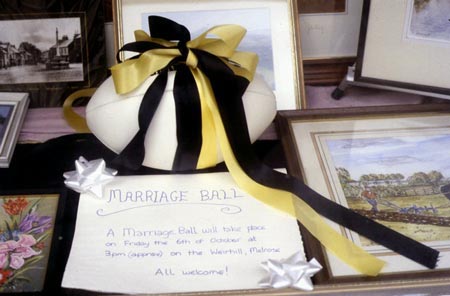
15. An announcement of a wedding ba’ in a shop window in Melrose.
If you didn’t already know about the Borders ba’ game, you may have found all this as surprising as I did!
Dr Emily Lyle is an Honorary Fellow in Celtic and Scottish Studies and has been with the department since 1970. Her main areas of research have been Scottish songs and customs and Indo-European mythology.
Photograph credits
Please do not reproduce without permission
All images held at (C) The School of Scottish Studies Archives.
Images 1-3 Lesley Davenport
Images 4, 6-8, 11-14 Ian MacKenzie
Image 5 Gisela Stuart
Image 9 Neill Martin
Image 10 Tom McKean
Image 15 Emily Lyle
Click & Collect comes to the Law Library
The Law Library now is part of the Click & Collect Service!
The Click & Collect service has been expanding since it’s launch in Feb 2021. As of 29th March 2021 staff and students are able to place Click & Collect requests for print material from the Law Library collections.
The Law Library resources are in addition to those already available from the Main Library, New College Library, ECA Library and University Collections Facilities. Items based at other site libraries are not yet available for Click & Collect.
To order a book collection using the service:
- Place your request through DiscoverEd.
- You can order up 3 Click & Collect items at any one time. The maximum number of requests covers your total current Click & Collect requests.
- All items requested should be collected from the Main Library as the Law Library remains closed.
- Staff will undertake retrievals of items requested from the Law Library once a week (Tuesdays). So depending on when you place your request it may mean that it may take over a week for you to receive an email notification that your requested item is available for collection.
- Once you have received an email notification that your requested Law Library item is available you should make a booking to collect your item from the Main Library.
Full details of the service are available on the main Library Click and Collect Service webpages:
Don’t forget that the Scan & Deliver Service is also available to you!
Fundraising for Lyell Digitisation
Library and University Collections Philanthropy Manager, David McClay, brings us news on the fundraising campaign to digitise the Sir Charles Lyell notebooks.
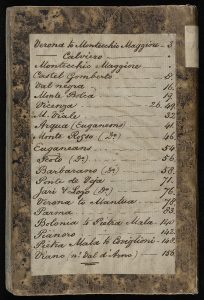
Cover and index of Sir Charles Lyell’s notebook, Italy, 1828 (Ref: Coll-203/A1/7)
The fundraising campaign to digitise Sir Charles Lyell’s notebooks is now well underway. To reach our ambitious target of £125,000 we are hoping that new and existing Lyell supporters and friends will consider donating. Might you be able to help?
We have already been delighted to receive many individual donations from the UK and overseas. If you too would like to donate you can do so online via our Donation Portal or if you are from the United States of America, please see our guidance here
If you are involved in an historical, geological organisation which would be interested in learning more about Lyell, his notebooks and collections, and our plans to make them fully accessible please do get in touch: david.mcclay@ed.ac.uk
David McClay
Philanthropy Manager, Library & University Collections
30 Days In
Senior Lyell Archivist, Elaine MacGillivray, reviews her first month in post and shares some of the exciting work and plans afoot for the internationally significant Sir Charles Lyell archive.
The Sir Charles Lyell archive is of international importance and attracts great interest from academics and researchers from around the world. A key aim of our Lyell project is to make the archive as openly accessible as possible. To achieve this aim, we are progressing a number of areas of project work.

The Charles Lyell Notebooks, 1825-1874
(Ref: Coll-203/A1)
Our project archivist, Elise Ramsay’s cataloguing work continues apace and Elise is aiming to complete the cataloguing of Lyell’s 294 notebooks by the end of July 2021. Between January and March 2021, Elise also undertook a pilot project to transcribe a sample of Lyell’s notebooks using ground-breaking transcription technology, Transkribus. Elise and I were delighted to showcase the Lyell archive, our project plans, and to share our learning from the pilot with 150 international delegates at the EDITOR Transcription Workshop held earlier in March 2021. (More on that exciting development in a future blog post).
While Elise has been diligently cataloguing, I have been busy mapping all of the Lyell archive. We now have a really useful and comprehensive overview of the location, extent, scope and content of the four main elements of the collection, which feeds into our newly devised cataloguing work plans.
On completion of the first phase of cataloguing, the subsequent focus will be Lyell’s vast working correspondence and notes allocated to the University of Edinburgh in Lieu of Inheritance Tax in 2020. We have already migrated some of the existing descriptive data for this series to an electronic data-set which we can use to undertake a stock-take. This work will allow us to enhance the existing item level descriptions which we will then import into our online archives catalogue ArchivesSpace. With almost 1200 letters and a further 54 folders of papers including lecture notes and field-work we expect this work to keep us busy for some time!
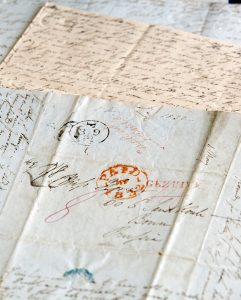
Letters from Sir Charles Lyell from the Sir Charles Lyell archive.
Photo © David Cheskin
(Ref: Coll-203/Uncat)
Lyell’s correspondence includes letters between Lyell family members from as early as 1806 (when Charles Lyell was only 9 years old), as well as over 640 letters received by Charles Lyell between 1829 and 1874. 65 of those letters are from botanist, explorer and close friend of the naturalist Charles Darwin, Sir Joseph Dalton Hooker (1817-1911). They cover almost 40 years (1846-1874) during which time, Hooker was appointed botanist to the Geological Survey of Great Britain, undertook expeditions to India, the Himalayas, Syria, Palestine, and Morocco, and was latterly appointed Director of the Royal Botanic Gardens at Kew. We can’t wait to discover how these letters further illuminate the relationships and ideas shared between Lyell, Darwin and Hooker. We will be sure to share our findings with you here – watch this space.
Thanks to generous funding from the National Manuscripts Conservation Trust, supplemented by philanthropic donations we are delighted that a comprehensive conservation and preservation project will commence, we hope, later in the summer of 2021 (global pandemic permitting). I have been working closely with our Special Collections conservator to pull together a work-plan for our incoming project conservator. The conservation project will see all of the Lyell archive cleaned, repaired, consolidated, stabilised, rehoused and the conservation work fully documented. This work will serve to stabilise the collection, preventing the exacerbation and risk of further deterioration. Expect more updates on this work later this year.
Other work for me has centred around developing our project plans for the next three years: looking at how we can best enable collections access and bring to light the fascinating stories, ideas and knowledge from within the Lyell collections, to support learning, teaching and research. With this in mind, we quietly launched our public engagement account on Twitter on 8 March 2021. We were somewhat overwhelmed by the warm welcome we received and are delighted to have amassed 184 friendly followers already. You can follow us @LyellTime for more regular project highlights and chat from the project team as we work to preserve, catalogue, digitise and engage with the Sir Charles Lyell archive.
As well as plans for the development of our online resource ‘Charles Lyell’s World Online’ (thanks to generous funding from the International Association of Sedimentologists), we have a high profile, impactful and collaborative exhibition and engagement programme in our sights for the second half of 2023.
Our plans also include a significant programme of collections digitisation. We have completed a trial of photographing at high resolution 12 of Lyell’s notebooks. This means that you can now view over 1500 pages from these 12 notebooks via the University of Edinburgh Image Collections website. These images are CC-BY licensed supporting the University of Edinburgh’s open education activities and initiatives. You can find more information on CC-BY licensing on the Centre for Research Collections Image Licensing website pages.
Digitisation helps us to protect and preserve this unique archive collection whilst simultaneously enabling and enhancing access. Completing the digitisation programme means that digital images of the Lyell collections will be openly accessible online. Digitised content is also critical to our plans to generate transcriptions of the Lyell collections using Transkribus. Our ambition is to build on our existing transcription pilot to build a significant body of transcribed material, making the collections more broadly accessible to all levels of scholar.
We hope you have enjoyed reading about our news from the last month. Please share your thoughts in the comments. Next month, Elise and our project volunteer Erin McRae, will be bringing you an update on our pilot transcription project – stay tuned!
Elaine MacGillivray
Senior Lyell Archivist
Queering the Archive: An Announcement of a New Initiative
We are excited to announce the work on our new Queering the Archive initiative. This initiative aims to increase representation of LGBT+ records within our collections.
Queering the Archive will hope to investigate the gaps in our collections and cataloging to improve LGBT+ representation with aims for further development and active archiving in the future. The initiative is a part of our 70th Anniversary plans and will be included in a series of events over the rest of the year. The initiative will allow us to go forward in improving marginalised and underrepresented voices and material.

Progress Pride Flag
There are unfortunately little accounts of LGBT+ histories and recordings in the School of Scottish Studies Archives. In particular, there is little representation on queer folklore, folk narratives, or songs in a wider historical and archival setting. LGBT+ histories are sometimes ‘hidden’ histories, either through historical context on discussion of LGBT+ identity and topics, lack of archiving or archival interest, or a lack of appropriate and inclusive search-terms and cataloging that reflects queer identities.
Queering the Archive will begin with an intervention and discussion workshop.
The workshop will provide a starting point to actively work with the community to discuss our collections, representation, as well as crowd-source search-terms for improvement of cataloging developed by and for the LGBT+ community.
Workshops will allow participants to engage with our records and active intervention through crowd-sourcing and discussion. It is our aim to work with the community, skill-share, and offer meaningful collaboration and discussion as much as possible throughout the initiative. It will introduce you to our collections, queer theory, and investigations into our LGBT+ and related records.
Workshops will be completely free and led remotely via Zoom, and will utilise other platforms.
Dates are to be announced.
We will also be producing a series of blogs exploring the initiative and application of queer theory to our collections with further discussion.
The next blog will explore queering the collections through the popular and infamous ‘cross-dressing’ ballads and exploring the queerness and issues of LGBT+ representation in the context of the selected ballads and traditions.
We will also be exploring the work ‘behind the scenes’ of Queering the Archive through our blogs and we will include other exciting material and updates!
If you are interested in taking part in the workshops, researching LGBT+ records, using our collections for your work, depositing your work and records, or working with us for Queering the Archive, please contact Elliot.Holmes@ed.ac.uk
Written by Elliot Holmes.
Elliot is one of the Archives and Library Assistants at the School of Scottish Studies Archives and uses He/They pronouns. You can also find him on twitter @elliotlholmes
Follow @EU_SSSA on twitter for updates on the 70th Anniversary, Queering the Archive, and sharing our collections.
#SSSA70 #QueeringSSSA
The term Queering has been used by many across the Gallery, Library, Archive, and Museum, (GLAM), sector with many launching queering initiatives to expand and represent LGBT+ histories. We will be using the term Queer as a catch-all term, and the term Queering in regards to application of queer theory and approaches. We will also be using the term LGBT+ throughout the initiative.
SSSA in 70 Objects: The Barnyards o’ Delgaty
Contributor: Enoch Kent
Fieldworker: Hamish Henderson
Reference: SA1954.33.a6
Link to the song on Tobar an Dualchais: http://tobarandualchais.co.uk/en/fullrecord/30120
Response by: Robert Fell
This Bothy ballad – rendered beautifully here by Enoch Kent in 1954 – holds a special place in my heart because it was one of the first examples of the genre I heard from The School of Scottish Studies Archives. At the time, I was working towards my undergraduate degree on the Scottish Studies 1B course ‘Creating Scotland’, where this track was used as an example of the unique repository of knowledge that the archives represent. From that moment on, I knew that my academic interests lay in the exploration of our archive and duly shifted the focus of my degree from English Literature to Scottish Ethnology. My current doctoral project has revealed to me that the diverse range of intangible cultural heritage embodied by the archives is truly breath-taking. This researcher, for one, has merely scratched the surface.
Enoch’s ballad belongs to genre of narrative songs associated with the reorganisation of rural Scottish society during the ‘Agrarian Revolution’ of the nineteenth century. ‘Just as the growth of capitalist farming ensured that the farming units were split up into large farms and small crofts’, says David Buchan, ‘it ensured that rural society was divided into a small group of wealthy farmers and a large group of farm labourers’ (1972: 255). These labourers were often peripatetic and sold their labour to farm owners on a six-monthly basis, a procedure known as ‘feeing’. From the 1830s until the late nineteenth century, the feeing procedure was notoriously inequitable and exploitative, in favour of the farm owners, of course. The unmarried labourers would live in Bothan [Scottish Gaelic: ‘hut, cottage’] attached to the farms and pass their leisure time sharing songs.
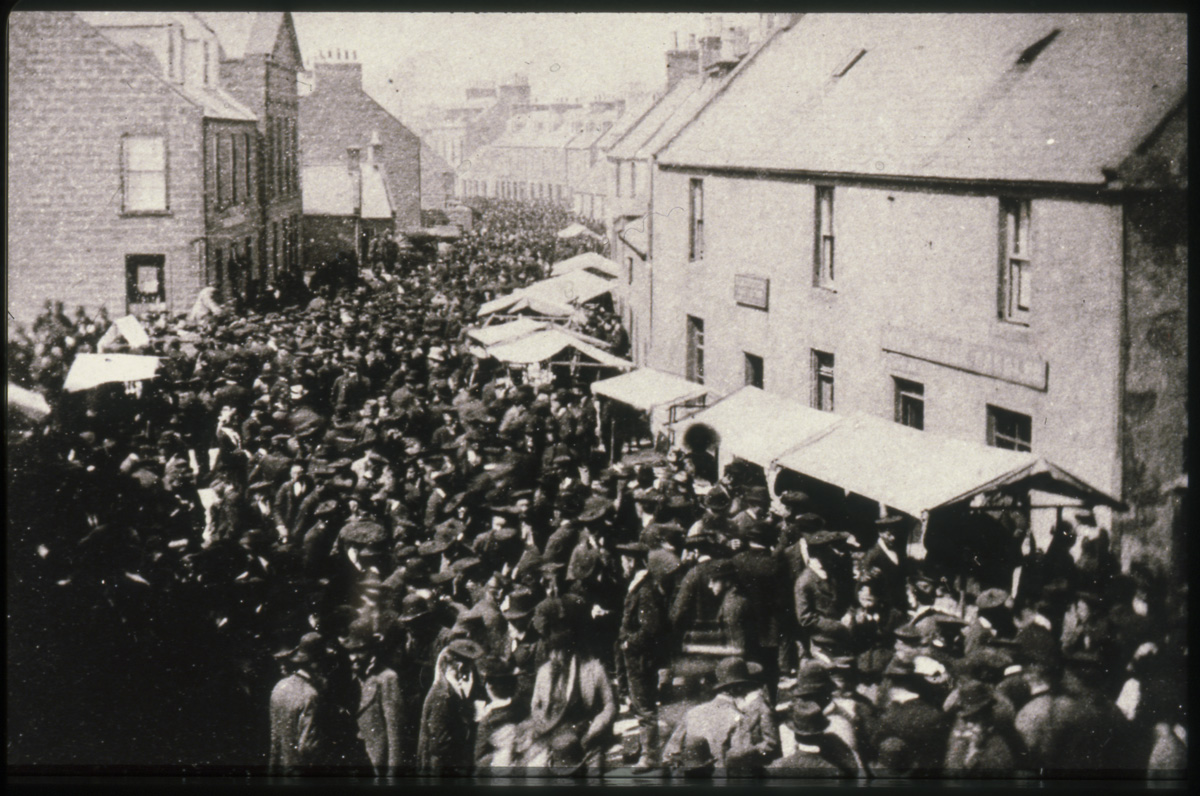
Turriff feeing Fair, 1890. (Photo: Peter Cooke Collection) (School of Scottish Studies Archives & Library) (ref. Peter_Cooke_Red_box 8_126)
Thus, a ‘new-style ballad grew and flourished […] and the literate descendants of the oral-traditional singers created and sang ballads which have traces of the old style, and which, like the old ballads, grew organically out of a certain set of social conditions’ (Buchan 1972: 268). Buchan goes on, noting that ‘instead of escaping from the hard realities of everyday life by singing about another life’, the Bothy ballad singer ‘relieved his feelings by commenting directly and sardonically on the life he led, day in, day out’ (1972: 268). In The Barnyards o’ Delgaty, for instance, we hear about the poor condition of the farm’s horses, them being all ‘skin and bone’; the narrator rails against the perceived social control exerted by the famer, exclaiming ‘I can drink and no be drunk’ and boasting that he can ‘fecht [fight] and no be slain’; and the central importance of the feeing procedure is writ large by its incorporation in the expressive culture of the farm labourers. The promises of the farmer and the bleak actuality of the farm (Buchan 1972: 262) are thereby negotiated in song, giving us an unparalleled insight into the lived experiences of Scotland’s farm labourers during the nineteenth century. Even this terse examination hints at the rich resource the archives represent for casual listener and researcher alike.
Robert Fell is a doctoral researcher in Celtic and Scottish Studies working with the storytelling traditions of Scotland’s Traveller communities.
Work Cited:
Buchan, David. 1972. The Ballad and the Folk (London: Routledge & Keegan Paul). Online access via DiscoverEd
Five things ASLs have been doing to help students since lockdown 2020
When coronavirus restrictions began in March 2020, the University of Edinburgh had to close some libraries and change some library services. But Academic Support Librarians haven’t gone away. We may have been working from home, but we’ve been busy helping students to get the best out of the library. So what have we been doing?
- Keeping you updated
From the start of lockdown the Library Academic Support team web editors have maintained the Library Updates page to provide an overview of the library services available to you during coronavirus restrictions.
- Helping you to get the books and journals you need
Coronavirus restrictions made it difficult to access the print library collections for your courses. We listened to what you needed and worked with our Library Acquisitions colleagues to purchase new digital versions of texts you could access remotely. We couldn’t get everything we wanted – sometimes publisher prices were just too high (see this reported in the press) and sometimes what you needed simply wasn’t available as a library e-book. But we worked to spend hundreds of thousands of pounds on new digital content to meet student needs.
- Giving help and advice for your dissertation research
We understand that researching your dissertation during coronavirus restrictions is a huge challenge. We’ve offered you help and advice on your library research by email and, if you needed it, a chance to meet online for a chat, with multiple librarian appointments available every week (we’ve met over two hundred students so far this academic year). Plus, we’ve run online Dissertation Festivals in October 2020 and March 2021 with events highlighting the wealth of digital resources available from the library and beyond to support your dissertation research.
- Writing an information literacy online course
We want every student to have the digital skills they need to use online library resources, so they don’t miss out on any of the resources and support that’s available to them. So we’ve written an online course, LibSmart, to help you develop key information literacy skills to navigate the library landscape for your studies and succeed at university.
- Making videos
We’ve delivered over two hundred live information literacy classes to students this academic year, but during coronavirus restrictions we know that you can’t always make it to a class when it’s happening. That’s why we’ve created over a hundred videos, many of them bitesize, so you can find out what you need to know about the library, when you need to know it.
Christine Love-Rodgers, Academic Support Librarian
Collections
 Love, Loss, and Literature: Cataloguing the Papers of Irene Jessie Young
My name is Nancy Britten, and I’m in my fourth year of studying History at...
Hill and Adamson Collection: an insight into Edinburgh’s past
My name is Phoebe Kirkland, I am an MSc East Asian Studies student, and for...
Love, Loss, and Literature: Cataloguing the Papers of Irene Jessie Young
My name is Nancy Britten, and I’m in my fourth year of studying History at...
Hill and Adamson Collection: an insight into Edinburgh’s past
My name is Phoebe Kirkland, I am an MSc East Asian Studies student, and for...
Projects
Cataloguing the private papers of Archibald Hunter Campbell: A Journey Through Correspondence
My name is Pauline Vincent, I am a student in my last year of a...
Archival Provenance Research Project: Lishan’s Experience
Presentation My name is Lishan Zou, I am a fourth year History and Politics student....