Home University of Edinburgh Library Essentials
April 7, 2026
Review 2022 and a look towards 2023
A lot has happened in 2022! Supported by both core and external funding, and with a return to more normal ways of working, we have been able to re-start and complete many of our plans.
Conservation
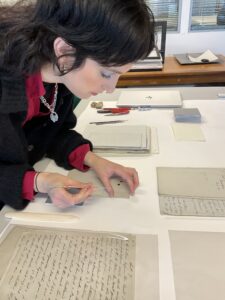
Sarah carefully treating minor folds
The care of the Lyell archives was our priority. Supported by external funding from the John R. Murray Charitable Trust, the National Manuscript Conservation Trust and others, professional Conservator Claire Hutchison worked on the collection from January – July 2022, along with two project interns, Joanne and Sarah M. We were able to slightly extend the conservation project, so a big thanks is due to Sarah P, who was able to clean Lyell’s Offprints and treat minor folds and tears found in his MS edits.
Digitisation
The University’s Cultural Heritage Digitisation Service have been making good headway, and we are 50% of the way there. At present, the digital images are hosted on the University’s image website Luna. You can use the left hand menu to select the Notebooks, select particular pages and zoom in on the detail – really helpful when deciphering Lyell’s handwriting. Mindful of any conservation needs, the team are able to also prioritise notebooks specially requested by researchers -so do get in touch – the team are very much bolstered by enthusiastic responses!
Charles Lyell’s World Online
Hosting the digital images online is one thing, but we also want to enhance digital access online. Funding provided by the International Association of Sedimentologists has enabled us to bring a Lyell Website Developer onboard. We know that Lyell’s Notebooks are packed with information; this information can jump around from topic to topic, but also builds, from observation to noting queries he needs answers to. The Web Team are currently working to apply the International Image Interoperability Framework (IIIF) that will allow the user to view the Notebooks, and flip seamlessly through the pages. Once this step is completed, we will explore what other functionality can be added to enhance the reader’s experience.
Cataloguing & transcription
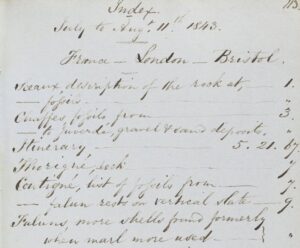
We are using the Notebook indexes to create a catalogue entry – they are often written by Mary, they can run to 6 or 7 pages – or missing entirely!
We have two cataloguing priorities – the Notebook indexes, and one set of Lyell’s correspondence. As we now have a large amount of Lyell’s handwriting digitised, we can start to share out the work to remotely transcribe the indexes using the AI platform Transkribus. The transcriptions are not completely accurate and need to be manually checked, so it’s time consuming, but the results produce rich descriptions that will enable good searching. A small group of remote online volunteers are working away on this (and doing a great job – thank you!). Please get in touch if you would like to join us!
We’ve also recruited on site volunteers, who are able to visit the CRC reading room, and view records that are not digitised. They are working away on one tranche of Lyell’s correspondence, identifying the senders and enhancing description. So far we’ve encountered some eminent correspondents, including Lucas Barrett and Samuel Beckles – yes, we are at the ‘B‘s!
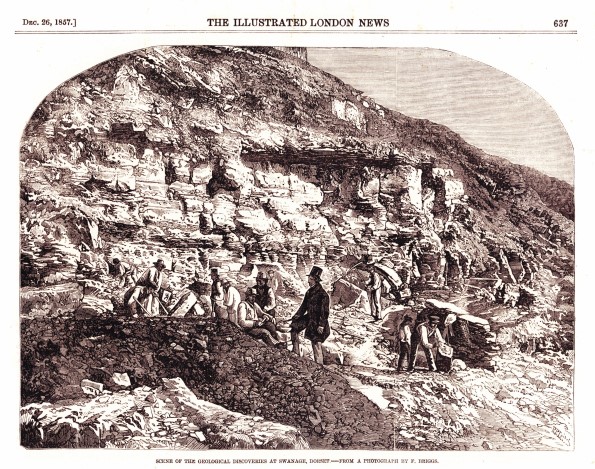
Beckles’ Pit at Durlston Bay, with Samuel Beckles wearing a top hat, directing operations. He is in touch with Lyell as soon as he starts finding specimens, Christmas 1856.
Looking ahead to 2023
As well as working on the website, plans are now in place for us to host what will be the first major exhibition on Lyell. This will be located in the Main Library Exhibition Gallery and will run from November 2023 to February 2024, so see you there! Lyell represents a huge topic – both in terms of scale and impact. The depth and breadth of the collection held at the University of Edinburgh offers a brilliant opportunity to show how he worked to develop and then promote his ideas. We’re also delighted to have secured funding to support a Lyell intern, who will focus on collating historical context and Lyell’s travels to populate both the exhibition and the website – more from them in 2023.
Thanks for all your support so far – enjoy the holidays when they come.
Pamela
Meet your LexisNexis Student Associate for 2022/23!
You may have seen that we’ve featured LexisNexis quite a lot on the blog this semester, due to the launch of their new platform, Lexis+. We’ve provided a fair bit of information about how to access items and how to get further training, but one person we have yet to mention is your Student Associate, Olivia Riddell. Lexis employ Olivia to provide peer support for students at the University of Edinburgh who want to work with Lexis and use it for their studies or research. We had a quick word with her to ask her more about what her role entails:
Tell us a little bit about yourself! Who are you and what do you study at Edinburgh?
My name is Olivia, and I am a fourth-year law student at Edinburgh. I am from the North of England but wanted to study at Edinburgh as a bid to broaden my horizons. It has been nice to experience the quieter life and scenery that Scotland offers before accessing work opportunities in the City.
Why did you apply to be the student representative for LexisNexis?
I wanted to have experience related to law. My previous experience working in retail taught me soft skills and resilience, but this role has truly developed other areas needed in a professional capacity such as marketing strategies, proactiveness and negotiations. This is especially necessary if students want to harness their skills in preparation for a role requiring good capacity of leadership and business relations. It also challenges me personally. For example, it has improved my confidence (in reaching out to students, and teaching sessions) and stretched my ability to form professional networks with students in the law school, and with faculty staff.
What do you think is the best feature that Lexis offers for students in the Law School?
The ability to type in key words and find related journal articles and added references for essays. It enables you to find related sources that have an affinity with your argument or essay title meaning your assignment will be much stronger based on accuracy and relevancy.
When students book a training session with you, what can they expect to get from the meeting?
There are different types of sessions. I will be organising certification sessions (Foundation and Advanced) which will enhance your professional profile and experience. These downloadable and professional certificates will make you stand out, and you can showcase these on LinkedIn. In addition, I will be running assignment training in December 2022 and Easter 2023 to ensure you know how to use LexisNexis to help in your upcoming assignments. In semester two, I will also be conducting commercial awareness sessions in 2023 to help with future internship and vacation scheme placement applications, and how you can access such material on the LexisNexis site.
You can reach Olivia by email with any queries or training requests: s1925406@ed.ac.uk.
If you need help with any other databases or would like to discuss other available training please let the law librarian team know by email: law.librarian@ed.ac.uk.
Study Spaces in the Law Library
One of the most common concerns for Law students at this time of year is finding study spaces in the library to help them get ready for assignments and exams. We know the Law Library is a favourite place to study, so here are some ways we’re trying to help manage during peak periods.
EXTRA STUDY SPACES:
Library Services book out other rooms in the University to help meet demand for study spaces during the revision and exam period. The spaces closest to the Law Library are the MacLaren Stuart and Quad Teaching rooms in Old College, and there are helpful signs pointing the way to these at the entrance to the Law Library:
G.158 Quad Teaching Room (seminar room, 15 seats) and G.159 MacLaren Stuart Room (large classroom, 55 seats)
Open daily from Saturday 3 December to Wednesday 21 December.
Opening hours as per Law Library opening hours: Monday to Thursday 09:00-21:50 ; Friday 09:00 to 18:50; Saturday 09:00 to 16:50 ; Sunday 12:00 to 18:50 on 4, 11, 18 December.
There are also temporary additional study spaces open at the Main Library and 40 George Square for study and revision; details can be found of these and many other study spaces across campus on the Study Spaces part of the website.
More information about opening hours for the Law Library specifically over the festive period can be found on the Law Library pages of the Library website. Please note that there are extended opening hours on Sundays in December (on 4th, 11th or 18th) until 18.50. Usual Sunday opening hours (open until 16.50) will resume in January.
STUDY MONITOR:
We’ve asked our student staff to work as study monitors from Monday 12th to Friday 16th December. They will be helping students find spaces, take counts and to monitor how the study space cards are being used.
STUDY BREAK CARDS:
Cards are situated around the library that can be used to keep your space while you take a short break. Turn the card to 15 minutes for a Short Break or fill out the time you intend to be away from your desk for longer breaks like lunch (up to one hour). This scheme has been shown to encourage healthy study patterns and help utilise the space we have available. We’ve used this system in the Law Library in the past and it’s gotten great feedback, so much so that it’s been extended to other libraries in our network.
RESERVE COLLECTION DESIGNATED DESKS (NEW):
One of the concerns we’ve heard from students is that at peak times there’s nowhere to consult Reserve (3-hour loan) materials as it’s impractical to take these items far from the library for use. We listened and are now trialling a system where the 18 desks nearest the Reserve collection on the ground floor are Designated Desks in order to use materials from the Law Library specifically. If students require use of these desks they should alert Helpdesk staff who will put out a call for those not using Law Library collections to vacate this bank of desks within 20 minutes. Signs indicating this procedure are posted on these desks.

We believe this is a compromise that can work for students who need to use materials held specifically in this library without limiting who can work and study in the space. We understand Law students can feel that they should be prioritised when it comes to space in the Law Library, however the Law Library is part of a network of 13 site libraries – including the Main Library, which also houses high use law books – and limiting access to one of these is neither possible nor fair. Law students also benefit from being able to use any of the campus library facilities – for example, did you know that the new KB nucleus is directly connected to the Murray Library and is open to everyone (including Law students)?
While we can appreciate the issues with finding space in the Law Library we find it a great compliment that so many students want to study with us. We are limited in the number of seats available but we hope you’ll understand we’re doing what we can to maintain a pleasant and peaceful study environment; the fantastic Helpdesk team are always on hand to assist where they can.
If you have queries or want to speak to someone directly about our libraries and collections, you can contact us by email: law.librarian@ed.ac.uk. We’d love to hear from you.
Digital Witness
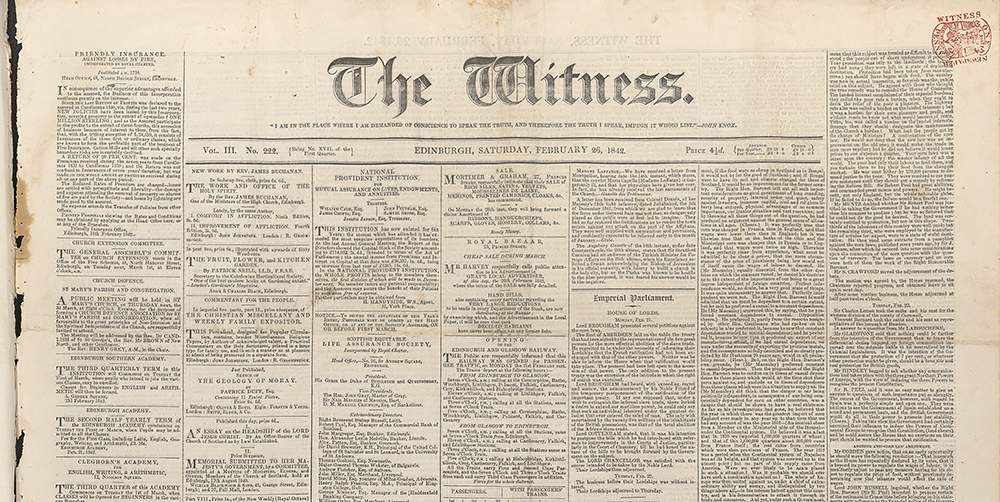
We have started digitising The Witness newspaper!
This twice weekly newspaper was created by the Church of Scotland in 1840 and edited by Hugh Miller (see https://en.wikipedia.org/wiki/Hugh_Miller ), an influential writer, geologist and stone mason. The Church of Scotland wanted a newspaper that reflected a Christian outlook, as well as news and comment from across Scotland. In 1843 The Church of Scotland was faced with 200 ministers walking out citing political interference, an event which came to be known as the Disruption, and led to the Free Church being established. Presbyterianism is founded on the basis that the people make the decisions, not an elite hierarchy, and the only head of the church, is God. This makes The Witness newspaper a fantastic primary source covering a significant event in Scotland’s social and religious history, and as such, a prime candidate for digitisation. Read More
On trial: Radical Irish Newspaper Archives
Thanks to a request from a researcher in HCA the Library currently has trial access to the Radical Irish Newspaper Archives, an extraordinary collection of over 115 Irish radical and political newspapers, journals, pamphlets and bulletins.

You can access the Radical Irish Newspaper Archives via the E-resources trials page.
Access is available directly on-campus or off-campus with VPN.
Trial access ends 8th January 2023. Read More
The Book Surgery is Open: Learning the Art of Book Spine Repairs
In this blog Project Conservator Mhairi Boyle discusses her new role within the One Health project at the CRC, and the training she has undertaken with Book Conservator Caroline Scharfenberg (ACR).
In August, I started a new role as the Project Conservator for the One Health project within the Heritage Collections team. One Health brings together three archival collections which chart the development of animal health and welfare in Scotland. The collections in question are from OneKind, an animal welfare charity; the Royal Zoological Society of Scotland (RSZZ); and the University of Edinburgh’s Royal Dick School of Veterinary Studies (R(D)SVS).
One of the challenges of this project is the variety of material I am working with. Whilst most of the material is loose leaf archival papers and photographs, we also have many bound volumes. On the opposite end of the spectrum, we have chicken skeletons, animal medicines, vet tools, and graduation robes. In these cases, I will stick to preventive measures such as handling instructions and appropriate rehousing to enable ease of access and prevent any further damage.
SSSA in 70 Objects: Together Forever
Rab Noakes in the Edgar Ashton Collection

Rab Noakes at Oran Mor 2010. Image: PKImage CC-BY-SA
We were very sad to learn that Scottish singer songwriter Rab Noakes passed away last month, aged 75. Rab was a leading figure in the music scene in Scotland; performing live, touring and recording 20 studio albums, He also created music programming for BBC Scotland for many years.
We would like to take this opportunity to pay a tribute by sharing a recording of him from our collections. There are several appearances by Rab in our Edgar Ashton Collection; Ashton was a long serving member of the Edinburgh Folk Song Society and created an incredible number of recordings in folk clubs, at sessions and in gatherings in his own home. Ashton’s collection was deposited in the SSSA over 20 years ago.
From that collection, we would like to share this recording of Rab Noakes singing Together Forever (EA2001.282). We believe this was recorded in the Kirkcaldy Folk Club at the Elbow Room, but unfortunatley we don’t have a date for the recording. Maybe you were there?
Rab was introduced by John Watt (1933-2011), himself a familiar face and voice around the folk clubs of Fife.
Rab Noakes was a unique, unparalleled voice in the Scottish and UK music scene, who will be much missed.
Open Research Support at Russell Group Universities
As part of my work as Research Data Steward, I was asked by our Open Research Co-ordinator to investigate the open research support available at Russell Group universities and how the University of Edinburgh compares.[1] Open research, which is also known as “open science” or “open scholarship”, refers to a collection of practices and principles around transparency, reproducibility and integrity in research. To understand to what extent Russell Group universities have adapted to the ongoing development of open science, we have conducted analysis in terms of four areas. Do they have a published policy around Open Research? Do they have an Open Research Roadmap? Do they mention any training or specific support for researchers in achieving Open Research? What services do they provide to support Open Research?
Firstly, we checked whether those universities have a policy/statement that outlines the university’s approach to support open research and key principles for researchers. Less than 30% of these universities have a clear policy or statement for Open Research. Good examples include the University of Cambridge,[2] University of Sheffield,[3] and Cardiff University.[4]
Secondly, we checked whether they have a Roadmap that provides a set of questions that universities can use to monitor their progress in implementing Open Science principles, practices and policies at a local level. Among the Russell Group members, University of Edinburgh and University College London – two members of the League of European Research Universities (LERU) – [5] provide a roadmap/page dedicated to monitor their progress. (Ours can be found on this Open Research page.)
 Thirdly,what services are provided to researchers to make their work public? Most universities provide support like a data repository (except for LSE), Research Data Management support, Open Access to publications and thesis and guidance on sharing research software. A few provide support on protocols sharing. Some universities have started hosting an open research conference. For example, UCL Open Science Conference 2021, 2022,[6] Open Research Symposium hosted by the University of Southampton,[7] and University Open Research Conference, June 2021, at the University of Birmingham.[8] As an active member of LERU, our university also joined in to launch our first Edinburgh Open Research Conference in May, 2022.
Lastly, we have found all universities have training relevant to open research, with around half of them clearly advertising their training. Some good examples which we could learn from include the “Open Research education for doctoral students” from Imperial College[9] and a practical libguide for open research provided by the University of York[10].
We are glad to see that Russell Group members have started adopting actions to support Open research, which is considered part of the new normal for research-intensive universities. However, this is a long and ongoing process. We have seen that many universities are still in the early stages of the implementation process and more can be done to advance their practice, including ours.
Yue Gu
Research Data Steward
Footnotes
[1] https://russellgroup.ac.uk/about/our-universities/
[2] https://osc.cam.ac.uk/open-research-position-statement
[3] https://www.sheffield.ac.uk/openresearch/university-statement-open-research
[4] https://www.cardiff.ac.uk/documents/2519297-open-research-position-statement
[5] https://www.leru.org/publications/implementing-open-science
[6] See the UCL Blog post for more information. https://blogs.ucl.ac.uk/open-access/2022/03/15/bookings-now-open-for-ucl-open-science-conference-2022/
[7] https://library.soton.ac.uk/openaccess/Plan_S_open_research_symposium
[8] See https://intranet.birmingham.ac.uk/as/libraryservices/library/research/open-research.aspx
[9] https://www.imperial.ac.uk/research-and-innovation/support-for-staff/scholarly-communication/open-research/open-research-education/
[10] https://subjectguides.york.ac.uk/openresearch/home
From Tantruming Cobots to Stephen Hawking at Work- CHDS at the AHFAP 2022 Conference
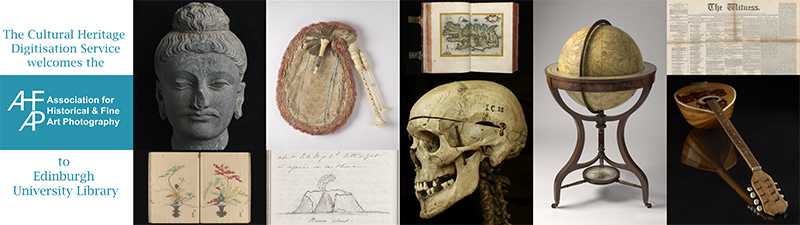
The Association for Historical and Fine Art Photogapher’s (AHFAP) conference is always a highlight of the year and, alongside 2and3D Photography at the Rijksmuseum and Archiving, it has become one of the must-attend events for any cultural heritage imaging professional. This year we were fortunate that AHFAP took place at the National Museum of Scotland here in Edinburgh, meaning for the first time ever the entire Cultural Heritage Digitisation team could attend! Read More
Collecting in East Lothian
We are always encouraging people to get involved with our Project, whether as a volunteer fieldworker or transcriber, or as a willing interviewee. As well as valuing the oral history interview for its own sake we are also keen to encourage and facilitate opportunities for people to get together and learn from each other about the community they live in. In this month’s blog post we hear from one of our East Lothian volunteer fieldworkers, Janis Macdonald, about her interest in social history, how she came to be involved with the RESP and what she has learned from her participation. To date, Janis has carried out 17 interviews with 18 interviewees and, as the following report demonstrates, she doesn’t seem to be thinking of hanging up her microphone anytime soon! We’re very glad to hear this!
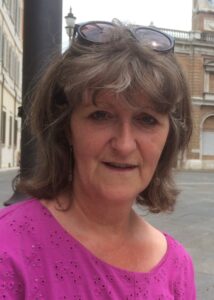 fieldworker, Janis Macdonald
For as long as I can remember I have had an interest in family history. I was very close to my maternal grandparents and I used to love encouraging them to share stories of when they were younger. Both were local and came from large families. However, it wasn’t until more recently that I realised how little I actually knew about their early years. My nana used to deliver Sunday papers for her father, regularly cycling miles out into the country from Haddington. My papa went to school in Prestonpans. I also knew that, as the oldest child he took on responsibilities for the well-being of his siblings.
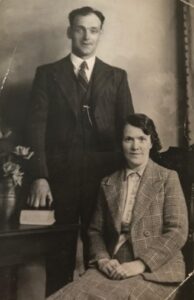 my grandparents, William and Helen Cunningham
On reflection now, I realise that most of the memories shared with me were from their married years, and the childhood years of my mother and her four brothers. My grandfather worked for the local Council and my grandmother for a local baker. I know they both had bikes and that my grandfather, having driven a Council lorry for many years, found the size of his first car challenging and it was regularly to be found parked quite far from the kerb! It’s often too late when we realise how little we know about our families.
Tracing family trees can give us names, dates and places but it is the social history that catches my interest. The Ethnology research project is helping us ensure that we can build our knowledge. People share their stories and this contributes to the pictures we have of when our relatives were younger.
I became involved in the Regional Ethnology of Scotland Project after attending a Haddington Remembered session with my uncle. At that event Ruth, one of the John Gray Centre archivists, asked if I would be interested in helping with fieldwork and later Mark, one of the project researchers, contacted me. He arranged a short training meeting for myself and two other interested volunteers. The session covered how to use the recording equipment, guidance on conducting interviews and there was also time to make some practice interviews. Now that I’m a fully-fledged fieldworker, I find I prefer to refer to the interviews as conversations. The term interview can seem a bit intimidating! Mostly I have engaged in guided conversations though, as I like to have a little knowledge of the person I am talking with!
My first conversation was with my mother-in-law and her twin sister. I felt a bit anxious beforehand but as they started talking I relaxed and it was good fun. One lesson I learned was that when the recorder was switched off the stories kept on coming! Mark gave me feedback on this first interview and commented on the electrical noise throughout the recording. It was my mother-in-law’s air mattress – a noise that we had become so used to that we didn’t give it a thought! Mark’s feedback was supportive and reassuring and he uses his experience to comment on recording levels, types of question and where there might be opportunities to elicit more information.
Everyone has a story to tell. I have had the privilege of talking with a number of local people who have grown up in East Lothian. Some may have similar experiences but each story has personal reminiscences which bring our County to life. East Lothian used to be called Haddingtonshire. The name Haddingtonshire conjures up a different way of life from East Lothian and, to my mind, lends itself to a more rural description. Rural links come across quite strongly in many of the conversations I have had.
It is also a real privilege to talk with people about East Lothian. It can be humbling to hear of their early years and make comparisons with those of today’s children. Despite what may appear to us now as hardships, their memories are usually positive and the importance of family and community comes through very strongly. I have been fortunate to know mostly all the people I have talked with, and my family has known their families. This connection has made these conversations all the more interesting to me. I can put faces to some of the personalities they mention, or even add to the reminiscences. Older people who knew my mother, and even those who knew my grandparents have told stories that I can make links to. Having lived in Haddington all my life, I too can remember the High Street shops as they were in the past: visiting several stores to acquire everything on the list – no credit cards, no scouring shelves for specific brands, no home deliveries and everyone had their own shopping bag!
As a volunteer fieldworker with the RESP I have been encouraged to follow my own connections and ideas while allowing each person the opportunity to speak about what matters to them. The people I have recorded have come from a wide range of backgrounds and our conversations have been varied – ranging from the drummer of a popular local band to a retained fireman working in Haddington. Stories I have heard cover a wide range of subjects too and have included changes in local businesses, school experiences, memories of World War 2, fashion, fishing life and Haddington Pipe Band. Although I have chatted with many older people, including a gentleman who is 101, I am also keen to record some school pupils in order to have contrasting experiences. And so there’s plenty to get on with and lots of people willing to share stories. Today’s events are tomorrow’s memories!
Janis Macdonald
You can find out more about the recordings made by janis on our RESP Archive website: www.collections.ed.ac.uk/eerc
Collections
 Hill and Adamson Collection: an insight into Edinburgh’s past
My name is Phoebe Kirkland, I am an MSc East Asian Studies student, and for...
Cataloguing the private papers of Archibald Hunter Campbell: A Journey Through Correspondence
My name is Pauline Vincent, I am a student in my last year of a...
Hill and Adamson Collection: an insight into Edinburgh’s past
My name is Phoebe Kirkland, I am an MSc East Asian Studies student, and for...
Cataloguing the private papers of Archibald Hunter Campbell: A Journey Through Correspondence
My name is Pauline Vincent, I am a student in my last year of a...

Projects
Cataloguing the private papers of Archibald Hunter Campbell: A Journey Through Correspondence
My name is Pauline Vincent, I am a student in my last year of a...
Archival Provenance Research Project: Lishan’s Experience
Presentation My name is Lishan Zou, I am a fourth year History and Politics student....