Warm wishes from your Law Librarian

Working in the Law Library today has been like night and day since the study space scramble of last week, and that’s because most students have now finished up for the term and are beginning their winter breaks. The Law Library is still open until 4.50pm tomorrow (Thursday 22nd December), and we will then close our doors until Wednesday 4th January 2022. If you are studying or conducting research over the winter break you will find our online resources remain accessible via the usual channels, but should you run into difficulties we will not be able to respond to any messages until we return in January. Alternatively the Main Library is available during the holidays, you can find out more on their page on the website.

It’s been a bit of a tricky year in the land of Law Libraries as we’ve been short staffed for much of Semester One both on the Helpdesk and in the Academic Support Librarian team. We appreciate your patience while we do what we can in the time available, and look forward to Semester Two where we hope we’ll be back up to a full complement before too long.

We wish you a pleasant and restful winter break and hope for your health and happiness during your time away from the University. See you next Semester!

 – SarahLouise 

Christmas tree on display in the quad at Old College.


Meet your LexisNexis Student Associate for 2022/23!

You may have seen that we’ve featured LexisNexis quite a lot on the blog this semester, due to the launch of their new platform, Lexis+. We’ve provided a fair bit of information about how to access items and how to get further training, but one person we have yet to mention is your Student Associate, Olivia Riddell. Lexis employ Olivia to provide peer support for students at the University of Edinburgh who want to work with Lexis and use it for their studies or research. We had a quick word with her to ask her more about what her role entails:


Tell us a little bit about yourself! Who are you and what do you study at Edinburgh?Photo of Olivia, a person with long blonde hair who is smiling at the camera. Photo is shown in round frame.

My name is Olivia, and I am a fourth-year law student at Edinburgh. I am from the North of England but wanted to study at Edinburgh as a bid to broaden my horizons. It has been nice to experience the quieter life and scenery that Scotland offers before accessing work opportunities in the City.

Why did you apply to be the student representative for LexisNexis?

I wanted to have experience related to law. My previous experience working in retail taught me soft skills and resilience, but this role has truly developed other areas needed in a professional capacity such as marketing strategies, proactiveness and negotiations. This is especially necessary if students want to harness their skills in preparation for a role requiring good capacity of leadership and business relations. It also challenges me personally. For example, it has improved my confidence (in reaching out to students, and teaching sessions) and stretched my ability to form professional networks with students in the law school, and with faculty staff.

What do you think is the best feature that Lexis offers for students in the Law School?

The ability to type in key words and find related journal articles and added references for essays. It enables you to find related sources that have an affinity with your argument or essay title meaning your assignment will be much stronger based on accuracy and relevancy.

When students book a training session with you, what can they expect to get from the meeting?

There are different types of sessions. I will be organising certification sessions (Foundation and Advanced) which will enhance your professional profile and experience. These downloadable and professional certificates will make you stand out, and you can showcase these on LinkedIn. In addition, I will be running assignment training in December 2022 and Easter 2023 to ensure you know how to use LexisNexis to help in your upcoming assignments. In semester two, I will also be conducting commercial awareness sessions in 2023 to help with future internship and vacation scheme placement applications, and how you can access such material on the LexisNexis site.


You can reach Olivia by email with any queries or training requests: s1925406@ed.ac.uk

If you need help with any other databases or would like to discuss other available training please let the law librarian team know by email: law.librarian@ed.ac.uk.

Study Spaces in the Law Library

One of the most common concerns for Law students at this time of year is finding study spaces in the library to help them get ready for assignments and exams. We know the Law Library is a favourite place to study, so here are some ways we’re trying to help manage during peak periods.


EXTRA STUDY SPACES:

Library Services book out other rooms in the University to help meet demand for study spaces during the revision and exam period. The spaces closest to the Law Library are the MacLaren Stuart and Quad Teaching rooms in Old College, and there are helpful signs pointing the way to these at the entrance to the Law Library:

G.158 Quad Teaching Room (seminar room, 15 seats) and G.159 MacLaren Stuart Room (large classroom, 55 seats)
Open daily from Saturday 3 December to Wednesday 21 December.
Opening hours as per Law Library opening hours: Monday to Thursday 09:00-21:50 ; Friday 09:00 to 18:50; Saturday 09:00 to 16:50 ; Sunday 12:00 to 18:50 on 4, 11, 18 December.

There are also temporary additional study spaces open at the Main Library and 40 George Square for study and revision; details can be found of these and many other study spaces across campus on the Study Spaces part of the website.

More information about opening hours for the Law Library specifically over the festive period can be found on the Law Library pages of the Library website. Please note that there are extended opening hours on Sundays in December (on 4th, 11th or 18th) until 18.50. Usual Sunday opening hours (open until 16.50) will resume in January.

STUDY MONITOR:

We’ve asked our student staff to work as study monitors from Monday 12th to Friday 16th December. They will be helping students find spaces, take counts and to monitor how the study space cards are being used.

STUDY BREAK CARDS:

Cards are situated around the library that can be used to keep your space while you take a short break. Turn the card to 15 minutes for a Short Break or fill out the time you intend to be away from your desk for longer breaks like lunch (up to one hour). This scheme has been shown to encourage healthy study patterns and help utilise the space we have available. We’ve used this system in the Law Library in the past and it’s gotten great feedback, so much so that it’s been extended to other libraries in our network.

RESERVE COLLECTION DESIGNATED DESKS (NEW):

One of the concerns we’ve heard from students is that at peak times there’s nowhere to consult Reserve (3-hour loan) materials as it’s impractical to take these items far from the library for use. We listened and are now trialling a system where the 18 desks nearest the Reserve collection on the ground floor are Designated Desks in order to use materials from the Law Library specifically. If students require use of these desks they should alert Helpdesk staff who will put out a call for those not using Law Library collections to vacate this bank of desks within 20 minutes. Signs indicating this procedure are posted on these desks.
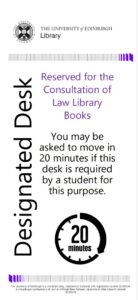
Designated Desk sign with Library branding. Sign reads: Reserved for the Consultation of Law Library Books You may be asked to move in 20 minutes if this desk is required by a student for this purpose.

We believe this is a compromise that can work for students who need to use materials held specifically in this library without limiting who can work and study in the space. We understand Law students can feel that they should be prioritised when it comes to space in the Law Library, however the Law Library is part of a network of 13 site libraries – including the Main Library, which also houses high use law books – and limiting access to one of these is neither possible nor fair. Law students also benefit from being able to use any of the campus library facilities – for example, did you know that the new KB nucleus is directly connected to the Murray Library and is open to everyone (including Law students)?


While we can appreciate the issues with finding space in the Law Library we find it a great compliment that so many students want to study with us. We are limited in the number of seats available but we hope you’ll understand we’re doing what we can to maintain a pleasant and peaceful study environment; the fantastic Helpdesk team are always on hand to assist where they can.

If you have queries or want to speak to someone directly about our libraries and collections, you can contact us by email: law.librarian@ed.ac.uk. We’d love to hear from you.


BOO-lean operators

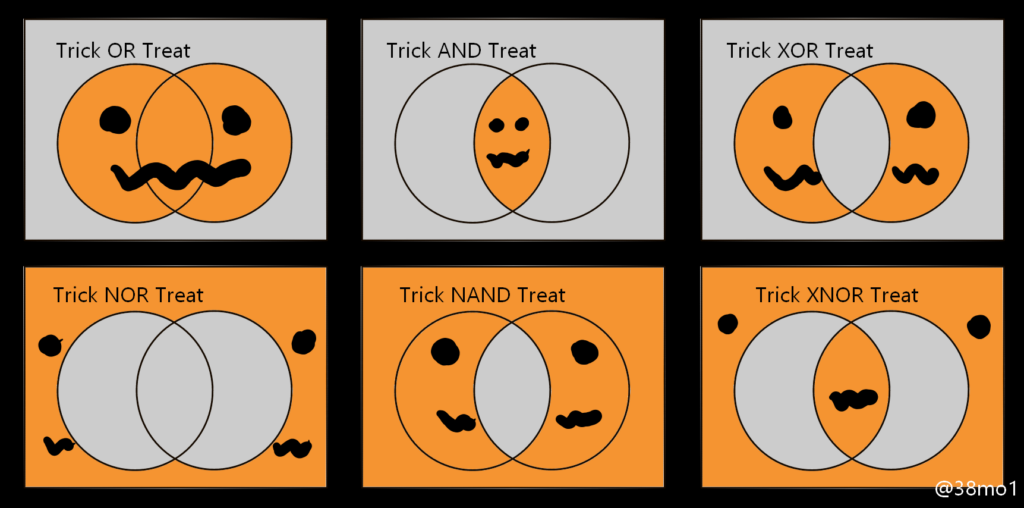
We know Hallowe’en was last week, but saw this on Twitter and it’s too good not to share! If you’ve ever wondered what library staff (and mathematicians and engineers and many other professions) talk about when they mention Boolean operators or logic gates, this handy infographic from @38mo1 may help!

A grid of three images across, two rows deep. Each image shows an example of Boolean searching/logic gates using halloween images of pumpkins and phrases to demonstrate. The first shows Trick OR Treat, two circles which overlap with the entire shape coloured. The second shows Trick AND Treat with just the overlapping area coloured. The third shows Trick XOR Treat with the area inside the circles which does not overlap coloured. The fourth shows Trick NOR Treat, with the area outside the circles and overlap coloured. The fifth shows Trick NAND Treat, with everything in the image apart from the overlapping area coloured. The sixth shows Trick XNOR Treat, which shows everything outside the circles plus the overlapping areas coloured but not the main body of each circle.

Traditionally search engines and databases used Boolean operators along with keywords to help you search more constructively. Some (like Google) now accept natural language searching, but many academic or technical databases still require you to search in this format.

For example, if you search on DiscoverEd:

  • “Property Law” OR Servitudes: 70,745 results.
  • “Property Law” NOT Servitudes: 57,500 results.
  • “Property Law” AND Servitudes: 154 results.

Those little connecting words can make all the difference!

For more help with searching, watch this short video (9 minutes) about Search Techniques on our Law Librarian Media Hopper Channel. Unfortunately pumpkins not included.

Lexis+ database training: Thursday 20th October

We’ve got a training day for the new Lexis+ database coming up which we highly recommend for students of all levels. The new platform from Lexis replaces LexisLibrary and LexisPSL so it’s well worth getting to know, whether you’ll be using databases for assignments, dissertations, research or as a legal practitioner. In each of these sessions Lexis trainer Claire will take attendees through training and tips for using the platform at either foundation or advanced level.

If you book the 10.30am or 2pm slot you will also gain the chance to sit your Lexis Certification test, which means you will gain a certificate perfect to put on your CV – future employers will be impressed if you come to them with certified research skills!

Book using the links below or search for ‘Lexis+’ on the MyEd Events Booking system.

If you can’t make the sessions but still require help using the Lexis+ database, you can view our video (38 mins) recorded by Lexis trainer Claire specifically for our Diploma students. It provides a great all-round view of the database and where to find key items.

Please contact SarahLouise on law.librarian@ed.ac.uk if you have any questions or concerns about the live sessions or getting help with any of our databases.

Information skills throughout the year

If you read our last post, you’ll have heard all about the top information we like our students to have early in the semester; about inductions and key resources we want to make sure you can access. Now we’re a few weeks in we’ve had some more questions about what we have coming up next.

We have made up two documents here (one for undergraduate students, one for postgraduate students) which outlines the key training events we’ll be offering during 2022/23. This includes some law specific materials and some training that is open to all UoE students. Click on the documents below to download the PDF you need:

Information Skills sessions for Law (UG)

Information Skills sessions for Law (PG) 

We’ll write more about specific training sessions nearer each event but in the mean time we hope this is useful. If you want to get in touch to discuss any library or research related questions, you can always reach us via law.librarian@ed.ac.uk.


American Prison Newspapers, 1800-2020: Voices from the Inside

The library has access to a new collection from JSTOR.

Image of books stacked on a small table in the foreground on the mezzanine of the Law Library, looking out across a room full of students studying in the Senate Room (out of focus).

Books stacked on a table on the Law Library mezzanine. Photo by Sam Stills, copyright University of Edinburgh.

American Prison Newspapers, 1800-2020: Voices from the Inside.

The first newspaper published within a prison by an incarcerated person was Forlorn Hope, in 1800. Since then more than 450 newspapers from U.S. prisons have been published. Some are still in publication today such as Angolite and the San Quentin News. 

This collection brings together hundreds of these periodicals from across the US into one collection. Representing various institutions there is special attention on women-only institutions.

The collection is open access and can be accessed via the A-Z list of databases.


Equity, Diversity & Inclusion resources in Law

This month the Academic Support Librarian team are highlighting resources linked to Equity, Diversity & Inclusion in the areas of Law and Social and Political Science. You may be aware that Justice Week 2022 is nearly upon us (28th February to 4th March), and we thought this would be an excellent time to shine a light on a number of legal materials which are free to access, and therefore help to make the understanding of law more accessible to a greater number of people. We list several useful resources on the Law subject guide under ‘More Legal Resources’, including:

  • Free legal dictionaries
  • Links to Scottish, UK and European court websites
  • Links to legal regulatory and advisory bodies
  • Links to resources that offer free case details e.g. BAILII
  • Human Rights – free databases from UN and IJRC

The University subscribes to even more databases which offer staff and students additional access to support their study and research. You can find these by visiting our Law Databases page:

  • Jutastat – containing legal content from Africa
  • Slavery and the Law – a collection of petitions on race, slavery and free blacks submitted to American state legislatures and county courthouses 1775-1867
  • China Law Info– also known as Beida fabao
  • Making of Modern Law: Legal Treatises, 1800- 1926 – the world’s most comprehensive full-text collection of British Commonwealth and American legal treatises from the nineteenth and early twentieth centuries
  • Proquest Law Sources via the History Vault Platform – including African American Police League Records, 1961-1988, Law and Society since the Civil War

You may also be interested in our short video (9 minutes) which demonstrates how to access international legal resources via library services online.:

Thumbnail of the opening slide of the 'Finding International Legal resources via the University Library' presentation video

Video: Finding International Legal resources via the University Library

As well as databases we have some great books and eBooks including:

We hope this will inspire you to explore the library’s collections further when considering Equity, Diversity and Inclusion themes – so now over to you to take a look!

Legal resources: taking care of quizness!

A neon sign is mounted on a dark wall. The sign shows a green old-fashioned television set with pink dials and grill on the front below the screen. Inside the screen are the words 'Quiz Time' in pink capital letters.

Image from USA-Reiseblogger on Pixabay.

It’s week one of semester two and we’ve already run several induction sessions for our January starts (and refresher sessions for current students who need them). Now would be a perfect time to put your newfound legal information resource skills to the test, and what better way than to with our quiz?

tinyurl.com/lawlibquizjan2022

Twelve questions with no time limit to test what you’ve learned about searching and using the library catalogue and databases. Have a go, and let us know how you get on!


New Year, New UoE Library Services training sessions

A blue and golden sky with a few scattered fluffy clouds is visible, with a black city skyline at the bottom of the image. Beams of light seem to be projecting from a golden glow in the centre of the image, where the sun is just visible setting beyond the buildings.

Rays of sun through houses at sunset, Morningside, Edinburgh (@eilisgarvey via Unsplash)

Welcome back to Edinburgh! Although we don’t yet know what 2022 has in store for us, we do know that we’re keen to make sure our students are the best prepared they can be! For the Law Library team that means offering you a full range of induction and refresher sessions on how to use the library. If you’re feeling like you could do with a little update on the best ways to find resources, book on to one of our upcoming events using the links below.


Library Refresher: Wednesday 12th January, 11am to 11.50am (online)

Aimed at all undergraduate and postgraduate students, this session is a whistle-stop tour of all the things we told you at the start of the year. We’ll rattle through the resources and links relatively quickly so that we’ve lots of time to answer your questions, and if you’re feeling confident by the end of the session we’ve also got a quiz for you!

Come along if… you found researching your assignments just a little bit tricky at the end of last term, and you can’t remember where to go to find help.


PG Using the University Library – Law: Wednesday 19th January, 10am to 11am

Join us for an introduction to using library resources at the University of Edinburgh. Topics covered will include how to find and access books, journal articles and legal databases using library resources, and how to get help if the library doesn’t have what you need. The second part of this presentation will take a closer look at major legal databases including Westlaw and Lexis Library where you will learn how to find full text cases, legislation and commentary, and tips on how to use these resources efficiently and effectively.

Come along if… you’re a PG Online student starting in January 2022 at the School of Law.


Library Support for the School of Law (STAFF): Wednesday 19th January, 12noon to 12.30pm (online)

We don’t just work directly with students, we’re keen to speak to fellow staff members about how we can support their work too. We’re running a short session where we’ll present a bit and chat to anyone who works with the School of Law to make sure they know about all the ways we can help enhance their teaching or support throughout the year.

Come along if… you’re a member of staff and want to find out more about how we can help you!


PhD Sources, Materials & Bibliography: Wednesday 26th January, 11.30am to 12.30pm

(contact the Law PhD office for a link to the Collaborate room)

This session is aimed directly at PhD and PGR students, and takes the form of a one hour session featuring top tips on how to conduct complex research and construct your projects. We also look at some of the key resources you will need and signpost some bespoke materials that may be useful for students at this level.

Come along if… you’re a PhD students starting in January 2022 at the School of Law.