Home University of Edinburgh Library Essentials
September 25, 2026
Prints Gone Off – Conserving the Lyell Collection
Today’s blog post concludes Lyell Intern Sarah MacLeans’s two-part series on the Lyell Project. Sarah discusses the variety of work she carried out over the last few weeks of her internship at the CRC.
With my conservation work on Lyell’s correspondence finally being successfully completed in the sixth week of my time at the CRC, I’ve been able to devote the final fortnight fully to – well – to everything else!
My time in this internship has not, of course, been devoted to Lyell’s letters alone. In fact, I have had ample opportunity to pursue work in many other areas of this exciting collection.
It Is Our Mantra
Last week I was honoured to accept an invitation to speak at the Library Technology Conclave at Somaiya Vidyavihar University in Mumbai, India, organised by Informatics Limited and the University. A prelude the day before the event included a half-day “Research Data Management (RDM) Basics” tutorial for about 50 attending librarians, which I delivered based on adaptations of our Research Data Support team’s training materials for PhD students and staff. The training exercises, developed from a few other external librarian training sessions I’ve done, focused on building librarians’ confidence in supporting researchers with data management planning and data sharing. Doing the training in person helped me to overcome communication barriers and foster deeper engagement than could have happened online only.
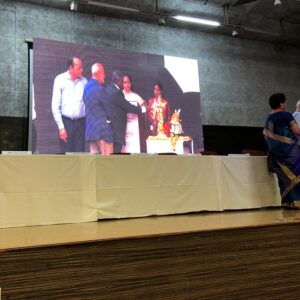
Lighting the flame of the hybrid conference
The conference was on the theme of “Research Data Management and Stewardship: Building Blocks for Open Science,” with a number of eminent librarians, scientists, and educators speaking in keynotes and on panels in six thematic sessions, in-person and remotely. There was a palpable sense of urgency to the proceedings, as those in the room were concerned that India’s scientific institutions, without funder mandates, national open infrastructure, nor observable changes in cultural norms for RDM and Open Science, might be left behind, given this emerging new, more transparent way of conducting research. Questions focused not on the What or Why of Open Science, but how to instigate behavioural change of scientists and researchers, and how librarians could create demand for new services such as data repositories and quickly skill themselves up.
I have some empathy for their position. A decade or so ago I attended conferences which felt more like hand-wringing than change-making, with endless talk of carrots and sticks (and carrot-stick jokes), with researchers explaining over and again their reluctance to be ‘scooped’ by giving access to their data. I am not sure what caused the tipping point to talking about the potential of data sharing and open science to the exciting reality of it happening, but it seems to have come round (more or less). I do still harbour concerns that our own researchers will be left out of participation in the shared infrastructure that is the European Open Science Cloud because of Brexit-related barriers here.
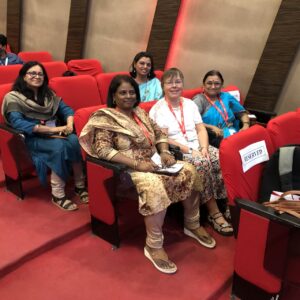 One talk that piqued my interest involved a survey of librarians in Gujarat about RDM and their capacity to deliver new types of service, by Dr. Bhakti Gala. As the Indian LIS (library and information science) curriculum was apparently seen to not be delivering RDM training to any great extent yet, the researcher had asked how the librarians had acquired knowledge of RDM. She said that about half the librarians who had pursued self-training had learned from the free, online MANTRA course (which stands for Research Data Management Training), offered by the University of Edinburgh.
The Chair of the panel, Prof Shalini Urs, with whom I had had a conversation over dinner with about the name of the course, said [naming me, as I sat in the audience] that I would be happy to hear that was the case, to which I of course smiled and nodded. Alluding to our prior conversation about whether the name was a cultural [mis-]appropriation or not, she looked me in the eye and said, “It is Our MANTRA, now.” Which is, of course, the great thing about Openness.
LILAC 2022 : Student transitions in information literacy : from school to HE, from learners to researchers
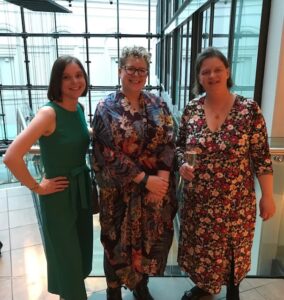
Ruth Jenkins, SarahLouise McDonald and Christine Love-Rodgers at LILAC 2022
The LILAC 2022 conference in Manchester this April was a challenge and a pleasure to attend : my first real life, in person conference for two years! I put aside my laptop with the distraction of its constant stream of email to concentrate on being present in the conference and using my LILAC notebook and pen.
Alongside my colleagues, I was there to present papers about the projects we’d delivered in the COVID years, including LibSmart, our online information literacy course. We’ve developed LibSmart I to develop student information literacy skills to support student transition into the first years of an undergraduate course, and LibSmart II to support student transition into Honours and PG dissertation research. We had lots of great questions about the courses, and interest from Uppsala and Gothenberg Universities in Sweden who are keen to develop similar projects.
Student transitions in information literacy was a key theme of the conference. I attended a session by Paul Newnham on Information literacy and the transition to university education : Reflections and initial findings from Lancaster University. This research study aimed to understand student needs for information literacy and how the Library can support students with information literacy and critical thinking skills. Using qualitative data from groups in Blackpool Sixth Form College and Lancaster University, the study found that both lecturers and teachers thought that students’ ability to find information had deteriorated over the last 10-15 years. However there was wide understanding of the importance of referencing and plagiarism.
Roe v Wade, or how to find international resources

Norma McCorvey, left, who was Jane Roe in the 1973 Roe v. Wade case, with her attorney, Gloria Allred, outside the Supreme Court in April 1989, where the Court heard arguments in a case that could have overturned the Roe v. Wade decision. [Photo by Lorie Shaull, CC BY-SA 2.0 via Wikimedia Commons]
If you are interested in the outcome of this draft, you may be interested in finding reputable sources for American legal information. Fortunately we have access to several.
- We’ve created a video on International legal resources available through the University Library (8 mins 30 secs). You can find information about how to access Westlaw US and Westlaw International at around the 5 minute mark.
- Just like the Supreme Courts of Scotland and the UK Supreme Court, decisions from SCOTUS are published on their website – the latest on their front page, or searchable decisions can be accessed through ‘Opinions’ on the navigational bar.
- To find out more about the difference between federal and state laws, the US Courts website has useful information.
- Previously we’ve blogged about the Scottish Feminist Judgments Project based at the University of Edinburgh and the University of Warwick (book available via DiscoverEd), but did you know there was a US Feminist Judgments Project too, which resulted in a book related to their findings including a chapter dedicated to Roe v Wade? You can access the book via DiscoverEd:
Feminist judgments: rewritten opinions of the United States Supreme Court - For information about abortion laws in the UK and Ireland you may be interested in this article from the BBC, which outlines changes in Northern Ireland after the decriminalisation of abortion in October 2019.
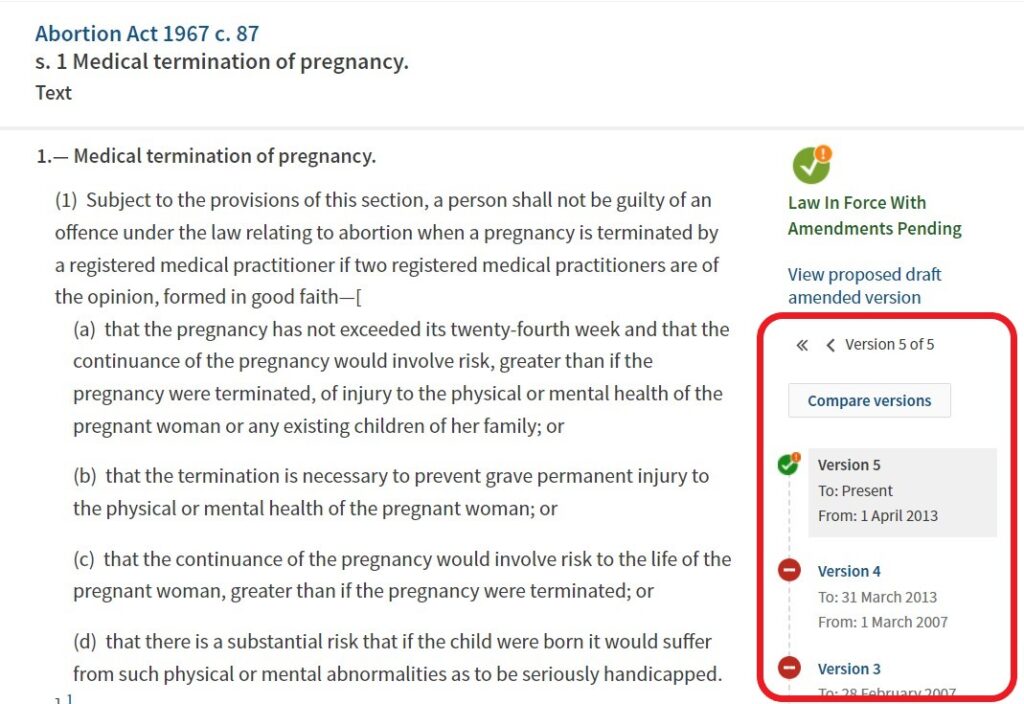
In the UK the Act to amend and clarify the law relating to termination of pregnancy by registered medical practitioners came into force in 1967. It is referred to as The Abortion Act 1967, and the full text can be viewed on Westlaw.
Don’t forget that when viewing legislation on Westlaw it is possible to view amendments and previous versions of Acts by using the navigational tools. In the below image you can see where to locate information about previous versions of this section. By clicking on each hyperlinked version title you will see the text of the Act as it was when each version was in force.
If you have any questions about finding legislation or reputable law sources for your research you can contact us on law.librarian@ed.ac.uk at any time to arrange an appointment with one of us. We’d love to hear about your research and help you find academic resources for your work.
Students’ wellbeing and ways to escape exam
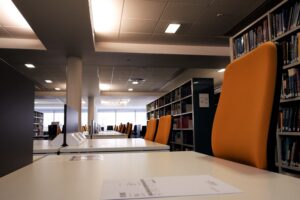
Study spaces in the Veterinary Library by Zofia Matuszczyk
Yes, exams are important. We know. But we also want you to remember that at the end of the day, it is your wellbeing that is the most important.
We all know how stressful exams can be and how they can negatively affect our wellbeing. As the Library, we try not only to support you in learning but also to support your wellbeing, especially at these times. Thus, we’ve put together some resources from the Library that you might find helpful when trying to escape your exams for a moment, get some well-deserved rest and gain the energy and strength to continue with your revisions and exams.
Listen to music
Did you know the Library offers you access to databases that allow you to listen to millions of songs from pop and rock to classical music? You can check them out here.
Visit our museum and art collections
While it’s not always possible to physically visit a museum or gallery, you can still do a lot of exploring of the University collections online. If you, however, have some time to physically go somewhere, we also recommend the National Museum of Scotland or the Scottish National Gallery. Both are free and within the walking distance of George Square! Remember that to visit Scottish National Gallery, you must book a ticket beforehand.
Enjoy a film or drama performance
You can access a wide range of TV programmes, documentaries, films, drama, and theatre performances through the Library. Check out what Box of Broadcasts (BoB) has to offer!
Read some fiction
Reading may be the perfect escape from your exams. Our databases give you access to millions of positions!
Meditate
Meditation is one of the best ways to relax. Have you tried mindfulness or spiritual meditation? Maybe now is the time to do so!
And if you feel stressed because you cannot get a seat in the main library, make sure to check out the additional study spaces available.
Zofia Matuszczyk
Communications Officer Intern
Project Reboot!
The last few years has seen us all face challenges and embrace change – and the Charles Lyell Project is no different. The Project has said farewell to Elaine and Elise – and we thank them both for all their efforts and wish them well. We also need to thank existing University of Edinburgh, CRC and Digital Library staff for keeping the aims and objectives alive – and we can report that there’s been significant progress on recruitment, funding, digitisation, and, in conservation.
So – more blogs are GO!
Starting with conservation, we are delighted to signpost you to two brilliant blogs, detailing the work of the fantastic Interns who have been working on the Lyell papers and specimens.
Supported by Project Conservator Claire (her blog forthcoming) their light but expert touch has greatly enhanced the health and well-being of the collection. Find out more here:
Righting Letters – Conserving the Lyell Collection | To Protect and (Con)serve (ed.ac.uk)
and
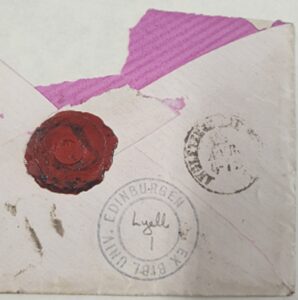
Reverse of an envelope addressed to Charles Lyell, part of the Acceptance in Lieu deposit. Photograph taken by Sarah McLean.
Homes for Rocks – Rehousing the Lyell Geological Specimen Collection
Today we have the first installment of a two-part series from Joanne Fulton. Joanne is here on an 8-week internship funded by the John R. Murray Charitable Trust to help with the conservation of the collection of Sir Charles Lyell (1797 – 1875).
It is a privilege to handle objects that have been worked on by people in the past, to experience the connection and witness their working and learning processes. Therefore, it has been a fascinating opportunity to work on the rehousing of the Lyell Geological Specimen Collection which consists of various specimens from flint implements and axe heads, to shells and raindrop traces.
As previously outlined in these blogs, Sir Charles Lyell (1797-1875) was a hugely significant scientific figure in the 19th century. Amongst others, Lyell corresponded and was a close friend of another well known figure, Charles Darwin, a name closely linked to a number of the shell specimens within the collection I’m rehousing.
These specimens were collected or given to Charles Lyell on his many geological excursions. They were then used to inform his geological research, and they continue to inform learning and research within the University of Edinburgh today. When observing the many documents in the Lyell collection, I’ve found drawings of the same specimens I’m rehousing, illustrated by Lyell in his papers and notebooks.
In the first week I calculated I should be aiming to complete at least 5 objects per day to finish within the 8 weeks of my internship, as I had to bear in mind that within the 168 objects to be rehoused there are groups of items – here I’m largely referring to the shells – that make up a single object. However, as I reach the end of week 4, I’ve found I’m now completing over 10 a day due to more efficient preparation.
The materials I have been using to rehouse the specimens includes card tray compartments and plastazote, a type of foam used in archival repackaging. I have several sizes of trays, however there are 6 specimens which are too large for the largest of trays and need their own custom boxes. I’ve made these myself with card and corrugated card.
My process for rehousing a specimen begins having prepared the tray and two layers of plastazote to fit within. I then cut into the plastazote as appropriate to the rock. Using a white pencil I mark out where I need to cut through the top layer of plastazote, and then using a sharp scalpel, I carve into the thicker bottom layer. This carving is continued until the specimen sits tight and will continue to do so in the future when the specimens are returned to their storage.
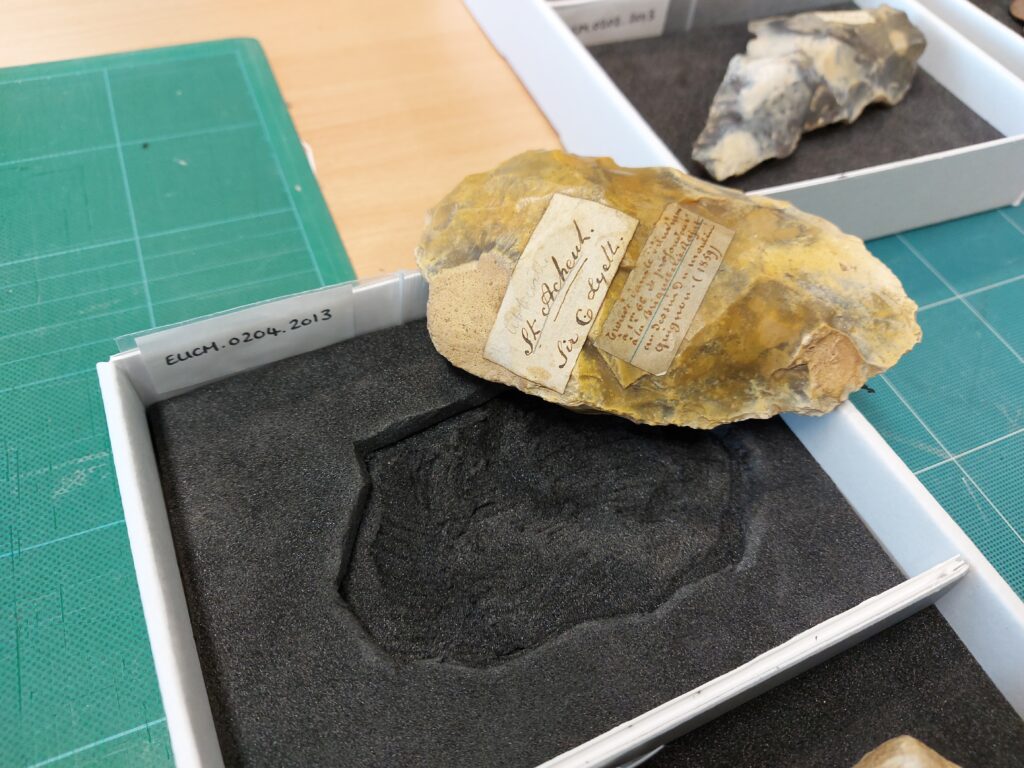
A sharp scalpel is needed to create a neatly cut support for each specimen (EUCM.0204.2013)
All this cutting creates a lot of off-cuts from the plastazote. Rather than wasting them, I shall be reusing them as padding for a Tyvek book cushion in order to make my project more sustainable.
Previous to my rehousing, some of the rocks were held in small green trays of a standard size, often not suited to the actual size of the specimens and offering no added protection. The shells, which I shall be rehousing next week, are in small red boxes.
Included with many of the specimens are extra notes and labels of various origins – some of Lyell’s own handwriting – which also need to be housed with the object as part of their history. When this is the case, I create a third layer of plastazote to house this paper note slipped in a melinex sleeve, carving a little recess for it to sit flat. I then attach cotton tape to the middle layer so the user can lift the object to see the paper note when needed.
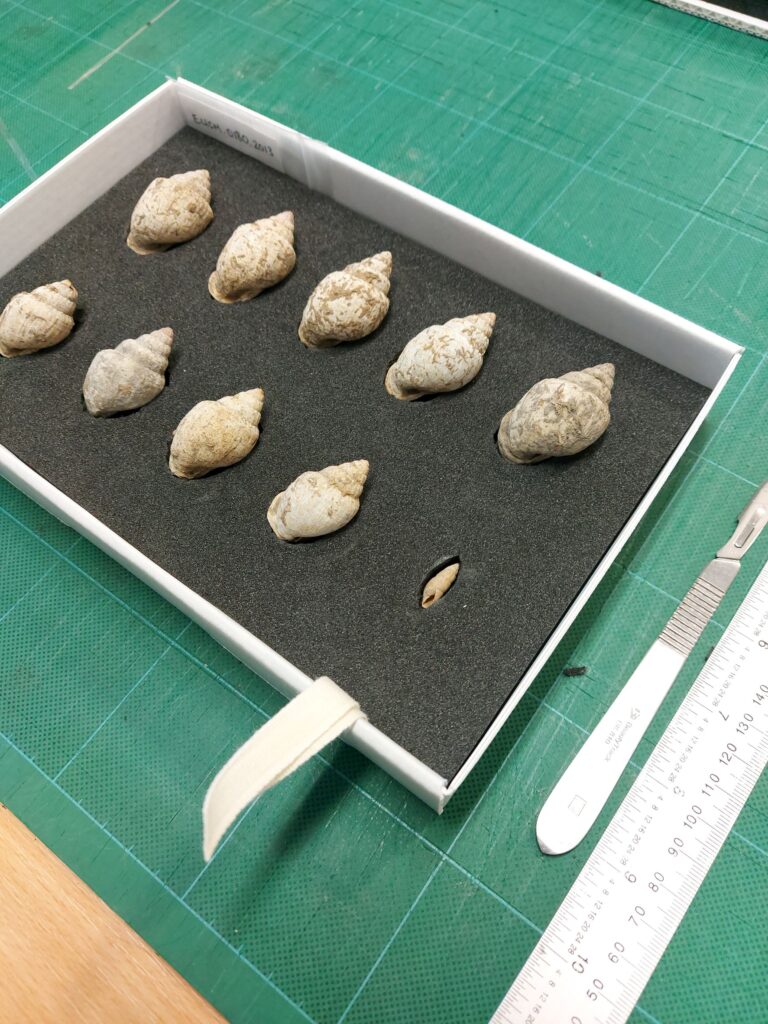
Shells after rehousing: A note stating these shells were collected by Darwin is stored underneath (EUCM.0180.2013)
The majority of these specimens are in good condition – they are rocks and so robust by their composition- the labels, many handwritten by Lyell, and other attachments to the object are less so. Many are in need of repair having suffered losses, crumpling, and have become detached from the specimen. This is a problem I shall be tackling in the second half of my internship; repairing the tears and losses, as well as reattaching the labels with an adhesive.
There have also been a few messy surprises and oddities in the collection, with one rock having a large amount of white tack attached, unfortunately this was also stuck to the rock’s labels. This white tack was removed, and the same tack was used to remove the tiny amounts left in the small crevices on the rock surface. I carefully removed the labels from the rock and the tack, removing the unwanted and potentially damaging tack mechanically from the paper labels.
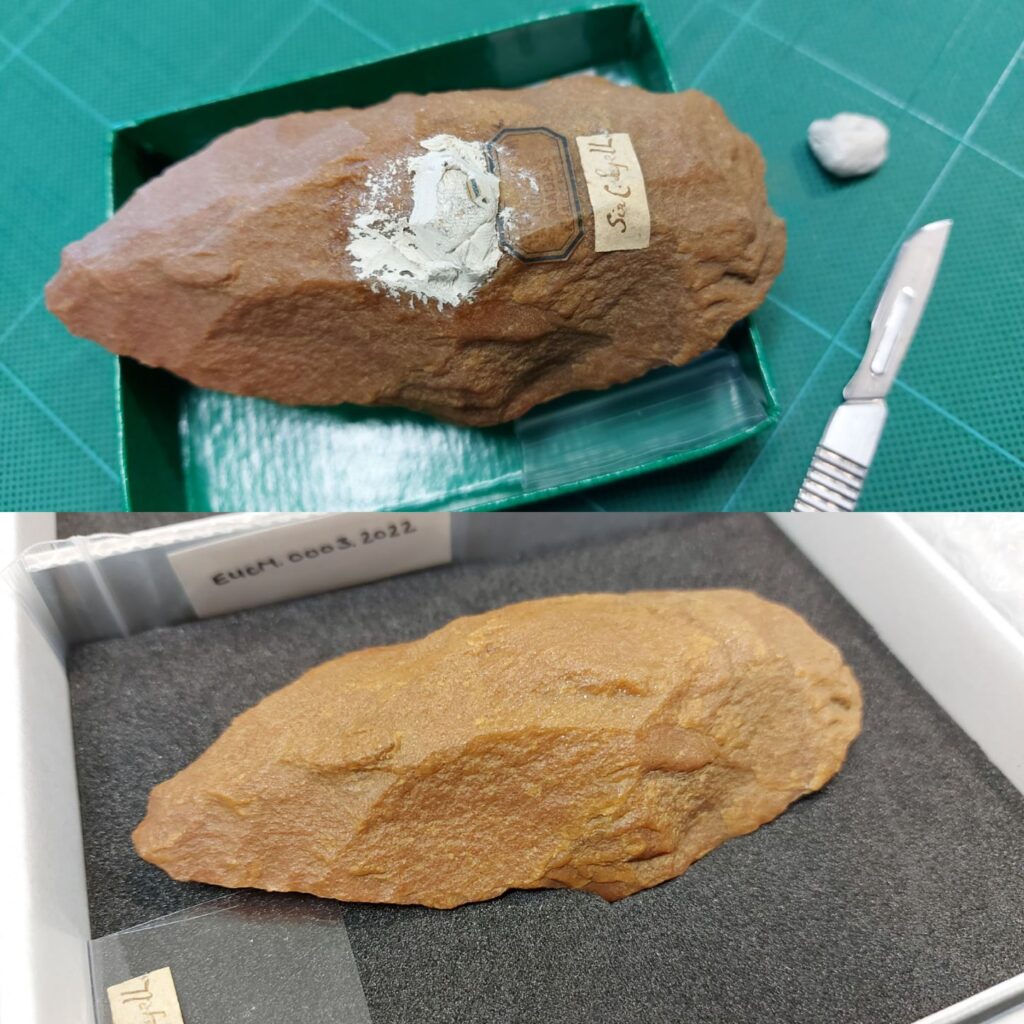
Photo during and after removing white tack from one of the specimens (EUCM.0003.2013)
Having recently graduated from the paper conservation course at Northumbria University, its been a rich learning curve working with objects such as the geological specimens. In my second blog, I plan to examine the method of reattaching the loose labels to the specimens as well as the finalisation of the rehousing within the second half of my internship.
Disability Studies: A New Subject Guide
The Subject Guides are a useful tool in getting started with your research. Whether you’re an Engineer or a Classicist, they contain a wealth of information for navigating library resources, including journals, databases, and bibliographies, available to students here at the University of Edinburgh. Part of my role as Digital Engagement Intern involves reviewing and creating guides within the remit of Equity, Diversity, and Inclusion, and I’m delighted to share our newest Subject Guide in Disability Studies.
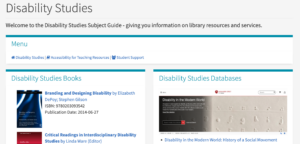
This guide has been created to both assist students in the academic study of Disability and highlight ways the University can support you with any additional learning needs you might have. We’ve included access information for students using the Main Library, advice on how to make your device more accessible, and details of several groups and societies for students to get involved with. As well as supporting students, we’ve also included various materials to assist staff in creating more accessible learning environments, signposting additional training and resources available at the University.
We hope that this guide will serve as a helpful tool for students and staff to access the support that’s available by bringing these resources together in one guide that will continue to grow over time. If you have any feedback or suggestions on ways this guide can be improved, then we would love to hear from you!
You can access the Disability Studies Subject Guide to clicking on the link or navigating to the webpage at the following URL: https://edinburgh-uk.libguides.com/disabilitystudies.
Tristan Craig
Digital Engagement Intern (Equity, Diversity and Inclusion)
The Skene Album – An artistic partnership between author and artist

Collection: Walter Scott Image Collection; Persons: Scott, Walter; Event: N/A; Place: Scotland; UK; Category: Art; Description:
James Skene was a close friend of one of Scotland’s greatest and most influential writers. By profession he was a lawyer, but he was also a keen amateur artist. Skene and Scott first met as fellow Advocates at the Scottish Bar and were brought together by their common love of German literature. They were subsequently joint co-founders of the Light Horse Regiment and the pair formed a close friendship.
This particular album appears to have fallen into obscurity over the years, as it had been in private collections and out of public view. Skene made these sketches for Scott to use as a reference or aide-memoire when writing his novels. Knowledge of its existence does not appear in any research or exhibitions relating to Scott or Skene. We were very fortunate to have this new acquisition and it was a pleasure to personally handle this beautiful album and see every drawing up close.
On trial: Research Methods Primary Sources
I’m happy to let you know that the Library currently has trial access to Research Methods Primary Sources from Adam Matthew. This new resource is an online learning tool for primary source literacy that can be used in classroom-based and online teaching, as well as for independent study.
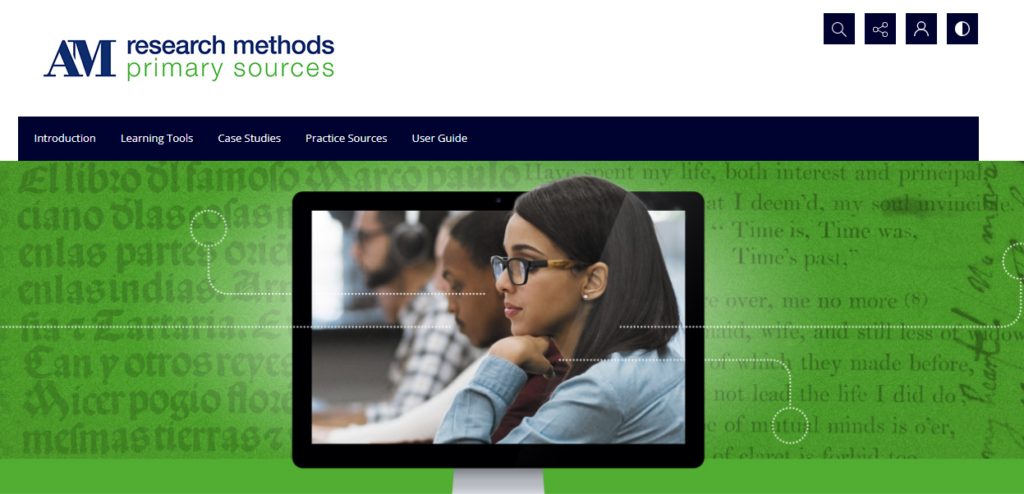
You can access Research Methods Primary Sources for an extended period via the E-resources trials page. Access is available on and off-campus.
Trial access ends 16th June 2022. Read More
Collections
 Love, Loss, and Literature: Cataloguing the Papers of Irene Jessie Young
My name is Nancy Britten, and I’m in my fourth year of studying History at...
Hill and Adamson Collection: an insight into Edinburgh’s past
My name is Phoebe Kirkland, I am an MSc East Asian Studies student, and for...
Love, Loss, and Literature: Cataloguing the Papers of Irene Jessie Young
My name is Nancy Britten, and I’m in my fourth year of studying History at...
Hill and Adamson Collection: an insight into Edinburgh’s past
My name is Phoebe Kirkland, I am an MSc East Asian Studies student, and for...
Projects
Cataloguing the private papers of Archibald Hunter Campbell: A Journey Through Correspondence
My name is Pauline Vincent, I am a student in my last year of a...
Archival Provenance Research Project: Lishan’s Experience
Presentation My name is Lishan Zou, I am a fourth year History and Politics student....