Home University of Edinburgh Library Essentials
September 25, 2026

LILAC 2022: Power structures in library and information services

Geese and goslings on Rochdale canal
Last month, three of our Academic Support Librarians team attended the LILAC conference. LILAC is a conference for librarians and information professionals who teach information literacy skills, are interested in digital literacies and who want to improve the information seeking and evaluation skills of library users. You may have seen our previous post about LILAC 22 here.
Much of the conference covered issues of critical information literacy, including long and slightly intimidating words such as critical pedagogy and decolonisation, and it was great to have the space to explore what these mean.
Keynote speaker Marilyn Clarke, Director of Library Services at Goldsmiths, University of London, spoke on Decolonisation as a means to creating an equitable future.
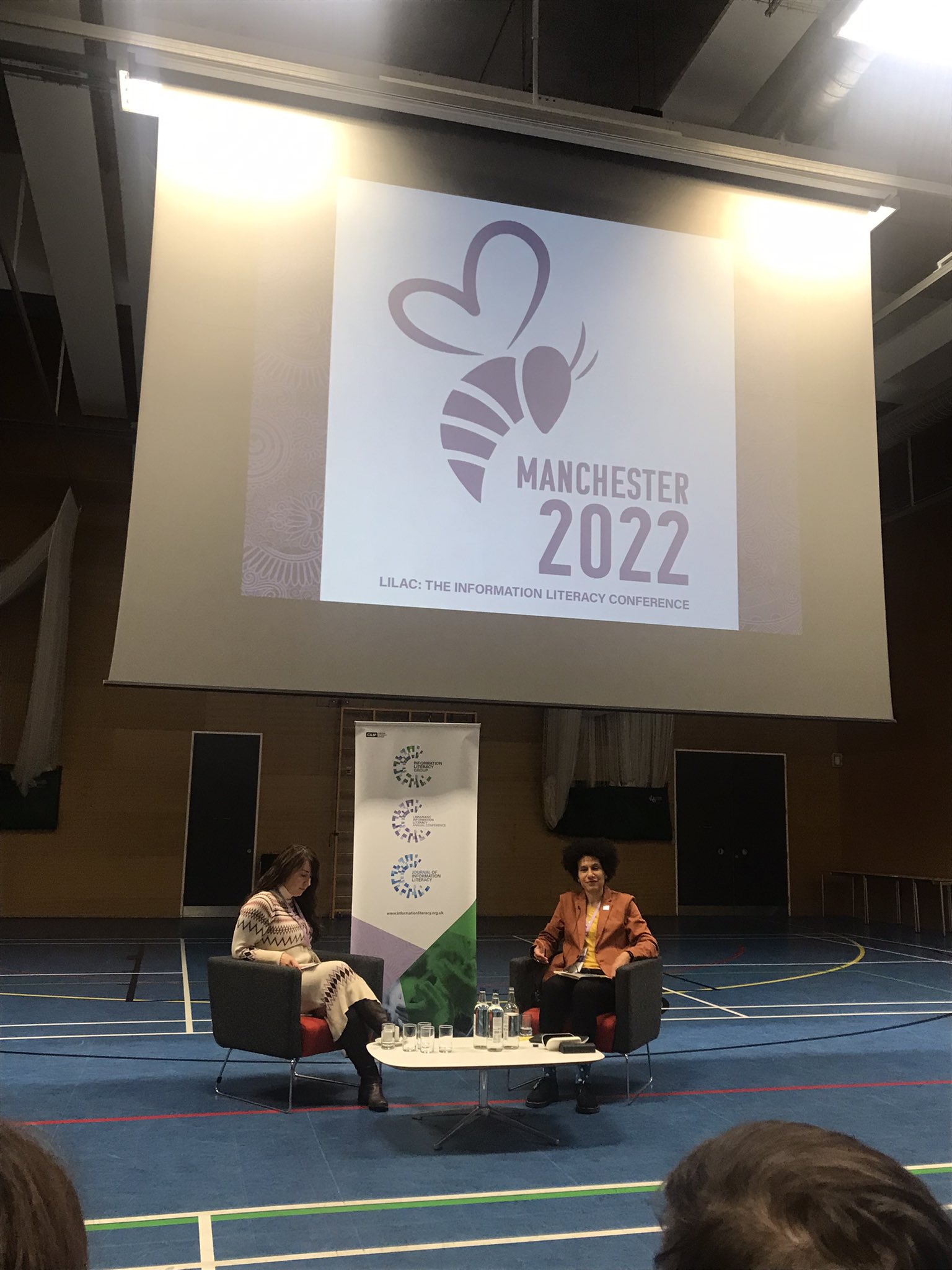
Marilyn Clarke with discussion chair Elizabeth Brookbank at LILAC 2022.
Marilyn clarified succinctly the difference between decolonising and diversifying library collections; diversifying ≠ decolonising, we need to ask the question why are these voices underrepresented?
She highlighted fantastic work at Goldsmiths to dismantle Eurocentric structures in the library and university, including funds for the ‘Liberate My Degree’ collection set aside for student book purchase suggestions to address gaps in the library collection. At the University of Edinburgh we have the Student Request a Book service which empowers students to request purchase of books and other resources to be added to the Library collections.
When cataloguing their Zines collection, librarians gather suggestions for keywords (used as a finding aid in the catalogue) from the authors themselves, to ensure the language used is representative. This is not just about addressing race, but also other systemic oppression such as LGBTQ+ and class.
In the final keynote of the conference, Emily Drabinski, Critical Pedagogy Librarian at the Graduate Center, City University of New York, explored how information literacy can reveal and challenge structures of power, and equip our students with tools to recognise and understand power dynamics.
By power, this mean the ability to change things, do things, influence things – we all have power in different ways and different situations. As librarians who help people find, use and understand information, we need to take societal values and power structures into account.
For example, who designed this database? With whom in mind? What is included in the database and what isn’t, and who makes those decisions? That feeling, where you get no results from a search, or too many, or their wrong – that’s not you, that’s the way the system is constructed with power.
Myself, I will be doing more to incorporate discussions of power into my teaching. It’s something I do when teaching literature searching for Systematic Reviews in medicine and biomedical sciences (these aim to find and synthesise all clinical evidence on a topic), where comprehensive searches and minimising bias are a core foundation of the review methodology – and as such, knowing what is included in a database, and crucially what is excluded, is crucial. But we can introduce this criticality earlier in students’ academic careers. I am not sure yet what that will look like exactly, but it’s exciting to consider.
Ruth Jenkins, Academic Support Librarian
Royal Reflections from the RESP Archive
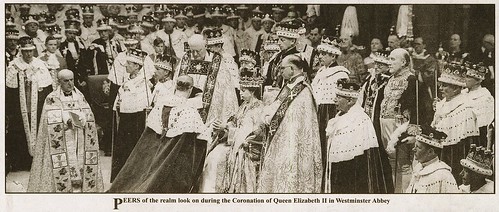
This weekend sees the culmination of celebrations to mark the Platinum Jubilee of Queen Elizabeth, and marks her 70th anniversary as monarch. This event provides us with an opportunity to explore some of the Royal Family related material that can be found in RESP archive recordings.
The RESP archive includes a number of recordings which contain memories of monarchs and royal celebrations. The earliest relates to a recording made in 1975 with 100 year old Granny Blacklock. Recorded by her grandson, Ian Blacklock, and subsequently donated to the RESP, this interview takes us back to Granny’s childhood, in the late 1870s and provides us with some of the earliest recollections we have in the archive. Although not yet available to listen to on the website, there is a published summary on the site https://edin.ac/3NavMXC and the recording and transcription will be uploaded soon. As a young woman, Granny worked for a family who were based in Manchester for a while and she was taken along to the opening of the Manchester ship canal, in 1894. Queen Victoria was there, and Granny could recall the monarch in her ‘wida’s weeds’ as she passed quite close by and waved to the crowd. When asked by Ian if she’d waved back, she recalled, ‘Aye, Ah waived back, aye’.
We then jump to the green at West Barns, East Lothian, 1935. Peter Aitchison, who was a small child in 1935, recalled a cedar being planted to celebrate the silver jubilee of Queen Mary and King George V. In a moving, informative and often funny interview, https://edin.ac/3NJKioW Peter mentions this occasion and then adds quickly that he’s always keen to tell people that the tree ‘wisnae his fault’, a reference, perhaps, to the impressive, or possibly intrusive, size of the tree today!
Other interviewees recall the coronation celebrations in different parts of Dumfries and Galloway. These include Tom Allan, who remembers the celebrations, including pipe bands and bonfires, in Lochmaben https://edin.ac/3NQlZWm and Sheila Austin, who remembers the celebrations in the more remote farming parts of the region https://edin.ac/3NJLrNg.
My favourite recollection comes to us from Davie Graham, of Sanquhar, who recalls that only a few people in the town had a television in 1953 and so many, himself included, watched the coronation through a shop window! https://edin.ac/3NdQoxV
Dissertation Support
At this time of year many students are finishing their dissertations. There are a few places where students can get some advice and support on this in relation to library resources:
- Law Librarian Resources Media Hopper Channel: We have collated several videos that cover using legal databases and also referencing.
- Law Subject Guide: This collates all the useful legal resources that the library has in one guide. With links out to useful resources it also has a section on referencing.
- List of Legal related databases: This list collates resources that students could find useful for their studies. It helps to distill ones that relate to this subject area- however if the research spans other topics then looking through the lists for those areas could also offer useful resources. If you are not sure which database will help then take some time to look at the descriptions.
- LibSmart II Legal Module: This short online module offers information and advice on finding legal resources.
- Contacting the Academic Support Librarians who support the Law School: You can contact us on Law.Librarian@ed.ac.uk .
Other help and advice:
The Institute for Academic Development have resources which offer assistance to students undertaking their dissertations.
Rock, Paper, Scissors – Conserving the Lyell Collection
Today’s blog post concludes Lyell Intern Joanne Fulton’s two-part series on the Lyell Project. Joanne discusses the variety of work she carried out over the last few weeks of her internship at the CRC.
As my internship at the CRC draws to a close, I can reflect on the many exciting opportunities I’ve had to experience all aspects of the work involved in conserving the Lyell Collection. As I shall discuss further in this second blog, my responsibilities have not solely covered the rehousing of the specimens in the geological collection which was explained in my first blog.
In my last blog, I spoke of the labels on the Lyell Geological specimens, some of which were more fragile than others. In twelve cases, these labels needed to be conserved and re-attached. To do so, I needed an adhesive. While I tested both gelatine mousse and EVA, a co-polymer adhesive commonly used in bookbinding. I chose to use gelatine mousse as I found it to have the strength required and was more historically appropriate than EVA, as the labels had previously been attached with an animal glue.
The labels offered a few different challenges and solutions. Following the discovery that white tack was attached to one of the rocks previously, upon closer look at the labels I found one of these labels had used blue tack to be secured to the specimen. Once I had carefully removed both the blue tack from the specimen and label, I made the decision not to reattach the label but to slip it into a Melinex pocket, which I then housed with the specimen in its box.
Welcome to One Health
A new project is taking shape at Edinburgh University’s CRC department!
With funding from the Wellcome Trust, the One Health archival project aims to pull together resources relating to human responsibility for animal health in Scotland from 1823 to the present day. Animal health and welfare is a massive and topical subject and the hope is that this project will allow further research and awareness of animal rights in Scotland. This history can be somewhat imposing, but luckily the project is made up of three separate archives. The papers of the Royal (Dick) School of Veterinary Studies (R(D)SVS), the Royal Zoological Society of Scotland (RZSS) and the animal rights charity One Kind.
Let’s break down these different archives since each has its own part to play in understanding the history of human and animal health in Scotland.
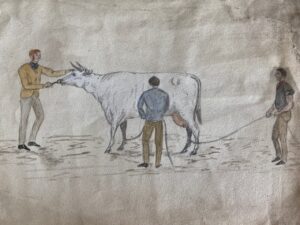
Illustration of how to tip a cow from the R(D)SVS collection
Now known as the R(D)SVS, Scotland’s first veterinary college was founded in 1823 by William Dick, the son of a blacksmith and farrier. The college was initially set up to educate blacksmiths and farriers about treatments when shoeing horses, but the college expanded over time to become the world leading veterinary college it is today. Items held within the archive include papers relating to the running of the college, the lives of its staff and students, a vast array of photographs and glass plates slides, research papers, and a host of fascinating objects.
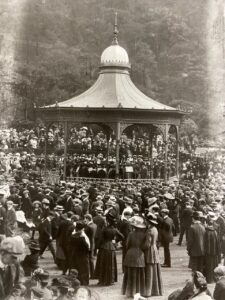
Photograph taken by an unknown veterinarian of the Ross Bandstand in Princes Street Gardens, Edinburgh, c.1905
The RZSS was founded in 1909 by Edinburgh lawyer Thomas Gillespie with the aim to promote awareness and and conservation of rare and endangered animals from across the world. The original charter states the role of the society was;
To promote, facilitate and encourage the study of zoology and kindred subjects and to foster and develop amongst the people with an interest in and knowledge of animal life
Today the RZSS manages both Edinburgh Zoo and the Highland Wildlife Park as well as well as supporting a wide variety of research, conservation, education and public engagement projects both in the UK and around the world.
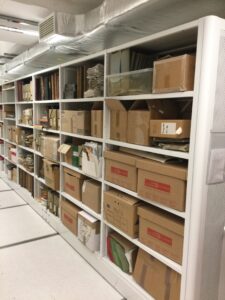
The OneKind archives in store at the CRC
The One Kind animal charity was founded in Edinburgh in 1911 as the Scottish Society for the Prevention of Vivisection. Although the name may have changed over the years (It was known as Advocates for Animals from 1990-2010) the aims of this charity has not. Since the charity’s foundation, they have expanded their aims to encompass far reaching political and social engagement. This is a great resource for those interested in animal welfare, ethics, research and social and political engagement. The material within the archives spans their entire organisational existence and includes correspondence and investigations into the R(D)SVS and the RZSS, which brings these separate collections together.
Phew! There’s quite a lot to get through, so be sure to follow this blog for updates and to hear about the stories which are emerging from these collections.
An update from Project Conservator, Claire
My name is Claire Hutchison and I am very proud to introduce myself as the Lyell Project Conservator at the University of Edinburgh’s Centre for Research Collections. I am a Paper Conservator who has worked extensively across archives in Edinburgh on a number of archival projects. My work has led me to become a specialist in fragile formats, such as transparent papers, newspapers and wet press books. This is not my first time working at the CRC; I was lucky enough to be an intern in the conservation studio twice in my career.
I have learnt a lot about Lyell and his dedication to recording his findings since starting. It’s a very personal collection, and it’s clear that they were cherished by Lyell. The labels and indexes are beautifully written and constructed; one can only dream of having the same patience and dedication with their own notebooks. As a Conservator, I was also impressed to find examples where Lyell had hand sewn his index pages into the notebooks. It’s a wonderfully consistent collection which has been a pleasure to conserve. It’s also been made clear to me since starting just how sought after this notebooks are as requests have been flying in; researchers are keen to start connecting those dots across the collection.
Conserving the Notebooks prior to digitisation was imperative in order to prevent loss or further damage to the bindings. The 294 Notebooks were in varying levels of condition, however, overall they were stable with very few requiring intense treatment. It was clear from the flexibility of the spines that they had been well used and heavily manipulated by Lyell on his travels. The adhesive Lyell used to apply his labels and covering material was starting to fail. The earlier Notebooks suffer from red rot – commonly found in vegetable-tanned leathers from the late nineteenth and early twentieth centuries. The leather will become dusty, and the fibrous structure will deteriorate, resulting in the damage or complete loss of the leather binding.
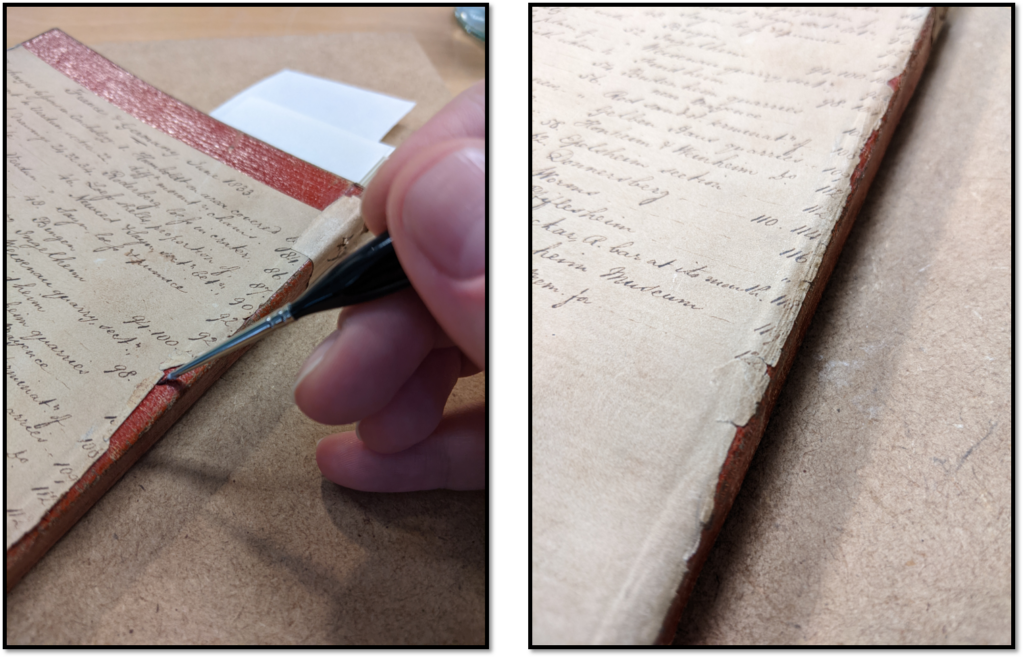
Reattachment of covering material before and after
Internally, it was clear that Lyell had held and bent the spines to write into positions that had caused splits to form between the signatures of the text block. If not treated, these will worsen with handling and ultimately lead to loose pages or whole sections of the text block detaching fully from the binding. Lyell used either graphite or ink within his notebooks, so gelatine has been used to ensure that no bleeding or movement of the corrosive iron in the ink occurred. A strip of Japanese paper was applied to repair this inner joint and prevent further splitting (see example below).
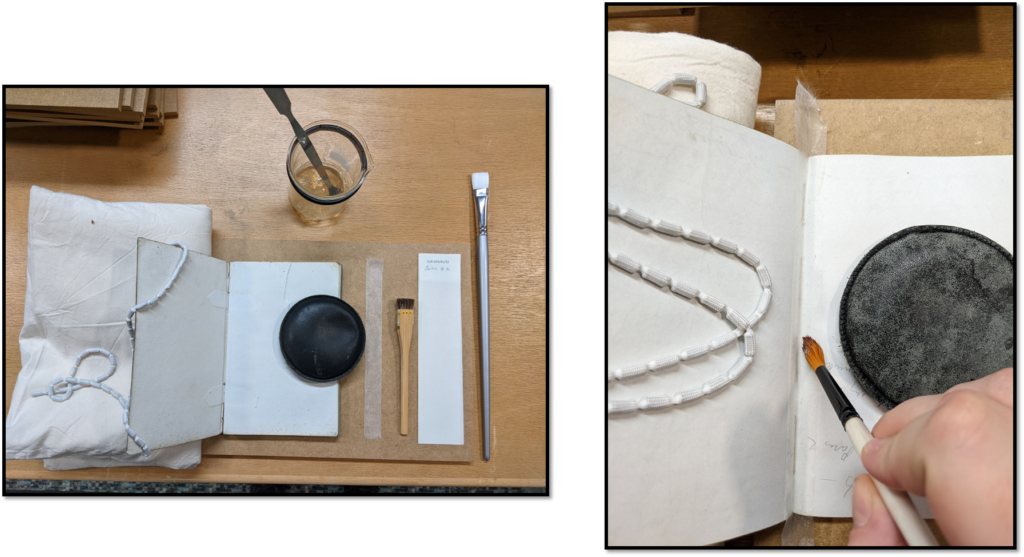
Setup and attachment of inner joint repairs
In some rare instances, further intervention was needed where parts of the spine were lost and the sewing was exposed. This required lifting back the leather of the boards either side of the spine and inserting a repair to stabilise the structure. Layers of Japanese paper were applied to the spine and built up to the required thickness of the leather. Then a final layer of toned Japanese paper was applied to the top, blending in with the rest of the spine piece.
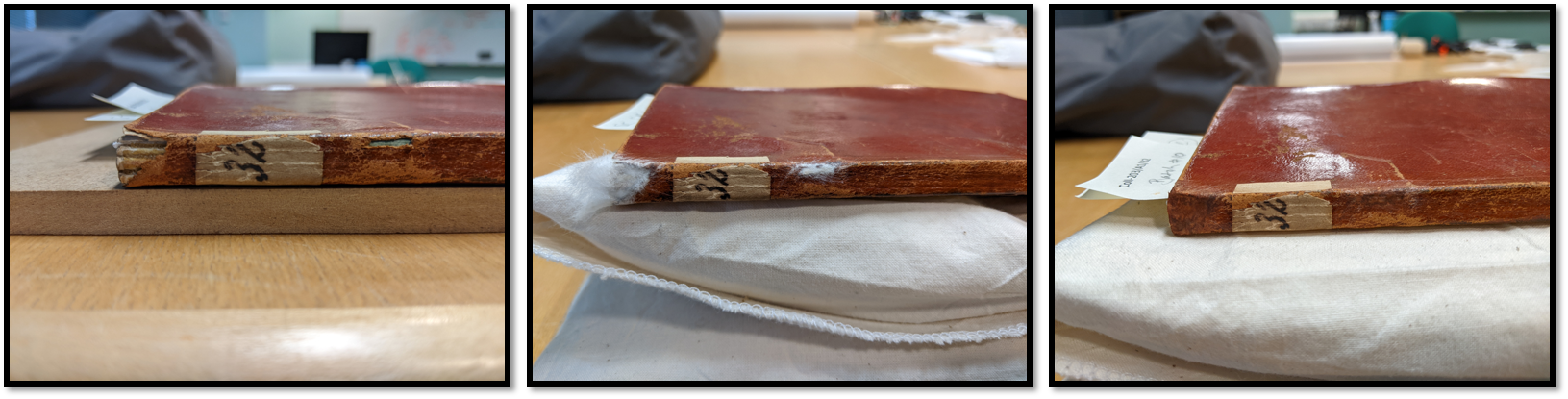
Spine repairs before, during and after treatment
Thanks to generous funding from the National Manuscripts Conservation Trust, two 8-week interns have started working on the Lyell Project. They are helping to assist in the overall efforts of the project, but also have been given their own branch of the collection to work on. Sarah MacLean is currently working on the 1927 donation of letters of correspondence. Joanne Fulton has been given the task of rehousing Lyell’s collection of Geological specimens. This month, my work on the project will continue with the conservation and rehousing of the printed material in the collection, such as Lyell’s own copy of the ‘Proceedings of the Geological Society’.
Stay tuned for more conservation updates soon!
Project Re-boot!
The last few years has seen us all face challenges and embrace change – and the Charles Lyell Project is no different. The Project has said farewell to Elaine and Elise – and we thank them both so much for all their efforts and wish them well. We also need to thank existing University of Edinburgh, CRC and Digital Library staff for keeping the aims and objectives of the project alive – and we can report that there’s been significant progress on recruitment, funding, digitisation, and in conservation.
So – more blogs are GO!
Starting with conservation, we are delighted to signpost you to two brilliant blogs, detailing the work of the fantastic Interns who have been working on the Lyell papers and specimens.
Supported by Project Conservator Claire (her blog forthcoming) the Intern’s light but expert touch has greatly enhanced the health and well-being of the collection. Find out more here:
Righting Letters – Conserving the Lyell Collection | To Protect and (Con)serve (ed.ac.uk)
and

Reverse of an envelope addressed to Charles Lyell, part of the Acceptance in Lieu deposit. Photograph taken by Sarah McLean.
Quicker, easier interface for DataVault
We are delighted to report that Edinburgh DataVault now has a quicker and easier process for users. The team have been working hard to overhaul the form for creating a new ‘vault’ to improve the user experience. The changes allow us to gather all the information we need from the user directly through a DataVault web page. The users no longer need to first login to Pure and create a separate dataset record there. Instead, that bit will be automated for them.
I have explained the new process and walked users through the new form in a new and updated how-to video, now combining the getting started information with the demo of how to create a vault:
Get started and create your vault! (8 mins)
The new streamlined process for users is represented and compared to our open research data repository DataShare in this workflow diagram. DataVault is designed for restricted access, but can also handle far larger datasets than DataShare.
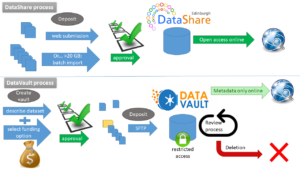
The DataVault process includes the gathering of funding information, and review and deletion none of which are present in the DataShare workflow since they would not be relevant to that open research data repository.
The arrow showing DataVault metadata going to the internet represents the copying of selected metadata fields into Pure, where they are accessible as dataset records in the university’s Edinburgh Research Explorer online portal.
Our new course “Archiving Your Research Data”, featuring Sara Thomson, Digital Archivist, provides an introduction to digital preservation for researchers, combined with practical support on how to put digital preservation into practice using the support and systems available here at University of Edinburgh such as the DataVault. For future dates and registration information please see our Workshops page.
A recording of an earlier workshop (before the new interface was released) is also available: Archiving Your Research Data Part 1: Long-term Preservation.
If you are a University of Edinburgh principal investigator, academic, or support professional interested in using the Edinburgh DataVault, please get in touch by emailing data-support@ed.ac.uk.
Pauline Ward
Research Data Support Assistant
Library and University Collections
University of Edinburgh
New to the Library: Vetus Latina Database
Thanks to a request from staff in Classics the Library now has access to Vetus Latina Database from Brepols. This is an online index to all Greek and Latin patristic citations or allusions to the pre-Vulgate editions of the Bible, collected by the Vetus Latina Institut in Beuron, Germany.
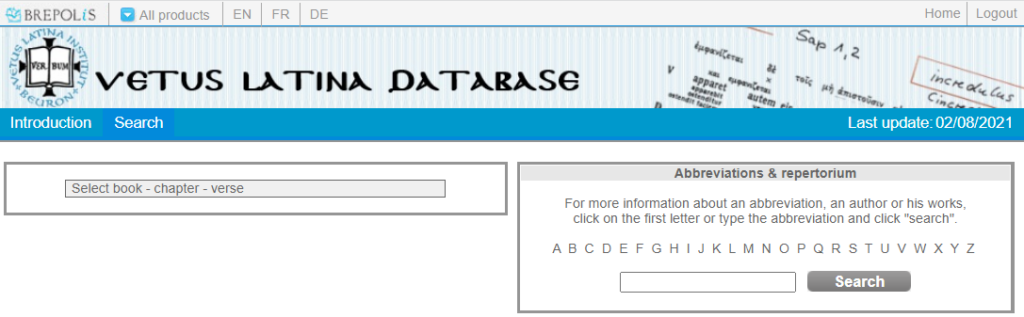
You can access Vetus Latina Database via the Databases A-Z list, Classics subject guide or DiscoverEd. Read More
Geo-mapping the RESP
My name is Denise Hick and I am a Master’s student in Earth Observation and Geoinformation Management at the University of Edinburgh. Together with Rowan Rush-Morgan, a second-year PhD student in Geography, we had the opportunity of working on an exciting web-mapping internship for the Regional Ethnology of Scotland Project (RESP) within the Centre for Research Collections (CRC).
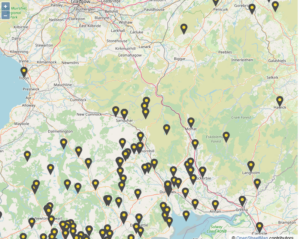
A web-map was envisaged as an interactive way for users to browse the RESP catalogue in a visual way, finding recordings based on the place names mentioned within them. There are some examples of using web-mapping technology to visualise archival information, such as this map (https://witches.is.ed.ac.uk/ ) of witch trials in Scotland. However, we could not find any examples that used data directly from within an archival catalogue, so this would be a venture into the unknown both for ourselves and the RESP team.
Geocoding and updating the Archive
Throughout the internship, Rowan focused on data preparation. Place names were collated from recording transcripts, these were then converted into co-ordinates using the QGIS Geocode plugin. This was no easy task: in fact, multiple places with the same name exist. You can find Aberdeen in Hong Kong, the USA, and Jamaica! Furthermore, interviewees often refer to places by their locally known rather than ‘official’ names, while other place names have changed over the years. After finding the best possible co-ordinate matches, Rowan added this information to ArchivesSpace, RESP’s digital archive, linking each place name to the interview where it was mentioned.
Pins on the map
While Rowan prepared the data, I focused on setting up the web map. With the help of Scott Renton, IT project manager, and Patryk Smacki, software developer at the University of Edinburgh, we developed an interactive web map for the RESP website using open-source mapping library OpenLayers. This entailed a lot of coding in JavaScript and Python. To improve performance, we then had to come up with an innovative way of plotting the place name data onto the map in the form of clickable pins, because the RESP archive now contains more than 300 different place names!
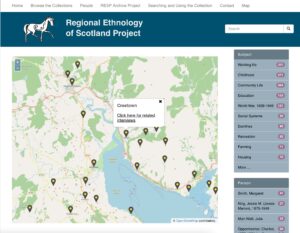
The end result
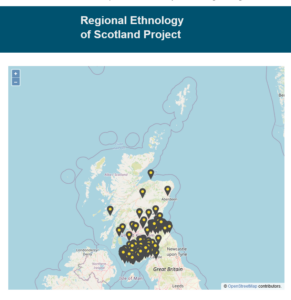
The final result of our internship is an interactive web map that displays places mentioned in the interviews carried out by RESP in Dumfries and Galloway and East Lothian (consultable here). Users can explore the map and zoom, pan and click on a pin to be directed to all the RESP interviews relating to that specific place. We hope the map gives users a much more accessible way to browse the RESP catalogue and offers an example to other archives of the ways in which web-mapping technologies can be utilised to visualise archival collections.
We have really enjoyed our time with the RESP team. Whilst at times challenging, it has been an interesting internship and we learnt a lot about geocoding and coding, but also about Scottish geography, life and traditions!
Collections
 Love, Loss, and Literature: Cataloguing the Papers of Irene Jessie Young
My name is Nancy Britten, and I’m in my fourth year of studying History at...
Hill and Adamson Collection: an insight into Edinburgh’s past
My name is Phoebe Kirkland, I am an MSc East Asian Studies student, and for...
Love, Loss, and Literature: Cataloguing the Papers of Irene Jessie Young
My name is Nancy Britten, and I’m in my fourth year of studying History at...
Hill and Adamson Collection: an insight into Edinburgh’s past
My name is Phoebe Kirkland, I am an MSc East Asian Studies student, and for...

Projects
Cataloguing the private papers of Archibald Hunter Campbell: A Journey Through Correspondence
My name is Pauline Vincent, I am a student in my last year of a...
Archival Provenance Research Project: Lishan’s Experience
Presentation My name is Lishan Zou, I am a fourth year History and Politics student....