Home University of Edinburgh Library Essentials
June 18, 2026
New Acquisition – National Theatre Collection
The Library has just purchased the National Theatre Collection which is now available to access on the film platform of Alexander Street Press, Academic Video Online. Direct access to the National Theatre Collection is here.
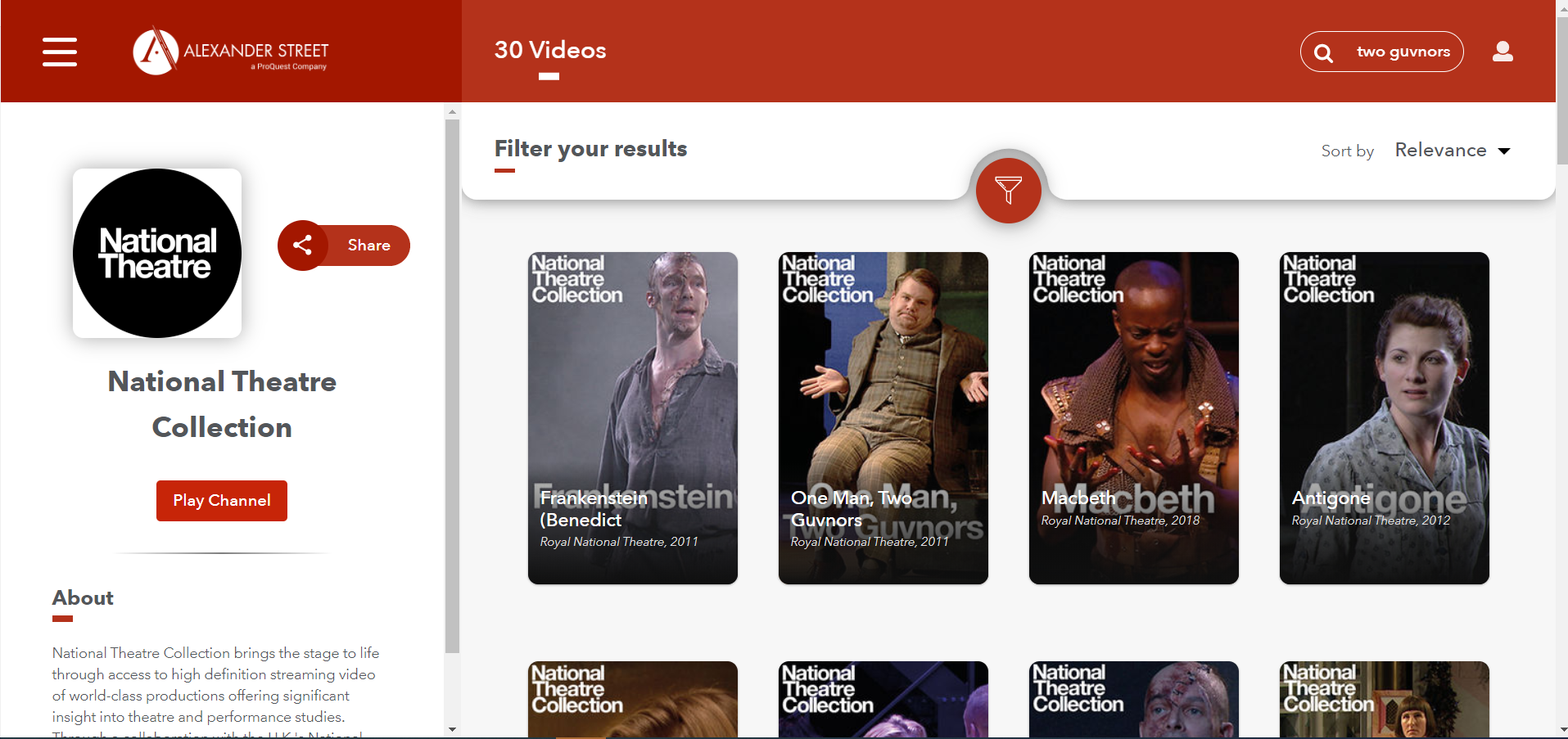
National Theatre Collection brings the stage to life through access to high definition streamed video of world-class theatre productions and unique archival material, offering insight into British theatre-making and performance studies. The collection contains 30 video performances. As a supplement to the filmed productions, exclusive digitised archival materials such as prompt scripts, costume designs, and more are available to provide behind-the-scenes background and contextual information. The featured 30 performances are:
- Comedies:She Stoops to Conquer (2012), One Man, Two Guvnors (2011), and London Assurance (2010)
- 20th century classics: Yerma (2017), The Cherry Orchard (2011), The Deep Blue Sea (2016), Les Blancs (2016), A Streetcar Named Desire (2014), Cat on a Hot Tin Roof (2018), Consent (2017)and Translations (2018)
- Shakespeare plays:Hamlet (2010), Othello (2013), King Lear (2011), Macbeth (2018), Julius Caesar (2018), Coriolanus (2014), Twelfth Night (2017), The Winter’s Tale (2018) and Romeo and Juliet (2017)
- Literary adaptations:Frankenstein [Jonny Lee Miller as Creature, 2011], Frankenstein [Benedict Cumberbatch as Creature, 2011], Jane Eyre (2015), Treasure Island (2015), Peter Pan (2017), Wonder.land (2015) and Small Island (2019)
- Greek classics:Antigone (2012) and Medea (2014)
- World historical drama:Dara (2015)
Notebook No. 4 Update
 During this lockdown, the Lyell Project has been able to continue enhancing metadata, despite having no access to the Lyell notebooks, thanks to some quick digitisation done by the amazing team at the DIU prior to lockdown. We’ve been working quite a bit with Notebook No. 4, from 1827, when Lyell was balancing his two callings; the law and geology. In 1825 his eyesight was no longer ailing him as it had been years previously, and following his father’s wishes, he was called to the bar and joined the Western Circuit for two years. But during this time, as we can see from the Notebook, he also maintained fervent correspondence with fellow geologists, read the works of George Poulett Scrope, and Lamarck, and thereby fostered a great curiosity for the volcanic Auvergne region in France. In 1825 he joined Scrope as a Secretary to the Geological Society, and contributed frequently to the Quarterly Review (published by John Murray, the archive of issues are available with EASE access here).
This notebook is a fascinating look into this dichotomy Lyell was facing; pages constantly change between matters of law and geology. He expresses great passion and opinion on both, but his notes concerning law and society are often tinged with a sense of discontentedness, whereas his entries on geology are mostly “Queries” about the properties of geological phenomena, or discussions on how he disagrees with a recently published position.
 Another curious element in this notebook is the inclusion of citations to works by Dante, namely Dante’s Inferno. These appear often among entries on other subject, and without explanation. Clearly, this an excellent area of research, as we know Lyell’s father was a great scholar on Dante.
That’s all for today’s update! Explore Notebook No. 4 for yourself here!
For more information about the Lyell notebooks, see Lyell Rocks! Saving & Sharing the Charles Lyell Notebooks
Reflecting on New College Library at DHT
A guest post from Gina Headden, New College Library Helpdesk Team
New College Library on the Mound is a grand and imposing building but like many historic locations it occasionally needs significant maintenance to allow its continued use as a venue fit for purpose in the 21st century.

New College Library @ DHT Helpdesk
Thus, in the early days of 2020, the general library stock moved from its historic location on the Mound to the ground floor of the 1960s David Hume Tower (DHT) in George Square so that essential repairs could be carried out ‘back at base’ over the next 18 months. Read More
Dealing with Data 2019 (January 2020): Collaboration Across the Nations
Picture the scene: A cold January day, the wind blowing the scarves of the passers-by through the large windows of the Informatics Forum meeting room. The group inside listens, takes notes, tweets, and asks questions of the speakers, representing a range of disciplines across the University…
Dealing with Data is an annual event hosted by the Research Data Service. Its aim is to engage the University community of researchers and support professionals around a theme, to share success stories and challenges in the myriad, everyday issues involved with data-driven research. The theme this year reflected the difficulty of managing research data in large, collaborative projects. Due to industrial action, the original November event was postponed to January. Around a hundred researchers – staff and students – participated, along with support staff who gave lightning talks about research-focused services. Full presentations and videos are now available.
So Benjamin Bach, our keynote speaker, inspired us with state of the art data visualisation software and techniques for both exploration and presentation. But he also illustrated the difficulties of portraying all of the data in all of its facets of a rich dataset, and the consequences of making necessary choices for its interpretation.
The first session began with Tamar Israeli’s study of researchers’ use of collaborative and institutional tools showed the challenges of making local infrastructure user friendly enough to attract new users familiar with slick cloud-based services. Then Mark Lawson demonstrated his ingenuous ‘ethical hacking’ to piece together a set of APIs to create a research workflow for samples and images for histology research. Minhong Wang conveyed a higher level view of data management focused not just on data-driven, but knowledge-driven phenotyping.
Next were the lively lightning talks, in which Mike Wallis of Research Services warned of a new Digital Dark Age, and David Creighton-Offord spoke of the dillemmas in Information Security user support where shiny doesn’t always equal safe. Lisa Otty spoke of innovative training and text mining projects bringing data science to the Humanities, and Rory MacNeil demonstrated how the RSpace electronic lab notebook can connect to a host of popular open science tools.
Following a lively lunch with chat between delegates and with hosts of the service exhibitions, Alex Hutchison showed a highly programmatic view of data management and ethics control from the UNICEF collaboration, in collecting and analysing real world data about children in need. Caileen Gallagher offered a case study of how food courier data could be used to empower workers. Sanja Badanjak shared her data integration problems of peace agreements around the world, conveying both innovative solutions and time-consuming workarounds.
In the final session Edward Wallace brought in the Edinburgh Carpentries to the rescue of poor data skills within Biological Sciences and the wider University – itself a great example of cross-community collaboration building a community of trainers. Gillian Raab showed us how any data problem however intractable can be solved by resourcefulness and determination, making use of DataShield for multi-party computation when datasets are too sensitive to be shared. Johnny Hay and Tomasz Zielinski demo’d their Plasmo ‘boutique repository’ for plant-systems biology modelling and Holly Tibble described tackling an international collaboration in linking administrative datasets via ‘ridiculously detailed’ statistical analysis plans. Representing the Research Data Service, I wrapped up proceedings with some of these very observations.
Both presentations and videos are available.
Welcome
- Jeremy Upton, Director of Library and University Collections. [Presentation]
Keynote
- Data Visualization for Exploration and Presentation, Prof. Benjamin Bach. Lecturer in Design Informatics and Visualization. [Presentation] [Slides]
Session 1 – Chair: Theo Andrew
- “Data Something”: Assessing Tools, Services and Barriers for Research Data Collaboration at the University of Edinburgh – a small-scale study carried out by Dr Tamar Israeli with support from the Research Data Support team. Robin Rice – Data Librarian & Head of Research Data Support Services. [Presentation] [Slides]
- Integrated secure web application to deliver centralised management of research samples, histology services and imaging data. Mark Lawson, Data & Project Manager, MRC Centre for Reproductive Health, QMRI. [Presentation] [Slides]
- Building the Knowledge Graph for UK Health Data Science Minhong Wang et. al, Deanery of Molecular, Genetic and Population Health Sciences. [Presentation] [Slides]
Session 2 – Chair: Kerry Miller
- The Data Opportunities & Challenges when Collaborating across Organisations
Alex Hutchison, Delivery Director – Data for Children Collaborative with UNICEF. [Presentation] [Slides] - Restoring Gig Workers to Power: Personal Data Portability, Supply of Digital Content and Free Flow of Data in the European Data Economy. Cailean Gallagher, Scottish Trades Union Congress, & St Andrews University Institute of Intellectual History. [Presentation] [Slides]
- Dealing with data in peace and conflict research. Sanja Badanjak, Postdoctoral Research Fellow, School of Law. [Presentation] [Slides]
Session 3 – Chair: Robin Rice
- Bringing researchers to data: computing skills training with Edinburgh Carpentries.
Edward Wallace, Sir Henry Dale Fellow, Institute of Cell Biology. [Presentation] [Slides] - Running an analysis of combined data when the individual records cannot be combined. Gillian M Raab and Chris Dibben, Scottish centre for Administrative Data Research. [Presentation] [Slides]
- The grant is dead, long live the data. Johnny Hay and Tomasz Zieliński, School of Biology, University of Edinburgh. [Presentation] [Slides]
- International collaborations using linked administrative data: Lessons from the MARIC study. Holly Tibble, Usher Institute, University of Edinburgh. [Presentation] [Slides]
—
Robin Rice
Data Librarian and Head, Research Data Support
Library & University Collections
Caring for the New College Library Torah Scroll
A guest post by Valentina Flex, New College Library & Archive Assistant.
In order to ensure the safe and successful decant of collections at New College Library, myself and my fellow Archive and Library Assistants have wrapped (with acid-free tissue paper or Tyvek) and cotton-taping tied particularly fragile objects within the archives in order to stabilise and reinforce them before they move. The preparation for this task involved surveying the collections and taking notes of items in need of special attention. Surveying the items in New College Library archives and assessing the best method of collections care for them made me think about the context of each object’s creation and use. Specifically, I wondered if there were any implications involving certain items in a religious setting that would affect the ways we treat and care for them.
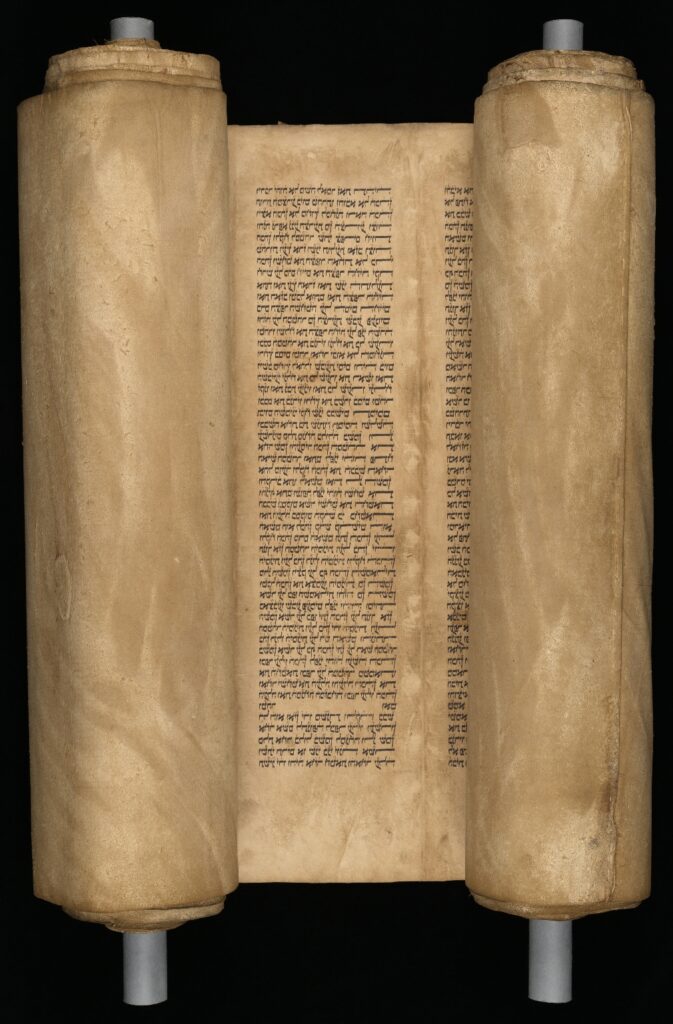
Torah Scroll, New College Library
On trial: State Papers Online Eighteenth Century
Thanks to a request from a PhD student in HCA the Library currently has extended trial access to State Papers Online: Eighteenth Century, 1714-1782 Parts I-IV from Gale. This covers the final section of the State Papers series from the National Archives in the UK before the series was closed and replaced by the Home Office and Foreign Office series in 1782.
You can access State Papers Online: Eighteenth Century via the E-resources trials page.
Access is available on and off-campus.
Trial access ends 30th June 2020.
State Papers Online: Eighteenth Century comes in 4 parts and we have access to all 4 during this trial. Read More
‘Protecting sensitive data’: new MANTRA unit now available
The Research Data Support team are pleased to announce a new update to MANTRA, the free and open online research data management training course.
The new ‘Protecting sensitive data’ module has been created from scratch, replacing the previous ‘Data protection, rights and access’ unit to provide an up-to-date guide for researchers working with sensitive and personal data.
MANTRA is designed to give post-graduate students, early career researchers, and information professionals the knowledge and skills needed to work effectively with research data.
The ‘Protecting sensitive data’ unit considers the ethical and legal contexts for conducting research with sensitive data, including information and guidance on:
- What makes data sensitive?
- What UK and European data protection laws mean for research
- Research ethics, informed consent and consent documentation
- Approvals processes and accessing restricted data
- Safeguarding sensitive data, including data retention limits, access controls and anonymisation
- Data protection training
MANTRA is designed to be approachable and informative, and incorporates text and video content plus quizzes, interactive exercises and a ‘further reading’ section.
We hope you find the new content interesting and useful, and we welcome comments on the new unit, as well as feedback on the other seven MANTRA modules.
Finally, the RDS team are currently working on a series of further updates to MANTRA which will be rolled out over the coming weeks, and information about these releases will be posted on this blog and the RDS Twitter account.
Bob Sanders
MANTRA, Lead Editor
Edinburgh Research Archive downloads: April 2020

Oxford Politics Trove – on trial
Thanks to a request from a member of staff from Politics & International Relations, the Library currently has extended trial access to Oxford Politics Trove, which enables you, for the first time, to search and interrogate the wealth of Oxford’s politics textbook list.

You can access Oxford Politics Trove via the E-resources trials page.
Access is available on and off-campus.
Trial access ends 30th June 2020. Read More
New to the Library: Trismegistos
I’m happy to let you know that further to a request from staff in HCA the Library now has a subscription to Trismegistos, an online resource that aims to surmount barriers of language and discipline in the study of texts from the ancient world, particularly late period Egypt and the Nile valley (roughly BC 800 – 800 AD).

You can access Trismegistos via the Databases A-Z list and Classics subject guide.
The core component of Trismegistos (TM) is Trismegistos Texts, currently counting 823212 entries. When the database was created in 2005, it focused on providing information (metadata) on published papyrological documents from Graeco-Roman Egypt. Since then the geographical scope has been widened to the entire ancient world, the time period covered was broadened to between BC 800 and AD 800, and the database was expanded to include epigraphic material as well. Read More
Collections
 Hill and Adamson Collection: an insight into Edinburgh’s past
My name is Phoebe Kirkland, I am an MSc East Asian Studies student, and for...
Cataloguing the private papers of Archibald Hunter Campbell: A Journey Through Correspondence
My name is Pauline Vincent, I am a student in my last year of a...
Hill and Adamson Collection: an insight into Edinburgh’s past
My name is Phoebe Kirkland, I am an MSc East Asian Studies student, and for...
Cataloguing the private papers of Archibald Hunter Campbell: A Journey Through Correspondence
My name is Pauline Vincent, I am a student in my last year of a...

Projects
Cataloguing the private papers of Archibald Hunter Campbell: A Journey Through Correspondence
My name is Pauline Vincent, I am a student in my last year of a...
Archival Provenance Research Project: Lishan’s Experience
Presentation My name is Lishan Zou, I am a fourth year History and Politics student....