Home University of Edinburgh Library Essentials
June 18, 2026
Protocols.io trial… six months on!
We launched a trial of protocols.io Enterprise in December 2019, and a lot has been achieved in the first six months.
The number of registered UoE users has increased from 121 to 217 and the number of private protocols from 36 to 106 which demonstrates a significant interest in using the platform with its additional Enterprise functionality,
We have also run a number of webinars specifically for UoE staff and students which have been well attended.
While these numbers suggest interest amongst our research community in using protocols.io we have to collect better feedback before we can decide if protocols.io Enterprise is to become an ongoing service provided by the University.
That is why we are now launching this short survey about protocols.io which is open to all UoE research staff and students. The aim is to gather initial thoughts from our community and to identify people who may be prepared to contribute more in-depth feedback as the trial progresses.
The survey can be accessed at https://edinburgh.onlinesurveys.ac.uk/protocols-io-6-month-survey
To find out more about protocols.io or this trial you can read this blogpost from when the trial launched: https://libraryblogs.is.ed.ac.uk/2019/12/13/new-research-data-management-tool-on-one-year-trial-protocols-io/
Alternatively please visit our website, where you will also find links to all the protocols.io webinars we have run: https://www.ed.ac.uk/information-services/research-support/research-data-service/during/open-research-tools/protocols
—
Kerry Miller
Research Data Support Officer
Library & University Collections
We Are Still Here!
We are delighted to announce that thanks to generous support from the Wellcome Research Resource Fund, our Body Language archives project will now run until January 2021.
It seemed a very different world when we began our Wellcome Research Resource-funded ‘Body Language’ project back in September 2017. The aim of our project is to catalogue, preserve and make available three significant collections relating to movement, dance, gymnastics and physical education in Scotland and beyond. The collections include the Margaret Morris Archives, the records of Dunfermline College of Physical Education and the records of Scottish Gymnastics. You can read more about the project and collections on our ‘About’ page. The project was originally due to complete in July 2020 – but we are still here, and I am very pleased to report that we are not going anywhere soon. Thanks to a generous grant supplement and project extension from our project funder, our ‘Body Language’ project will now run until January 2021.
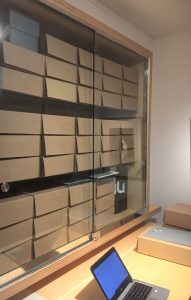
We miss discovering daily delights in the archive – the Margaret Morris Collection in situ at the Fergusson Gallery, Perth
In February 2020, my main focus was centred around completing the cataloguing of the Margaret Morris collection. The cataloguing, conservation and preservation of both the Dunfermline College of Physical Education and Scottish Gymnastics collections were largely complete. I was working on final edits for those two collections, alongside the work on the Margaret Morris collection. The work required a lot of to-ing and fro-ing between boxes, creating the last of hundreds of box-lists, crafting and implementing a new intellectual arrangement for the Margaret Morris collection, and numbering the physical collections. I was also working with colleagues from our Digital Imaging Unit on the digitisation element of our project and with colleagues from our Library Digital Development team, developing the technical infrastructure for our new project website. The website will host the collections catalogues and provide contextual information for public engagement and research based around the collections.
By the middle of March 2020, Europe had been identified as the epicentre of the COVID-19 pandemic and it was becoming increasingly evident that we may have to move to home working at very short notice. With the prospect of no physical access to the collections for an indefinite period, I began to capture as much information as possible about the remaining uncatalogued material. I hastily created box-lists and took photographs of the physical layout and arrangement of collections, to act as a memory aid and to allow me to continue project work from home.
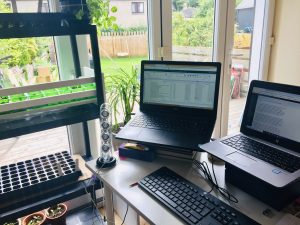
View from our project archivist’s home office
I have been working from home since 18 March 2020. While I have been able to continue work on many of the outstanding project tasks at home, I and others on the team have been unable to physically access collections to complete essential cataloguing and digitisation work. And like so many people, our team are also facing some of the many and varied challenges that have come along with lock-down, such as increased childcare commitments, home schooling, and caring commitments.
We are delighted therefore (and a little relieved) that Wellcome have offered to supplement our original grant and to extend the project end date by 6 months. This will help enormously to mitigate some of the impact and challenges that we have faced, and continue to face, in light of the current global health crisis. We hope to be able to return to working with the physical collections before the end of the project – we miss them (and our colleagues).
The extension provides an opportunity, over the coming months, for us to share more here; about the collections, our work, and to highlight some of the interesting discoveries that we have made. We’ll be posting something every week, (with perhaps a guest post or two). Please join us on our journey as we work our way through the concluding stages of our project.
I am really happy to be able to work with these fantastic collections for a little longer. Thank you Wellcome!
Elaine MacGillivray
Project Archivist
Database trial – Global Newsstream

The Library has just arranged a free trial of Global Newsstream from ProQuest. The trial has been advertised in the Library’s E-resources Trials website http://edin.ac/e-resources-trials and can be accessed on and off campus via University login.
Global Newsstream enables users to search the most recent global news content, as well as archives which stretch back into the 1980s featuring content from newspapers, newswires, and news sites in active full-text format. This product provides one of the largest collections of news from the US, Canada, Europe, Africa, Asia, Latin America, and Australia. All titles are cross-searchable on the ProQuest platform allowing researchers easy access to multiple perspectives, resources, and languages on the topic they are researching.
Coverage: 1980 – current. Trial ends: 7th Aug 2020.
It includes the following sub-databases:
Canadian Newsstream
Full text of over 190 Canadian newspapers from Canada’s leading publishers. This full text database includes the complete available electronic backfile for most newspapers, providing full access to the articles, columns, editorials and features published in each. Some backfiles date as far back as the late 1970s. View title list.
Global Breaking Newswires
Provides timely access to the best newswire content available globally as well as growing archive of news that may not be captured in any of the traditional print sources. View title list.
International Newsstream
Provides the most recent news content outside of the US and Canada, with archives which stretch back decades featuring newspapers, newswires, and news sites in active full-text format. View title list. It consists of the following Nesstreams:
- Asian Newsstream — more than 60 of the most respected national and regional sources of news and current affairs information in Asia and the Far East. View title list.
- Australia & New Zealand Nesstream — offers access to leading Australian and New Zealand newspapers. View title list.
- European Newsstream — contains 552 national and regional newspapers and other news sources from across Europe. View title list.
- Latin American Newsstream — includes titles from Brazil, Mexico, Argentina, Costa Rica, Peru, Uruguay, Chile, Colombia, Ecuador, Guatemala, Puerto Rico, and Venezuela. Latin American Newsstream provides newspapers in Spanish and Portuguese. Key newspaper titles include: El Universal (Mexico City);O Globo (Brazil);La Nación (Argentina);and El Mercurio (Chile). View title list.
- Middle East & African Newsstream — newspapers, news wires, websites, and blogs from leading publishers throughout the region. Sources include The Jerusalem Post, the Gulf Daily News, Kuwait Times, Cape Times, and Yemen Times, among many others. It includes backfiles as far back as 1988. View title list.
U.S. Newsstream
Provides the most recent premium U.S. news content, as well as archives which stretch back into the 1980s featuring newspapers, newswires, blogs, and news sites in active full-text format. For academic and public libraries, U.S. Newsstream offers exclusive access to the Los Angeles Times, Chicago Tribune, and co-exclusive access (with Factiva) to The Wall Street Journal. View title list.
We already subscribe to two full-text global newspaper databases: Factiva and Nexis UK. It’d be useful to compare these sources. Feedback welcome.
ProQuest Access 350: 600 years of world history
*Access has now been extended until 31st July 2024*
I’m very pleased to let you know that University of Edinburgh Library has set up a new subscription with ProQuest that gives you access to almost all available ProQuest digital primary source databases until 31st December 2021.
ProQuest Access 350 allows you to explore 600 years of world history online and will help enrich learning, teaching and research at the University across a range of subject areas and topics including History, the Arts, Literature and Social Sciences.

New! African Newspapers, Series 1 1800-1922
I’m pleased to let you know that the Library had recently purchased the digital primary source database African Newspapers, Series 1 1800-1922 part of the World Newspaper Archive from Readex. This gives you unique access to a fully searchable collection of historical newspapers from Africa.

You can access the African Newspapers, Series 1 1800-1922 via the Newspapers, Magazines and Other News Sources guide. Or you can access it via the Databases A-Z list. Individual newspaper titles will also be added to DiscoverEd in the near future. Read More
Two new Quick Guides for good Research Data Management
The Research Data Support team have recently published two new Quick Guides, the latest in a series of short, user-friendly documents intended to help our research staff and students plan, manage and preserve their data effectively, safely, and for the long-term.
Quick Guide 5 takes the topic of “Open Research” – also known as Open Science, particularly in a European context. The drive towards research transparency and the removal of barriers to accessibility has gathered a great deal of momentum over recent years, to the extent that “Open by default” is an increasingly common approach. Open research enables scientific findings to be tested, reproduced and built upon far more quickly than traditional approaches allowed. The benefits of Open Research are being demonstrated in real time, right in front of our noses, as researchers at Edinburgh tackle various aspects of the Covid-19 pandemic. We recently tweeted about one such project which examined the effectiveness of face coverings in reducing the range travelled by breath, which of course helps transmit the virus. The data underpinning this research is freely available to everyone via Edinburgh DataShare.
The latest Quick Guide, the sixth in the series, addresses the ‘FAIR’ principles, which state that research data should – so far as possible, and appropriate – be Findable, Accessible, Interoperable and Reusable. These principles emphasise machine-actionability (i.e. the ability of automated computational systems to find, access, interoperate, and reuse data with minimal or no human intervention) as humans increasingly rely on computational means to discover and work with data as a result of the increase in volume, complexity, and creation speed of data.
These two new publications join our existing guidance on topics such as the basics of Research Data Management (RDM), RDM and data protection, and research data storage options at the University. Future topics planned include conducting research safely online, FAIR approaches to research software, and an overview of the systems and services available at Edinburgh in support of Open Research. If there is a particular topic you would find useful, please get in touch with us via data-support@ed.ac.uk or the IS Helpline.
All of our Quick Guides can be found at https://www.ed.ac.uk/information-services/research-support/research-data-service/guidance
—
Martin Donnelly
Research Data Support Manager
Library and University Collections
Edinburgh Research Archive downloads: May 2020

Edinburgh Research Explorer downloads: May 2020

New! LGBT Magazine Archive
I’m happy to let you know that the Library now has access to the LGBT Magazine Archive from ProQuest until 31st July 2024. This primary source database is a searchable archive of major periodicals devoted to LGBT+ interests, dating from the 1950s through to recent years.

You can access the LGBT Magazine Archive via the Newspapers, Magazines and Other News Sources guide. Or you can access it via the Databases A-Z list. Individual magazine titles will be added to DiscoverEd this week. Read More
Rare Book Cataloguing: The Case of the Blurry Page
Sometimes in rare book cataloguing you come across something that requires you to flex you analytical bibliography muscles. It can be amazing what you can gather from the study of the physical form of a particular volume.
In the following case we managed to learn quite a bit about the printing practices in Cologne during the 1470s from the study of one page.
So, one day I was merrily cataloguing CRC Inc.S.16/2 (De excidio Troiae historia. Not printed after 1472) when I turned a page and found this:

Not actually a bad photograph, but a badly printed page. Possibly what is known as a “slur” where the platen (we’ll get into that later) moves during the printing process and causes the ink to smear. But more likely the platen was lowered twice on the same page, whether on a one- or two-pull press is open to debate.
So far, so what. ¯_(シ)_/¯
Well, it occurred to me that there was only one mis-printed page. In the printing process there will always be a partner page printed on the same sheet, which is then folded. So, I checked the partner of our mis-printed page and found that it wasn’t blurred. This book was a quarto which meant, as I’m sure you’re all thinking, that that was impossible.
Okay, so a lot of jargon there. Let me break this down.
This is a diagram of a hand-pulled press. Showing the frisket, tympan, forme, press stone and the aforementioned platen.

(Public domain image made available by Smithsonian Libraries (AE25.E53X 1851 Plates, t.7, “Imprimerie en caracteres,” plate 15))
- Frisket: Used to hold the paper in place on the tympan and to mask off areas that you don’t want printed.
- Tympan: Holds the paper using small pin-like pieces of metal.
- Forme: The name given to the frame that the type is tightly packed into.
- Press Stone: The frisket and tympan are folded onto the press stone.
- Platen: Is the part of the press that applies the pressure to the paper on the forme.
The illustration above is actually a two-pull press. In this case the press is set up for a quarto sheet with four pages to be printed. The stone is rolled under the platen once, the platen is pressed down printing two pages, then it’s lifted and the stone is rolled further in and the platen is lowered again, printing the final two pages.
In the case of a one pull press, the platen is lowered once. If it’s a folio then one page is printed, if it is a quarto then two pages are printed. After it’s printed, the forme is reset with the next page(s) to be printed.
Now the complicated bit.
Let’s talk about formats. Folio, quarto, octavo, etc.
The format of a book is determined by how many pages are printed on a sheet and how many times that sheet is folded.
So, for example, one sheet of paper is printed on both sides, then folded once.
This is a folio. It’s folded once along the y-axis. Giving two leaves or four pages.
Front of sheet

Back of sheet
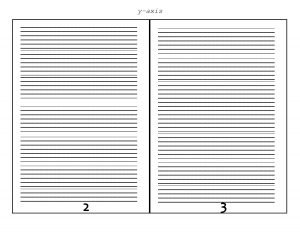
The Folger Library has an interesting website that lets you play with Shakespeare’s First Folio where you can assemble sheets into “gatherings”.
This is a quarto. It’s folded twice. First the y-axis, then the x-axis giving four leaves or eight pages.
Front of sheet

Back of sheet

Check out this video to see how it’s done.
Octavos are folded three times, giving you eight leaves or sixteen pages. And so on …
Okay now that we’re all experts on formats, let’s stampede over to chain lines.
Chain lines are formed during the paper making process. The mould used to make the paper is dipped into a vat of pulped linen and the water is sieved away leaving behind an impression of the mould.
Check here to see the process.
The mould consists of wire sewn onto supports, it’s these supports that leave the chain line impressions.
Here’s a paper mould.
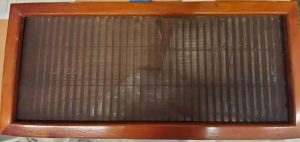
The thicker, vertical lines you can see are imparted onto the sheet of paper during the paper-making process and will end up looking something like this.

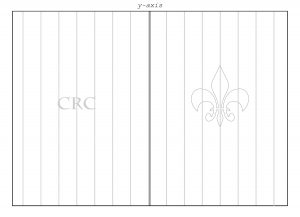
Chain lines help to determine the format of a volume. With a folio the sheet is folded once along the y-axis, therefore the chain lines will be vertical on the page. If there is a watermark (and there isn’t always!) it is placed on the right-hand side of the sheet.
In the example below there’s a watermark on the right-hand sheet and a countermark on the left. When the sheet is folded the chain lines will be vertical and the watermark will be in the centre of the page.
Folio
With a quarto the sheet is folded once along the y-axis, then once along the x-axis therefore the chain lines will be horizontal on the page. The watermark will be in the gutter, often difficult to see, especially in tightly bound books.
Quarto

Phew! Okay, we now have all that knowledge, so here’s why that blurry page is so weird. The chain lines and watermarks in the book show that it is a quarto. And if you remember from before, quartos are printed either two or four pages at a time, so how can there be only one mis-printed page on a sheet? The conjugate page should be mis-printed as well.
When the platen lowered the mis-printed page should have had a mis-printed partner:

If the red page is the mis-printed page, then the green page must be mis-printed because the platen would be lowered on the both at the same time.
No such mis-printed partner existed.
Headaches ensued.
More headaches.
Much sighing.
Light-bulb!
This volume was printed before 1476, we know this because the rubricator (someone who would emphasise areas of the text with red ink) very kindly dated his rubrication. So, it’s a very early quarto. What if the printer viewed printing a quarto like printing a small folio?
Possibly they used a half sheet and imposed the quarto as a folio, and then printed it a page at a time. That would allow for only one page to be mis-printed. We checked the watermarks and chain lines and established that these were indeed half sheets.
Calls went out on Twitter; colleagues were asked for their opinions. Robert MacLean at the University Glasgow put us on to Karina de la Garza-Gil at the University of Cologne who confirmed that the common practice for Cologne printers at that time was to print quartos in half sheets one page at a time.
All that was left was to work out how it happened.
There is no smearing of the ink, and the first printing is sharp if faint. This makes it unlikely that anything twisted or moved, so perhaps the printer lowered the platen once and changed their mind before lowering it with the required force a second time.
The final mystery: was it a one or two pull press? It would be pure speculation to decide either way. Arguments could be made for either. At this point you really need to be able to read the mind of a printer from five hundred years ago. What we do know is that printing quartos on full sheets on a two-pull press became common a few years after this particular book was printed.
In the end what this does show, is how much information can be gleaned from analysing the physical properties of a book. From one mis-printed page we established the printing practices in Cologne from five hundred years ago.
And that end’s the tale of the blurry page!
Collections
 Hill and Adamson Collection: an insight into Edinburgh’s past
My name is Phoebe Kirkland, I am an MSc East Asian Studies student, and for...
Cataloguing the private papers of Archibald Hunter Campbell: A Journey Through Correspondence
My name is Pauline Vincent, I am a student in my last year of a...
Hill and Adamson Collection: an insight into Edinburgh’s past
My name is Phoebe Kirkland, I am an MSc East Asian Studies student, and for...
Cataloguing the private papers of Archibald Hunter Campbell: A Journey Through Correspondence
My name is Pauline Vincent, I am a student in my last year of a...
Projects
Cataloguing the private papers of Archibald Hunter Campbell: A Journey Through Correspondence
My name is Pauline Vincent, I am a student in my last year of a...
Archival Provenance Research Project: Lishan’s Experience
Presentation My name is Lishan Zou, I am a fourth year History and Politics student....