Home University of Edinburgh Library Essentials
June 18, 2026
New Digital Imaging Unit Website
Guest post by Meg Dolan (MScR Collections and Curating Practices, 2020) and Keith Bossert (MSc History of the Book, 2020)
This summer we had the opportunity to intern with the Digital Imaging Unit, working under Photographer, Juliette Lichman, and DIU Manager, Carla Arton. Due to COVID-19 we worked remotely to expand and update the DIU’s web presence on the University’s Main Library page, a service development project related to their larger Digitisation as a Service Strategy.
The project was divided into 5 phases:
- Pre-Planning and User Experience Research & Analysis
- Planning and Training
- Design and Creation
- Usability Testing and Tweaking
- Publication

Phase 1: Pre-Planning and User Experience Research & Analysis
In Phase 1, we viewed the websites of similar digitisation departments across other academic and research institutions. This allowed us to Read More
DataVault – larger deposits and new review process notifications
New deposit size limit: 10TB
Great news for DataVault users: you can now deposit up to a whopping ten terabytes in a single deposit in the Edinburgh DataVault! That’s five times greater than the previous deposit limit, saving you time that might have been wasted splitting your data artificially and making multiple deposits.
It’s still a good idea to divide up your data into deposits that correspond well to whatever subsets of the dataset you and your colleagues are likely to want to retrieve at any one time. That’s because you can only retrieve a single deposit in its entirety; you cannot select individual files in the deposit to retrieve. Smaller deposits are quicker to retrieve. And remember you’ll need enough space for the retrieved data to arrive in.
We’ve made some performance improvements thanks to our brilliant technical team, so depositing now goes significantly faster. Nonetheless, please bear in mind that any deposit of multiple terabytes will probably take several days to complete (depending on how many deposits are queueing and some characteristics of the fileset), because the DataVault needs time to encrypt the data and store it on the tape archives and into the cloud. Remember not to delete your original copy from your working area on DataStore until you receive our email confirming that the deposit has completed!
And you can archive as many deposits as you like into a vault, as long as you have the resources to pay the bill when we send you the eIT!
A reminder on how to structure your data:
https://www.ed.ac.uk/information-services/research-support/research-data-service/after/datavault/prepare-datavault/structure
Ensuring good stewardship of your data through the review process
Another great feature that’s now up and running is the review process notification system, and the accompanying dashboard which allows the curators to implement decisions about retaining or deleting data.
Vault owners should receive an email when the chosen review date is six months away, seeking your involvement in the review process. The email will provide you with the information you need about when the funder’s minimum retention period (if there is one) expires, and how to access the vault. Don’t worry if you think you might have moved on by then; the system is designed to allow the University to implement good stewardship of all the data vaults, even when the Principal Investigator (PI) is no longer contactable. Our curators use a review dashboard to see all vaults whose review dates are approaching, and who the Nominated Data Managers (NDMs) are. In the absence of the Owner, the system notifies the NDMs instead. We will consult with the NDMs or the School about the vault, to ensure all deposits that should be deleted are deleted in good time, and all deposits that should be kept longer are kept safe and sound and still accessible to all authorised users.
DataVault Review Process:
https://www.ed.ac.uk/information-services/research-support/research-data-service/after/datavault/review-process

The new max. deposit size of 10 TB is equivalent to over five million images of around 2 MB each – that’s one selfie for every person in Scotland. Image: A selfie on the cliffs at Bell Hill, St Abbs
cc-by-sa/2.0 – © Walter Baxter – geograph.org.uk/p/5967905
—
Pauline Ward
Research Data Support Assistant
Library & University Collections
New! Social Work Online
University of Edinburgh Library has recently set up a subscription with ProQuest that gives you access to almost all available ProQuest digital primary source databases until 31st July 2024. See ProQuest Access 350. This is the first in a series of blog posts that will highlight particular databases or collections from ProQuest Access 350 that are relevant to the School of Social and Political Science.
Social Work Online

Social Work Online is a first-of-its-kind resource that pairs recently published social work textbooks along with compelling documentaries, clinical demonstration videos, and engaging lectures that illustrate the complex and challenging realities social work students will face as practitioners. The content is structured around twelve of the most important topics in the social work curriculum, most of which are applicable worldwide. Read More
Introduction to Leadership
This is a not one of my usual posts about Open Research, but rather a short essay written about and submitted for a Leadership course that I recently completed.
I have been in my current role as Scholarly Communications Manager since 2017. When I first began the role was very hands on, but over time the line management responsibilities have significantly increased. Initially I was the line manager for two staff, however over the last couple of years the team has grown to a total of six. I’ve never had any formal training on how to manage staff or provide leadership, and have up to now just got on with the basic mechanics of the job – performing annual development reviews, reporting sickness absences and annual leave requests. Unfortunately, this has meant that I’ve not had much time dedicated to improving the team work environment or developing the members of my team.
It was recently pointed out to me that many jobs (especially teaching, clinical medicine or emergency services) require significant training and qualifications before you can start, but with management roles you are quite often thrown in at the deep end and told to just get on with it. The University has started delivering training for leadership and management roles and I was keen to enrol on one of the many courses to learn new skills and hopefully see how management should be done.
So, at the start of the year, as part of a cohort of 14 managers and academics all from different departments and units spread out across the University, I started out on an ‘Introduction to Leadership’ course. The course itself started in February and consisted of several monthly one day workshops spread over six months. We were able to have the first two sessions in person, however due to the COVID-19 pandemic the course had to quickly reorganise and switch to online delivery. Lots of credit is due to the trainers Agnes and Lesley who were able to act quickly and resume the course.
At the end of the course it was an expectation that attendees would deliver a Leadership Journey presentation in a format they were comfortable with – some chose a video recording, others a written document. I have chosen a public blog post to document my leadership journey over the last few months pre-and-post lockdown, focussing on some of the things I learnt during the course and how I have built them into my working practices.
Motivation Values
The Introduction to Leadership course introduced to me the idea of motivational values which I had not encountered before. Each of the participants took a Strength Deployment Inventory (SDI) test which consisted of a series of behavioural questions which asked what people do when things are going well and also when they face conflict. Depending on how you answered a profile was built up which describes your own personal motivational values focussing on three end points: People (empathy), Processes (logic) and Performance (results).

Strength Deployment Inventory plot showing motivational values
I found out that my answers placed me at the intersection of People and Processes, and that under stress I would verge towards Process based behaviour. This made sense to me as in my job I try to deliver a quality service focussed primarily on people and making sure they are happy with the outcome, rather than focussing singly on results. To run the service we have to develop new processes and protocols under rapidly changing scenarios. The guidelines and criteria we develop make sure the service we run is equitable and is understandable to our staff despite arising from an extremely complex set of policies and rules imposed on us by research funders and journal publishers who are often at odds with each other.
The technique of looking at peoples motivational values has helped me better understand my team members by understanding a little of the motives that drive their behaviours. For example, someone who is Green and values analytical approaches will feel more comfortable with clear instructions within a framework, whereas someone with Blue tendencies will prefer an empathic approach. In the last few months, I have tried to tailor my team management approach by considering the personalities involved and although it is difficult to monitor and assess I personally think that the team has been functioning better despite the difficult general circumstances we have found ourselves in. I cannot take credit for individual’s performances, but it is definitely easy to manage a team full of diligent and talented people so I can at least take some credit for hiring them!
Situational Leadership
Building upon the last point the next main concept that the Leadership Course introduced and I have found really interesting/useful is the idea of Situational Leadership. The basic premise is that a leader further tailors their approach depending on the people and task in hand.
Naturally, I found that I was changing my approach when working with colleagues – for example with new team members I was being very hands-on and with experienced team members I was able to rely on them to get on with things. However, having a framework to fit my behaviour in has given me an understanding on how to improve both my own management and my co-workers skills.
I now recognise that I have been poor at delegating tasks despite people offering to help. My resistance is not really a fear of losing power, or believing that I can do it better, but rather I have been put off somewhat by the time involved in explaining the task, and a general unwillingness to accept risk for certain high-priority’ tasks. Acknowledging this has been useful as I can now move forwards and change from an ‘Instructing’ style through ‘Mentoring’ and ‘Coaching’ to ‘Delegating’. By developing and trusting my colleague’s skills I have been able pass work on to them and carry out other tasks.
As shown in the graph below, since working from home starting in March 2020 we have seen the volume of team calls double when compared to previous years. It seems many of our academic colleagues (those without children anyway!) are using the time away from the workplace to write up papers, or carry our peer review to get through the backlog of submitted papers. More journal articles being accepted for publication means more work for my team as they deal with open access enquiries from academics.

Number of calls per month received by the Scholarly Communications Team has significantly increased during COVID-19 lockdown
During lockdown I have been working reduced hours to look after and teach my school-age children. With the increased workload I found myself working late into the evening to keep on top of things, but I soon realised that I could not keep up my old hands-on working behaviour in the long term. I would not have survived the last few months if I had not been able to fully delegate work tasks to my colleagues and I am extremely grateful that I have been supported by a wonderful team that has stepped up and responded to the challenges of working from home.
The leadership course has given me a set of tools and a framework with waypoints that I can use to inform my decision making. More importantly it has provided a support network of fellow managers who were part of this cohort.
Spotlight on ProQuest History Vault
Interested in American history? Then ProQuest History Vault may be exactly what you are looking for.
History Vault gives you access to millions of pages of cross-searchable, full-text/full-image documents including articles, correspondence, government records, photographs, scrapbooks, financial records, diaries and more, documenting the most widely studied topics in 18th- through 20th-century American history. It’s a fantastic resource for those teaching, learning or researching in the areas of history, African American studies, women’s studies, political science, social sciences, sociology, and international studies.
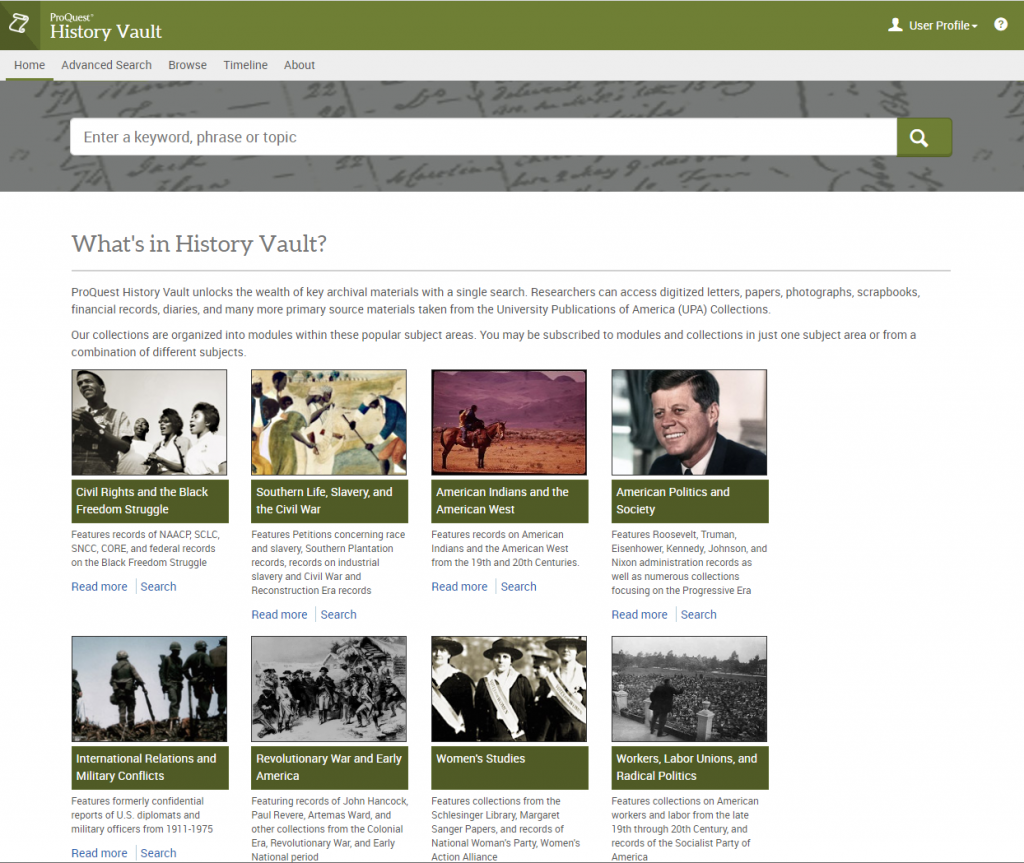
You can access ProQuest History Vault via the Databases A-Z list or Digital Primary Source and Archive Collections guide. Read More
The Humble Spider – A Measure of Moral Character in Physical Education
In this week’s blog post we take a closer look at the Dunfermline College of Physical Education Archives and attempt to join up the dots between the humble spider and the history of physical education in Scotland. Starting with the spider…
There are more than 45,000 species of spider found world-wide. An arachnid, they belong to a class of arthropods that include scorpions, mites and ticks. They can range in size from 0.11 inches (the tiny Samoan) to almost a foot (the Goliath birdeater tarantula). Metric, that’s around 2.5 mm up to 30.5 cm, or from a pin-head up to the length of your average class-room ruler. While a handful are dangerous to humans, the vast majority of spiders are harmless. They are critical to controlling insect populations.
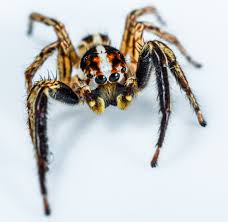
The Jumping Spider – which can jump up to 50 times its own length
Take a closer look at the humble spider and you’ll discover some surprising athletic prowess. The jumping spider can jump up to an impressive 50 times their body length. That’s the equivalent of a human jumping higher than a 25 storey building. The male Peacock spider lifts its legs and shakes its body in synchronised movements in order to attract mates. And every spider produces silk, the strong, flexible protein fibre which they use to build webs, to travel, to anchor themselves for jumping, and to float serenely along in the wind. Allegedly, the silk is so strong that it can absorb three times as much energy as Kevlar, the material used to make bulletproof vests.
Since ancient times, throughout the world, the spider has featured in folklore and cultural tradition. This nifty creature has been assigned a variety of moral attributes and character traits. In some cultural traditions, the spider is seen as an evil arch-intriguer, weaving webs of duplicity, designed to entrap the innocent. In others, it is cast as a model of industry, wisdom and foresight. From Persia to Poland, spiders and caves have featured in the folklore of Kings and Prophets. A Jewish story tells of a spider protecting King David, who was hiding from King Saul, by weaving a protective web across the mouth of a cave. The Story of Hijrah from the Islamic faith tells the story of a spider spinning a web in a cave to protect the Prophet Muhammad.
Here in Scotland, many will be familiar with the fabled encounter of King Robert the Bruce (1274-1329) with a spider, first popularised by Sir Walter Scott in his series ‘Tales of a Grandfather’ (1828-1830). The story goes that after defeat by Edward I at the Battle of Methven (1306), a dispirited and demoralised Bruce fled into hiding. Holed up in a cave, Bruce observed a spider stoically attempt time and again to spin its web. Every time the spider fell, it began again, until at last, the web was spun. Inspired by the tenacious spider, Bruce is alleged to have told his troops, prior to defeating the English at the Battle of Bannockburn (1314), “if at first you don’t succeed, try, try and try again”. Bruce reigned King of Scots from 1306 until his death in 1329, and is somewhat revered as a national hero in Scotland.
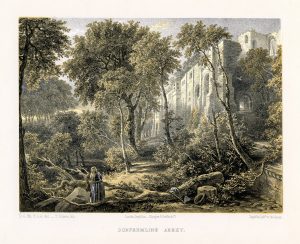
Lithograph of Dunfermline Abbey by T. Picken after D.O. Hill, 1847-1854 (Corson P.4114)
Dunfermline, the former capital of Scotland, has a long standing connection with Scottish kings. On his death in 1329, Robert the Bruce was the last of seven Scottish kings to be buried at Dunfermline Abbey. Sensationally, his remains were uncovered in 1818 and then re-interred at the Abbey in 1819. Towards the end of the nineteenth century, in 1891, the pulpit at Dunfermline Abbey was moved back and a monumental brass inserted to indicate the position of the royal vault.
Andrew Carnegie, the wealthy Scottish-born American industrialist and philanthropist, was born in Dunfermline in 1835. Carnegie was born just over fifteen years after the re-interment of Robert the Bruce at Dunfermline Abbey and only five years after Scott published his ‘Tales of a Grandfather’ featuring the legend of Robert the Bruce and the spider. The works of Scott were prominent in Carnegie’s education, enthusiastically relayed to him by his uncle, George Lauder, Snr. Carnegie’s ancestors had also been tenants on Broomhall Estate, the family home of Robert the Bruce’s descendants.
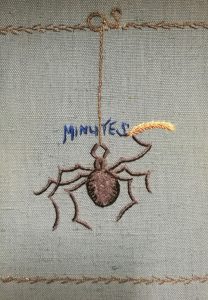
An embroidered spider motif on the front cover of the Dunfermline College of Physical Education Old Students’ Association Minute Book, 1912-1973 (Ref: EUA GD55/1/1/2)
Perhaps it is no surprise then, that the Carnegie funded Dunfermline College of Physical Education (DCPE), founded in 1905, should adopt the humble spider as its emblem. Its motto “Efforts are Successes” a distillation of Robert the Bruce’s alleged message to his troops. By 1905, Robert the Bruce and his spider were embedded in Scottish cultural tradition as a symbol of perseverance in the face of adversity. It is also fitting that this little creature assigned with traits of patience, dedication, resolve and resilience, and seemingly super-power athletic ability should become the lauded symbol of the college graduates.
The DCPE spider pops up in all manner of places throughout the the institution’s archives. The first minute book of the DCPE Old Students’ Association (OSA), which dates from 1912, features the spider motif intricately embroidered on its cloth cover. Open the cover and you will find revealed a controversy around the college brooch and its spider design. The minutes of 29 March 1929 read:
The Dunfermline College of Physical Education Brooch. Image courtesy of Lorna M. Campbell
The question of our badge having been raised. Mrs Manifold [the President of the Association] said it had been brought to her notice that our badge, not being registered, could be sold by Messrs R.W. Forsyth to any one who asked for it. She also said that she knew of a small shop-keeper who was making our pocket badge and had sold at least fifty, not necessarily to our members.
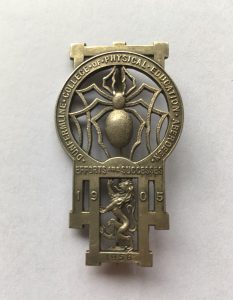
Inquiries were made to the Carnegie Dunfermline Trust (who owned the badge) to permit the spider design to be registered. Forsyth’s (a department store with premises in Edinburgh and Glasgow) offered to pay for the registration and were ‘prepared to protect their registration even to the point of a law-suit’ so strong were their feelings about the matter. Forsyth’s also committed to only sell badges to proven DCPE OSA members.
DCPE was founded as an instrument for improving the general health of the child but the story of the spider tells us it was about more than physical health. DCPE students and graduates were encouraged to align themselves to values of respectability, refinement, poise, deportment, and decorum. The moral standing and character of DCPE students was central to their teaching and their distinct identity in this area the source of some pride and cause for protection.
With growing secularisation, questions around how we shape the moral character and civic duty of society are as important now as ever before. Social and moral concepts such as loyalty, dedication, sacrifice, team-work, good citizenship, fairness, justice and responsibility are all tied up in the ethos of sports. But has the development of specialist sub-disciplines such as bio-mechanics, exercise physiology, sport psychology and motor learning led to a marginalisation of the social dimension of physical education? Has the renaming of physical education to ‘schools of exercise’ and ‘sports studies’ diluted its moral character? Does it matter? Asking these questions might lead us not just to a better understanding of the history of physical education, but of the human experience as a whole.
There are many ‘spider’ like stories to be found in the archives. This is one of thousands just waiting to be discovered. It is by uncovering and examining these stories that archives can help us to understand our past and our present, and subsequently, shape our future.
The records Dunfermline College of Physical Education and its’ Old Students Association are held at the University of Edinburgh Archives. You can search the catalogues of the Old Students’ Association online:
Dunfermline College of Physical Education Old Students’ Association
The catalogue of the college records will be made available online soon as part of our Wellcome Research Resource-funded ‘Body Language’ archive cataloguing project.
Sources and further reading:
- The National Geographic – Spiders
- On Walter Scott’s ‘Tales of a Grandfather’
- Isabella C. MacLean, The History of Dunfermline College of Physical Education, (1976).
- Phillips, M.G., Roper, A.P., History of Physical Education in ‘Handbook of Physical Education’ (2006).
- On Andrew Carnegie
With thanks to Clare Button for her background research of the minutes of the DCPE OSA (Ref: EUA GD55/1/1/2).
Tips for Searching Image Collections
The Digital Imaging Unit hosts the digitised content it has produced on a site called Image Collections. This site is available for searching, sharing, exporting, and reusing publically available and copyrighted images from the Library and University Collections. Many images have been used for research, teaching, publications and creating new content.
Need some images? Here are some tips for searching Image Collections.
-
Site Overview
The home page has a tiled look that will allow for you to jump straight into a collection of images (grouped by theme) to browse or to search across all collections using the search box at the top. If you click on a collection tile, it will take you to a collection overview page describing what you will find within that collection. Some collection pages have additional iiif manifest links so you can view an entire book as if reading through it, instead of looking at each page as an individual page. If you decide to browse that collection it will take you to a gallery style view of all the images in that collection. You can increase the number of images that appear at a time and page through to browse the entire collection. You can also use the navigation pane on the left side of the screen to filter based on specific characteristics, such as what, where, who and when.

-
Searching Across Collections
If you are looking for a specific search term, such as ‘student’, make sure to search across All Collections. Hover over the Collections tab on the top left of the page until Read More
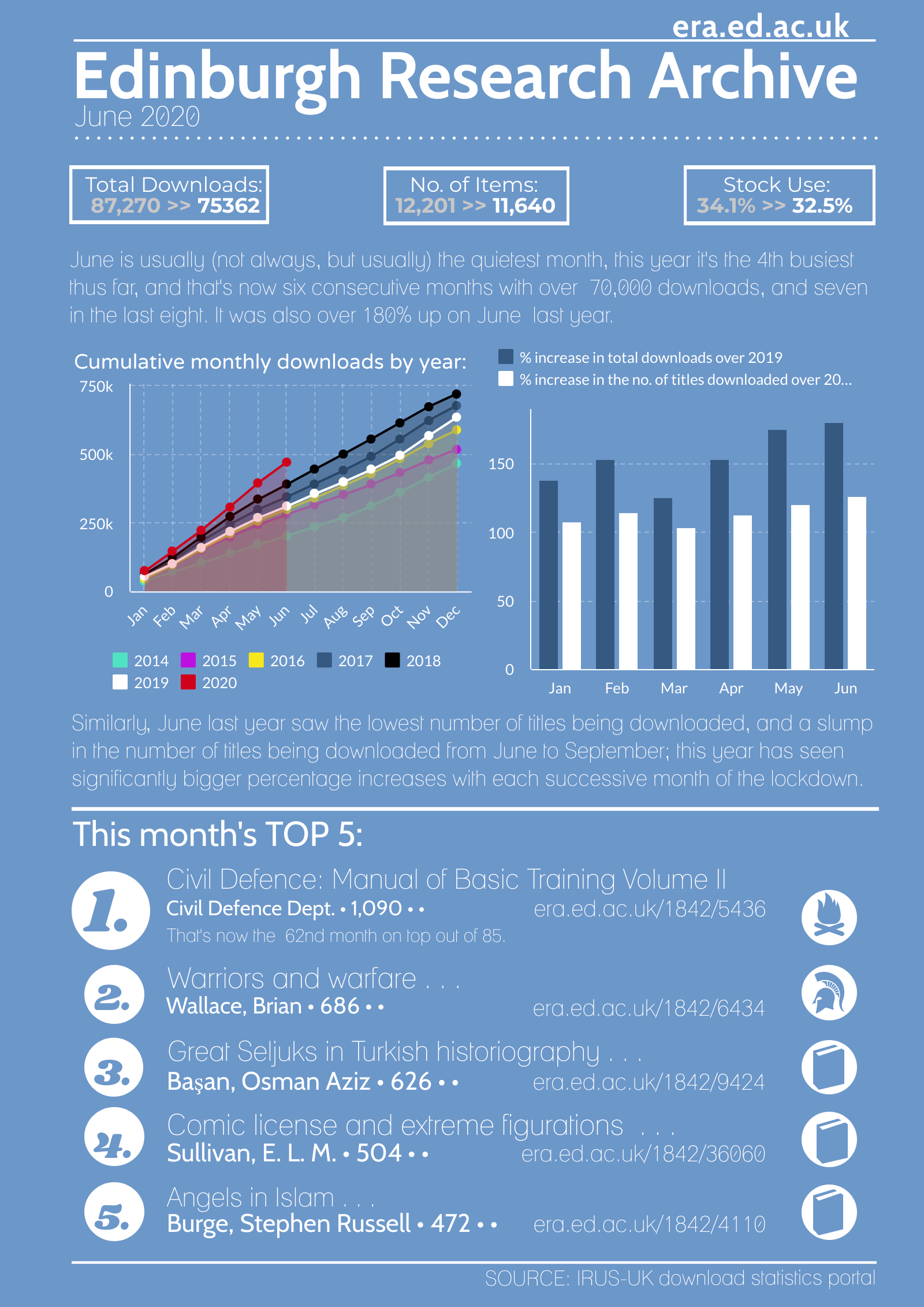
Edinburgh Research Archive downloads: June 2020
The Forsaken Mermaid
This week we dig a little deeper into the story behind a document that was conserved in the course of our project work in 2018, and discover legendary sea creatures and a folk-tale inspired Scottish ballet.
In 2018, project archivist, Clare Button, made a discovery: Margaret Morris’ copy of Erik Chisholm’s musical score for ‘The Forsaken Mermaid’, the first ever full length Scottish ballet. Clare made the remarkable find during her tenacious work to sort and catalogue over 300 boxes of archive material which make up the Margaret Morris Archives. The collection, which covers almost a century of movement, dance and art in Scotland, was donated to the Fergusson Gallery in Perth in 2010. It forms one of three collections included in our ‘Body Language’ project.

The Forsaken Mermaid manuscript before treatment (Ref: 2010.718)
On discovering the manuscript, which is dated to around 1936, Clare found it in rather poor condition. There were multiple tears to the edges of the paper and evidence of some well-intended but rather non-expert repairs. She carefully packed up the fragile volume and arranged for it to be transported by expert couriers to specialist conservators at the University of Edinburgh’s Centre for Research Collections.
On arrival at the University of Edinburgh’s main library, the volume was unpacked by the conservation team in the bright, clinically clean, fifth-floor conservation studio. Amidst a hive of conservation activity (from re-binding rare seventeenth-century books to repairing early twentieth-century glass plate negatives), this curious manuscript met with experienced book and paper conservation student, Lisa Behrens.

Book and paper conservation student, Lisa Behrens, carefully removing adhesive tape from the Forsaken Mermaid mansucript
Lisa’s first task was to dry-clean the volume and then, over two days, she painstakingly removed multiple layers of adhesive tape and binding threads. Each of the individual sheets were repaired using Japanese paper, pressed overnight and then re-sewn using a French sewing technique. This ensured that the conservation treatment did not damage the volume further and helps to protect it from further damage while still allowing it to be accessible to researchers.
A University of Edinburgh alumni (1931 and 1934), Erik Chisholm (1904-1965) was a leading Scottish modernist composer. Glasgow born Chisholm jointly founded the Celtic Ballet with Margaret Morris. At the age of 34, he was appointed Celtic Ballet’s director of music in 1938, although he had composed the musical score for ‘The Forsaken Mermaid’ earlier, in 1936. The choreography for ‘The Forsaken Mermaid’ was by Morris and the set and costumes by the artist, and then principal of Glasgow School of Art, Andrew Taylor-Elder (1908-1966). Celtic Ballet performed ‘The Forsaken Mermaid’, their inaugural production, at the Lyric Theatre, Glasgow, on 6 December 1940.
A curious folk-tale, ‘The Forsaken Mermaid’ features those legendary supernatural sea people, human from the head to the waist but with a fish tail instead of legs. There are many folk-tales of love stories and marriages between a mermaid and a man, some have even claimed descent from such a union. This particular story takes place under and on the water and partly on land. ‘The Forsaken Mermaid’ tells the story of a mermaid who fell in love with a man when she is caught in a fisherman’s net. But the man grows tired of her and she returns to the sea in despair. The sea-people seek revenge in a terrible storm, drowning the fishermen. The mermaid pleads for the life of her love.
Subsequent Celtic Ballet productions were set to Scottish themes and incorporated elements of Margaret Morris Movement, Scottish country and Highland dance styles. Celtic Ballet went on to tour in Europe, Russia and the United States of America. They were one of the first British companies to perform in France after the second world war. Chisholm went on to be appointed the Principal of the College of Music at the University of Capetown where he remained until his death in 1965. He held a lifelong interest in Scottish music and published a collection of Celtic folk-songs in 1964.

The Forsaken Mermaid manuscript after treatment (Ref: 2010.718)
This annotated manuscript is evidence of just one of multiple collaborations with artists that Margaret Morris spearheaded, which can be found throughout the collection. Since undergoing successful conservation treatment, it has now been returned to its home at the Fergusson Gallery at Perth. While the gallery remains closed for the time-being (July 2020) in line with Scottish Government guidance on coronavirus restrictions, there are lots of sources online where you can find out more.
- You can read more about the conservation treatment of the volume on Centre for Research Collections conservation blog ‘To Protect and (Con)serve’.
- We love this fantastic video footage from 1923 showing Margaret Morris Merry Mermaids, showing dancers at Harlech beach performing mermaid inspired movement, courtesy of the British Film Institute.
- Artist Donald Bain’s painting ‘Celtic Ballet: Forsaken Mermaid’ can be viewed on the National Galleries Scotland website.
- The Celtic Ballet and its history feature in this opinion piece from ‘The National’ newspaper.
- There is some fascinating reading around Erik Chisholm and his career to be found on the Erik Chisholm Trust website.
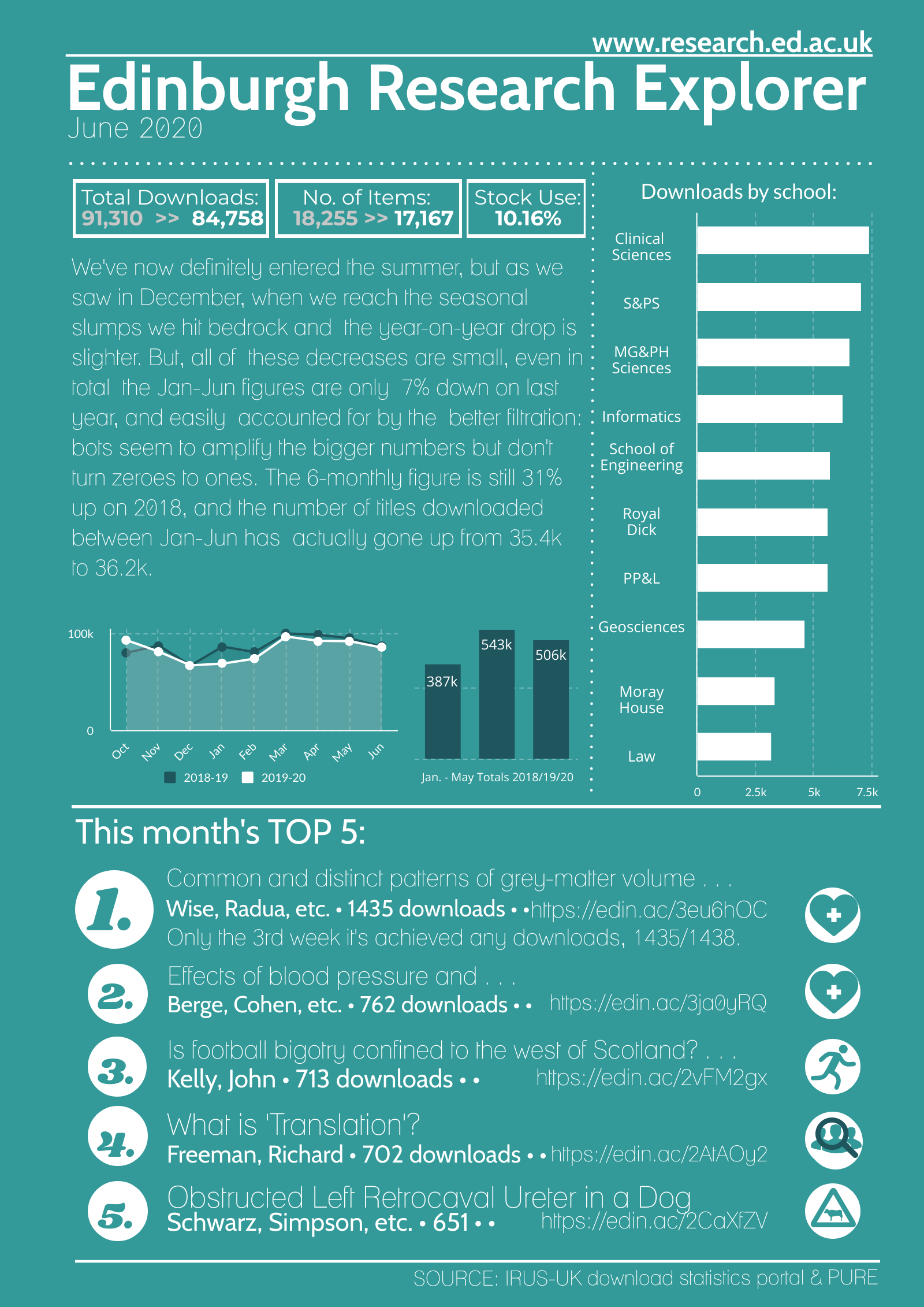
Edinburgh Research Explorer downloads: June 2020
Collections
 Hill and Adamson Collection: an insight into Edinburgh’s past
My name is Phoebe Kirkland, I am an MSc East Asian Studies student, and for...
Cataloguing the private papers of Archibald Hunter Campbell: A Journey Through Correspondence
My name is Pauline Vincent, I am a student in my last year of a...
Hill and Adamson Collection: an insight into Edinburgh’s past
My name is Phoebe Kirkland, I am an MSc East Asian Studies student, and for...
Cataloguing the private papers of Archibald Hunter Campbell: A Journey Through Correspondence
My name is Pauline Vincent, I am a student in my last year of a...

Projects
Cataloguing the private papers of Archibald Hunter Campbell: A Journey Through Correspondence
My name is Pauline Vincent, I am a student in my last year of a...
Archival Provenance Research Project: Lishan’s Experience
Presentation My name is Lishan Zou, I am a fourth year History and Politics student....