Home University of Edinburgh Library Essentials
May 9, 2026
What is LibSmart I?

LibSmart I is designed to give you an introduction to library resources for your study and research! The course enables you to take control of your learning as you self-enrol (click here to find out how) and choose the modules you cover. I personally love the flexibility of the course as you can recall the information provided by LibSmart easily on Learn.

Students studying in the library [Paul Dodds copyright of the University of Edinburgh]
So what does LibSmart I review?
In short, by completing LibSmart I you will develop your information literacy skills and understand what library support is available to you. For a more detailed overview keep reading or better yet check out the course for yourself!
A brief overview of LibSmart I and its learning objectives
Within the LibSmart I course there are five modules that cover key areas:
- Introduction to using the library
- Your information landscape
- Finding and retrieving information
- Managing information
- Referencing and avoiding plagiarism

With each topic, you will gain the confidence and knowledge to effectively research and use resources provided by the Library. My favourite module would be “Finding and retrieval”, I found the tips on research strategy construction and explanation to Boolean operators have been extremely useful when exploring a topic area.
The course has clear goals that you can use to guide your learning and ensure you are finding the support you need. There are also activities and reflective quizzes to help you consolidate your learning to discover the subject matter you need. When you’ve completed the course you’ll also be awarded a Digital Badge, which you can use to show off your newfound expertise.
Ready to get started?
Visit the LibSmart webpage to find out more about how to self-enrol for this course. If you’ve completed LibSmart I, you also read more about how to build on these skills with the next level of research support in LibSmart II!
If you have any questions or concerns about LibSmart you can contact us via the EdHelp portal.
Al-Ahram Digital Archive – on trial
Thanks to a request from a student in Politics & International Relations the Library currently has trial access to the Al-Ahram Digital Archive from EastView. This gives you access to one of the longest-running newspapers in the Middle East.

You can access the Al-Ahram Digital Archive via the E-resources trials page.
Access is available on and off-campus.
Trial access ends 1st October 2021. Read More
Training: Welcome to the Library!

Image from PXfuel, licensed for re-use
It’s almost the start of the new academic year which means it’s one of the busiest times of year for Academic Support Librarians. We offer a range of introductory training sessions for students joining the university, and we have some bespoke sessions arranged for each level of study in the School of Law.
14th September: Postgraduate (online) – Using the University Library
22nd September: Undergraduate: Using the University Library
23rd September: Postgraduate (all) – Using the University Library
29th September: PhD – Sources, Materials & Bibliographies
These training events will all be run online using the Collaborate platform, and are often very popular. To find out more and register please use the MyEd Events Booking system and enter the titles above in the search box. Alternatively watch out for direct booking links being circulated via the UG, PG or PhD offices. We will also record these sessions and upload them to our Media Hopper Channel after the event.
When the semester begins we’ll offer one-to-one appointments which you can use to get additional advice to support your studies. These are also available to book via the MyEd Events Booking system, just search for “Literature search clinic” and select the Law specific event, or search for “Law” and select provider group “IS Library and University Collections” to find all our Law related training.
If you have any questions about these or any other training you’d like, please contact us by email: law.librarian@ed.ac.uk. We look forward to welcoming you (or welcoming you back) soon!
We are digitisation ready to go!
We want to share our exciting news featuring the Sir Charles Lyell notebooks! Curious? Read on….
We are very happy to advise that the fuller project to digitise Lyell’s notebooks will start in September 2021. This means that we will soon be able to add yet more digital images of Lyell’s notebooks to those currently available to view online.
This important work is possible thanks to our generous supporters, who, in responding to our funding appeal, have donated over £40,000. That’s enough to fund two specialist photography staff for 12 months. The work will take place in a newly fitted out digital imaging studio, kitted out with new equipment.
 Thank you to all the individual donors and bodies who have supported us so far. In addition to our anonymous supporters, we would also like to acknowledge the ongoing support of the Murray family, Jim Hunter, the History of Geology Group and the Geologists’ Association Curry Fund. If you are interested in helping us complete the digitisation project’s funding target that would be wonderful. Individual gifts may be made online at: https://donate.ed.ac.uk/portal/public/donate/donate.aspx?destination=LyellAccess
Or please contact David McClay directly to discuss: 07815903725 or david.mcclay@ed.ac.uk
Patrick Geddes Archives – Online Catalogue Live!

Patrick Geddes at the Scots’ College, Montpellier, France (Coll-1869)
We are very pleased to announce that the online catalogue for the Sir Patrick Geddes Archives at the University of Edinburgh is now live.
The collection represents a vital and immensely valuable resource for understanding the life and work of Patrick Geddes, who is internationally revered and acknowledged as one of the most innovative thinkers around the processes of urbanisation and urban planning. Such an understanding may potentially help to inform current debates about wellbeing and how best to cultivate it, and is of great importance to all those working in the fields of sociology, ecology, architecture and urban development.
Sir Patrick Geddes (1854-1932) was a pioneer of the environmental movement. Credited as the father of town-planning, he used biological concepts to develop a holistic view of people and where they live, seeing both as organic and how the balance and imbalance between them affected health and well-being.
Geddes encouraged people to become actively involved in transforming their communities, the best-known example of which was in Edinburgh’s Old Town, injecting green spaces into what was then cramped and overcrowded, allowing the place to breathe, allowing children much-needed play spaces.
The collection was catalogued as part of a collaborative project with the University of Strathclyde Archives, which was generously funded by the Wellcome Research Resource-fund.
You can now search the online catalogue via our Online Archives Collections Catalogue.
Elaine MacGillivray
Strategic Projects Archivist
5 Reasons to check out LibSmart I and II

Introduction
If you haven’t heard about LibSmart I and II yet – then what have you been doing?!
To quickly summarise, LibSmart I and II are fully flexible, self-enrol Learn courses designed to help you get started and advance your library resource knowledge. If the description has got you intrigued and you want to know more, do not worry! In this blog, I will give you five reasons why LibSmart I and II can be beneficial to your studies, general university knowledge and digital skills development.
1. Builds awareness on library offerings
Edinburgh University’s Library and University Collections (L&UC) has a range of awesome resources – I am sure you will be aware of DiscoverEd, Special Collections and physical library locations like the Main Library. Well, the department has two new assets by the names of LibSmart I and II. They will help you discover other library-related services that will help you build your information literacy skills.

The Main Library entrance on George Square. [Taken by Paul Dodds, copyright of the University of Edinburgh]
2. Increases your knowledge: LibSmart helps you be more productive
The information contained in LibSmart will not only boost your awareness of library resources but also guide you, so you can use these resources effectively! Throughout the modules, there are activities and quizzes to help you consolidate your knowledge and test yourself.
3. Supports subject specialism
With LibSmart I you build a foundation of knowledge so you can confidently use library resources when researching for a report or topic. LibSmart II enables you to “advance your library research”, supporting you as you complete your thesis or dissertation. The modules in LibSmart II are subject-specific so you can tailor your learning to your project needs. See the image below of the 10 different modules tackled in LibSmart II.
4. Fully-flexible
As mentioned earlier, LibSmart has been created so that you can work independently and interact with the modules as and when you wish. By working at your own pace, you can make the most out of the courses, ensuring you understand the content available. You can still interact with others who are completing the course and Academic Support Librarians (ASLs) using the discussion board whenever you want, so you gain thoughtful insights into the material you are learning.
5. Earn Digital Badges
The final reason you should enrol onto LibSmart is because you have the opportunity to be rewarded for the work you complete with Digital Badges! After finishing a module and subsequent quiz you will be notified that you have earned a LibSmart eBadge that you can share on various digital platforms such as LinkedIn, Facebook, Twitter, or a website.
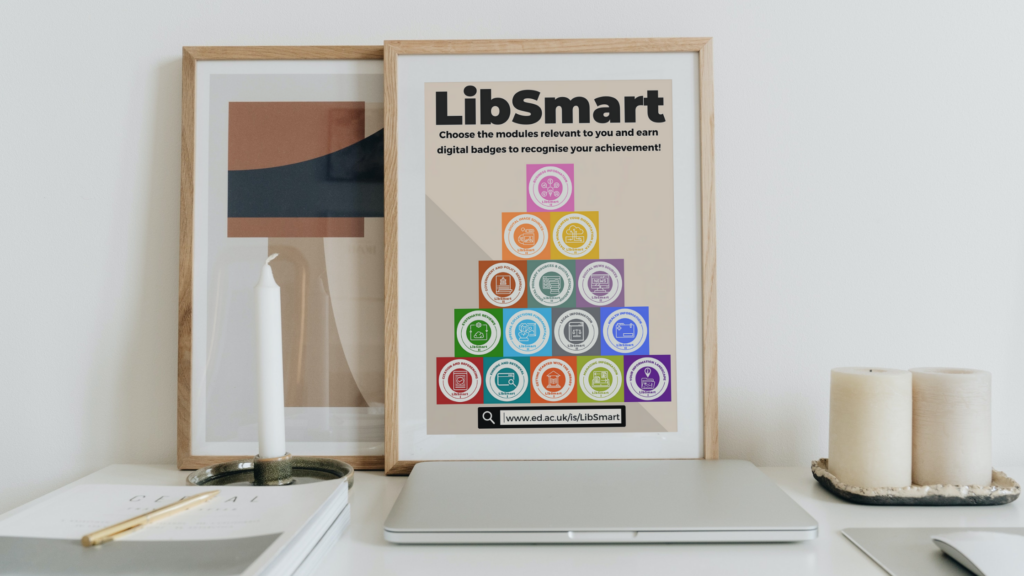
LibSmart badges
SSSA in 70 Objects: Nagra III
by Stuart Robinson, AV Technician at SSSA
It was hard to pick a single object from our extensive collection of historic equipment to speak about in this article. I did consider writing about some of our “repeater” machines like the one mentioned by Morag Macleod which are a great example of the inventiveness shown by my predecessor, Fred Kent, but in this post I thought I would share a device that is as easy on the eye as it is on the ear: The Nagra III.
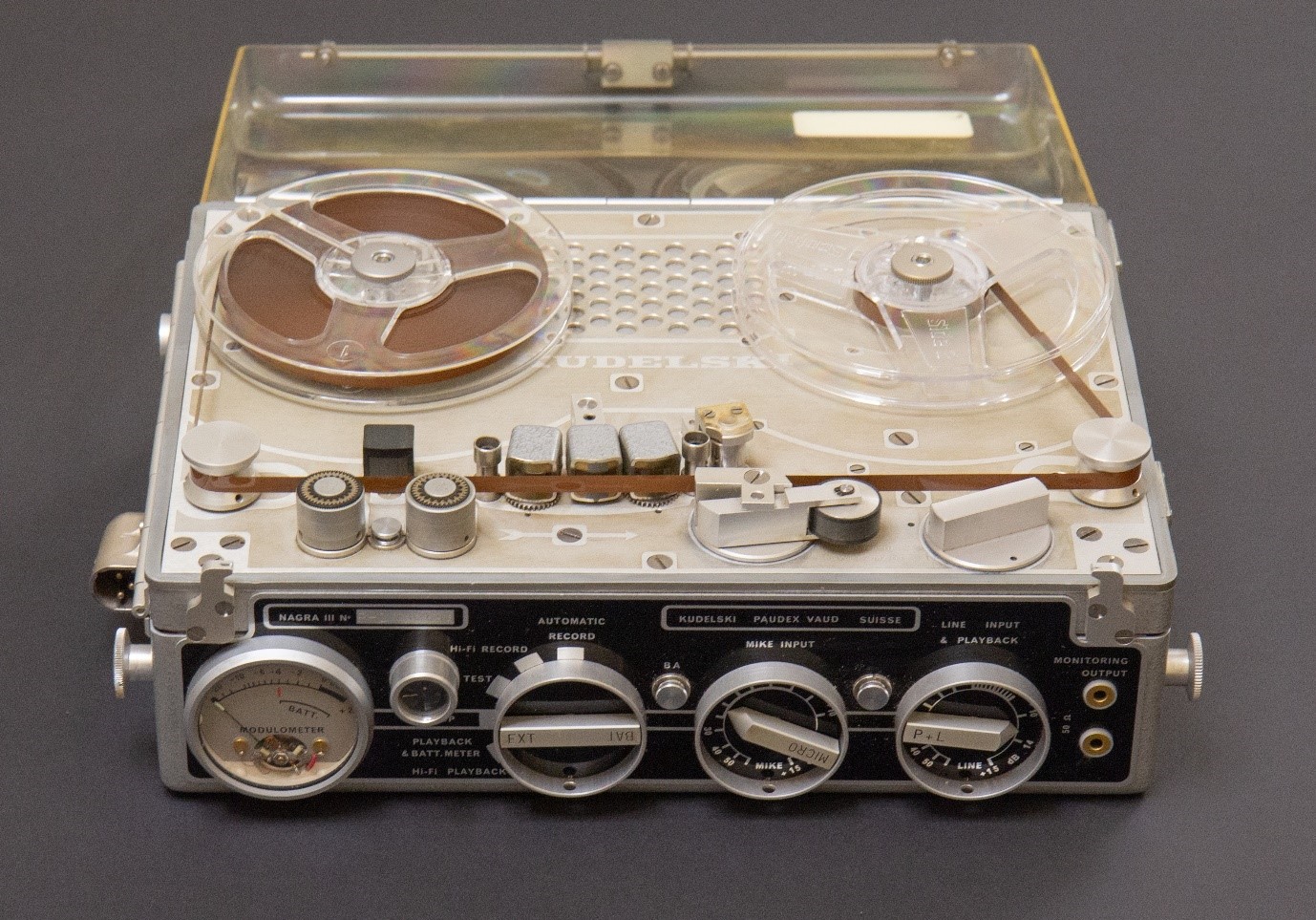
The Nagra recorders were designed by Stefan Kudelski, a Polish engineer who fled the war in Poland in 1939 and were named after the Polish word “nagra” meaning “will record”. Manufacturing began in 1951 by Kudeslki Company, his eponymous engineering firm based in Switzerland specialising in high-end recording equipment. The company still exists and makes field recorders and other Hi-fi equipment today (they also manufacture my all-time favourite amplifier, the Nagra VPA, which shows a similar design aesthetic).
As one would expect from the name there had been two preceding models of Nagra field recorders before our Nagra III was made, the Nagra I and II. These models are very impressive technically but still relied on clockwork winding mechanisms which suffer from poor speed control, and valve amplification circuits which required very high voltages and drew a great deal of power which is a major issue when recording in the field.
The Nagra III was designed in 1957 and was transistorised meaning lower power consumption for longer recording, and had a servo controlled motor for precise speed control, Kudelski also had the foresight to use a spring belt drive mechanism rather than using rubber or leather belts as other manufacturers did at the time, meaning a massive increase in reliability. The machines were designed by Kudelski to last 5 years in the field with no maintenance, and proof of his success is evident in the fact that there are still so many working examples of these machines out there more than 60 years after they were manufactured.
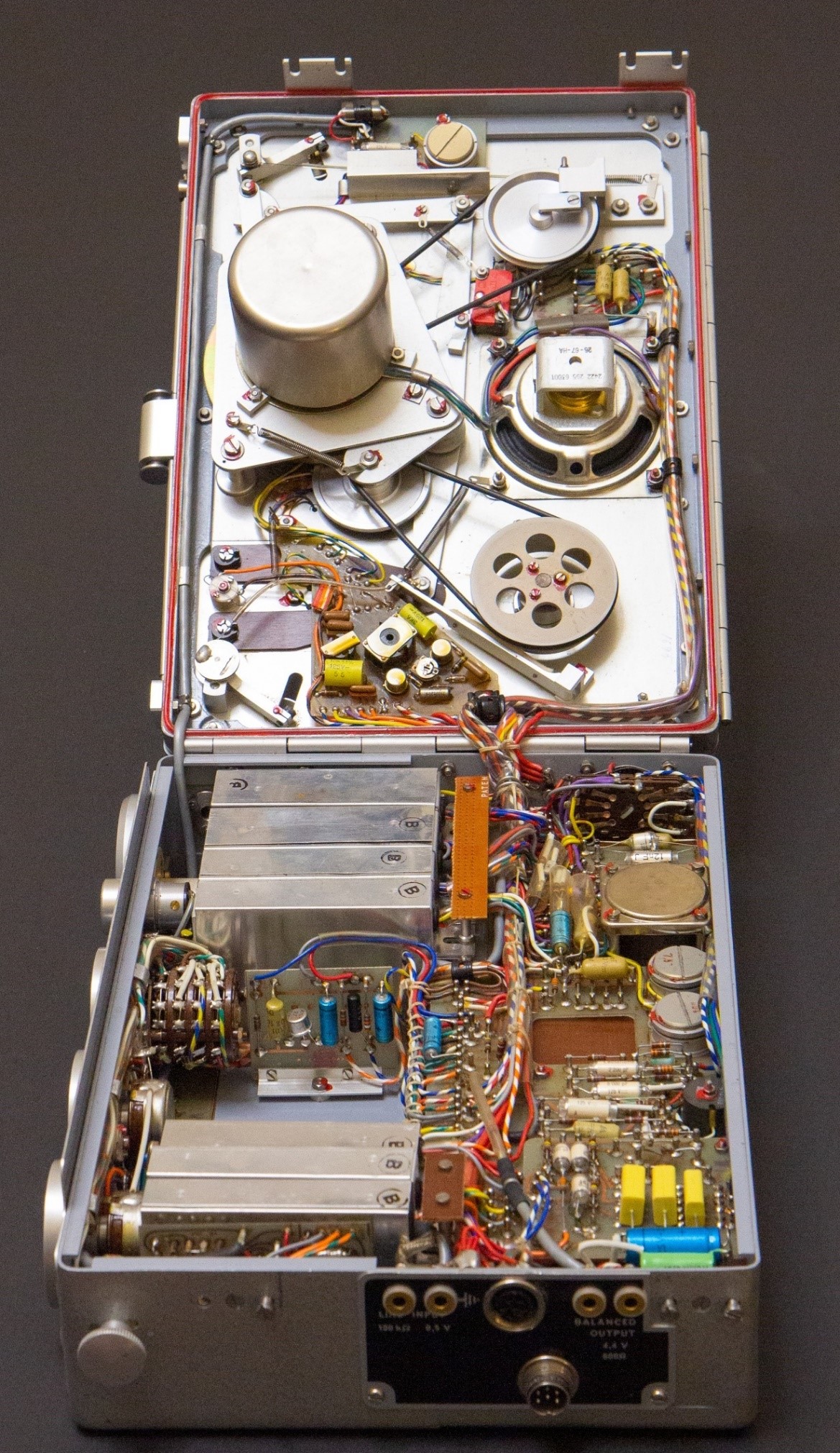
The Nagra had many design features that were ahead of its time, such as 3-way speed selection (3.75, 7.5 or 15 ips) and dual equalisation (CCIR or Ampex). This along with accurate level monitoring, recording quality, portability, and the optional Pilot-tone add-on made Nagra recorders the standard for location film work for at least 30 years.
We are fortunate enough to own two Nagra III recorders and the accompanying mini microphone mixer and external speaker unit. Here it is accompanied by a Sennheiser MD421, another classic piece of recording equipment.
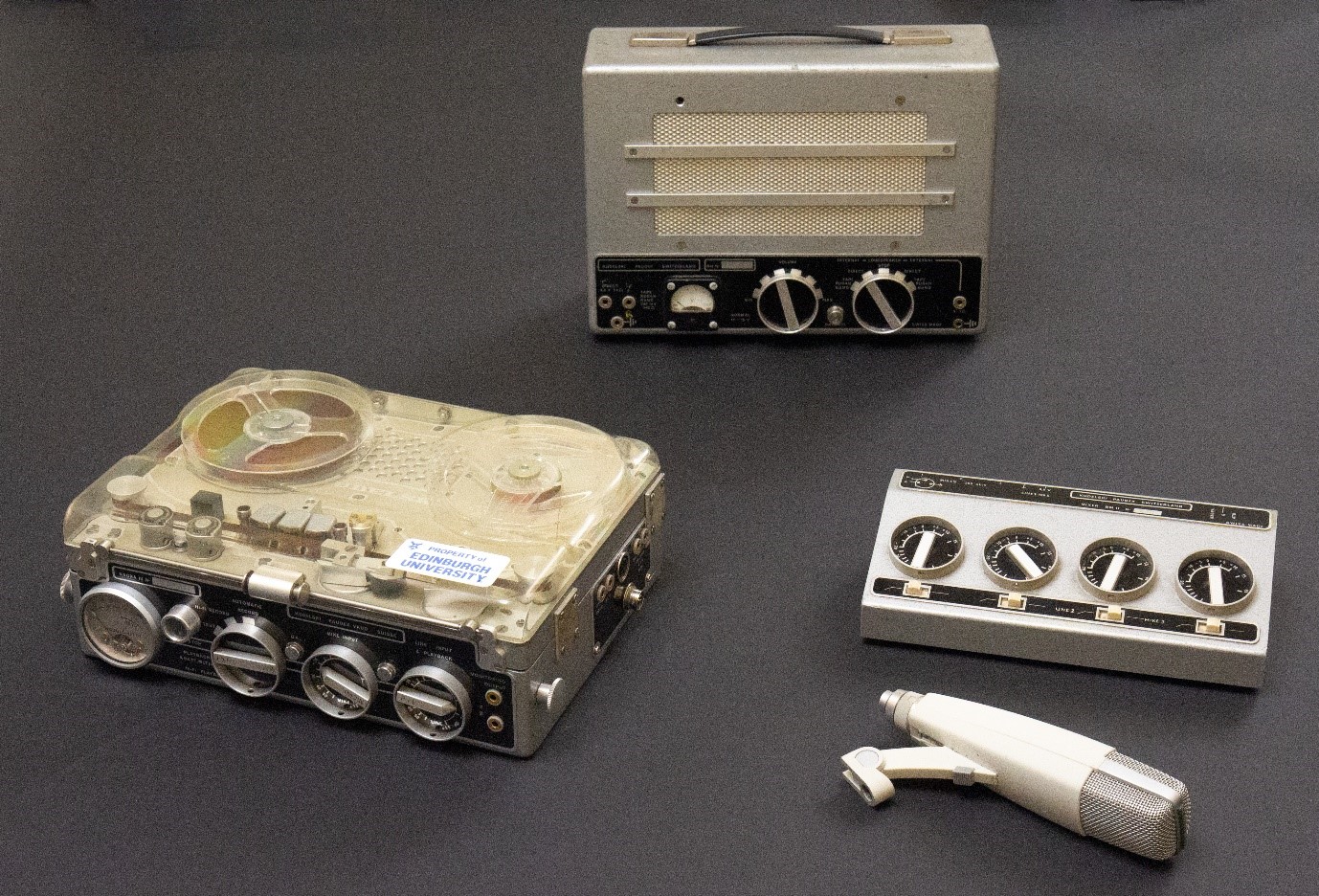
These were used extensively, it is hard to work out exactly how many recordings they were used for, but a quick search suggests nearly 500 in the official SA catalogue the earliest available on Tobar an Dualchais features Calum Johnston singing “Chunnacas na trì, na trì, calmanan geala” and the audio quality is still impressive to hear – note the lack of hiss or hum, and the clarity of the sibilants.
The Nagra recorders were also used to record one of the Archive’s most important works, “Cloth Waulking in South Uist”(VA1970.01,) as seen in the picture below of Peter Cooke and Morag Macleod.
(C) SSSA
This video is currently available to view on our Youtube channel:
It is amazing to think of the songs, tales and music that have passed through this unit’s Germanium over the past 60 years, and it is a joy to get to use it and be part of that great history. Even today people are finding new ways to use and experiment with these incredible recorders and finding new outlets for their creativity by doing so, like in the video below.
Thanks for reading,
Stuart Robinson,
Archival Audio-Visual Technician,
School of Scottish Studies Archives.
New resources: The Law and Practice of International Finance
You may be interested in some of the recent items we’ve purchased for use by students and staff in the School.

Philip R Wood QC. Author of Law and Practice of International Finance series.
The Law and Practice of International Finance series is your definitive guide to international finance. It considers the full range of topics across nine volumes, setting out the law and practice of trading assets on the international markets. This essential work, by one of the leading finance specialists of a generation, provides a simple, unified and distilled account of the whole topic. It sets out complex products in simple terms, alongside providing practical guidance on the structuring of deals and agreements, negotiating points and sample precedents. Over 321 jurisdictions are surveyed, providing the broadest possible perspective on the international financial markets.
While we have previously had access to some editions of these individual titles, we now hold the complete series with the most up to date editions of each text in both print and ebook:
- Volume 1: Principles of International Insolvency (3rd edn)
- Volume 2: International Insolvency: Jurisdictions of the World
- Volume 3: Comparative Law of Security Interests and Title Finance (3rd edn)
- Volume 4: Security Interests and Title Finance: Jurisdictions of the World
- Volume 5: International Loans, Bonds, Guarantees and Legal Opinions (3rd edn)
- Volume 6: Set-off and Netting, Derivatives and Clearing Systems (3rd edn)
- Volume 7: Project finance, Securitisations and Subordinated Debt (3rd edn)
- Volume 8: Conflict of Laws and International Finance (2nd edn)
- Volume 9: Regulation of International Finance (2nd edn)
For access to the print copies of these texts, please visit DiscoverEd to find out more about their location in the Law Library. These titles are also available as ebooks on Westlaw Books, which you can access via Westlaw UK.
For more information about the titles included in this series, visit the Sweet & Maxwell publisher website, which provides a synopsis of the contents of each volume.
If you have suggestions for books you’d like us to purchase for the library, students can use the Student Request A Book (RAB) service. Staff members can follow the procedure on the Library Support intranet page.
Water Quality Part 4 – Conclusions and Recommendations
Today’s blog post concludes remote intern Mhairi Boyle’s four-part series on water quality. Mhairi discusses the conclusions she reached during her internship and provides us with her recommendations for regular water testing at the CRC.
As the weeks drew to a close, I began to culminate all of my research into one final report. Mulling over everything, I was able to generate a few conclusions, and most importantly, some recommendations for the CRC.
- My first conclusion is that the tap water in Edinburgh is safe to use in paper conservation treatments. The on-site analysis demonstrated that the metal content is far below the maximum amount recommended by Scottish Water. This is, of course, subject to regular testing and monitoring.
- My second conclusion is that there is a lot more research to be undertaken in this area. Looking towards a more sustainable profession, the use of tap water in paper conservation should be encouraged, subject to quality. Further research should be undertaken into the metal and chlorine content of tap water.
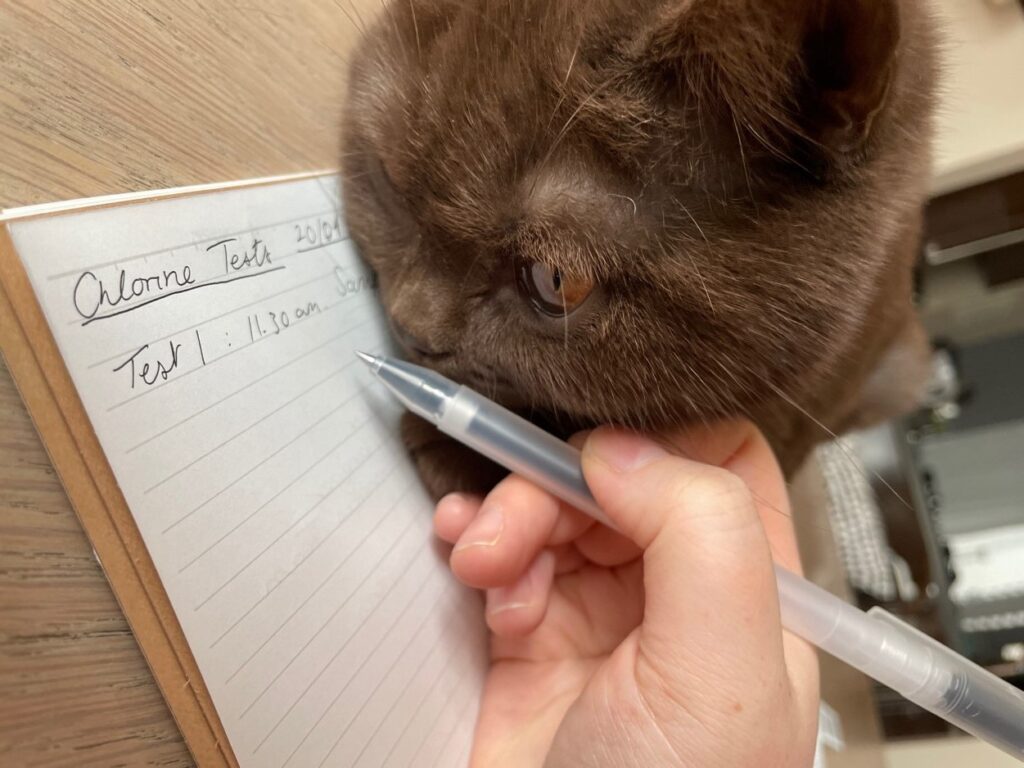
Further investigations should be taken.
As a culmination of all my research, I devised a Water Testing Programme for the CRC. I wanted to keep it simple, understandable, and easy to grab at a moment’s notice. The gist of the program is as follows:
- Monthly pH Testing. The CRC uses water to make solutions, adhesives, and to humidify objects. The pH of the water used should be tested monthly with a digital pH meter, and be adjusted if it is too acidic. It should also be tested before the washing of any objects.
- Monthly Chlorine Monitoring. A more sensitive digital chlorine reader has been recommended for the CRC. Monthly chlorine monitoring will allow the CRC to monitor the chlorine content and observe any fluctuations.
- Bi-Annual Water Analysis by an External Company. The results can be compared to Scottish Water quality reports for any discrepancies. Bi-annual water analysis accounts for any major seasonal changes in the water.
- Contingency Planning. I have recommended the use of a logbook to ensure the Programme is carried out, and to allow for the monitoring of results. If the results of the tests are deemed unacceptable, I have recommended the interim use of jugs of purified water until the results are fully investigated. For example, if the iron content jumps up significantly, it could be an indication of rusted pipework at the University.
And that’s a wrap! I’d like to thank my supervisor, Emily Hick, and all of the CRC & Museums staff for giving me this wonderful opportunity.

Water Quality Part 3 – Survey
In the third instalment of this four-part series, remote intern Mhairi Boyle discusses the survey she created to get insight on water type and water usage from fellow paper conservators all around the world. She talks us through how she analysed the results and provides the findings from the survey.
In this blog, I will be discussing the results of an online survey I conducted.
Do you ever walk into a supermarket and feel immediately overwhelmed by the amount of baked goods on display? Sourdough, or tiger loaf? Or maybe cleaning products are your thing: Cillit Bang, or Mr Muscle? Either way, this is called ‘choice overload’, or ‘overchoice’. When I first started looking into water filtration methods and types, this is exactly how I felt. Which company? How much? Is it effective?
In this case, it has proven very useful to conduct a survey. Surveying fellow paper conservators on their water usage and opinions has given me an insight into the most popular water types and filtration choices, and why conservators use them.
I asked ten questions, five of which were multiple choice, and five of which were open-ended. I wanted to keep it as simple as possible to maximise the number of respondents. A one-page survey is less daunting and time-consuming than a ten-page survey. The open-ended questions gave me information on emergent themes and concerns of conservators regarding their water usage. The multiple-choice questions gave me quantifiable, i.e. numerically measurable information, on which water and filter types were most popular. In the end, I got fifty respondents, which was a great result. When I closed the survey and exported the information into a spread sheet, I looked at it and froze for a moment. What now?

Over 50% of respondents resided in North America.
Enter… Excel. Microsoft Excel can be an intimidating beast. I feel that I have only scratched the surface of its analytical power, but even so, it has been a very valuable tool. If you are not mathematically-inclined (me), Excel can do all of the hard work for you. The multiple-choice results were surprisingly simple to grapple with: I was able to work out percentages using Excel calculations and visualise all of the answers in bar graphs and pie charts.
Qualitative information is a bit more complicated to analyse. I used a method called ‘open-ended coding’. Using this method, the researcher reads through all of the answers and notes any common emerging themes or feelings that arise from the answers. These can all be categorised. I used coded themes such as ‘Safety’, ‘Cost-effectiveness’, and ‘Sustainability’. I was then able to tally up how many conservators’ answers came under each theme, and from that I was able to get a general sense of what was important to the respondents. I could also add comments on the side. This process takes a few reads of the answers, as more themes may emerge on second and third analysis.
Here are some of the key findings:
- North American respondents used a larger combination of water filtration methods. For some, this was because their tap water quality was very poor, and for others, it was because they preferred the sense of control it gave them.
- Some conservators were wary of using tap water because of its regional and seasonal variability.
- Over half of respondents agreed that tap water is viable in conservation, but it is dependent on local quality and regular, thorough testing.
- Conservators chose water type and filtration methods based on: safety, control, purity, and cost-effectiveness.
- Most conservators did not have an official Water Testing Programme, but did undertake regular testing of some description.

Respondents in North America used a greater variety of water filtration systems.
The survey gave me some valuable information on the real-life practices of conservators, and I used some of this information to inform my Water Testing Programme. I will talk more about this in my next blog.
Collections
 Hill and Adamson Collection: an insight into Edinburgh’s past
My name is Phoebe Kirkland, I am an MSc East Asian Studies student, and for...
Cataloguing the private papers of Archibald Hunter Campbell: A Journey Through Correspondence
My name is Pauline Vincent, I am a student in my last year of a...
Hill and Adamson Collection: an insight into Edinburgh’s past
My name is Phoebe Kirkland, I am an MSc East Asian Studies student, and for...
Cataloguing the private papers of Archibald Hunter Campbell: A Journey Through Correspondence
My name is Pauline Vincent, I am a student in my last year of a...

Projects
Cataloguing the private papers of Archibald Hunter Campbell: A Journey Through Correspondence
My name is Pauline Vincent, I am a student in my last year of a...
Archival Provenance Research Project: Lishan’s Experience
Presentation My name is Lishan Zou, I am a fourth year History and Politics student....