Home University of Edinburgh Library Essentials
May 9, 2026
SSSA in 70 Objects: A Seer Saw a Full-Rigged Ship
Response by Gill Russell, Artist
Material from the archives of the School of Scottish Studies forms a central part of South West by South, An t-Eilean Fada, The Long Island: A Poetic Cartography, an exhibition of new work I created for An Lanntair in Stornoway, and Taigh Chearsabhagh in North Uist, in 2021.
My recent focus as an artist, explores the dynamic relationship between sea and land – ‘South West by South’ is the result of many visits to the Western Isles. Along the extent of the liminal shore the interplay of tidal currents and weather is complex and, from a human perspective, fickle, authoring dramatic, sometimes destructive, events. In ‘South West by South’ these are expressed through a ‘poetic cartography’, in an installation of large-scale prints, vinyl wall drawings, audio recordings, and maps.
The dense interplay of sea, land, and light in the northwest of Scotland, and in particular the Western Isles has captivated me since childhood. I often imagined living there. Although I felt a deep attachment to the place and however much it inspired my practice, I came to realise that I would always be a tourist, a spectator, on the outside of an entrenched culture looking in. It was important to make connections.
I listened to sea lore stories on the Tobar an Dualchais website, oral history interviews recorded by fieldworkers from the School of Scottish Studies Archives. The stories were hugely powerful, giving first-hand accounts of the lore of these waters – including ‘South West by South’, in which an apparition changes the course of a ship. This story was given by Peter Morrison, North Uist, recorded by Gun Forslin (SA1968.109.A3)
In another tale, a seer spies a full-rigged ship approaching from the direction of St Kilda, years before the vessel was wrecked on rocks between Heisker and North Uist – this story was also recorded by Gun Forslin, told to her by Angus MacKenzie (SA1968.110.A5)
The interviews held so much more than the words they spoke. They flooded me with intense and emotional visual imagery. In response to the stories, I began creating large drawings on a graphics tablet. The process became utterly meditative. I drew until the stories of the sea came back to me, producing hundreds, choosing just a few. It would be impossible to replicate any particular one, as I became lost in them.
(click on each image to open it fully)
Seer , 2021

An Lanntair May-July 2021 ( photo c. John MacLean)
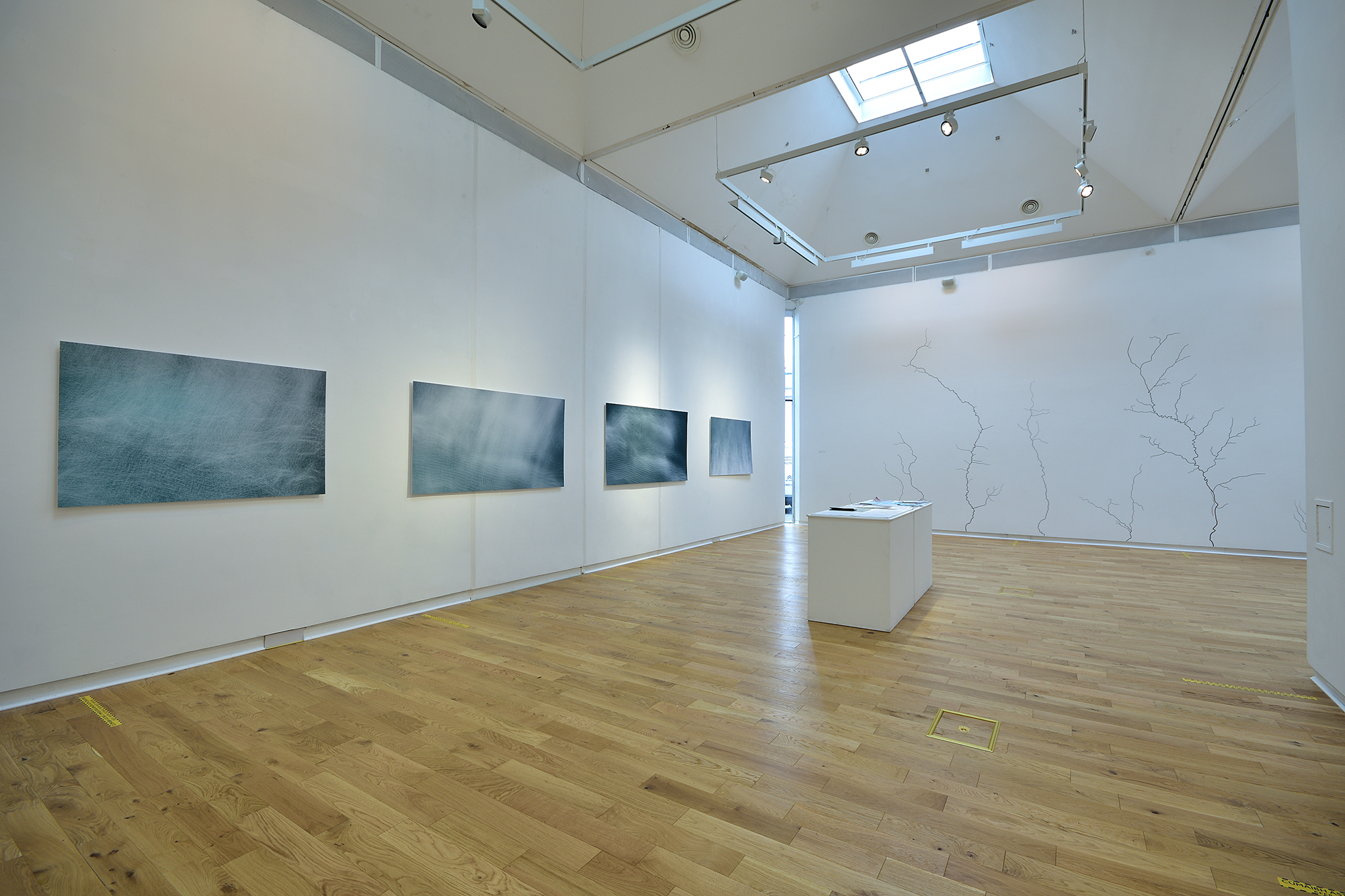
Audio recordings of the stories were played in the gallery at a low volume, looping continuously.
Selected extracts from the stories were made into a booklet: ‘A seer saw a full rigged ship’.
Through seeking permissions to use the material, and my visit to North Uist in 2019, I met Catherine and Alastair Laing from North Uist. Alastair’s father Andrew Laing had given an account of the Van Stabel, a ship wrecked off the coast of Heisker. Andrew’s father in law, Donald John MacDonald, was stationed on Heisker as the Receiver of Wrecks c.1900. Catherine also showed me her daughter Mary’s dissertation about Heisker. You can hear Andrew Laing’s recording with Donald Archie MacDonald on Tobar an Dualchais (SA1968.150.A7)
Catherine told me a story of a man she knew, who had stood out on the headland at Tigh a’ Ghearraidh, North Uist, watching a ship floundering in the sleet and gales with her sails torn. The day we visited that same headland it was very stormy. We walked to the point where the man had watched from, and the vision in his tale came to me vividly. It led me to explore shipwrecks, in the theme of ‘Lost Ships’.
Hundreds of ships were wrecked around the coasts of the western isles to the sea and weather, war, or navigational error. I trawled through the maritime archaeological archives from Canmore mapping, absorbed by the detailed records of events: loss of life and cargo, weather conditions, accidents. The immense journeys some of these ships made a hundred or so years ago, crossing oceans to other continents, and coming to grief on the Islands.
Map for Lost Ships, 2021
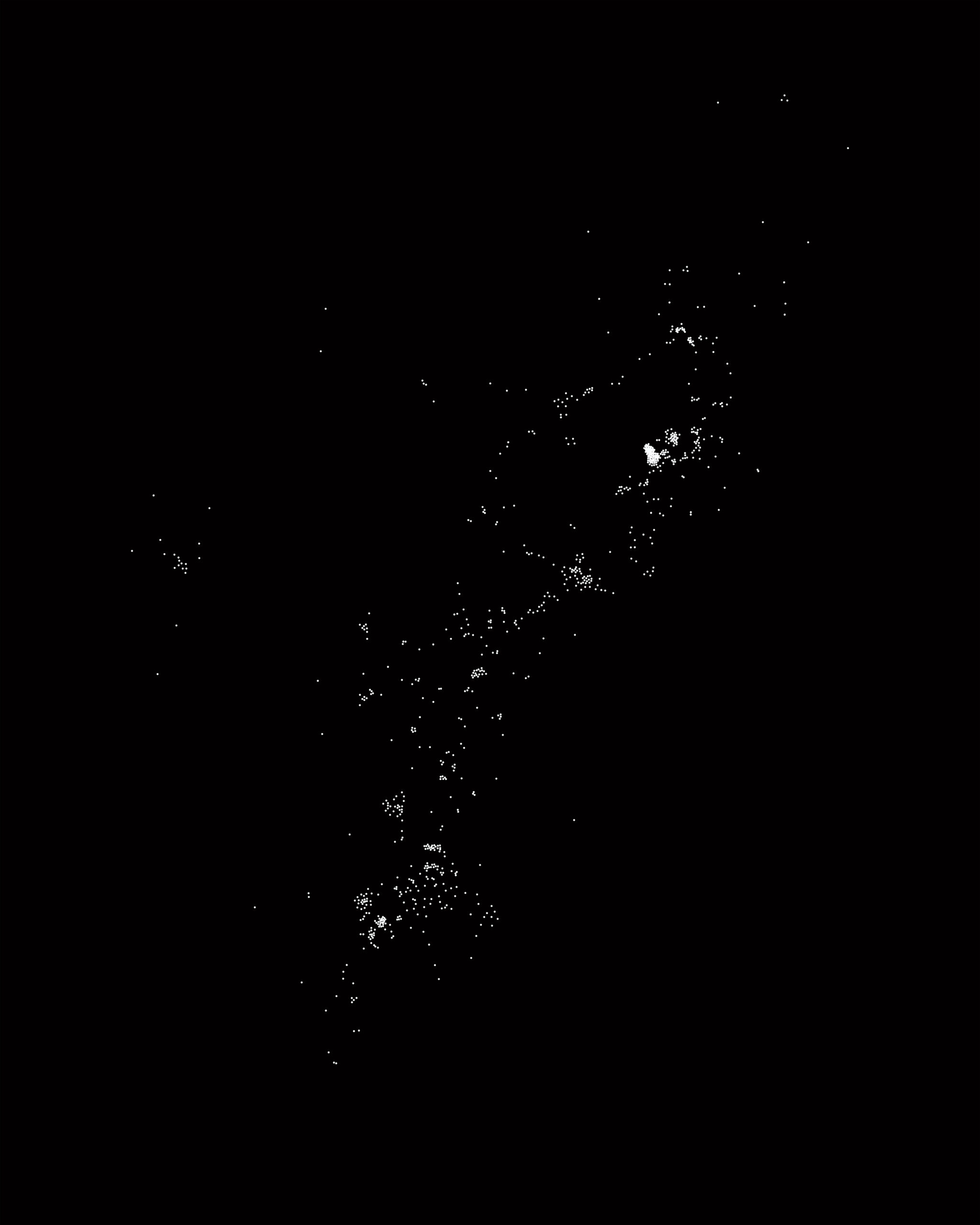
Poem for Lost Ships, 2021
in gale force winds and snow showers
her sails torn and tattered
lying on her side
thumping heavily in six fathoms
at Aird an Runair
north west of Shilley
blown off course
back and forth
demasted
a severe westerly gale
ripped her sails
and drove her through
the sound of Monach
to the sands of Baleshare
in dense fog she struck
a sunken rock
and was holed on the Uisgeir reef
at daybreak a heavy sea breaking
all around them
struck heavily on a rock
in the sound of Monach
during a gale in the night
a brocket washed ashore
at Hanglum Headland
with iron canons
struck by a huge wave
in rough weather off Barra
St Ilfonsado sank in ten fathoms
off the Butt of Lewis
three casks of whisky
marked ‘Glasgow Distillery Company’
floated on
St Kilda was sighted
off the port bow
by 6:30 pm the light
at Barra Head
******
Thanks to
Louise Scollay, from the SSSA who pursued permissions for the eight stories on my behalf.
Dougie MacDonald, for translation of the two Gaelic stories.
Gill Russell, 2021
https://www.gillrussell.co.uk/
Images are copyright and used with kind permission. Please do not reproduce.
Thanks so much to Gill, for sharing her process with us and letting us glimpse at how the recordings in SSSA have inspired and motivated her beautiful work.
If you would like to tell us about a project which has been inspired by the work of the School of Scottish Studies. our recorded contributors or fieldworkers, we would be delighted to hear from you. Email us at scottish.studies.archives (AT) ed.ac.uk
Access to Lexis PSL modules
Over the last few weeks the library have been working with the tutors on the Diploma course to set up access to four modules from Lexis PSL.
Aimed at diploma level students it offers practice notes, precedents, forms and current awareness alerts.

Access is provided to four specific modules within this database –
- Banking & Finance,
- Commercial,
- Private Client
- Property.
Specific Scots Law content is available within these modules which is why they were chosen to compliment the current resources that are available to students undertaking this course.
You can access it from the Law databases page at:

When you get logged in, you will automatically arrive in the Property module. To switch to other modules, use the dropdown arrow next to the word ‘Property’ in the top navigational bar. The modules we have access to will have a tick next to the titles.

If you wish to move over to LexisLibrary without returning to the Law Databases page, you can do that using the dropdown arrow next to the Lexis PSL page title.
If you have any problems with this or any of our other databases, please get in touch by emailing law.librarian@ed.ac.uk.
Water Quality Part 2 – Water Tests
Join us today for remote intern Mhairi Boyle’s second instalment of her four-part series on water quality and its impact on paper. Here she discusses the tests and analysis she undertook during her internship, explaining the chemistry and her results in an easy to digest way.
In this week’s blog, I will be discussing the water tests and analysis I have undertaken.
When doing this kind of research, it’s important to have real-life evidence to support your work. To start off, I created my own at-home experiments. This was my supervisor, Special Collections Conservator Emily Hick’s, great idea. My at-home experiments focused on the presence of chlorine and chloramine in tap water. To give you a bit of context, the chlorine content of tap water is something that concerns paper conservators. Chlorine is used to disinfect tap water to make it safe to drink, but it is also an oxidative bleach. This means that it has the potential to accelerate the degradation of paper-based objects, weakening them and making them more brittle, much like when you bleach your hair too much and it begins to snap off.
I wanted to firstly find out the chlorine content of my tap water, and also observe if the chlorine content varied drastically over the period of a month. I also wanted to compare the chlorine content to that of spring water, charcoal filtered water, and distilled water. I used WaterWorks test strips, which you dip into the water for ten seconds. The strip changes colour depending on how much chlorine is in the water. The results were quite positive. The chlorine level in the tap water and filtered water were very low, and varied slightly but not by much. The distilled and spring water had no chlorine, which made sense because they had both previously been purified.

Testing a water sample.

The Total Chlorine level of tap water from 26/04/21 – 21/05/21.
I also managed to analyse some on-site samples. During this most recent lockdown, most of the CRC has been closed to the public. However, a select few conservators have been allowed to go in on different days to complete essential work. Whilst on-site, the conservators have taken tap water samples for me which have been sent off for lab analysis by a company called IVARIO. Water was sampled from the CRC, St Cecilia’s Hall (SCH), and the University Collections Facility (UCF).
IVARIO’s Standard Test tests for almost everything that is of concern to paper conservators: metals, pH, conductivity, and more. As everyone knows, Scottish tap water is great, and so unsurprisingly the results came back very positive. All of the metals were under the maximum value recommended by Scottish Water; the pH was very close to neutral; and the water was deemed to be quite soft. There were slight variations, with the CRC and SCH samples differing from the University collections facility samples. This could be because the UCF falls under a different water supply area. Overall, the water at all sites performed very well.

A comparison of the on-site water samples to standards set by Scottish Water.
In my next blog, I will be looking into the opinions and practices of paper conservators from all around the world.
Introducing a 3D Digitisation Service: Feasible or Fantasy?
 For the past eleven weeks I’ve had the opportunity to intern with the Digital Imaging Unit, working on a project to evaluate the potential of establishing a 3D digitisation service within the department. “3D digitisation” in this sense encompasses everything from the initial production of digital models – using suitable items from across the University Collections – to online display, preservation of 3D data, and 3D printing. The project was roughly organised into three phases: research, testing, and implementation.
Although I worked primarily with Susan Pettigrew (Photographer, DIU) and Mike Boyd (uCreate Manager) I always felt supported by the other Library & University Collections staff; everyone I had the chance to speak to was eager to discuss their own work on top of contributing to the project.
Water Quality Part 1 – Introduction
Today we have the first instalment of a four-part series from our remote intern Mhairi Boyle. In her first instalment, Mhairi shares with us the importance of water and its inextricable link to paper. She eases us into the topic of different purity levels of water and comments on what it has been like interning from home during the pandemic.
My name is Mhairi, and I have spent six weeks in April and May virtually interning with the Centre for Research Collections (CRC) in the Conservation department. I graduated from the University of Melbourne with an MA in Cultural Materials Conservation in 2018, after which I worked on a freelance basis in Australia until returning to Scotland in late 2019. This internship has been a great opportunity for me to get back into conservation on this side of world, after a long pandemic-enforced break. This will be a four-part blog series, detailing my experiences and investigations as a virtual research intern.
I was first introduced to the concept of the ‘Five Minute Shower’ when I moved to Australia a few years ago. Concerned about the depleting sources of water due to many droughts and the impact of global warming, the Australian Government campaigned for the nation to hop in and hop out of the shower in a five-minute extravaganza instead of indulging in a lavish and lengthy bathing ritual. Indeed, water is a finite natural source, as well as being one of the main proponents used in paper conservation treatments.
People are often surprised to hear that water goes hand in hand with paper in the world of paper conservation. When you drop your book in the bath at home, it alters the fibres of the paper. Most often, after panicking and trying to dry it with a hairdryer, your book becomes distorted and wrinkly. However, when used in a controlled manner, water can be highly beneficial to paper! Water can be used to wash and flatten objects, and it is also used when making various adhesives used to repair tears and more.

My most recent bath tragedy.
You might remember the Bobble Bottle, or the Brita Water Filter craze. People started to question the water they were drinking, and how to best purify it. Activated charcoal filters have certainly had their moment in the spotlight. This topic is also discussed in paper conservation. Water can remove degradation products from paper fibres, but this means that it can also add undesirable elements to paper.
You may be wondering how a five-minute-shower, Bobble filters, and paper conservation are all connected. Here comes the tricky part: many water purification systems used in conservation use a lot of energy, and a lot of water. Tap water is the most cost-effective and sustainable option, but is it viable for conservation treatments? What about all of its unknown variables? My internship project is a preliminary study which explores all of these questions and assesses the viability of tap water in conservation treatments.
My internship has been a fully remote research project. Pre-pandemic, I would have never imagined working from home as a conservator. The first thing that comes to mind when thinking of conservation is practical treatment work. However, there is a lot more to it than that! I have gained a lot of valuable experience working remotely, which will be very relevant to post-pandemic work habits and routines. I have been introduced to the world of Microsoft Teams, remote all-staff meetings and seminars, and lovely coffee breaks with the conservation team, CRC volunteers and interns.
Interestingly, it has made me very aware of my own work habits. I have learned a lot about my own productivity levels, and how to plan my work around my energy levels. One of the main perils and joys of working from home has been spending time with my kitten, Taro. Sometimes, he is a very helpful assistant intern. Sometimes, he is intent on distracting me any way he can, from sitting on my keyboard to yowling the songs of his people at the highest decibel possible. It has been a time of growth and adaptability for both of us.

My assistant helping me get started.
In my next blog, I will be diving into the world of water analysis and what is actually in our tap water.
SSSA in 70 Objects: Puzzling Black Cats
Do you suffer from paraskevidekatriaphobia or Mavrogatphobia? Perhaps don’t read on!
Today is Friday, 13th August – Friday the Thirteenth! The day, it is said, that is purported to be unlucky or be shrouded in superstitious or even supernatural belief, although nobody really knows why! Nevertheless, we are always keen for an opportunity to delve into the collections related to superstitions.
I found this letter in a box of correspondence (SSSA/Box141) related to Alan Bruford, Archivist and lecturer at the School of Scottish Studies. This letter was sent from a school in Aberdeen by Class 1K and is dated January 1980; the query is on black cats and luck! The class had been learning about superstitions, but had a burning question for Professor John MacQueen, the Director of The School of Scottish Studies at that time.

“Most of the things [superstitions] that we have thought of we have found a solution to them, but there is one thing that has had us puzzled, BLACK CATS. We don’t know why they are lucky or unlucky, so that is why we are writing.”
The letter was signed by 19 students.
You can really feel that sense of bewilderment and that vehement thirst for knowledge of Class 1k.
As you can see, the secretary at the School was perhaps unsure who was best to answer this question and suggested Alan Bruford or Jack [John] MacQueen might have the answer. But did they? Did Class 1K get a response?
Often with correspondence such as this, a copy of the response was kept with the letter and there was no response with this one. I hope that we might be able to give some information today, if it isn’t too late.
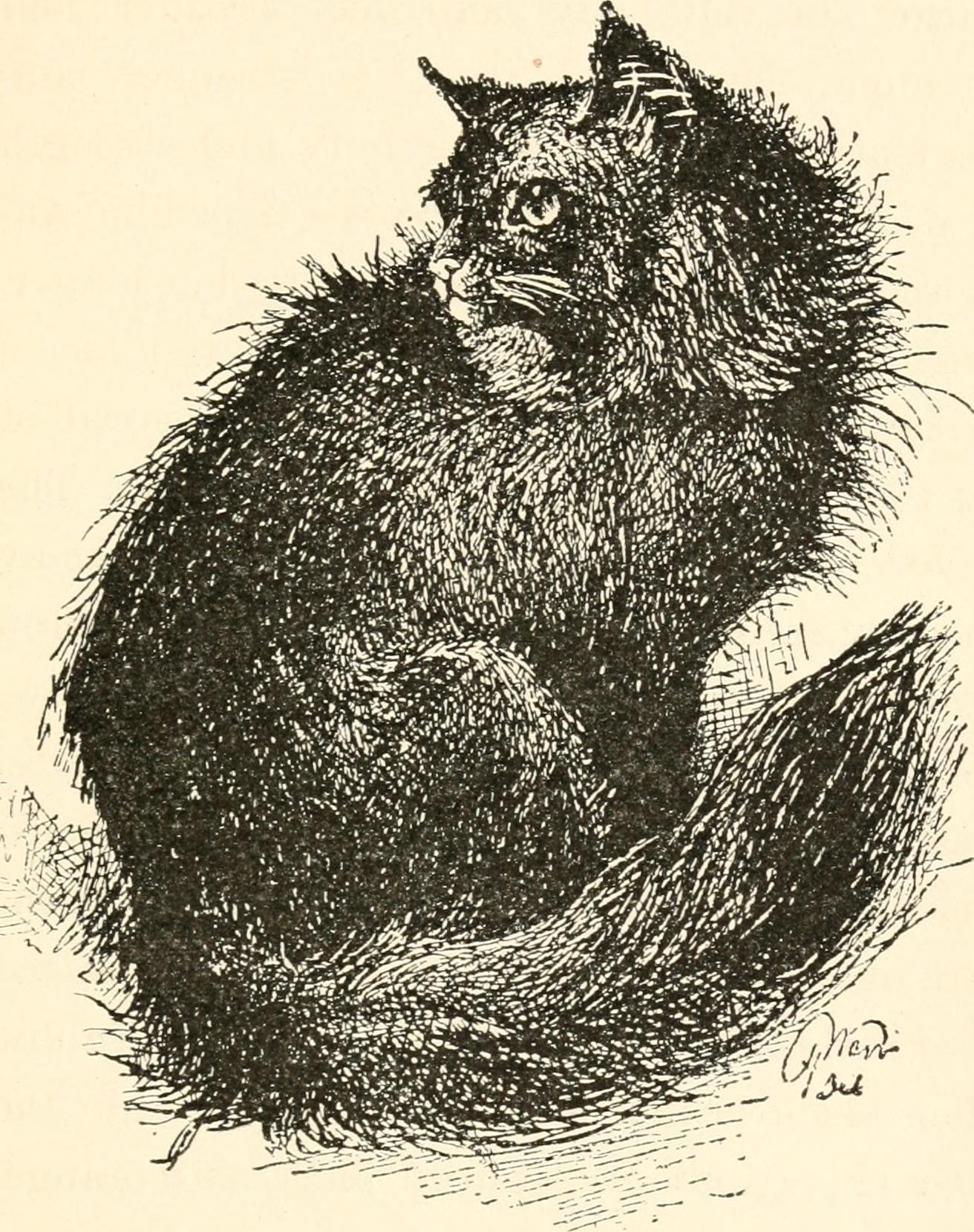
page 81 of “The cat, a guide to the classification and varieties of cats and a short treatise upon their care, diseases, and treatment” (1895)
It is true, there are conflicting reports – sometimes Black cats seem to foretell good and bad luck. Perhaps one reason for this is that black cats were associated with being the devil or with the alleged ill doing of witches. The persecution of people as witches is a blog post for another day!
Perhaps (like “witches”) it’s all down to individual beliefs and who the luck is intended for. Often the cats came off worse! Here are a few examples from our collections.
Bad Luck?
Nan MacKinnon told Anne Ross about a black cat that followed a man who had jilted his wife. The man’s mother had to speak to the minister before the cat, mysteriously, stopped appearing. Was this black cat really a wronged woman, come to seek out revenge?
BANA-BHUIDSEACH MAR CHAT. Nan MacKinnon (contributor), Anne Ross (fieldworker). SA1964.078.B. https://www.tobarandualchais.co.uk/track/23715
In the Maclagan Manuscripts (1893-1902) there are a few mentions of Black cats and mostly of them related to bad luck. A female contributor in Newhaven, Edinburgh, told if men were to meet a black cat on their way to go fishing, they would just say to one another ‘We hae gane far enough the day’, and they would turn back, for they would be quite sure their luck was gone. (MML8840)
This practice was also observed in St Ninians; miners there held that it was unlucky for one to meet one. When they returned home after the encounter, they did not go out for the rest of the day, simply on account of a black cat having crossed the road before them! (MML9112). Also from Maclagan is a statement from an Lewis contributor, who stated that the breath of a black cat was pure poison (MML3847a)
Good Luck, but for who?
Another entry in the Maclagan manuscripts details another fishing-related black cat tale, this time from Westray, Orkney. An old man was often asked to secure good weather for the fishermen and he did this by putting a black cat under a creel while the boats were out. On one occasion a boy (who became the reciter’s brother in law in time) let the cat out for mischief. This apparently caused a sudden storm at sea from which the fishermen managed to escape from (MML 6771-6772).
Donald John Stewart, of South Uist, told a curious tale of a Glasgow man who went to stay in the highlands for his health. An old woman told him about a particular mirror in one room in the house he was staying in, and said that anyone who looked in it when the full moon was shining on the sea outside would turn into a cat. The man did just that, and turned into a big black cat. The old woman then told his family to submerge the cat in the well seven times by the light of the full moon, and that when they let him go the seventh time, he would be restored!
AN SGÀTHAN ANN AN TAIGH COIRE BHREAGAIN. Donald John Stewart (Contributor), Donald Archie MacDonald (fieldworker). SA1975.113.B3. https://www.tobarandualchais.co.uk/track/76886
Stanley Robertson told a tale to Barbara McDermitt about a woman who sold her soul to the Devil for some wishes. Before her time came to spend the afterlife with the Devil, she wished to be young and beautiful and for her black tom cat to be made into a man to love her. Sadly – for both, presumably – ‘Big Tom’ was lacking somewhat!
An old spinster wished for her cat to be turned into a handsome young man, Stanley Robertson (Contributor), Barbara McDermitt (Fieldworker). SA1971.13.A1. https://www.tobarandualchais.co.uk/track/65452
Good Luck – they just are!
In my own upbringing I was always told that a black cat crossing your path was good luck indeed. According to my Nannie, they just are lucky!
I can’t find too many examples from our material available on Tobar an Dualchais, but Donald Sinclair, from Tiree. told John MacInnes that it was fortunate to have a Black cat around the place {SA1968.024) and Eileen McCafferty, from East Lothian, told Morag MacLeod and Emily Lyle that the tail of a black cat could cure warts (SA1974.24). If that isn’t good luck, then what is?!
Thankfully, we don’t only have to look to the archives to find out the answer to the query. We took to the twitter hivemind and this is what they had to say (well, 42 of them!)
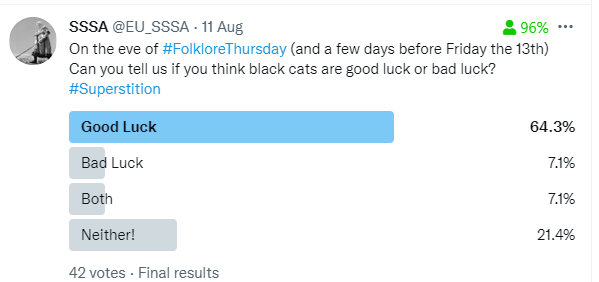
Class 1k, from Bankhead Academy, 1980 I think it is safe to say there is no real solution to this one.
What are your own thoughts, reader?
We will leave you to ponder your own superstitious beliefs with two bonny black cats belonging to Archive & Library Assistant, Elliot.
Queering the Archive with drag king Dorian T. Fisk
For the second podcast for Queering the Archive, Elliot sat down with Dorian T. Fisk to discuss representation in the drag scene and elsewhere.
Dorian is just one of many of Scotland’s Drag Kings and performers. Dorian represented Scotland in EuroStars Drag Contest, drag’s answer to EuroVision, in which Dorian placed in the Top 5. Dorian also runs the collective Shut Up And King, a Glasgow-based platform for Scottish Drag Kings everywhere.
Dorian first got their start in Shanghai, beginning with stage management for shows for Pride and Qi Pow! Burlesque & Cabaret and was inspired by the King Ennis FW, which began the experience and the creation of Dorian T. Fisk. Dorian started as a ‘roadie’ and events manager, and is drawn from “experiences of being a teen in the 80s loving rock music and that sort of glam rock type vibe, and this guy Dorian T Fisk was a bit of a smush of some lead singers from bands I grew up liking long haired dudes and a bit of Johnny Depp thrown in there”. After growing as a performer in Shanghai and representing Shanghai Drag Kings, Dorian came to be in Scotland around 2018 and is now based in Glasgow and has performed across Scotland.
Dorian has recently performed in London as part of ‘All The King’s Men’, an all Drag King ensemble for Tuck Shop West End at the Garrick Theatre, which also included performers Len Blanco, Tito Bone, Chiyo, Romeo De La Cruz, Louis Cyfer, Richard Energy, Manly Mannington, Sigi Moonlight, Oedipussi Rex, Max Ryder, and Rex Uranus.
Dorian can also be seen performing in an upcoming gig with Drag Race star Gottmik at AXM Glasgow on the 10th September.
In this podcast we discuss the drag scene in Edinburgh and Glasgow and wider Scotland, as well as Dorian’s time uplifting kings in the collective and workshops for Shut Up and King. We also discuss EuroStars and what influences Dorian’s drag and the creativity that goes into costuming and performing and much more.
Listen to the full podcast on Media Hopper here: https://edin.ac/3s68450
You can find out more on Dorian on their website: https://www.doriantfisk.com/
And on their socials here:
Instagram: https://www.instagram.com/doriant.fisk/
Links: https://linkin.bio/doriant-fisk
Shut Up and King details can be found here:
Facebook: https://www.facebook.com/shutupandking
Instagram: https://www.instagram.com/shutupandking/
Links: https://linktr.ee/ShutUpAndKing
https://www.instagram.com/d_knstrkt/
Dorian is currently in the UK and available for bookings: doriantfisk@gmail.com
You can still get tickets for the Gottmik show at AXM here: https://gottmik-glasgow-18.intix.com/
Copyright disclaimer: Copyright belongs to those interviewed and recorded and there is strictly no re-use for publication and broadcast of this recording or blog text. Quotation and para-phrasing from the recording and/or blog post is also prohibited. If you wish to use the recording for private study and research and any potential other uses, you must get in touch with scottish.studies.archives@ed.ac.uk for permissions and access.
The big 3-0-0-0: DataShare reaches three thousand datasets

Timestamp showing the accession of the deposit on the 2nd of August.
We’re thrilled Edinburgh DataShare has just ingested its 3,000th deposit:
The depositor was Dr Tom Davey, Senior Experimental Officer in the School of Engineering, who said:
“It is a pleasure for us all in FloWave to see one of our datasets achieve this milestone for Edinburgh DataShare. This is also the tenth DataShare upload making use of experimental outputs from the FloWave Ocean Energy Research Facility. Providing a reliable and accessible repository of our project outputs is not only important for our funders, but also promotes new research collaborations and builds lasting impact for our experimental programmes. This particular project will aid in the understanding measuring wave and currents at deployment sites for offshore renewable energy technologies, and adds to the existing FloWave portfolio of datasets in the field of wave energy, tidal energy, advanced measurement, and remote operated vehicles.”
You can explore more data generated at FloWave in the IES DataShare Collection:
Collection – The Institute for Energy Systems (IES) (ed.ac.uk)
Although the ‘wave buoy in current’ dataset is under temporary embargo, currently set to expire on the 5th of September, it is possible to request the data using DataShare’s request-a-copy feature in the meanwhile. Embargoes may be extended, or lifted early, usually reflecting publication dates.
You might also enjoy this hilarious and very popular video about FloWave:
Pauline Ward
Research Data Support Assistant
Library & University Collections
University of Edinburgh
Assessing books for exhibition
This week Special Collections Conservator Anna O’Regan talks us through her experience of learning new skills and how they were applied to conserving a group of books for an upcoming exhibition.
Over the last few months working part-time as a Special Collections Conservator at the CRC, I have gained numerous new skills such as assessing books for digitisation, exhibitions, and loans. Having had limited experience with assessing books before, I jumped at the chance to assist in a consultation of a group of books marked for exhibition.
Leventis Foundation Exhibition Registrar and Project Manager Emma Ulloa and myself, along with Special Collections Conservator Emily Hick who joined us virtually, collaborated to assess the group of books picked out for Edina/Athena: The Greek Revolution and the Athens of the North, 1821–2021. Emma and I, maintaining social distancing throughout the consultation, were able to assess all the books picked out and agree which ones were suitable to exhibit and which ones were not. Emma called out reference numbers for the books and updated the exhibition spreadsheet from one side of the room while I handled the books with Emily there (virtually) beside me. I was able to pick the books up and have Emily look over them with me via the Wolfvision CZ-V6 overhead projector. I talked through any damage or lack thereof that I was seeing, commenting on the function of the books and whether there were any loose pages or pieces of leather, if the spine was intact, or if something wasn’t quite right so we could investigate it further together.
Queering The Man and Woman’s Love Song
 An image of our Tale archive with a Progress Pride flag filter. The image includes cabinets, index card boxes on top, and shelving with books above.
Throughout Scottish tradition and history we have heard many iterations of the Love Song, be it through themes of unrequited love, courtship, lamentations at the loss of a lover, or even bawdy tunes and romance. No matter the theme, there is always one thing in common – that they are a man and a woman’s love song. There is not much in the way of recorded queer love in traditional Scottish songs, and it would have been near impossible for these to enter into the mainstream of known love songs. However, in my research on what we hold on the traditional Man’s Love Song and Woman’s Love Song, I have found some content that can be ‘queered’. Through a mix-up of pronouns in song or change of the gender of the singer and the protagonist we can find queer undertones and subtext within these traditional love songs.
Within the Man’s Love Song, we of course have many examples of songs with a male protagonist describing his love or telling a tale of love about a woman. I will take you through a few examples of songs that can be ‘queered’ through being sung by a female singer and no change of the gender of the person the protagonist loves. Below are just a few example of songs that we hold that can be viewed through this lens.
For example, there is “Mo Ghaol an Tè Nach Dìobair Mi”. This version, sung by Mary MacRae and recorded by Donald Archie MacDonald is a Man’s Love Song on how ‘he will always stand by beautiful Mary as being a woman of virtue.’ What I like about this version is that the lover is named, and through queering can be seen as a romantic tune about the virtues of women as recognised and sung by another woman. Listen to this track on Tobar an Dualchais linked below:
MacRae, Mary, “Mo Ghaol an Tè Nach Dìobair Mi”, recorded by Donald Archie MacDonald, The School of Scottish Studies Archives, SA1964.062, Tobar an Dualchais / Kist o Riches, http://tobarandualchais.co.uk/en/fullrecord/104516
There are also examples of unrequited love. “Och Mar a Tha Mi ‘s Mi nam Aonar”, sung by Peggy Morrison and recorded by Morag MacLeod is of a man’s love song for a beautiful girl from Lochcarron. The protagonist hopes she gets a man who is worthy of her. As this particular recording is sung by a woman, we can view this recording as being about a woman’s unrequited love for the beautiful girl from Lochcarron, but they cannot be together so she hopes she finds a good man who is worthy of her love. Listen below:
Morrison, Peggy, “Och Mar a Tha Mi ‘s Mi nam Aonar”, School of Scottish Studies Archive, SA1975.210.A4a, Tobar an Dualchais/Kist o Riches, https://www.tobarandualchais.co.uk/track/108130?l=en
There is also another about promises of marriage, sung by Nan MacKinnon, in “Gur Tu Mo Chruinneag Bhòidheach.” In this love song, ‘a man praises his beautiful darling. He would do many things if she promised to marry him’. Different from “Och Mar a Tha Mi ‘s Mi nam Aonar”, this song allows for a reading of a woman promising many things to her lover if she married her, and is not about unrequited love or not being able to marry the lover described. Listen below:
MacKinnon, Nan, “Gur Tu Mo Chruinneag Bhòidheach”, School of Scottish Studies Archive, SA1958.132.5, Tobar an Dualchais/Kist o Riches, https://www.tobarandualchais.co.uk/track/97353?l=en
There are also a few examples of The Woman’s Love song as sung by men about a man the protagonist longs for or is telling of love for him. Although we have less examples of men singing the Woman’s Love song, there are still more recordings of this type within the collections.
The song “Ò Hù Tha Mo Ghaol air Òigear a’ Chùil Dualaich” is a, ‘woman’s love song to the young man with the beautiful hair.’ This version is sung by John MacLeod and recorded by Polly Hitchcock. Again, through the singer being male, we can hear the description of his love and admiration of the man with beautiful hair. Listen below:
MacLeod, John, “Ò Hù Tha Mo Ghaol air Òigear a’ Chùil Dualaich”, School of Scottish Studies Archives, SA1951.43.A7, Tobar an Dualchais / Kist o Riches, http://tobarandualchais.co.uk/en/fullrecord/90295
In “Cha Bhi Mi Buan ‘s Tu Bhith Bhuam”, the singer, ‘will not survive if she is parted from her beloved, whom she has loved since she was young. She sits on the hillock, looking over the narrows seeing his boat passing.’ This version sung and recorded by Calum Iain MacLean can be viewed about the sadness of the childhood lover leaving for sea and being so in love it is difficult to part with him. Listen below:
MacLean, Calum Iain, “Cha Bhi Mi Buan ‘s Tu Bhith Bhuam”, School of Scottish Studies Archives, SA1953.79.1, Tobar an Dualchais / Kist o Riches, Tobar an Dualchais
With Queering the Archives, we are creating a finding-aid to help other’s locate queer and related records. If you are interested in responding to these recordings with your own work or researching our queer collections, please do just get in touch with us. Visitor Information | The University of Edinburgh
Why not take a look at the material we hold remotely on Tobar an Dualchais and think of ways in which our sound recordings can be ‘queered’? If you are interested in recreating our material in any form, please get in touch with us or submit an access to digitised collections form directly. Access to Digitised Collections | The University of Edinburgh
As always, we would love to hear thoughts on the material we hold and would love for you to work with us and our records.
Queering the Archives will have our very first workshop held on the 25th August from 13.00 – 15.30. This is a public workshop and is open to all under the LGBT+ and Queer umbrella and allies. Get your tickets here: https://www.eventbrite.com/e/165396797273
This will take you through understanding of queering, what we are doing for Queering the Archives, and working with our queer records and will involve discussion and practical work on improving our search-terms and catalogues. Access to event via QR code below:

Collections
 Hill and Adamson Collection: an insight into Edinburgh’s past
My name is Phoebe Kirkland, I am an MSc East Asian Studies student, and for...
Cataloguing the private papers of Archibald Hunter Campbell: A Journey Through Correspondence
My name is Pauline Vincent, I am a student in my last year of a...
Hill and Adamson Collection: an insight into Edinburgh’s past
My name is Phoebe Kirkland, I am an MSc East Asian Studies student, and for...
Cataloguing the private papers of Archibald Hunter Campbell: A Journey Through Correspondence
My name is Pauline Vincent, I am a student in my last year of a...

Projects
Cataloguing the private papers of Archibald Hunter Campbell: A Journey Through Correspondence
My name is Pauline Vincent, I am a student in my last year of a...
Archival Provenance Research Project: Lishan’s Experience
Presentation My name is Lishan Zou, I am a fourth year History and Politics student....