Home University of Edinburgh Library Essentials
April 7, 2026
On (long term) Trial: More Gale Primary Sources
*The Library has subsequently purchased access to Archives of Sexuality and Gender: Inernational Perspectives on LGBTQ Activism and Culture, British Library Newspapers Part VI: Ireland, 1783-1950, Financial Times Historical Archive 1888-2021 and The Mirror Historical Archive, 1903-2000. These can be accessed via the Databases A-Z.*
During the summer the Library was able to purchase two Gale primary source databases to add to our collections: U.S. Declassified Documents Online and The Telegraph Historical Archive, 1855-2016. Because of this, Gale have offered us free long-term trial access to 7 more of their digital primary source databases through their Gale Accelerate programme.

The Library has access to these 7 databases until 12th July 2023.
They can be accessed from our E-resources trials.
They can also be accessed via the Digital Primary Source and Archive Collections guide or Newspapers, Magazines and Other News Sources guide, as appropriate.
So what do we now have access to?
(In alphabetical order) Read More
BOO-lean operators
We know Hallowe’en was last week, but saw this on Twitter and it’s too good not to share! If you’ve ever wondered what library staff (and mathematicians and engineers and many other professions) talk about when they mention Boolean operators or logic gates, this handy infographic from @38mo1 may help!
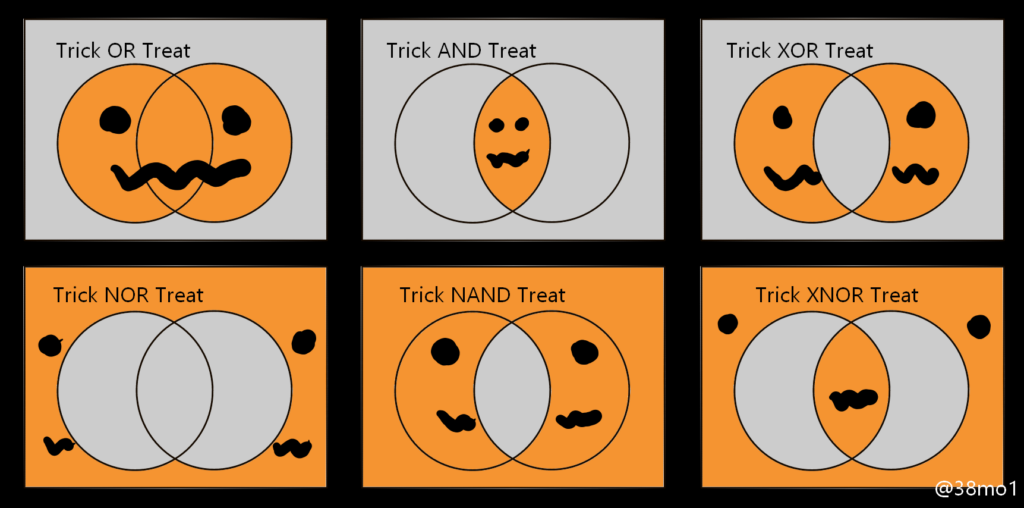
Traditionally search engines and databases used Boolean operators along with keywords to help you search more constructively. Some (like Google) now accept natural language searching, but many academic or technical databases still require you to search in this format.
For example, if you search on DiscoverEd:
- “Property Law” OR Servitudes: 70,745 results.
- “Property Law” NOT Servitudes: 57,500 results.
- “Property Law” AND Servitudes: 154 results.
Those little connecting words can make all the difference!
For more help with searching, watch this short video (9 minutes) about Search Techniques on our Law Librarian Media Hopper Channel. Unfortunately pumpkins not included.
Join the L&UC Journal Club!
Part of the professional development we’re involved in as library staff includes attending conferences and reading journals relevant to our profession. Recently the ASL team realised that we don’t have dedicated time in our schedules to get to grips with issues facing libraries at the moment, and so we decided to resurrect the L&UC Journal Club! We’d like to invite our colleagues from across Library & University Collections to join us to discuss articles and developments in libraries and information sectors at regular meetings throughout the year.
Are you a member of Library and Universities Collections staff interested in keeping up to date with issues and events in the Library and Information sector, but struggle to make time for professional development? Would you like to prioritise improving your academic discussion skills and network with colleagues from across L&UC?
We will alternate online and in-person meetings from November, and have a rotating chair and moderator system so everyone gets the chance to suggest articles and lead discussion. Our first meeting will be on Wednesday 23rd November 2022 at the Digital Scholarship Centre in CRC, Main Library. We’ll be discussing What Academics Really Think About Information Literacy by D. Stebbings et al.
If you fancy joining us or finding out more, search for L&UC Journal Club on Teams or contact Christine Love-Rodgers or SarahLouise McDonald.

Halloween Divination in our Sound Collection
Today is Halloween and – placing pumpkins and trick-or-treating (as we know it today) firmly to one side for now – this is the day on which we traditionally mark the end of the harvest season and the commencement of the dark season of the year. It is also the night of the Celtic calendar where the boundaries are thin between this world and the Otherworld; between life and death – making way for all sorts of spooky shenanigans, including divinations games and rites!
Our collections here at The School of Scottish Studies Archives are rich indeed with personal memories of such practices and we thought we would share some of these with you, should you care to try any out yourself.
Burning Hazelnuts
The placing of nuts in a fire for divination occurs more than once in our collections. For many this was a love divination – a very popular reason for Halloween rituals – if the nuts burned to ash then any union would not prosper, but if they cracked or fused, this was a good sign. However in this recording, from 1964, William Forbes told Anne Ross that in Perthshire they would watch to see if the nuts cracked and if so they made a wish!
Kale Stalk
Kale is relevant to several Halloween pranks and rites. This recording tells of the practice in Shetland of using kale stalks to divine how large a woman’s family might be or what shape her future husband would take. The woman was blindfolded and led to the kaleyard where she tied one of her garters to a kale stalk. It was pulled up and hung above her house door. If she was a newly-married woman, the number of shoots on the side of the stalk forecast the number of children she would have.
In this later recording, also from Shetland, Andrew Hunter told Alan Bruford about the practice of ‘Casting Kale’ where kale stalks would be throw into people’s houses or down their chimneys. A particularly messy form of chap-door-run!
Andrew also describes some other seasonal customs and rites in Shetland, which would also occur at Yule too.
SEASONAL CUSTOMS AND CELEBRATIONS
SA1978.067
Contributor: Andrew Hunter
Fieldworker: Alan J Bruford
Balls of Wool
“Cò tha siud thall air ceann mo ròpain?” or “Wha haads my clew end?” are questions you may heard called on Halloween night! We have recordings of this marriage divination across Scotland. Reverend Norman MacDonald, from Skye, described this practice to Calum Iain Maclean in 1952.
Kate Manson, from Foula, described to Sandy Fenton this practice when she was a girl, but instead of a wall, the wool was dropped down the chimney of an old watermill. She also told that another practice was for a girl to go to a big standing stone and go three times around it one way and three times around the other. The first man she saw after that was to be her future husband – hopefully she didn’t get too dizzy!
Eggs and Shirt Sleeves
Divination using eggs was once common and not only at Halloween, but at other calendar customs as well. Much like tea-leaf reading, it is said that egg whites could be read if poured slowly into a glass of water; different shapes could foretell the future.
In South Uist, Donald Alastair Johnson described egg divination in a different way; An egg was broken into a glass and stirred. Everyone took a mouthful, chose a house, and stood outside the window. The first name heard would be the same as their future spouse – but whilst this was happening they had to keep the egg in their mouths This was done by boys and girls – which is a refreshing change from these often being prescribed rites for young unmarried girls or women. He also describes further customs such as cabbage-stealing which is aligned with some of the kale-related high-jinks elsewhere in our collections
Cleachdaidhean Samhna ann an Uibhist a Deas.
SA1971.043
Donald Archie MacDonald Angus John MacDonald
From Orkney, we have a round up of Halloween customs from Johina Leith (recorded in 1977), she also talked of egg reading and how it was to prove true for her own aunt. Johina also described the process the dipping of a garment sleeve in water where three lairds land crossed. The shirt was left over a fire to dry and it was said that the person who approached would be the person they will marry.
Orkney Halloween customs, including divination; tricks at Halloween
SA1977.085
FIELDWORKER: Alan J. Bruford
Brucie Henderson, from Yell in Shetland, also had evidence of the shirt washing rite. As he described it, on the night of Halloween, a girl might wash her blouse in a burn at a bridge where a corpse had crossed for burial in the churchyard. The blouse would be taken home for drying and as she left the burn the girl was supposed to see the man she would marry passing by.
SHETLAND HALLOWEEN DIVINATION CUSTOMS
SA1970.242
Contributors: Brucie Henderson
Fieldworkers: Alan Bruford
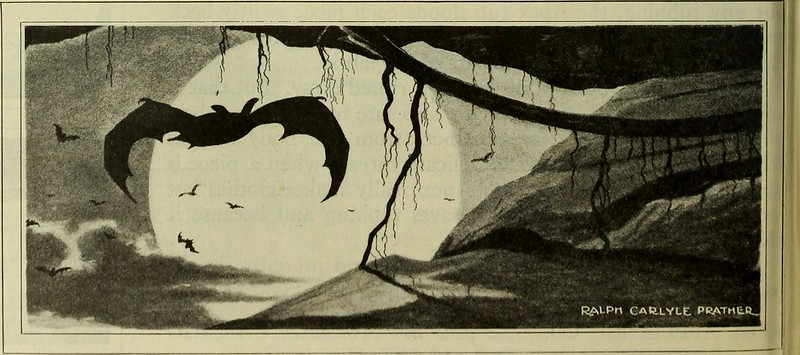
These are but a few examples from our collection and you can access more of our collection over at Tobar an Dualchais, where there are over 33,000 tracks from SSSA available to listen to online.
Do take care with your Halloween divinations: we cannot vouch for the efficacy or outcome and you may need to think about your health and safety before undertaking any of these!
Images from Internet Archive Book Collection on Flickr and are public domain
Out of (Kar)luck
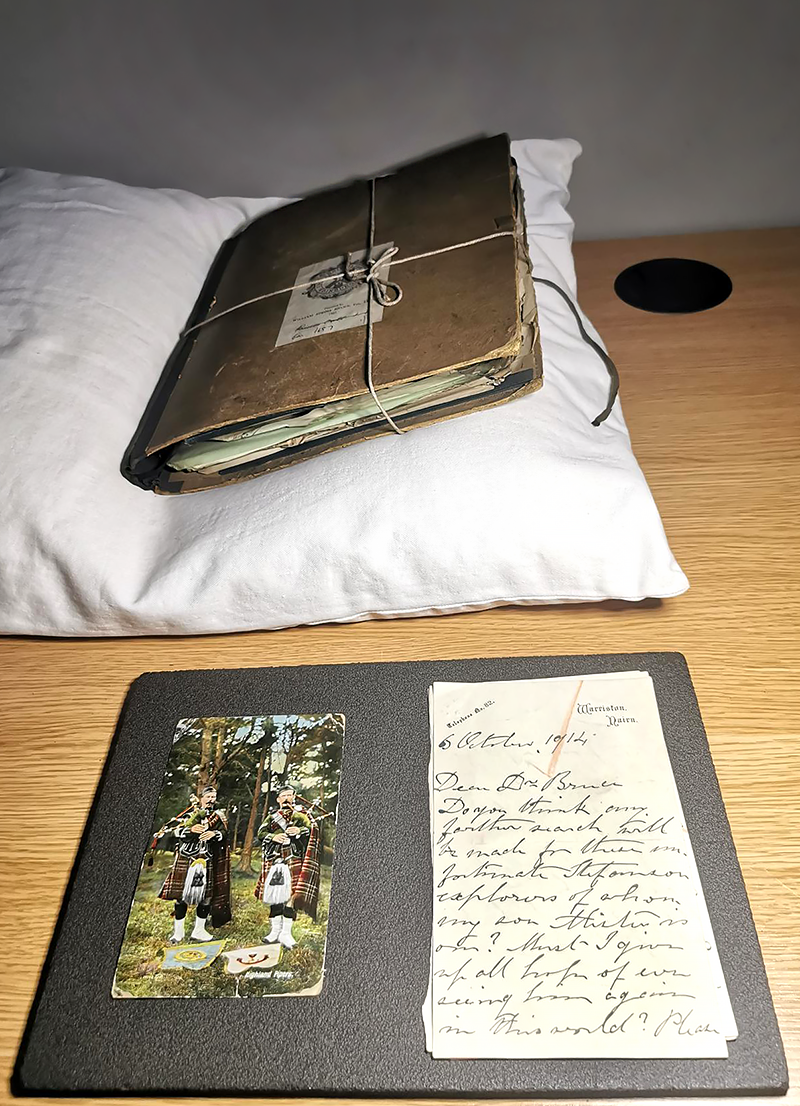
For several months now I have been working as a Digitisation Operator at our studio in the main University library, and that time has flown by. A large part of my job is to take care of orders that come into the Cultural Heritage Digitisation Service (CHDS), which will often be requests from academics or researchers who require a digital copy of something from our collection. This means that I get to see a fantastic cross-section of what we have here, on a daily basis. This will usually be books, pamphlets, letters – any paper-based object that can sit safely on the scanner, and where the digitised copy doesn’t need to be publication-quality as this would be done on the high-quality cameras at a higher charge.
A recent favourite of mine was a set of letters and ephemera relating to a doomed Arctic expedition that set off from the west coast of Canada in June 1913, led by Canadian anthropologist Vilhjalmur Stefansson, and captained by American explorer Robert Bartlett. This was to be the last voyage of the Canadian ship, the Karluk.
Have you heard about LibSmart?
We’re midway through the first semester now, and many students will have settled into the routine of lectures, seminars and practical class preparation. You may even be thinking ahead to the end-of-module deadlines moving ever closer, and beginning to consider how to research and write assignments. For some students this can be stressful or confusing as they realise they don’t really know where to start with looking up resources to back up their work. Don’t panic though, we’ve got you!

Enter, LibSmart! This is our online information literacy course which you can access via Learn at any time throughout your studies. It’s self-enrol and open to absolutely everyone, and will provide you with a great grounding in how to access resources online and via the library, and how to reference your research correctly. There’s five modules in LibSmart I and although we recommend you work through them all, you can dip in and out of the bits you feel you need a bit of help with.
If you’ve completed that, you may find that you want to go a step further. In that case, check out LibSmart II which has ten modules on a variety of different topics all designed to help you get to grips with a specific focus. Unlike LibSmart I we don’t ask you to work through all the modules here, just pick ‘n’ mix your favourites! You might be interested in health information and systematic reviews, or legal information and government and policy research. Maybe you’re unsure of what’s in our Special Collections and you’d like to explore that more fully. Students who’ve completed these modules before have said that they’re extremely useful and relevant to their work.
If this sounds interesting to you, you can find out more on the LibSmart webpage. Remember you can access LibSmart any time you like throughout the year, and for each module you complete you get a digital badge!
There’s a video here on how to self-enrol in case you’re unsure of the steps. Hope to see you in LibSmart soon!
Lexis+ database training: LexisNexis Certification
You may remember last week we posted a reminder about the Lexis+ training we had scheduled. That training took place yesterday and those that attended found it very helpful, so we’re putting the recording and information about how to get certified with LexisNexis up here too.
LexisNexis offers four levels of certification for students in the UK – Foundation level for England and Wales, Foundation level for Scotland, Advanced level for England and Wales, Advanced level for Scotland. Our students can pick whichever is the most relevant for them, or complete all of them if they want to collect the set!
First, you’ll need to watch the Foundation level training video (recorded yesterday by Claire Black of Lexis UK). You can find that on our Media Hopper Channel or by clicking the image below.
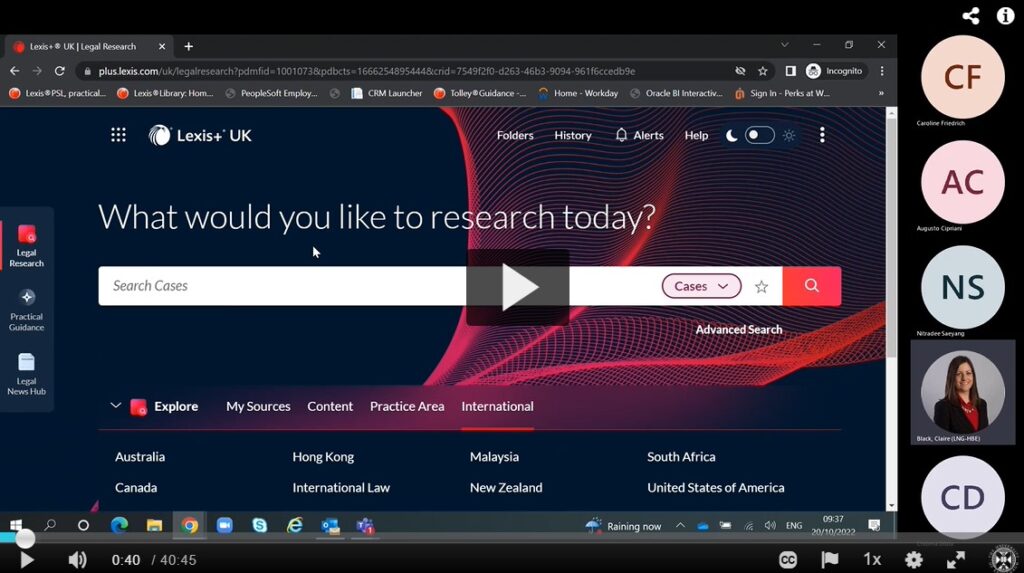
Next you will need to log in to Lexis+. The best way to do this is using the link on the Law databases page; it currently says ‘LexisLibrary’ but I’m in the process of getting that updated to Lexis+. If when you’re logged in you arrive at the screen that says ‘Nexis’ at the top of the page, click the nine dots in a square next to the Lexis logo, and you should be able to click ‘Lexis+ UK’ instead.
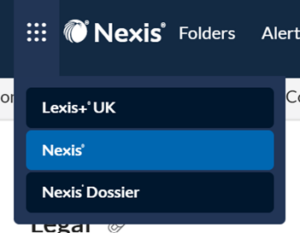
Then Claire has provided the following instructions:
- Make sure you are logged in to Lexis+ through the University – you will need to use the site to answer the questions.
- In a new tab or window, access the LexisNexis Student Hub: https://www.lexisnexis.co.uk/law-students/overview.html
- Register your details – your choice whether to choose university or personal email. It gives you access thereafter if you need to retake the test or want to do other certifications. Course end date is the date you intend to graduate.
- Once registered, scroll down the page to where it says ‘Get Certified’ and choose Lexis+ UK Legal Research Certification (there is the option for the Practical Guidance one, but given access to practice areas can vary, it’s probably safer to stick to research)
- You will then see a page which lists 6 steps to being certified. Scroll past this to the bottom and there are 4 options: Foundation and Advanced Certifications for either England and Wales, or Scotland.
- You will then enter your email address (which allows you to come back later and will allow you to retake the test if necessary)
- 15 multiple choice questions which are completely randomised. 13/15 correct to pass. You must use Lexis+ to answer the questions.
- You can take the test as many times as you need to pass.
- Certificate will be emailed to you upon passing within 24 hours.
Our thanks to Claire and all at Lexis for making sure our students are well trained and well prepared for legal research! Good luck to anyone choosing to take one of the Certification tests. If you encounter any issues please let us know on law.librarian@ed.ac.uk.
“An epoch in history” – Charles Lyell in Nova Scotia 1842

Guest Blog Author Tim Fedak
We are delighted to welcome Tim Fedak – a Curator and Palaeontologist based at Nova Scotia Museum – to our blog! Tim has been waiting ever so patiently for access to Charles Lyell’s Notebook number 104, documenting his visit to Nova Scotia in 1842 to view the geology and fossil trees at Joggins, and which ushered in a new era of geology….
Today, Nova Scotia is well known among geologists around the world for its important geology. The Joggins Fossil Cliffs UNESCO World Heritage Site has a world class interpretive centre and regular tours of the famous fossil forests. The importance of that site, as well as the Cliffs of Fundy UNESCO Global Geopark on the northern shore of the Minas Basin, both find their beginning in 1842.
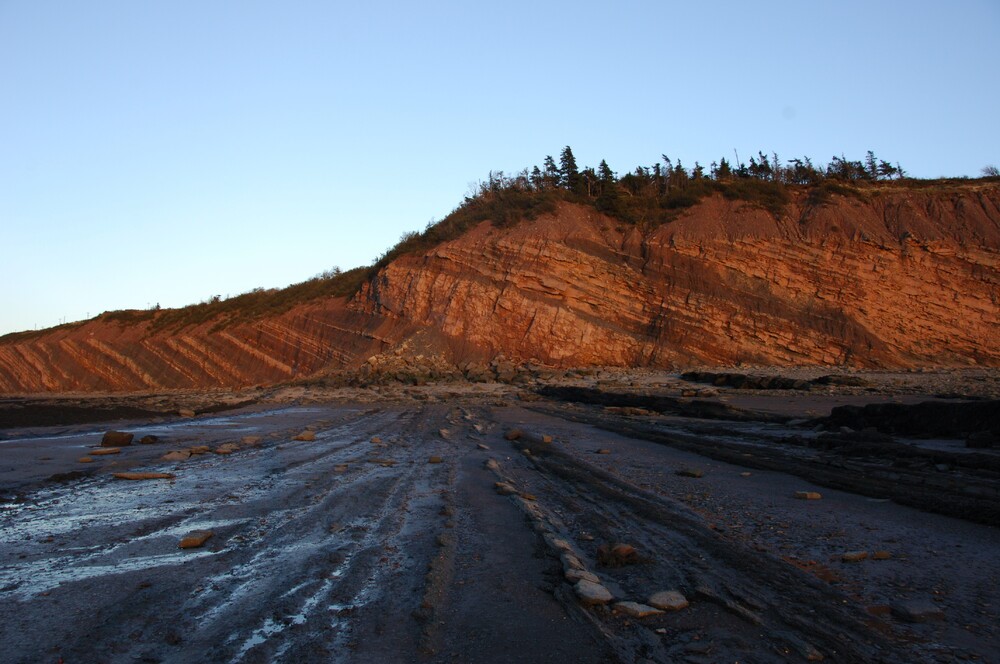
Joggins Fossil Cliffs, a UNESCO World Heritage Site on the shores of the Bay of Fundy, Nova Scotia.
In July and August of 1842, Charles Lyell was visiting Nova Scotia for a month of geology, to engage the local geologists and to examine the fossil forest that everyone, including Darwin would come to hear about. The interactions he had and the insights he gained from walking along the shores of the Bay of Fundy shaped his observations and convictions about ancient trackways and life in the Coal Age.
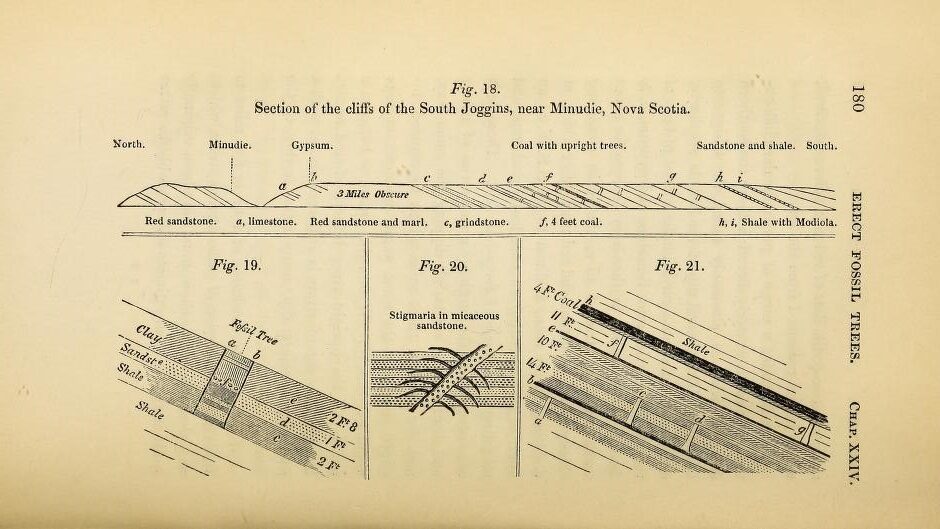
Cliffs of South Joggins, Figure 18 from Charles Lyell’s Travels in North America, Vol 2. 1845.
Sir. William Dawson was born and raised in Pictou, Nova Scotia but he had studied at the University of Edinburgh in 1840-41. He was still just a young man passionate about geology and fossils when Lyell visited the province, and they shared insights and views of geology. When Dawson published his iconic Acadian Geology in 1855, he noted in the introduction:
“The year 1842 forms an epoch in the history of geology in Nova Scotia. In that year Sir Charles Lyell visited the province, and carefully examined some of the more difficult features of its geological structure, which had baffled or misled previous inquirers.“ p6.
Dr. Ebenezer Fitch Harding, a community physician in Windsor, Nova Scotia, was another local geologist that Lyell interacted with, accompanying him to the geology sites and mud flats of the Minas Basin, Bay of Fundy in the summer of 1842.
See more on this important period in Nova Scotia geology, including the links between Nova Scotia and Edinburgh, and Harding’s contributions to science in Tim’s article https://www.erudit.org/en/journals/scientia/2021-v43-n1-scientia05889/1078926ar/
Lyell’s trip to Nova Scotia is well described in Volume 2 of his ‘Travels to North America’ published in1845. However, when I first heard that the University of Edinburgh was attempting to purchase Lyell’s 294 Notebooks for archival research, I was immediately thrilled with the thought of what more he might have written during his visit to Nova Scotia. I then celebrated when the project was successful and have been waiting (somewhat) patiently since then.
In early September this year, I learned that Notebook 104 had been scanned and was now available online. I dropped everything and began to carefully make my initial examination of the notes and drawings of the scanned pages. You can see my short presentation of some of the immediately interesting observations made about Notebook 104 at:
Joggins Sketch
The Joggins cliff sketch on page 48 was immediately of great interest and value. This illustration became the key that unlocked the understanding that the gypsum and limestone layers (now known as the Windsor Group) – were below the coal.
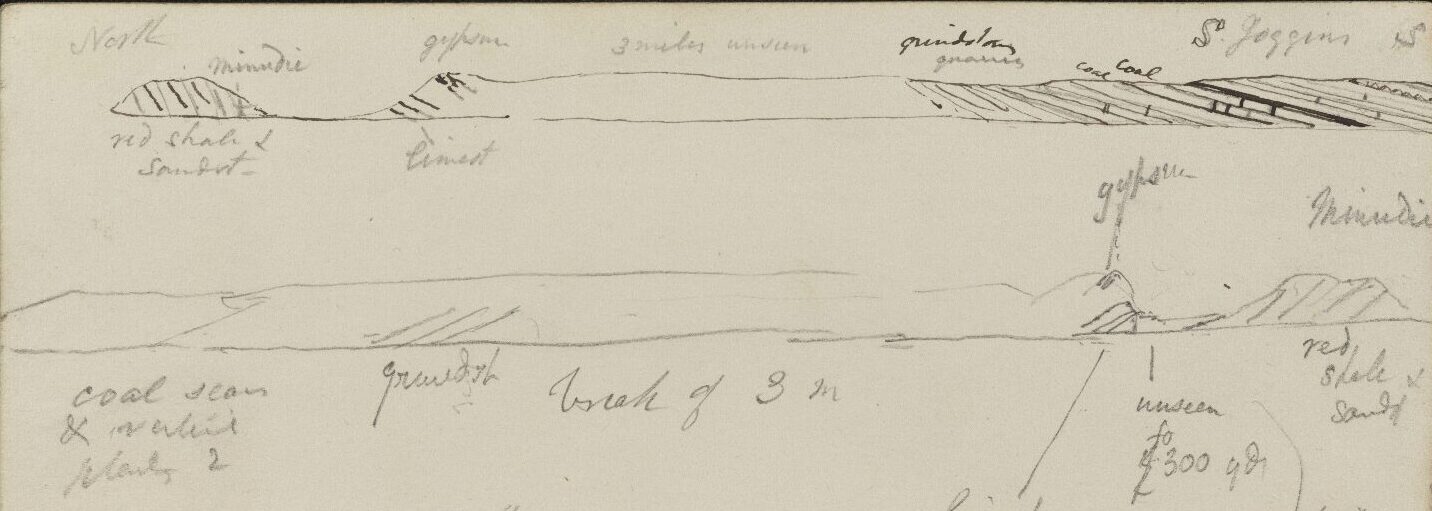
Detail of two preliminary sketches of the Joggins Cliffs in Lyell Notebook 104, p. 48.
Shubenacadie River
The notebook includes many important sketches of the work carried out along the Shubenacadie River, which included contributions from J.W. Dawson, William Duncan, Richard Brown and others.
Field Work, Travel Notes
I am interested in the people of geology and what it was like for them to carry out the work and attain their insights. I was particularly struck by the notes of the bags that Charles and Mary Lyell travelled with, and the supplies that they required. A very personal view into the travelling aspect of field work.
Mary Lyell
Mary Lyell being on this month-long visit to Nova Scotia is also incredibly interesting. It remains difficult to locate any records that describe her activities when they were apart. However, there are notes in Charles’ notebook, as well as in letters he wrote to Dawson that Mary was actively engaged in discussions of geology and conchology.

Extract from Letter from Charles Lyell, to William Dawson, Pictou, Nova Scotia, quoting “…Mrs. Lyell says…”
I am truly grateful for the opportunity that the University of Edinburgh and the project partners are providing in making these notebooks available for research. Here in Nova Scotia, this is a special way to celebrate 180 years since Charles and Mary Lyell where here exploring the geology and natural history of Nova Scotia.
I’ve mapped the Lyell’s travels in Nova Scotia using the information in Notebook 104, descriptions from Lyell’s Travels in North America, and links through to archived letters on this interactive timeline. Follow the hashtag #NS1842 and find additional information in this Tweet Collection #NS1842
Thanks Tim – it’s great to hear more about Lyell’s impact in Nova Scotia. We love your enthusiasm (and patience!).
Since her last blog, Project Conservator Mhairi Boyle has been getting to work assessing and conserving the bound volumes from the R(D)SVS and OneKind archives. In this blog, she explains the assessment process used to evaluate the condition of OneKind’s bound volumes.
In my last blog I was at the Zoo, helping to move the archive on a warm yet rainy summer’s day. It’s now a crisp October and I am stationed back at the Main Library, tasked with conserving the bound volumes in the OneKind and R(D)SVS collections.
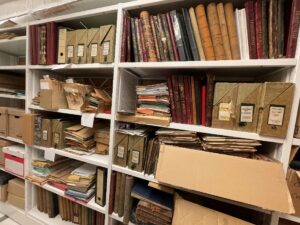
The OneKind archive, before rehousing
First, I had to decide where to start. When working on a long-term project, it’s important to establish an efficient workflow. This project is a little bit different than anything else I have worked on because all the collections were either partially catalogued or not yet catalogued. Project Archivist Fiona Menzies is hard at work establishing an order and organising the metadata for each collection, which means that over time many of the items and boxes will change location. To not disrupt the cataloguing and organisational processes, I decided to start with the larger bound volumes in the R(D)SVS and OneKind collections.
Upon initial examination, it was clear that the OneKind volumes needed more attention than the R(D)SVS ones. I decided to undertake a more detailed survey of the OneKind volumes to provide an overview of their condition and identify the most common issues. Surveys often go at snail’s pace in the beginning, as you get to know the collection and the common conservation issues and the extent to which objects are damaged. As I got to know the collection, I was able to create damage categories to assign to each volume. I created Categories 1-4, from ‘Good’ to ‘Fair’ to ‘Poor’ to ‘Severe Multiple Damages’. ‘Good’ volumes are in stable, functional condition and require little/no interventive conservation treatment, and the other categories represent a sliding scale of object condition.
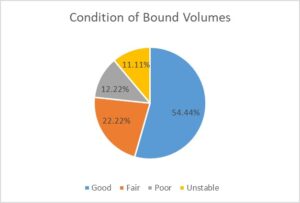
The survey gave me an overview of the condition of the collection
The most common issues were surface dirt; red rot (the deterioration of the leather cover and/or spine); and damaged leather covers and/or spines.
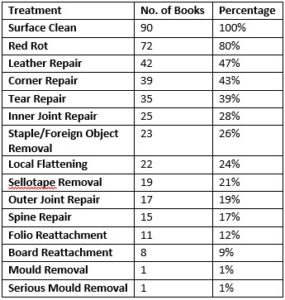
Surface dirt, red rot, and damaged leather are the orders of the day!
However, the most complex issue with the collection is the amount of Sellotape on many volumes. In many cases, extensive tape has been applied to volumes with damaged/detached boards and/or spines, to keep the volume intact. This will prove to be tricky to remove, because whilst in some areas the adhesive has hardened and come away from the plastic carrier, in many areas it is still fully adhered to the leather. Removing it may in fact further damage the leather.
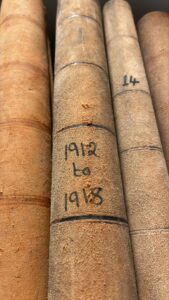
Red rot galore. This deteriorated leather can be consolidated with Klucel G in Industrial Methylated Spirit
The removal of the tape is one of many ethical decisions which must be considered when treating the OneKind collection. Because this is an archival rather than a fine art collection, the preservation of information is of utmost importance. Because the bindings of the volumes are not historically unique, an in-situ and minimally interventive approach to the treatments will be adopted. To maximise efficiency and speed, tape will be left as-is on areas of the volumes where it does not affect the movement and functionality of the volumes. This will not affect the quality of the treatment, allowing me to preserve the whole collection rather than completely rebinding singular volumes.
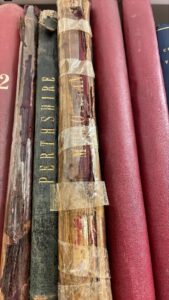
Tape has held this volume together. Now, it can be replaced with archival-friendly conservation treatments
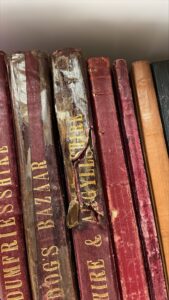
Did somebody say tape?
In a way, I must be thankful for all the tape that I am going to tackle. A well-meaning person recognised the importance of keeping the volumes intact and put in their best efforts to preserve them in their original formats. It means that no boards or spines have been lost into the ether. I will be sure to update when I begin my tape-laden conservation journey!
Rights retention policy: an update after 9 months
2022 has been a big year for open access at the University of Edinburgh. We started the year off with a bang by introducing a revised Research Publications & Copyright policy in January. This mandatory open access policy applies to all University staff members with a responsibility for research. Going forwards all authors automatically grant the University a non‐exclusive, irrevocable, worldwide licence to make manuscripts of their scholarly articles publicly available under the terms of a Creative Commons Attribution (CC BY) licence.
We are proud that the University of Edinburgh was the first institution in the UK to adopt this type of progressive rights retention open access policy, and we are hugely encouraged to see that many other universities are adopting similar policies. In many ways the policy is just the starting point and most of the hard work actually happens afterwards when supporting members of staff with new publishing processes. This post is intended to give an update of progress so far and to give an account of how the University of Edinburgh policy is having a positive effect on the number of open access publications being immediately available.
Contacting authors
During 2022 the Library in conjunction with Professional Service staff embedded within Schools and Colleges have held an ongoing series of internal seminars for Schools/Institutes. To date the recorded attendance has been 1700 researchers (21.5% of 7,900 total). During these sessions academic staff were informed about the new institutional policy and the support options that are available to them. A second approach was to send All-Staff emails circulated by local College and Schools with information about the new policy and guidelines. This co-ordination between the Library and Professional Service staff was essential in spreading the message about the new institutional policy and getting widespread buy-in from academic staff.
Contacting publishers
In parallel to informing academic staff the University undertook an exercise to formally write to and inform the most popular publishers that University staff submit their work to. Solicitors from our Legal Services department sent a Notice of Grant of Licence by recorded delivery and email to 170 publishers we identified. These publishers we selected covered in the region of 95% of the University’s publication outputs.
Many publishers have introduced restrictive publishing agreements which require embargo periods, and some publishers even assert that their licensing terms will supersede any other prior agreements. We dispute this and if challenged the University will be able to bring a legal claim against the publisher as they have willingly procured a breach of contract against our pre-existing rights.
For a claim of procuring a breach of contract to succeed it must be shown that the defendant knew about the prior contract and intended to encourage another person to break it. Our solicitors have prepared a sworn Affidavit confirming service on all the recipients which will be sufficient to confirm that all the named publishers were indeed advised of our position ahead of article publication and that they have subsequently asked an author to breach the terms of their employment contract by accepting a publishing licence. Most of the time these publishing agreements are click-thru licences that are impossible to edit or change.
With a prior licence granted and publishers contacted the University can now deposit the accepted manuscript of articles in our digital repository, with the article metadata usually available immediately upon deposit and the scholarly article made accessible to the public on the date of first online publication under a Creative Commons Attribution (CC BY) licence.
A snapshot of open access statuses
So with the policy in place, and the majority of authors informed, how effective has the policy been over the first 9 months?
Using data from our Current Research Information System (CRIS) we can track progress on articles published and their open access status. However, we have to be aware of some of the limitations about the health of the metadata extracted from the CRIS. Sadly around 5% of research output records do not have complete metadata allowing us to determine their status. Another point to note is that individual research outputs records in the CRIS commonly have information about both the accepted manuscript version and a final published version. Due to the data model of the CRIS it is not easy to disambiguate between the green versus gold OA statuses when running reports.
Bearing this in mind the table below shows the current open access status of 2022 journal articles:
| Open status | Count of OA status | Percentage |
| Closed | 219 | 5% |
| Embargoed | 576 | 12% |
| Indeterminate | 226 | 5% |
| Open | 3519 | 78% |
| Grand Total | 4540 | 100% |
For the 2022 calendar to the present date (mid-Oct) University staff members have written and published 4737 journal articles, of which 197 are not yet published so we’ll discount those. This table includes journal articles that are published via all types of OA route – including fully Gold OA journals and Gold OA via Transformative Agreements (Read & Publish deals). If we remove the journal articles that have been published under a Transformative Agreement or in a fully open access journal we will be left with the number of Green OA articles. We have determined that 958 journal articles have made open access via the repository (Green OA) route in the first 9 months of 2022. It is interesting to note that a Rights Retention Statement (RRS) was only included in 103 articles.
Timing of Open Access
By comparing the dates we have recorded for the official publication date and the date of earliest online access via the repository we can tell something about the timing of open access. The table below shows the available data for articles published in 2022.
| Timing of OA | # of Green OA articles |
| Before publication | 157 |
| Within 1 month of publication date | 644 |
| Between 1-3 months of publication date | 58 |
| Between 3-6 months of publication date | 16 |
| Greater than 6 months of publication date | 83 |
The majority of articles released before official publication in the journals are preprints that have been deposited in arXiv (or similar) and share a single research output record for the preprint version and journal article.
Around two-thirds (67%) of the Green OA articles were deposited and made OA within 1 month of the date of publication. This time period is the one recommended by UKRI to comply with their 2022 Open Access policy. Around 16% of Green OA articles were made open access after this 1 month deadline so technically would not comply with research funders policies, like the UKRI. Looking at the data more closely reveals that the majority of these seemingly uncompliant articles were submitted before 2022 so actually would not need to follow the immediate OA requirements.
Progress: snapshot of licensing formats
Looking at the licence details on the open access research output records in the CRIS (which includes Gold OA and Transformative Agreements) show that the Creative Commons Attribution (CC-BY) licence is the most popular. It is worth noting that many scholars have opted to choose the more restrictive Creative Commons Attribution-NonCommercial-NoDerivatives (CC BY-NC-ND) licence. The licence field is not mandatory in the CRIS which means that often is it not completed. This is reflected by the high ‘unspecified’ response recorded for 1311 records.
| Row Labels | Count of Licenses to electronic version documents |
| All Rights Reserved | 56 |
| Creative Commons: Attribution (CC-BY) | 2433 |
| Creative Commons: Attribution No Derivatives (CC-BY-ND) | 10 |
| Creative Commons: Attribution Non-Commercial (CC-BY-NC) | 244 |
| Creative Commons: Attribution-NonCommercial-NoDerivatives (CC BY-NC-ND) | 551 |
| Creative Commons: Attribution-NonCommercial-ShareAlike (CC BY-NC-SA) | 20 |
| Creative Commons: Attribution-ShareAlike (CC-BY-SA) | 1 |
| GNU GPL | 1 |
| Other | 55 |
| Unspecified | 1311 |
| Grand Total | 3519 |
Summary
During the first 9 months of this year professional service staff in conjunction with the Library have been rolling out a massive advocacy push to let authors know about the new research publications policy. This has led to widespread engagement with academic authors who have made 90% of their research outputs open access, mostly within one month of publication. So far we have been informed that only three academics have opted-out from the institutional policy. This relatively low drop-out rate when considered alongside the fact that only 10% of accepted manuscripts have included the rights retention language (RRS) may mean that more outreach activities are required.
We note that the majority of these outputs have been made open via a combination of Transformational Agreements and Gold Open Access journals. However, where this has not been possible, the open access policy has enabled the remaining 27% to be published via the repository Green OA route mostly without embargo. We believe the rights retention policy is an important mechanism to allow authors to publish their research immediately, regardless of whether they have research funders mandates or not.
Collections
 Hill and Adamson Collection: an insight into Edinburgh’s past
My name is Phoebe Kirkland, I am an MSc East Asian Studies student, and for...
Cataloguing the private papers of Archibald Hunter Campbell: A Journey Through Correspondence
My name is Pauline Vincent, I am a student in my last year of a...
Hill and Adamson Collection: an insight into Edinburgh’s past
My name is Phoebe Kirkland, I am an MSc East Asian Studies student, and for...
Cataloguing the private papers of Archibald Hunter Campbell: A Journey Through Correspondence
My name is Pauline Vincent, I am a student in my last year of a...

Projects
Cataloguing the private papers of Archibald Hunter Campbell: A Journey Through Correspondence
My name is Pauline Vincent, I am a student in my last year of a...
Archival Provenance Research Project: Lishan’s Experience
Presentation My name is Lishan Zou, I am a fourth year History and Politics student....