Home University of Edinburgh Library Essentials
April 6, 2026
Sage Knowledge E-Books – New Additions
 We have added a further 147 Sage e-books to DiscoverEd. Subject areas primarily Education and Psychology. See the new additions list here.
Further info
Further information about our e-books is available from http://www.ed.ac.uk/information-services/library-museum-gallery/finding-resources/ebooks
If a book you require is not held by the library, please visit our Library Resources Plus webpage.
Palgrave Connect E-Books – New Additions
 Over 600 new e-books from Palgrave have been added to DiscoverEd. Subject areas include: Business & Management, Economics & Finance, Education, History, Language & Linguistics, Literature, Media & Culture, Political Science Collection, International Relations & Development, Religion & Philosophy, Social Sciences and Theatre & Performance.
A title list of the new additions can be viewed here.
We now have access to over 6,600 e-books on the Palgrave Connect platform, these can be browsed at this link http://www.ezproxy.is.ed.ac.uk/login?url=http://www.palgraveconnect.com/pc/browse/jumpStartResults.
Open Book Publishers Library Membership
 The Library has recently taken out membership to Open Book Publishers (OBP). OBP are an open access publisher, primarily for humanities and social sciences but now expanding into other disciplines. Further info. about their vision can be found here. Currently there are 63 books available with a further 12-18 to be published during the next 12 months. A list of the e-books currently available can be found here. New titles will be added to DiscoverEd.
Library membership provides students/staff and alumni with the right to freely download any digital edition format of any title from their website. Library Membership also provides a 15% discount (to staff/student/alumni) on any printed edition of their titles, purchased from their website.

Top five library questions from SPS PG students

Welcome from Caroline & Christine
It was great to meet so many SPS postgraduate students in our Welcome Week workshops on Library Resources. We’ve now put the slides from these sessions up on our subject guide web pages. We asked you to write any questions you still had about the library on your feedback sheets so we could get back to you. Here’s some of the things you asked :
- “How do I find out more about using Endnote?”
To learn more about Endnote Online (Web) you canbook on the iSkills course, Using EndNote Online to Manage your References via MyEd. Further details can be found at http://www.ed.ac.uk/information-services/help-consultancy/is-skills/classroom-courses/basic-it-library-and-bibliography. Alternatively, the course materials are also available online.Training for the desktop version of Endnote that I mentioned is also available (Managing Bibliographies with EndNote X7).
2. “How do I log in/sign in via the University to JSTOR journals?”
If you access JSTOR via the University link at http://www.ed.ac.uk/is/databases-a-z, you will be taken through the University’s authentication which is the EASE username and password log in. This will enable you to be recognised as a University of Edinburgh student and access JSTOR. If you have done this and you get an “authorisation failed” error message, contact the IS Helpline (IS.Helpline@ed.ac.uk) , by phone (0131 651 5151) or via the self-service portal (https://ed.unidesk.ac.uk/tas/public/.
3. “Are IT services and helpdesk the same? If not where can I find the IT desk?”
The IS Helpline are the main contact for IT and e-learning enquiries. They don’t have a desk that you can visit them in-person, but they do offer a pretty much 24/7 service. You can contact them via email (IS.Helpline@ed.ac.uk) , by phone (0131 651 5151) or via the self-service portal (https://ed.unidesk.ac.uk/tas/public/ – if you contact them via this route then you can keep a track of your enquiry).
There are also Mobile Device Clinics that you can book onto via MyEd for one-to-one help with your laptop or tablet : www.ed.ac.uk/is/mdc
If you’re having problems connecting to your email account or using the University’s wireless or VPN services then the Helpline are running drop-in Get Connected sessions in the Main Library, 10am-4pm (until Fri 25 Sept). More information at www.ed.ac.uk/is/get-connected
4. “Can you tell me more about study spaces beyond the Library (as I’ve heard it gets crowded)? ”
During peak periods such as undergraduate revision and exam time, extra study space is opened up around the central area and this is advertised through the Library website, library social media accounts e.g. https://www.facebook.com/EdUniLibraries and https://twitter.com/EdUniMainLib, and a large map gets put up in the Main Library itself.
Apart from this though, remember that you can use any of the other site libraries around the University, which have study space and often open access computing facilities as well. Also in George Square the Hugh Robson Building, which is next door to the Chrystal Macmillan Building (CMB), has a 24 hour open access computing lab in it which all students have access to. There are also other open access computing labs available, not based in libraries, around the central area. See http://www.ed.ac.uk/information-services/students/study-space for more information.
5. “I want to know more about the possibility of using other academic libraries in the UK”
Have you heard of the SCONUL Access scheme? Most of the Universities in the UK and Ireland are members of this reciprocal scheme which gives students and staff of member universities access to other member university libraries. You have to register with the scheme first of all and you register online with your home library i.e. University of Edinburgh Library. Once registered you will be sent a registration email and it is this email AND your student card that you will need to gain access to other University Libraries in the UK. For more information see :
More information can also be found on the SCONUL Access website http://www.sconul.ac.uk/sconul-access
Christine Love-Rodgers & Caroline Stirling, Academic Support Librarians – Social & Political Science
DIU Moving Image Update
The work that DIU are developing around moving image has grown considerably in the last two years and the demand for moving image has increased exponentially with each new film produced. We now have around twenty two separate projects archived on the servers, some of these include up to six films in one project. A good example of that is the Curators short films that appear on the Universities Collections web page. Recently we produced an exhibition introduction film for Towards Dolly : A Century of Animal Genetics in Edinburgh. The Dolly intro film features on the University Collections page, social media and also on the Towards Dolly exhibition App. This is the second exhibition App we have contributed to which is proving a popular way to deliver content. The izi App is a free download from the Apple App store and contains information on the Dolly and “Out Of The Blue” exhibitions. We have also made our first contact with digitising 8mm film in the form of Eric Lucy’s “Drosophila Egg” for the Towards Dolly exhibition which is currently open.
Projects under way at writing include time-lapse films “Documenting the Redevelopment of St Cecilia’s Hall” the first section of which you can see below. This section is the very early stages and we are now starting to film the deconstruction of the 1960’s caretakers flat. This is an ongoing project which shall also include film of musical instrument conservation work to be shown on screen within the new development and musical performance using the collection itself.
The performances captured already include the exhibition opening concert for “The Stuart Sound” exhibition currently open in the Centre for Research Collections which featured a beautiful performance of the anonymous, ” but probably” Padua Lute circa 1620. Also captured are the recording sessions from the Edinburgh College Music Box Studio. These are active projects still to be completed.
In addition we have created seven two minute films as content for the upcoming Main Library guide App soon to be released on the Apple and Android App stores. We also have a ton of footage still to be bashed and coerced into a watch-able form. Watch this space for new material soon.
Malcolm Brown, Deputy Photographer.
LOCH Project Update – September 2015
The three partners in the LOCH Project have all had busy few months, using the Summer to gear up for Open Access implementation in the new semester.
Events
- In early August, the project held a workshop in Edinburgh to talk about planning and implementation of Open Access requirements in REF 2020. Project partners presented case studies relating to activities at their universities and delegates were given the opportunity to start formulating or refining their own institutional plans. Presentations are available at https://libraryblogs.is.ed.ac.uk/loch/2015/08/06/ref-open-access-planning-workshop-5th-august/.
External Promotion & Publications
- Dominic Tate attended the ELPUB 2015 conference in Valetta, Malta and talked about UK Open Access policy and the University of Edinburgh’s approach to implementing Green Open Access in light of the OA requirements for the forthcoming REF. A conference paper which briefly analyses the implications of these requirements and the presentation slides are available at https://www.era.lib.ed.ac.uk/handle/1842/10553.
Reusable Outputs – Deposit of Acceptance Email Templates
- Colleagues at St Andrews University have published a series of reusable email templates which can be used by repository staff in a variety of circumstances to encourage academics to transition to “deposit on acceptance” (as required for REF compliance). These are licenced with CC-BY and are available at https://research-repository.st-andrews.ac.uk/handle/10023/7506.
Reflections on the Last Few Months
Reviewing progress over the last few months, the Summer has been extremely busy, with LOCH Project partners working closely with colleagues from Elsevier and the PURE UK User Group to further develop functionality to support OA compliance for research funder and research assessment requirements. Thinking back about our activities, they have mostly been informed by external policy and amendments to it – and balancing these external pressures with a need to provide robust processes and services to support researchers in their work. Thinking about our conversations and deliberations over the last months – here are five top tips for Open Access implementation:
- Devise, implement and maintain one steady internal policy on Open Access which provides best-fit for a range of external drivers (REF, RCUK, Wellcome, Horizon 2020 etc.).
- Do not change internal Open Access policy to reflect changes in the wider environment – doing so could be unsettling for researchers and undermine confidence in your Open Access services.
- Devise one very simple, clear message about what action researchers need to take and the support there is available to them.
- Robust yet flexible planning and early adoption are everything. Do not underestimate the time it takes to achieve a change of culture around publication practice.
- Don’t work in isolation – gain the buy-in of senior stakeholders, research administrators, library staff and academic research leads across your institution.
Looking Forward
We are now in the new Semester and April 2016 is rapidly approaching – and there is still much work to complete, but there are already a number of dates for the diary and events in planning:
- A short workshop on Open Access implementation for PURE customers is planned to take place at the PURE UK User Group in Birmingham on Wednesday September 30th. Please contact dominic.tate@ed.ac.uk for further details of this event.
- Dominic Tate will be presenting at a FOSTER webinar facilitated by Jisc and ARMA on Thursday 19th This webinar will feature a series of case studies on Open Access advocacy – details are available at https://www.arma.ac.uk/events/training-and-development/online-resources/neventitem.2015-06-17.2792528938.
- A further Open Access planning workshop is planned for early December – this will take place in England – exact location and date to be confirmed and publicised shortly.
Dominic Tate – on behalf of the LOCH Project Team
Encouraging ‘deposit on acceptance’ by email
Earlier this year we published a report “A year in the life of Open Access support: continuous improvement at University of St Andrews” which described development of our OA support service. In our case study we mentioned email templates that were being used and in our “REF-monitoring” workflows (Appendix 2. p14) and to back up our simple messages about the HEFCE OA Policy for the next REF. We have recently amended the templates, simplifying the message further to avoid any confusion over dates, and because many of our researchers now have a reasonable awareness of the policy. We continue to use them as a way of encouraging early deposit of accepted manuscripts into our Research Information System, Pure – and to thank authors who have already deposited.
The email templates are at: http://hdl.handle.net/10023/7506 (with a Creative Commons license)
We have now sent out well over 200 emails, and have been getting a great response. Naturally our inbox is bursting with additional enquiries and some concerns, but in general authors are happy that they are getting guidance on what/how/when to deposit. Our deposit rate for 2015 across the University is now around 69%, with one School (where we have been working closely to develop additional support) reaching 89%. Some Schools are yet to catch on, so we continue to use other forms of communication such as regular newsletters. Our favourite response to these is “Interesting… please do come and speak at our staff council to get us up to speed” – so the advocacy work continues!
Jackie, Mike & Kyle – OA Support Team, University of St Andrews Library
Arthur Holmes: The most famous British geologist you have never heard of
Gillian McCay, co-curator of the School of GeoSciences Cockburn Museum collection, writes about geologist Arthur Holmes, the subject of a micro exhibition in the University Main Library
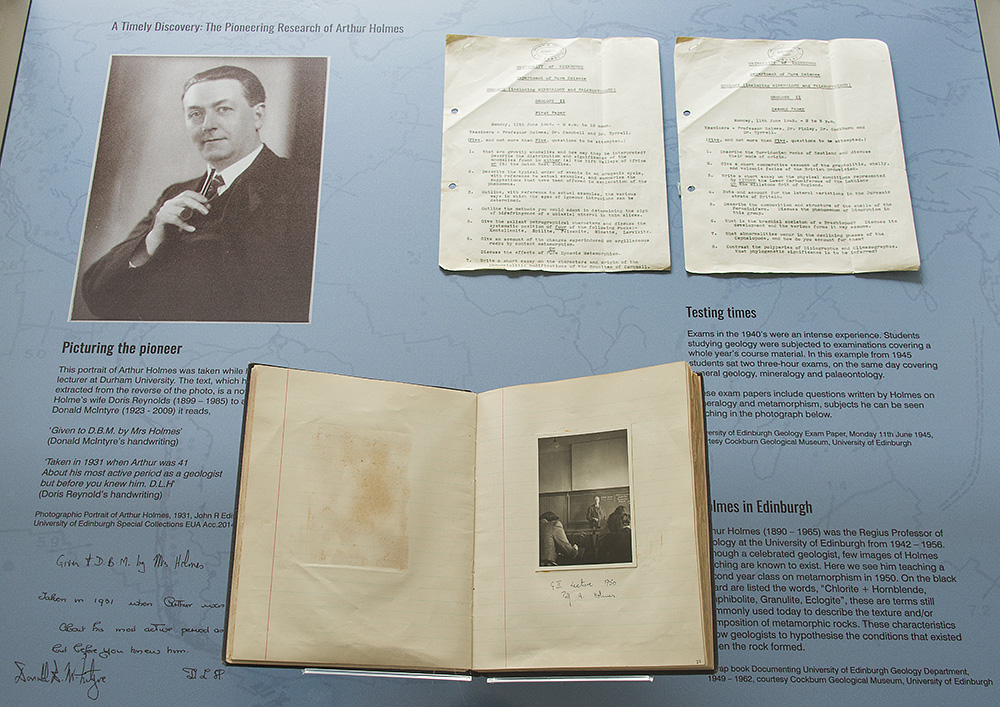
Exhibition display.
Sunday September 20th marks 50 years since the passing of eminent geologist Arthur Holmes. The CRC is currently marking this anniversary with a micro exhibition celebrating his life and achievements.
Although many people have never heard of Holmes, he was arguably the greatest British geologist of the twentieth century. Geologists today recognise Holmes for making two major contributions to our understanding of Earth Science; he was the first earth scientist to recognise that heat within the earth could create currents that could move the crust of the planet and consequently rearrange the continents, and he also widely applied the newly-developed method of “radiometric dating” to minerals in the first attempt to numerically estimate the age of the Earth.
It was as an undergraduate, at London’s Imperial College, that Arthur first became interested in the phenomenon of radioactivity, which was a new and exciting field in science at the time. Originally studying for a degree in physics, Arthur took a course in geology in his second year which settled his future as a geologist, much to the shock of his tutors! It was during his final year as a student, in 1910, that he pioneered the use of radiometric dating, a technique that can be used to date rocks and minerals. It was this method which allowed scientists to discover the age of specimens which are many millions of years old, and eventually to attempt to discover the age of the earth itself. Initially Holmes was reluctant to comment on the age of the earth, but by 1913 he had published results indicating that some of the oldest rocks identified were 1.6 billion years old. Years of method improvement and retesting followed and in 1946 several different groups of scientists came to agreement – the Earth is in the region of 4.5 billion years old!
Holmes was also able to use his understanding of radioactivity and apply it to other longstanding geological problems, including suggesting that currents caused by radioactive heat were the driving force behind the Theory of Plate Tectonics. The Theory of Continental Drift, which predated Plate Tectonics, was unfashionable among scientists because it lacked a driving force to create movement of the Earth’s crust. Holmes suggested, in 1930, that the circulation of heat within the Earth could push large areas of the crust together, forming mountains such as the Himalayas, or away from each other, producing oceans such as the Atlantic. It was not until 1960 that other scientists were able to find physical evidence for the movement of the continents when sea-floor mapping revealed submarine plateaus and trenches, where tectonic plates were being pulled apart or forced underneath each other.
Thankfully Arthur Holmes was well recognised as an eminent scientist in his life time and he was given the prestigious position of Regius Chair of Geology at the University of Edinburgh. In addition to securing a professorship, Holmes received many awards and medals from international geological surveys and societies including; the Murchison Medal (1940) and Wollaston Medal (1956) awarded by the Geological Society of London; the Penrose Medal (1956) awarded by the Geological Society of America; and the highly prestigious Vetlesen Prize (1964).
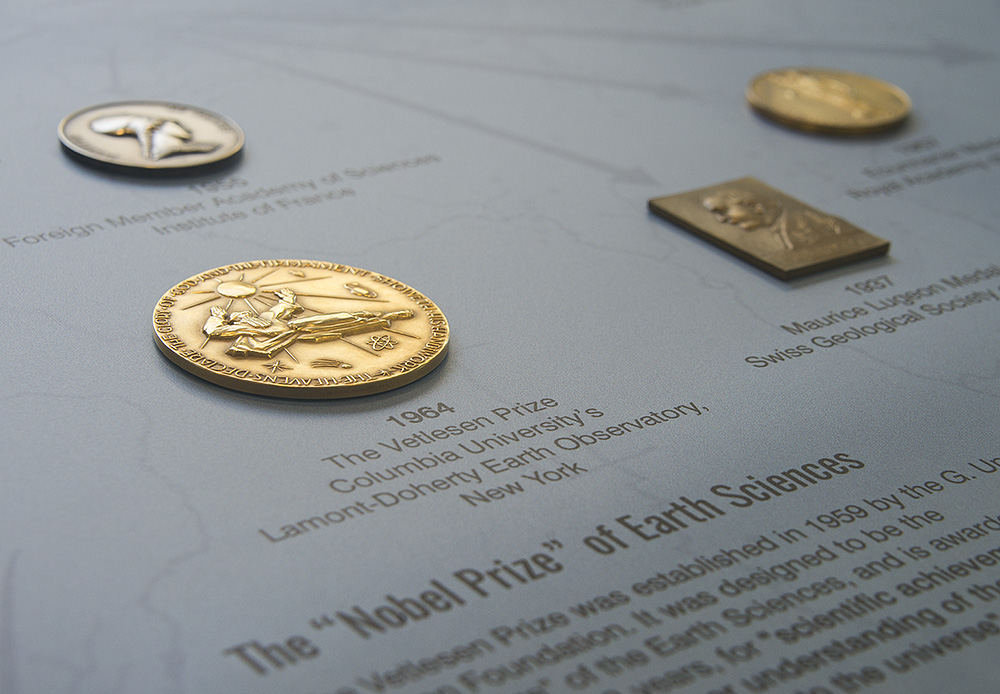
Exhibition display.
The Vetlesen Prize was established in 1959 by the G. Unger Vetlesen Foundation, and was designed to be the Nobel Prize of the Earth Sciences, awarded for “scientific achievement resulting in a clearer understanding of the Earth, its history, or its relations to the universe”. Characteristically both modest and forthright in his acceptance letter, Holmes expressed his surprise at being selected “for what must surely be the highest distinction in the world for geologists. The surprise was all the greater because I have to confess that I had not even known there was such an award”.
Holmes shared the award of $25,000 with his friend the Finnish geologist, Professor Pentti Eskola. Unfortunately Arthur was suffering poor health and was unable to travel to America to receive the prize. The Royal Society London held a luncheon party in his honour where another famous geologist Maurice Ewing presented him with the medal. Ewing, who was the first recipient of the Vetlesen Prize in 1960, praised Homes as a “pioneer in the field of isotope geology, in the use of radioactive elements for determination of the age of rocks and of the Earth… His papers, books and teaching have profoundly influenced the thinking of every modern student of the Earth Sciences”.
The micro exhibition devoted to Arthur Holmes is on display until the end of October at the Centre for Research Collections.
How to find the Centre for Research Collections
Additional images of the medal collections
More information on the Cockburn Museum and the University’s geological collections
Blog post by Gillian McCay, co-curator of the School of GeoSciences Cockburn Museum collection. Edited by Steven Skeldon, Centre for Research Collections. Credit for photographs to Susan Pettigrew, University of Edinburgh Digital Imaging Unit.
Latest enhancements to DiscoverEd
- There is now a “Request from closed stack” link on the Details tab for items which are held in the Main Library basement closed stacks. The link points to the Main Library closed stack request form.

- There is now a “Library Annexe Scan Request” link on the Details tab for items which are held at the Library Annexe. The link points to the ILLiad Logon page.

- A “Course Name or Code” option has been added to the Advanced Search. This allows search for bibliographic records which are attached to items in Reserve for particular courses.
- A “Course Name and Code” field has been added to the Details tab for items which are attached to items in Reserve. This shows the course details for each course to which the item is attached.

Dealing with Data 2015 – Presentations now available
On the 31st August, over one hundred researchers from across the breadth of the University of Edinburgh met together in the Informatics Forum to discuss the challenges of dealing with the research data. Following-on from the 2014 conference of the same title, the event consisted of twenty presentations on this subject.
The event was opened by a keynote given by Prof Jonathan Silvertown, talking about his experiences of using crowd-sourced data from citizen scientists, and how to build mechanisms to ensure the quality of the data.
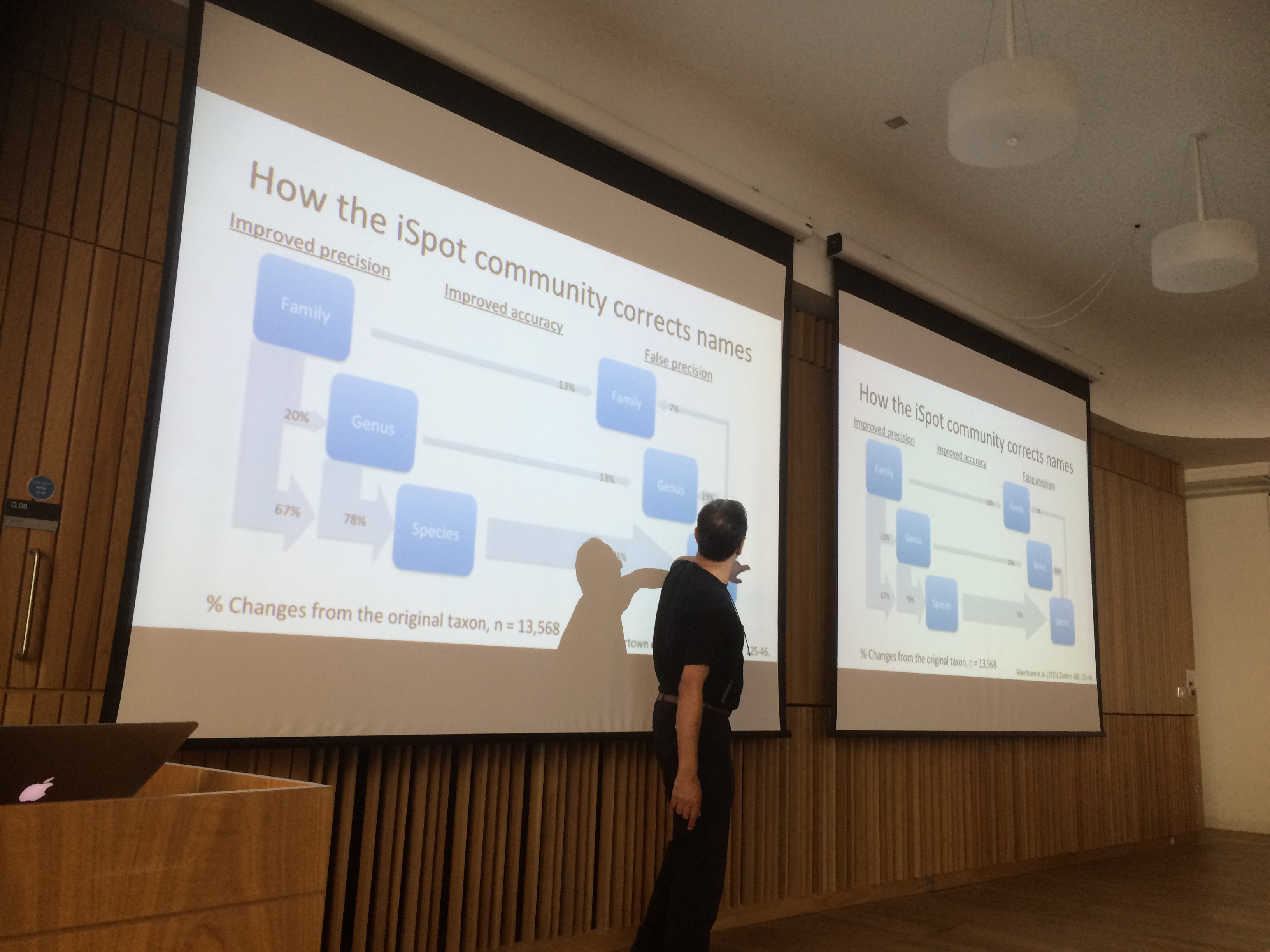
The rest of the day was filled with presentations addressing a wide range of data challenges, including topics such as data from the Large Hadron Collider, working with large data sets from China, and data derived from social media. At the end of the event, the topics were pulled together in a closing talk by Kevin Ashley, Director of the Digital Curation Centre.
If you attended Dealing with Data 2015, and have not already done so, could you please complete our brief survey at DwD2015 Feedback. It should only take 5 minutes and will help us to improve future events.
Programme with presentations
10:00 Welcome. Download PDF
10:05 Opening keynote: The Alchemy of Volunteered Data: turning base metal into gold, Prof Jonathan Silvertown, Institute of Evolutionary Biology. Download PDF
Session 1 – Informatics Forum
10:45 – 11:05: University data, open data and the Smart Data Hack, Ewan Klein, Informatics.
11:05 – 11:25: Edinburgh Data Science and Managing National Data Services at Edinburgh. Mark Parsons, EPCC. Download PDF
11:25 – 11:45: Channel shift – using data analysis to improve service delivery at the City of Edinburgh Council. Michal Wasilewski, Informatics. Download PDF
Session 2 – Informatics Forum
12:00 – 12:20: What are the challenges of collecting and analysing data in primary care? Lessons learned from a feasibility study in six general practices in Lothian, Scotland. Natalia Calanzani, Debbie Cavers, Gaby Vojt, David Weller, Christine Campbell, Population Health Sciences and Informatics. Download PDF
12:20 – 12:40: Facilitating the reuse of brain imaging and clinical data from completed studies across the life course: the Brain Images of Normal Subjects (BRAINS) Imagebank. Samuel Danso, Dominic E. Job, David Alexander Dickie, David Rodriguez, Andrew Robson, Cyril Pernet, Susan D. Shenkin, Joanna M. Wardlaw, Brain Sciences. Download PDF
12:40 – 13:00: Scottish Neighbourhood Statistics and R: Adding value to a public data resource with the ‘tidy data’ paradigm. Jon Minton, AQMeN. Download PDF
Session 3 – Appleton Tower
12:00 – 12:20: Data ecosystems and wicked problems; supporting “students as researchers” in complex data environments. Arno Verhoeven, ECA; James Stewart, SPS; Ewan Klein, Informatics. Download PDF
12:20 – 12:40: Networked learning analytics: Studying the association between learner generated discourse and learning. Srećko Joksimović, Dragan Gašević, Education. Download PDF
12:40 – 13:00: Automated Content Analysis of Discussion Transcripts. Vitomir Kovanovic, Dragan Gašević, Informatics and Education. Download PDF
Session 4 – Informatics Forum
13:45 – 14:05: Exploring Digital Divides in China, Ashley Lloyd, Business School; Mario A. Antonioletti, Terence M. Sloan, EPCC.
14:05 – 14:25: Gone Fishing: The Creation of the Comparative Agendas Project Master Codebook, Shaun Bevan, SSPS. Download PDF
14:25 – 14:45: Electronic lab notebooks and research data management at Edinburgh Experience to date and challenges and opportunities going forward. Rory Macneil, RSpace. Download PDF
Session 5 – Appleton Tower
13:45 – 14:05: Tweeting Jonson’s “Foot Voyage”: deeply mapped data, Anna Groundwater, HCA. Download PDF
14:05 – 14:25: University of Edinburgh Reid Concerts Database Project, Fiona Donaldson, Music. Download PDF
14:25 – 14:45: Encountering feminism on Twitter, Prof Viviene Cree, and Dr Steve Kirkwood, Social and Political Science, with Dr Daniel Winterstein, Sodash. Download PDF
Session 6 – Informatics Forum
15:00 – 15:20: The VELaSSCo framework: a software platform for end user analytics and visualization of large simulation datasets, G. Filippone, A. Janda, K.J. Hanley, S. Papanicolopulos and J.Y. Ooi, IIE, Engineering.
15:20 – 15:40: From raw data to new fundamental particles: The data management lifecycle at the Large Hadron Collider, Andrew Washbrook, Physics. Download PDF
15:40 – 16:00: Tipping the balance – introducing data management on a centre-wide level, Tomasz Zieliński, Eilidh Troup, Andrew Millar, Biology. Download PDF
16:00 Closing talk: Kevin Ashley, Director, Digital Curation Centre
Kerry Miller
RDM Service Coordinator
Collections
 Hill and Adamson Collection: an insight into Edinburgh’s past
My name is Phoebe Kirkland, I am an MSc East Asian Studies student, and for...
Cataloguing the private papers of Archibald Hunter Campbell: A Journey Through Correspondence
My name is Pauline Vincent, I am a student in my last year of a...
Hill and Adamson Collection: an insight into Edinburgh’s past
My name is Phoebe Kirkland, I am an MSc East Asian Studies student, and for...
Cataloguing the private papers of Archibald Hunter Campbell: A Journey Through Correspondence
My name is Pauline Vincent, I am a student in my last year of a...
Projects
Cataloguing the private papers of Archibald Hunter Campbell: A Journey Through Correspondence
My name is Pauline Vincent, I am a student in my last year of a...
Archival Provenance Research Project: Lishan’s Experience
Presentation My name is Lishan Zou, I am a fourth year History and Politics student....