Home University of Edinburgh Library Essentials
May 21, 2026

Contributors to the Old Statistical Account: Reverend Doctor James Octavius Playfair (1738-1819)
This is the second guest blog post from the independent researcher John Moore, who is writing to commemorate the 200th anniversary of the death of a number of contributors to the Old Statistical Account. This time, he is focusing on the Reverend Doctor James Octavius Playfair.
________________________________
On 26th May 1819, the Reverend Doctor James Octavius Playfair, minister of the Perthshire charge of Meigle (1777-1800), died and we commemorate the bi-centenary of his death this month. Playfair was the author of the entries for both Meigle, a parish lying in the centre of Strathmore (OSA, Vol. I, 1791, p. 503-518) and the adjacent Angus parish of Eassie and Nevay (OSA, Vol. XVI, 1795, p. 212-221) in the Statistical Account.
Born the son of a farmer at West Bendochy in Perthshire, he studied at St. Andrew’s University before becoming minister of Newtyle in 1770, having been presented by James Stuart Mackenzie, Lord Privy Seal. In 1773 he married Margaret Lyon, daughter of the Reverend George Lyon of Longforgan. Seven years later, he transferred to the neighbouring parish of Meigle. During his time there, he wrote A System of Chronology in 1782, his alma mater awarded him an honorary doctorate in divinity (DD) in 1779 and in 1787 he was elected a Fellow of the Royal Society of Edinburgh.
The Meigle description appears in the first volume of the Old Statistical Account (1791) and much of the text reflects Playfair’s interests. He notes the heights of several local hills with great accuracy as ascertained by barometrical measurement and describes carefully the course of the river Isla. However, his discussion of local antiquaries, Playfair is quite scornful of early writings, stating that ‘the tales and stories related by fabulous writers are, for the most part, too wild and extravagant to merit belief’ (OSA, Vol. I, 1791, p. 505). In describing a monument in Meigle churchyard said to be dedicated to Vanora (or Guinevar), he comments that ‘the antiquary may amuse himself with the fragments that remain; but he can scarcely form one plausible conjecture with respect to their original meaning and design’ (OSA, Vol. I, 1791, p. 507).

The memorial to Rev James Playfair, St Andrews Cathedral churchyard
By 1791 the parish had a population of 1148 but the description of Meigle as an ancient, inconsiderable and meanly built town suggests that Playfair had little love for his charge, particularly as he scarcely mentions the conditions of its people. There can be no doubt, however, about where Playfair’s loyalties lay. He praises the period since 1745 as a fortunate epoch for Scotland, contrasting the formal rude and uncivilised state of the country with the benefits enjoyed following the introduction of many agricultural improvements, including his own use of a better quality of oats. The production of linen was the parish’s principal manufacture and Playfair details how progress would result from the construction of a canal between Perth and Forfar.
The account of Eassie and Nevay did not appear until four years later. Local rivers are again detailed and Playfair makes mention of James Mackenzie as its chief proprietor. Most of the text discusses various aspects of agricultural change – farms, inclosure, manures and livestock. With a population of 630, the parish inhabitants are described as ‘sober and industrious, strangers alike to intemperance and dissipation of every kind’.
At the end of 1799, he was appointed to be principal of the United Colleges of St. Leonard’s and St. Salvator’s in St. Andrew’s and moved to become minister of the congregation of St. Leonard’s in that city. It was during his time there that Playfair came into his own as a writer on geography. He published a sizeable System of Geography, Ancient and Modern between 1810 and 1814, followed by a four-volume General Atlas, Ancient and Modern (1814) and a Geographical and Statistical Description of Scotland in 1819. This final work is almost entirely based on the original Statistical Account of Scotland. In addition, Playfair was the official historiographer of the then Prince of Wales. He admired the work of Robert Burns and was one of the defenders of the authenticity of Ossian’s poems.
________________________
We would like to thank John for this guest post.
Crowdsourcing Conservation – Thomas Nelson Collection
Following on from the popular “Crowdsourcing Conservation” sessions held in February 2017 and 2018, the Centre for Research Collections held seven more crowdsourcing events from October 2018 to March 2019. This time, we focussed on the Thomas Nelson collection. Over seven days, 67 volunteers helped to rehouse 197 boxes of archival material. The collections are now stored in acid-free folders and boxes, and are much easier to handle and access.

Thomas Nelson Collection, before rehousing

Thomas Nelson Collection, after rehousing
New books in the Library for Social and Political Science
Thanks to recommendations from members of staff and requests via RAB from students the Library is continually adding new books to its collections both online and in print. Here are just a (very) small number of the books that have been added to the Library’s collections in semester two, 2018/19 for the School of Social and Political Science and these demonstrate the wide range of subjects being taught, studied and researched within School.
–> Find these and more via DiscoverEd.
 Heart: a history by Sandeep Jauhar (shelfmark: QP111.4 Jau.)
Heineken in Africa: a multinational unleashed by Olivier van Beemen ; translated by Bram Posthumus (HD9397.N44 Bee.)
Tangled diagnoses: prenatal testing, women, and risk by Ilana Löwy (e-book).
Pervasive punishment: making sense of mass supervision by Fergus McNeill (shelfmark: HV7419 Macn. Also available as e-book).
Can we all be feminists?: seventeen writers on intersectionality, identity, and finding the right way forward for feminism edited by June Eric-Udorie (shelfmark: HQ1221 Can.)
Energy and geopolitics by Per Högselius (e-book).
Reclaiming Afrikan: queer perspectives on sexual and gender identities curated by Zethu Matebeni (shelfmark: HQ75.16.A35 Rec.) Read More
On trial: Foreign Broadcast Information Service (FBIS) Daily Reports, 1941-1996
Thanks to a request from staff in HCA the Library currently has trial access to all collections from Foreign Broadcast Information Service (FBIS) Daily Reports, 1941-1996 from Readex. A unique 20th-century archive for students and scholars of international studies, political science and world history.

You can access Foreign Broadcast Information Service (FBIS) Daily Reports from the E-resources trials page.
Access is available on and off-campus.
Trial access ends 21st June 2019. Read More
New! E-journals from Edinburgh University Press

With our 2019 renewal to Edinburgh University Press E-Journals package, we gain access to the following titles.

Ancient Philosophy Today: DIALOGOI provides a forum for the mutual engagement between ancient and contemporary philosophy. The journal connects interpretative work in ancient philosophy to current discussions in metaphysics, epistemology and ethics, and assesses the continuing relevance of ancient theories to current philosophical interests and debates.
 Gothic Studies – The official journal of the International Gothic Association considers the field of Gothic studies from the eighteenth century to the present day.

Scottish Church History is the journal of the Scottish Church History Society. Founded in 1922 to promote the study of the history of Christianity in Scotland, the journal covers all periods and branches of Scottish churches from the early to the modern.
Fifty Years of ‘An Orkney Tapestry’
This year marks the fiftieth anniversary of two of George Mackay Brown’s landmark publications, An Orkney Tapestry and A Time to Keep. While Brown was already well established as a poet, these works made his reputation as a master of prose.
Unusually, An Orkney Tapestry was a commissioned publication. In late 1967, literary agent Giles Gordon approached Brown on behalf of Victor Gollancz publishers to inquire whether he might be interested in writing a general guide to his native Orkney. Although it was not the kind of work that appealed to Brown, Gollancz were offering a generous advance, and it presented an opportunity of visiting parts of the Orkney archipelago that he had not previously seen. The manuscript that Brown eventually submitted, however, was very far from a conventional guidebook. Instead, in An Orkney Tapestry, Brown wove prose, poetry, and drama together to commemorate the stories and traditions that had forged the character of the islands and their inhabitants.
The book consists of six sections: a polemical sketch of contemporary Orcadian life; a history of the ‘ghost village’ of Rackwick; a retelling of crucial episodes from the Orkneyinga Saga; an essayistic account of Orkney folklore; a short story-like evocation of a ballad singer’s performance at the Renaissance court of Earl Patrick Stuart; and a play ‘The Watcher’ concerning the apparition of an angel in an everyday Orkney setting.
Brown’s intention was to stress the importance of stories in creating a community and holding it together. A community cuts itself off from these formative stories at its own peril (p. 23), and Brown feared that the life of contemporary Orkney was increasingly meaningless (p. 19). An Orkney Tapestry is as much a jeremiad as a celebration. Time and again, Brown rails against progress–or rather a dogmatic, utilitarian ‘religion’ of Progress–as a ‘cancer’ that ‘drains the life’ out of ‘an elemental community’ (p. 53). He laments the loss of the old Orcadian speech and the uniformity created by compulsory education and the omnipresent new media of radio and television. With An Orkney Tapestry, he hopes to reawaken Orcadians to their history and traditions, and to inspire them to return to their life-giving roots.
Edinburgh University Library hold a much-corrected MS draft of An Orkney Tapestry (Gen 1868/5) together with a fair copy with instructions for a typist (Gen 1868/4).
We also hold George Mackay Brown’s letters to fellow poet Charles Senior (E2000.11), in which he traces the genesis of An Orkney Tapestry. In a letter of 28 December 1967, Brown tells Senior that he has been commissioned to write ‘a book about Orkney’. It is not ‘the kind of thing I like doing’ but should ‘bring in a couple of hundred quid or so’. On 8 January 1968, he reports that his usual publisher Chatto & Windus have reluctantly granted him permission to write for Gollancz, but Brown is unsure ‘whether I’ll be good at that sort of thing or no’. By 13 January, his doubts have grown: ‘I’m not good at patient research and reappraisal and I have no idea where the drift of history is taking the Orcadians’. He hopes to hit upon some ‘valid & original way’ to tackle the commission. On 20 January, he declares that he is determined, at least, not to write ‘some kind of a glorified guide book’. By Candlemas Day (2 February), the book is clearly beginning to take shape. It will be ‘highly impressionistic’ and entirely free of statistics: ‘I shun figures and tables as I would the devil’. He is planning a chapter on Rackwick, and a section contrasting a medieval or renaissance bard with the contemporary Orkney poet Robert Rendall. By 9 February, he reveals that he has been working on the ‘Orkney book’ all week, and has finished the first draft of the chapter on Rackwick (‘interlarded with poems’). This has left him ‘with a flush of achievement’, though he suspects that closer scrutiny may discover ‘a hundred flaws’. On 16 February, he laments the difficult of translating (‘or, rather, freely adapting’) Norse heroic verses for the third chapter of An Orkney Tapestry. These ‘stretched all my faculties to the utmost’ but ‘it’s good for writers to tackle something hard now and again’. Unfortunately, the correspondence with Senior is suspended at this point, as Senior was now, in fact, living close by in Orkney. These few letters, however, give a vivid impression of how An Orkney Tapestry swiftly evolved from impersonal commission to personal vision.
Within a fortnight of publication, An Orkney Tapestry had sold over 3,000 copies. One of its first readers, composer Peter Maxwell-Davies was so transfixed by Brown’s prose, that he was inspired to move to Orkney and make it his base for the rest of his life. Edinburgh University holds manuscript librettos for three works that Brown wrote for Maxwell-Davies: Apples and Carrots (MS 2846/4/2), Lullaby for Lucy (MS 2843/8/1), and Solstice of Light (Gen. 2134/2/4).
Another enthusiastic reader was veteran poet Helen B. Cruickshank. We hold Cruickshank’s well-thumbed copy of An Orkney Tapestry (JA3388), inscribed on the title-page by Brown and by artist Sylvia Wishart (whose illustrations for An Orkney Tapestry first brought her to prominence). There is also a brief letter from Brown on the half-title page, congratulating Cruickshank on the receipt of an honorary M.A. from Edinburgh University. A further letter from Brown in our Helen Cruickshank Papers (Coll-81) grants Cruickshank permission to quote a line from An Orkney Tapestry in her memoir Octobiography (Montrose: Standard, 1976): ‘Decay of language is always the symptom of a more serious sickness’. What Brown says of the decay of Orcadian speech (An Orkney Tapestry, 30), Cruickshank applies to the decline of her native Scots (Octobiography, p. 77).
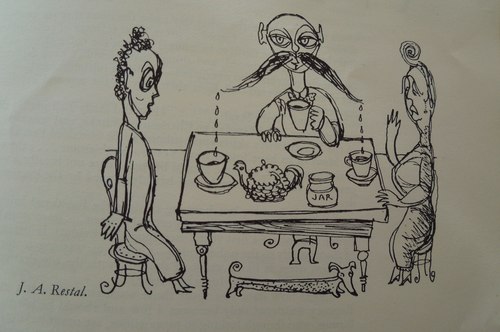

The commercial success of An Orkney Tapestry was largely matched by critical approval. Seamus Heaney praised it as ‘a spectrum of lore, legend and literature, a highly coloured reaction as Orkney breaks open in the prisms of a poet’s mind and memory’ (Listener, 21 August 1969). For J. K. Annand, it was ‘one of those rare books which capture and convey the essential character of a place’ (Akros, January 1970). Not everyone, however, was entirely convinced. Robin Fulton, in the New Edinburgh Review (November 1969), felt that the problems raised by Brown ‘deserve more serious treatment than can be afforded by polemics and jeremiads’ and wondered ‘how closely in touch’ Brown was ‘with the way of life he professes to reject’. Brown rails against progress as a ‘new religion’ but ‘in fact who does in 1969 naively accept such a belief?’ (p. 6). Similarly, Janet Adam Smith felt that ‘Mr Brown is a far better poet than preacher and some of his diatribes on the present run too glibly’ (Times, 12 July 1969).
No such doubts were expressed about Brown’s second major publication of 1969, A Time to Keep, his second short-story collection after A Calendar of Love (1967). Alexander Scott wrote that Brown ‘gives more fundamental insights into our common humanity in even the shortest of his stories than will be found in a hundred full-length fictions of the conventional kind’ (Lines Review, 28 March 1969). Janice Elliot described him as a ‘precise, poetic, and dazzling writer’ (Guardian, 7 February 1969). Paul Bailey wrote the stories ‘often brought me close to tears’ and that there ‘are few writers alive today with the courage to be so simple and direct, or with the talent—the sheer, unforced talent—to lighten up the most humdrum detail’ (Observer, 2 March 1969). Even Robin Fulton, despite some reservations about the volume as a whole, declared that its strongest tales were ‘among the finest stories written by any Scottish writer’.
We do not hold any manuscripts or working papers relating to A Time to Keep. We do, however, have Norman MacCaig’s personal copy of the volume, signed by MacCaig on the half-title page.
For further information on our Papers of George Mackay Brown, see:
Sources (other than previously cited)
- Timothy Baker, George Mackay Brown and the Philosophy of Community (Edinburgh: Edinburgh University Press, 2009)
- Maggie Fergusson, George Mackay Brown: The Life (London: John Murray, 2007)
- Berthold Schoene-Harwood, The Making of Orcadia: Narrative Identity in the Prose Work of George Mackay Brown (Frankfurt am Main: Peter Lang, 1995)
- Hilda D. Spear, George Mackay Brown: A Survey of his Work and a Full Bibliography (Lewiston: E. Mellen Press, 2000)
Salvesen Archive – 50 years at Edinburgh University Library – 1969-2019
50th ANNIVERSARY OF THE ARRIVAL OF THE CHRISTIAN SALVESEN & CO. ARCHIVE AT CRC – MARITIME TRADING AND WHALING MATERIAL
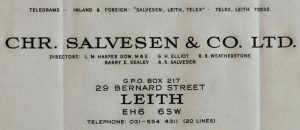
50 years ago in May 1969 former colleagues of the Centre for Research Collections had been busy collecting a large maritime trading and whaling archive from the offices of Christian Salvesen & Co. in Leith. The collection of company records was deposited on ‘permanent loan’, and would be joined by a second tranche in 1990, and a third in 2008. A gift of the entire archive to Edinburgh University Library was negotiated and signed in May 2012. That year, a small additional collection of material relating to the firm and its activities was received from Sir Gerald Elliot (1923-2018), a great-grandson of Christian Salvesen (1827-1911), the founder of the company.

Christian Salvesen and his wife Amelie, with their family, and photographed on holiday in Norway, in about 1860. The children may be (from left to right) Johan Thomas (b. 1854?), Edward Theodore (b.1857), and Frederick (b. 1855).
From Mandal, Norway, Salve Christian Fredrik Salvesen, son of a Norwegian merchant ship owner, first arrived in Scotland in the 1840s working at the Grangemouth shipbroking business owned by his brother, Johann Theodor Salvesen (1820-1865). Later on, after gaining experience on the continent, at Szczecin (then Stettin), he returned to Scotland and joined his brother again at Salvesen & Turnbull, now in Leith. On Johann’s retirement, the name changed to Turnbull, Salvesen & Co. The firm imported grain and timber, exported coal and iron, and also handled cargoes of salt and Norwegian herring. The carrying of migrants and gold prospectors to Australia was also an important trade.

Letter addressed to Christian Salvesen at the offices of Messrs Turnbull and Salvesen & Co., Leith, May 1861.
Following his brother’s early death in 1865, and after arguments with Turnbull, Salvesen went into business on his own, and his new firm, Chr. Salvesen & Co. began life on Bernard Street, Leith, in 1872. This change coincided with the advent of the steamship, and the expansion of maritime commerce with German and Baltic ports. In the 1880s, Salvesen was joined in the business by three of his sons.

For the Salvesen whaling enterprise in the South Atlantic, a subsidiary company was formed – the South Georgia Company of Leith (1909-1966), based at Leith Harbour, Stromness Bay, South Georgia.
By 1911, the year of Salvesen’s death, the firm’s vessels were trading with ports on the Baltic, in Norway and Sweden, and were servicing whaling stations in the Arctic, Iceland and the Faroe Islands. Cargo lines were also opened up between Leith, Malta, and Alexandria, and then into the Black Sea.

The Salvesen Archive contains ledgers and cash and account books in various forms, both from the firm Christian Salvesen & Co., and the important subsidiary, the South Georgia Co.
During that first decade of the 20th century, the shipping industry was in a depressed state and, globally, shipping companies made heavy losses. While the Salvesen fleet fared no better, the company’s whaling interests – now expanding as far as the Falkland Islands and South Georgia – helped it to show occasional profit. The Salvesen whaling enterprise in the waters of the South Atlantic was operated by a subsidiary company, the South Georgia Company of Leith (1909-1966), based at Leith Harbour, Stromness Bay, South Georgia.

Whale on the ‘slip’ prior to be being ‘worked’, South Georgia. From a large photograph collection in the Salvesen Archive.
Into the 20th century, whaling began to dominate Salvesen business and the firm became an industry leader just at the time when food oils and other products from the Antarctic were considered a boundless resource.

Conservation of species… far from the concern of our own time… Report on whale stock and conservation in The Times, 9 September 1918, from a correspondent in Oslo. However, the concern about conservation at that time was not so much about the various whale species themselves, but rather more about continuing access to whale oils. Conservation of whale oils, rather than conservation of whales. From a collection of newspaper cuttings albums in the Salvesen Archive.
A third Salvesen generation entered the business in the troubled economic period of the inter-war years. The firm managed to ride out these troubled times, and whaling was expanded and modernised. As stocks began to diminish however, the firm of Salvesen – whalers for nearly 70 years – was prominent in urging conservation. In 1963, they gave up whaling.

Distinctive funnel colours of the Chr. Salvesen & Co. shipping line shaded-in on the plans for the whale catchers ‘Southern Lily’ and ‘Southern Laurel’. From a collection of plans in the Salvesen Archive.
By the 1960s and 1970s, a fourth generation was still playing an important role in the firm, and over that period the company had begun to diversify its interests: home construction; canning, and cold-storage facilities; food processing; frozen and chilled food logistics; generator rental; off-shore oil support; and, road transport logistics.One of Salvesen’s acquisitions was the Buttercup Dairy cold storage business, taken over in 1964… though the company was unable to save the well-known and popular Buttercup Dairy stores.

Day Books of the Aberdeen-based Glen Line, a shipping firm owned by John Cook and Son which had been an acquired by Christian Salvesen & Co. in 1928.
In 1985, Salvesen went public on the London Stock Exchange – Christian Salvesen PLC. In 1990 the firm left shipping, and in 1997 it moved to Northampton, England. In October 2007, the Christian Salvesen board recommended a takeover of the firm by Norbert Dentressangle, the large French-based European logistics firm (the unmissable red trucks of Groupe Norbert Dentressangle are almost on a par with Eddie Stobart among the lorry-spotting community!).
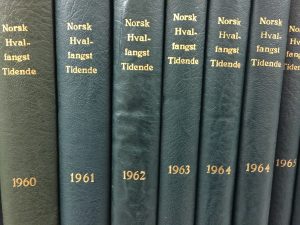
The Salvesen Archive includes many years of the ‘Norwegian Whaling Gazette’, or’ Norsk Hvalfangst Tidende’, which is rich in articles concerning the whaling industry (in Norwegian and English), and rich in contemporary whaling industry advertisements.
It was with Christian Salvesen Investments Ltd., a Groupe Norbert Dentressangle subsidiary, that the Centre for Research Collections would finally agree acquisition of the Salvesen Archive in 2012, so ending much involved contact and conversation between CRC staff and the firm in Northampton over access to the deposited collection.
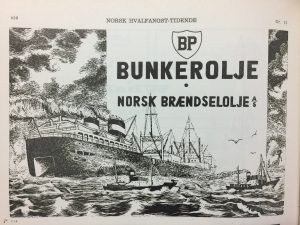
Advertisement for BP bunker fuel placed in the ‘Norwegian Whaling Gazette’.
Taking up just short of 70 metres of storage space, the archive is composed of a wide mix of material representing the firm’s early shipping interests, its whaling interests, and the firm’s later diversification. The archive includes: office ledgers; cash, accounts and invoice books; letter and day books; order and stock books; whale catch records; log books; correspondence; newspaper cuttings; photographs; and, copies of the ‘Norwegian Whaling Gazette’ and the company magazine of latter years ‘Salvesen News’.
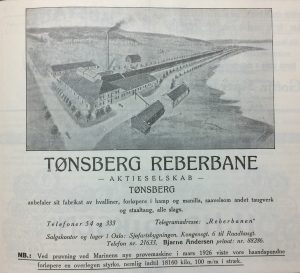
Advertisement placed in the ‘Norwegian Whaling Gazette’ by the Tønsberg ‘ropewalk’ (or reperbane), a covered pathway, where long strands of material are laid before being twisted into rope.
When the first tranche of the archive arrived at the Library in 1969, Christian Salvesen & Co. had been preparing to make a move from their offices at 29-33 Bernard Street, Leith, to larger and recently constructed premises at Citadel House, East Fettes Avenue, in Edinburgh. Doubtless the impending move had spurred the firm into disposing of unneeded company records, and the National Register of Archives for Scotland (NRAS) had surveyed and drawn up a list of material in July 1968.
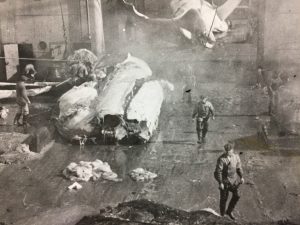
Whales being ‘worked’ on a whale factory ship. From a photograph in the Salvesen Archive photograph collection.
The NRAS list shows that the material now in the care of CRC had been located at several places: Inveralmond House, Cramond, the home of Captain Harold Keith Salvesen (1897-1970), grandson of Christian Salvesen; Attic No.1 at the firm’s offices, 29 Bernard Street, Leith; Metal cupboards at the top of the stairs at the same location; Captain H. K. Salvesen’s room in the offices at the time of the survey; and, the Operations Store Room, at the Bernard Street offices (it is worthwhile noting here too that some material in the second tranche, 1990, had been drawn from not only the headquarters in Edinburgh, but also from the abandoned whaling stations on South Georgia).

The interior of the cinema at Leith Harbour. Many of the films (in Norwegian and English) were brought out to South Georgia from Norway and the UK.
In 1968, the Library had moved into its new premises on George Square in closer proximity to the academic community and departmental offices, and from an exchange of correspondence between the Company and the Library, and between the Library and Professor Samuel Berrick Saul (1924-2016), Economic History, it can be speculated that Professor Saul may have been a prime mover in having the Salvesen Archive brought to the Library. As an economic historian, he may have been helping us to build up a business archive. Professor Saul had facilitated the commissioning of Mr Wray Vamplew, a postgraduate Economic History student, to write a history of the Company.

Painting of a whale factory ship, the ‘Southern Venturer’, by George McVey, which illustrates the cover of Wray Vamplew’s book, ‘Salvesen of Leith’.
The book, entitled Salvesen of Leith, was eventually published by the Scottish Academic Press, Edinburgh and London, 1975.
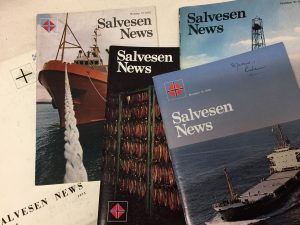
Copies of the Salvesen in-house magazine. From a run of the magazine in the Salvesen Archive.
Graeme D. Eddie, Honorary Fellow, CRC… Engaging with the Salvesen Archive of maritime trading and whaling
If you have enjoyed reading this post, check out previous ones about the Salvesen Archive…:
Cinema at the whaling stations, South Georgia August 2016
Maritime difficulties during the First World War – Christian Salvesen & Co. October 2015
Talk on the Salvesen Archive to members of the South Georgia Association November 2015
‘Empire Kinsley’ – 70th anniversary of sinking on 23 March 1945 March 2015
Pipe bombs, hurt sternframes, peas, penguins, stoways and cookery books: the Salevesen Archive July 2014
Whale hunting: New documentary for broadcast on BBC Four June 2014
Journey to the Centre of the UCF

Image source: https://www.themarysue.com/tardis-library-doctor-who/
As a brand new library assistant at the University Collections Facility, the biggest challenge I have faced so far has been learning to navigate this somewhat labyrinthine building. Those bewildering first few days whilst I tried to get my bearings I dwelled upon my favourite literary representations of labyrinths – those appearing in the works of Borges or Mark Z. Danielewski. The most persistent, however, was the Doctor Who episode “Journey to the Centre of the TARDIS” – a show which is a favourite topic of our morning breaks. In this episode, Clara becomes trapped in a maze of ever-changing rooms as she tries to escape the crashing machine and ends up stumbling from a steel corridor into the Doctor’s library. In this blog post, I likewise hope to take you with me on a journey to the centre of the UCF, as I work to become an intrepid navigator of its shelves.
Sitting at my computer desk, an online request arrives. It’s for a medical journal, “Neurology”. I double check its shelf-mark, print off the request slip and off we go. Out of the office and down a set of stairs, past the hard-working cataloguers and into the lower portion of Unit 2. This is not my final destination but is worth a linger. I stride down the central aisle, past the Vet library and books from the Edinburgh College of Art, turning right at a large blue painting and through a door into Unit 1. This is where most people’s stereotypical vision of a library store will be satisfyingly fulfilled. Vast rolling stacks tower above me and I am reminded of a fight scene in the recent Captain Marvel movie, where Nick Fury took on a miscellaneous alien in amongst an archive (I remained tense through the whole thing – mind the collections!) Thankfully, the UCF is more peaceful than that, and I walk towards the stacks at the top of the room, scanning the periodicals for the correct shelf-mark. I spy my target, a run of journals neatly bound in post-box red with “Neurology” stamped in black on the spine. But, alas, they are on the highest shelf and several metres out of arms reach. Never-mind, I manoeuvre a large blue ladder into place and climb its steps to retrieve my item. Then it’s back down the ladder, along the row, into Unit 2, through the corridor, up the stairs and into the office. This book will now be packaged up and sent to its destination across the city. The rest of its journey from here to reader I cannot follow, but I’m glad to have helped it along its way and, in doing so, added another pathway to the detailed map of the UCF building in my head.
Daisy Stafford, UCF Library Assistant
On trial: State Papers: Eighteenth Century (Part II)
Thanks to a request from a student in HCA and following a previous trial the Library now has trial access to Part II of State Papers Online: Eighteenth Century, 1714-1782 from Gale. Part II covers State Papers Foreign: Low Countries and Germany.

You can access State Papers: Eighteenth Century (Part II) via the E-resources trials page. Access is direct on-campus but if working off-campus you must use VPN.
Trial access ends 30th May 2019. Read More
New! More Springer Protocols added to DiscoverEd

Used primarily in the life sciences, protocols provide individual sets of instructions to allow scientists to recreate experiments in their own laboratories. These documents provide written procedural methods in the design and implementation of experiments that describe the safety, bias, procedures, equipment, statistical methods, reporting, and troubleshooting standards to be used in order to successfully conduct the experiment.
We have now purchased copyright year 2019. These will be added to DiscoverEd for the remainder of the year. A title list is available from https://experiments.springernature.com/download-source-titles-list.
Further info
Springer Protocols can also be accessed at http://www.ezproxy.is.ed.ac.uk/login?url=https://experiments.springernature.com which will allow you to cross-search our other subscriptions from SpringerNature (Nature Protocols, Nature Methods) as well as the open access repository Protocol Exchange.
Collections
 Hill and Adamson Collection: an insight into Edinburgh’s past
My name is Phoebe Kirkland, I am an MSc East Asian Studies student, and for...
Cataloguing the private papers of Archibald Hunter Campbell: A Journey Through Correspondence
My name is Pauline Vincent, I am a student in my last year of a...
Hill and Adamson Collection: an insight into Edinburgh’s past
My name is Phoebe Kirkland, I am an MSc East Asian Studies student, and for...
Cataloguing the private papers of Archibald Hunter Campbell: A Journey Through Correspondence
My name is Pauline Vincent, I am a student in my last year of a...

Projects
Cataloguing the private papers of Archibald Hunter Campbell: A Journey Through Correspondence
My name is Pauline Vincent, I am a student in my last year of a...
Archival Provenance Research Project: Lishan’s Experience
Presentation My name is Lishan Zou, I am a fourth year History and Politics student....