Home University of Edinburgh Library Essentials
May 21, 2026
Edinburgh Research Explorer Statistics: May 2019

‘This Single Song of Two’: Centenary of the Marriage of Edwin and Willa Muir
7 June 2019 marks the centenary of the marriage of Edwin and Willa Muir, one of Scottish literature’s great creative partnerships. Acclaimed in their own right as poet and novelist respectively, they worked together as a translating team to bring the novels and stories of Franz Kafka to an English-speaking audience.
Edinburgh University holds a number of remarkable documents, bearing witness to their long and exceptionally close union.
Read More
Normandy landings: through our digital primary sources
On this day, 6 June, 75 years ago the Normandy landings took place. This was part of a major combined naval, air and land assault on German-occupied France by Allied forces, codenamed Operation ‘Overlord’. The D-Day landings saw around 150,000 Allied troops land on French soil but it was just the start of a much longer operation to liberate France. In this week’s blog post I have pulled together just a small selection of our digital library resources that will help you explore the Normandy landings, the events leading up to it and the aftermath. And you can use many of these to find out more about the many other events happening around this time that contributed to the end of the Second World War.
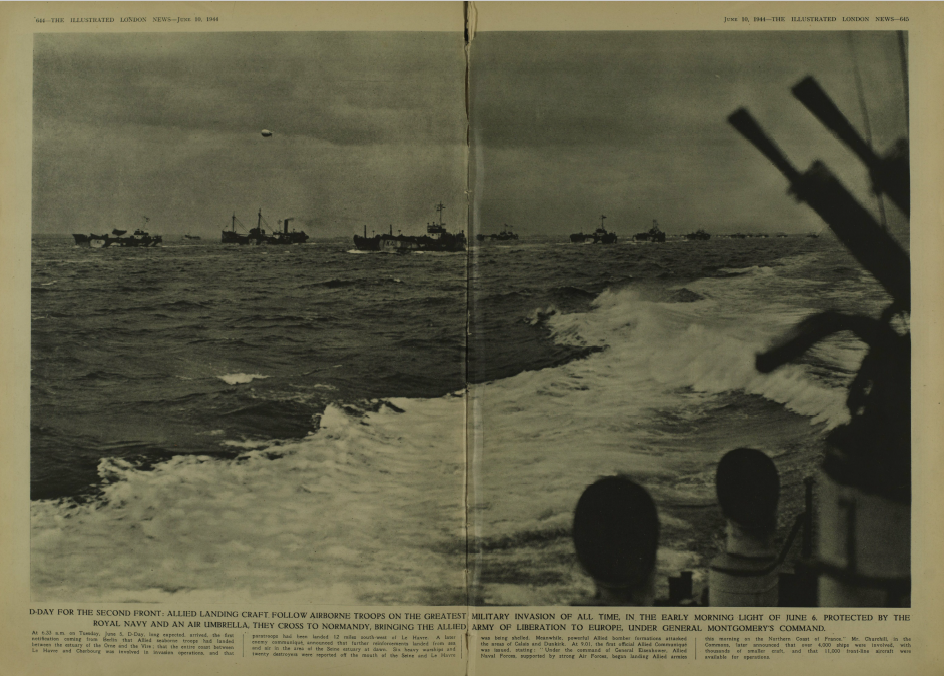
D-Day For the Second Front, ‘Illustrated London News’, Saturday 10 June 1944, pp. 644-645. From Illustrated London News Archive.
What did the papers say?
Operation Overlord was top secret, so it wasn’t until the 6th June that news of the invasion began to filter through. Reports of the Normandy landings does appear in some late editions of newspapers from that day but it is mostly covered in issues published the next day, 7th June, or on next subsequent publication date.
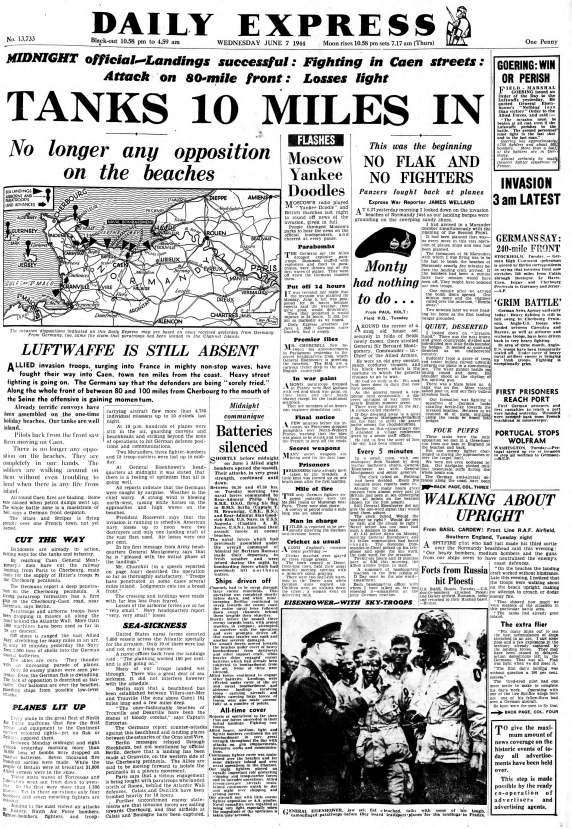
Front page of the ‘Daily Express’, Wednesday 7 June 1944. From UK Press Online.
The Library subscribes to a large number of digitised newspaper archives that will allow you to see what events were being reported on at the time and how they were being reported. Read full text articles, compare how different newspapers were covering the same issues and stories and track coverage of Operation Overlord from the Normandy landings onwards. Read More
On trial: The Sixties: Primary Documents and Personal Narratives 1960 – 1974
*The Library has access to The Sixties: Primary Documents and Personal Narratives 1960-1974 until 31st July 2024 as part of ProQuest Access 350.*
Thanks to a request from a HCA student I’m happy to let you know the Library currently has trial access to The Sixties: Primary Documents and Personal Narratives 1960 – 1974 from Alexander Street Press. The Sixties documents the key events, trends, and movements in 1960s America through digitised archive and primary source material.

You can access The Sixties from the E-resources trials page.
Access is available on and off-campus.
Trial access ends 30th June 2019. Read More
Times Higher Education update

Following a successful first year of a subscription to Times Higher Education Online, we have now renewed it for a further year. Existing subscribers should have received an alert from the publisher that the THE app will be discontinued following the publication of the 6th June issue. For readers who still want to page through the digital version of the weekly THE magazine, the digital editions section of the THE web site allows you to do this, and to download the full weekly magazine for offline reading.
New users, please see our webpage for set up instructions.
An intern’s first impressions
Archive cataloguing project intern, Sorina Mihai, relays her first impressions from her busy first two weeks with our ‘Evergreen: Patrick Geddes and the Environment and Equilibrium’ project. With a jam-packed schedule, and jumping right in at the deep-end of core archive work, Sorina is already making a significant and valuable contribution to our project. Read more about her initial experience and learning in this thoughtful and considered blog post.
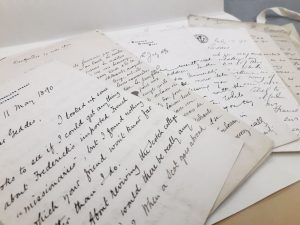
Selection of correspondence from the Patrick Geddes papers (Ref:T-GED12/3)
I was very excited to start my archives cataloguing internship with the ‘Evergreen: Patrick Geddes and the Environment in Equilibrium’ project two weeks ago. I am delighted to be part of a collaborative project between the universities of Edinburgh and Strathclyde which is instrumental in reuniting, preserving and cataloguing the two collections of papers of Scottish polymath Patrick Geddes. My eight-week internship is based predominantly at the Archives and Special Collections at the University of Strathclyde. I will be creating new catalogue descriptions for a discreet series of records within the collection, which pertains to the correspondence related to Patrick Geddes’ educational projects. My contribution will help to enhance the discoverability and usability of the Geddes collection.
I am looking forward to familiarising myself further with professional archive standards and becoming more confident in using them in my daily work. My previous experience as a volunteer with the ‘Evergreen’ project helped me to get acquainted with these standards and professional practices. I feel I am going to benefit considerably through having to use them continuously over a sustained period of time during my internship.
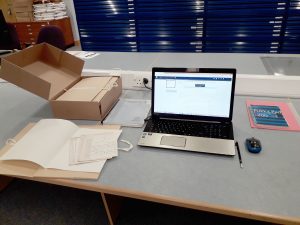
Archive cataloguing project intern work-station at the University of Strathclyde Archives and Special Collections
One of my main objectives is to become aware of and understand the challenges related to archive cataloguing and ways of facilitating access to archive collections. At the beginning of my internship I had the chance to meet with and speak to a range of information and curatorial professionals from both universities. At the University of Edinburgh, I had conversations with Joe Marshall (Head of Special Collections and the Centre for Research Collections), Grant Buttars (Archivist: University Archives and Technical Systems), Louise Williams (Lothian Health Services Archive), Jenny Duffy (Project Archivist), Lorraine McLoughlin (Appraisal Archivist), Fin West (Rare Books), and Emily Hick (Conservation). At the University of Strathclyde I met with Victoria Peters (Head Archivist), Rachael Jones (Assistant Archivist) and Carol Stewart (Special Collections Library Assistant). I also had the opportunity to shadow staff in the archive reading rooms at both institutions. These conversations have allowed me to broaden and deepen my general understanding of the professional field, and I have been able to see how various departments can work together. For example, Lorraine’s new system of appraisal not only helps save precious storage space, but it also greatly facilitates and helps colleagues from other departments keep track of how much stock they have and how much space they still have for new acquisitions. Grant’s efforts for securing funding are paramount for cataloguing, conservation or digitisation projects in order to make valuable collections available to the public both online and on site.
I am particularly interested in developing skills related to collections promotion and advocacy which are areas I have not yet explored. I strongly believe in the value of the Patrick Geddes collections and their importance to national and international cultural heritage. The collections cover most of Geddes’s life, nearly all the places where he lived and worked, and are a testimony of his many fields of activity, such as sociology, education, urban planning, and nature conservation. They also reunite a vast collection of correspondence in various languages from notable scientists, academics, sociologists, artists and writers from across the world. They are an invaluable record of Geddes’ global thinking and many interests, the fervent exchange of ideas across borders and joint efforts for improving education, urban planning and the wellbeing of citizens…just to name a few.
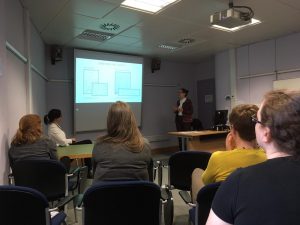
Project intern, Sorina Mihai, helping to promote the Patrick Geddes collections to University of Strathclyde library staff
I realise the ever-increasing importance of promoting collections to patrons and justifying the value of archival services to stakeholders. Archives offer communities the opportunity to learn, explore, interact and can inspire people to become more active in their communities. This is why I would like to develop the ability to engage with different audiences, develop and improve my presentation skills, such as presentation structure and delivery, and body language.
On a personal level, I hope to enhance my decision-making and time management skills, particularly in relation to how to prioritise competing agendas, and successful multi-tasking. I am also looking to gain networking skills which are so valuable in creating and sustaining connections with fellow professionals, enabling innovative and engaging collaborations, projects or initiatives. I would also like to further develop core skills such as work-planning, analysis, interpretation and research.
I feel very fortunate to be working within such an experienced and supportive team. Across the project team and supporting staff I have access to a vast bank of knowledge and professionalism, and their dedication is extremely inspiring and motivating. I very much appreciate the opportunity to learn in such a supportive and knowledgeable environment.
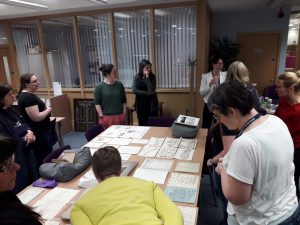
Promoting the Patrick Geddes collections to University of Strathclyde library staff
I have already started on cataloguing, have helped to deliver a training session which was designed to raise awareness of the project, collections and research activity around Patrick Geddes, and learned about reading room procedures at both universities. Helping to deliver the training session, I came to realise that a lot more time and work goes into delivering a presentation than I had anticipated. A lot of thought and work went into designing the content of the presentation for a particular audience and also in selecting the most relevant items to have on display in the reading room. The items had to complement the presentation and be arranged thematically in such a way as to encourage and facilitate curiosity and discovery. This experience also made me realise that the process of physically selecting, retrieving and returning documents for my section of the presentation took a good few hours to complete.
The ‘Evergreen’ internship is a tremendous opportunity for me to start transitioning from libraries to archives, a profession I have developed a great enthusiasm and passion for. I am applying for a postgraduate course in Archives and Records Management this year and this experience will help me to develop a solid practical foundation on which I can build the theoretical knowledge delivered by the postgraduate course. I hope this practical experience, complemented by my academic training in Information and Library Studies and the future study of Archives and Record Management will provide a strong grounding for my future career as an archivist.
Meanwhile, I greatly enjoy discovering the vast network of correspondents that Patrick Geddes was in touch with. I was very pleased to come across correspondence from French Nabis painter Paul Sérusier, Scottish physician and academic Diarmid Nöel Paton, French Prime Minister Georges Benjamin Clemanceau, Belgian lawyer and Nobel Peace Prize winner Henri Marie la Fontaine, English pioneer of women’s higher education Constance Maynard, and French poet and writer Marc-André Raffalovich. Who shall I uncover next?
From Barbed Wire to the BBC: The Writings of Tom Burns
Introduction
Throughout his career as researcher, lecturer and finally Professor of Sociology, Tom Burns was a prolific and engaging writer of journal articles, lectures, conference papers and reviews. His works include references to philosophers and political thinkers (Max Weber, Karl Popper, Antonio Gramsci to name a few) and are peppered with wonderful imagery, gentle humour and acute observation. The titles of his works are delightful: Sancho Panza’s Grandmother; The Revolt of the Privileged; Models, Images and Myths. He interweaves his subjects of interest, frequently using the organisation of factories to explore social interactions and urban planning, and technological change to inform notions of community and social status.
Early Works
“We did not feel that we had jettisoned decency for good and all, but that we had pocketed such things until the time came for employing them again”, Men and Barbed Wire
Tom Burns graduated from the University of Bristol with an English degree in 1933. A Quaker, he did not enlist in active service at the outbreak of war but volunteere d with the Friends Ambulance Unit. Burns was captured in 1941 and spent almost three years as a POW in Germany. He wrote at least 3 pieces discussing his war time experiences, one in Finland before his capture – an unknown piece to which he refers in his collection of selected writings – Calamity Bay written while imprisoned, and finally Men and Barbed Wire, a raw and honest portrayal of a POW’s reaction to repatriation and memories of incarceration:
“…the great herd of men which had been driven through the streets of Kalamata on the morning of 30 April 1941 remained, for the most part, a herd. Dirty, unshaven, undisciplined, shiftless, grubbing continually for bits of food and cigarette ends, indecent, selfish”
“I met a large number of interesting people; many very funny things happened; there were many enjoyable times; a pleasant sort of easy friendliness existed; I had time to read; I had time to think”
Friends and Enemies
Burns was working with the Bournville Village Trust and the West Midland Research Group, both concerned with post-war reconstruction, when he was appointed research lecturer at Edinburgh University.
His main research interest was in the organisational structure of industry, this being the subject of his book The Management of Innovation written with G M. Stalker and published in 1961. But he extended his findings to other branches of sociology, using them to explore and discuss social interaction, leisure time, and the organisation of family life.
His fascinating essay Cliques, Cabals, Confidants explores the behaviour and purpose of different groups found within the workplace and how they can be the force behind success and/or failure. Gossip, he writes, can be exchanged between colleagues or friends but be warned, “it is always necessary to know with whom it is safe to gossip and with whom it is not.” 
The manager of a firm is painted as an isolated figure, not a member of any clique or cabal, but often accompanied by a confidant “always available and correctly responsive for the direct expression of fears, doubts and desires“. Crucially however, “there is no mutuality between confidant pairs; merely a contract“.
In Friends, Enemies and the Polite Fiction, a companion piece to the above, Burns observes how easily members of an organisation can switch the way in which they interact with each other based on what particular role they have assumed at any one time; these different interactions can be justified because “we carry with us the capacity for acting out a number of roles, for occupying a variety of social positions“. He also includes an interesting discussion on the use of banter and irony as tools to navigate situations where an employee finds himself having to play and safeguard two distinct roles.
Of course, Burns was not just talking about the workplace. I have no experience of factories or multi national companies but the similarities with social interactions at the school gates is remarkable!
China Ducks and African Masks
Burns was also interested in how social status is communicated by social acts and visual clues both within and outwith the workplace.
“It is the easiest thing in the world to attach the correct social weighting to looped window curtains as against straight hanging ones, to flights of china ducks against African masks, to an assortment of table lamps as against the central light….the significance lies in the values to which these displayed signs attach their owners [Non-Verbal Communication in Human Society].
In Cold Class War, he laments the middle class re-ignition of a class war despite having thought it put to bed with the end of the Second World War. “The proletarian peril is back with us again, irrational, hostile, nihilistic, getting more and more and doing less and less” and calls for better acceptance and understanding of differences:
“If we admit that within the workers situation there may be standards, judgements and codes of behaviour different from those of the middle class then there may be a possibility of understanding”
Tea and Sunday Newspapers
Industrialisation had, Burns writes in The City as Looking Glass, “separated work from leisure and workplace from home”. He was interested in the notions of community and the impact of urban development. The Planning Movement, he wrote in Neighbourhood Planning, had its roots in the revulsion against the industrial city and that “the millions of bright little gardens which now make up the greater part of the area of urban Britain are as much part of our way of life as tea and Sunday newspapers”.
However, he also hinted at a more sinister and uncomfortable side to suburbia:
” it is the vast random disorder of suburban development – the utter unrelatedness of the next bit of brick or concrete to anything else which dismays people. Then it was the octopus of ribbon development and urban sprawl; now it is the outrage of subtopia”.
These new “communities” now pose perpetual choices about whom to know, what to do and where to go.
Mass Communication
His paper presented to the Manchester Broadcasting Symposium in 1976, The Meaning of Local Radio in Community, actually says very little about local radio but a lot about community and community studies.
Burns observed that “the awkward, indeed appalling, fact is that the more conflict ridden a place is, the more deeply involved in the community itself are the people who live there” and posed the alarming question – could the practice of broadcasters to lead with death and disaster be an attempt, albeit unconscious, to awaken our sense of community?
Latterly Burns conducted research within the BBC, again he was interested in organisation but also in mass communication and the role of state broadcasting. In The Politics of Broadcasting: The BBC and the British Government he lists the many times government ministers, left and right, have accused the BBC of, in the words of Norman Tebbit, “bias, incompetence, low professional standard or simple error”. It would be fascinating to know what Tom Burns would have made of the current political climate’s impact on society, industry, communication and community.
 The following publications can be found in the University Library:
Description, Explanation and Understanding: Selected Writings, Tom Burns, 1994
The Management of Innovation, Tom Burns and G.M. Stalker, 1961
For the last 20 years of his life Tom Burns worked on a book on Organisation. It was never finished. Several early drafts exist within the material being catalogued as part of this project. The most recent draft can be accessed online at: http://www.sociology.ed.ac.uk/tomburns/
New books in the Library for History, Classics and Archaeology
Thanks to recommendations from members of staff and requests via RAB from students the Library is continually adding new books to its collections both online and in print. Here are just a (very) small number of the books that have been added to the Library’s collections in semester two, 2018/19 for the School of History, Classics and Archaeology and these demonstrate the wide range of subjects being taught, studied and researched within School.
–> Find these and more via DiscoverEd.
 Akrotiri: the archaeological site and the museum of prehistoric Thera: a brief guide by Christos G. Doumas (shelfmark: DF221.T38 Dou.)
Roman death: the dying and the dead in ancient Rome by Valerie M. Hope (shelfmark: HQ1073.5.R66 Hop. Also available as e-book).
Black revolutionary: William Patterson and the globalization of the African American freedom struggle by Gerald Horne (shelfmark: E185.97.P32 Hor.)
From Augustus to Nero: an intermediate Latin reader edited by Garrett G. Fagan and Paul Murgatroyd (shelfmark: PA2095 Fro.)
Information, communication, and space technology by Mohammad Razani (e-book).
Public sculpture of Edinburgh (vol. 1 and 2) by Ray McKenzie ; with research by Dianne King and Tracy Smith (shelfmark: NB481.E4 Mack.) Read More
Research Data Workshops: Electronic Notebooks Summary of Feedback
In the spring of this year (March & May) the Research Data Service ran two workshops on Electronic Notebooks (ENs) where researchers from all three colleges were invited to share their experiences of using ENs with other researchers. Presentations and demos were given on RSpace, Benchling, Jupyter Notebooks, WikiBench, and Lab Archives. Almost 70 research and support staff attended and participated in the discussions.
This post is a distillation of those discussions and we will use them to inform our plans around Electronic Notebooks over the coming year. It was obvious from the level of attendance and engagement with the discussions that there was quite a lot of enthusiasm for the idea of adopting ENs across a variety of different schools and disciplines. However, it also quickly became clear that many researchers and support staff had quite justified reservations about how effectively they could replace traditional paper notebooks. In addition to the ENs which were the subject of presentations a number of other solutions were also discussed, including; LabGuru, OneNote, SharePoint, and Wikis.
It appears that across the University there are a very wide range of platforms being used, and not all of them are intended to serve the function of an EN. This is unsurprising as different disciplines have different requirements and an EN designed for the biological sciences, such as Benchling, is unlikely to meet the needs of a researcher in veterinary medicine or humanities. There is also a huge element of personal preference involved, some researchers wish a simple system that will work straight out of the box while others want something more customisable and with greater functionality for an entire lab to use in tandem.
So, within this complex and varied landscape are there any general lessons we can learn? The answer is “Yes” because regardless of platform or discipline there are a number of common functions an EN has to serve, and a number of hurdles they will have to overcome to replace traditional paper lab books.
Firstly, let’s look at common functional requirements:
- Entries in ENs must be trustworthy, anyone using one has to be confident that once an entry is made it cannot be accidentally deleted or altered. All updates or changes must be clearly recorded and timestamped to provide a complete and accurate record of the research conducted and the data collected. This is fundamental to research integrity and to their acceptance by funders, or regulators as a suitable replacement for the traditional, co-signed, lab books.
- They must make sharing within groups and between collaborators easier – it is, in theory, far easier to share the contents of an EN with interested parties whether they are in the same lab or in another country. But in doing so they must not make the contents inappropriately available to others, security is also very important.
- Integration is the next requirement, any EN should be able to integrate smoothly with the other software packages that a researcher uses on a regular basis, as well as with external (or University central) storage, data repositories, and other relevant systems. If it doesn’t do this then researchers may lose the benefits of being able to record, view, and analyse all of their data in one place, and the time savings from being able to directly deposit data into a suitable repository when a project ends or a publication is coming out.
- Portability is also required, it must be possible for a researcher to move from one EN platform to another if, for example, they change institutions. This means they need to be able to extract all of their entries and data in a format that can be understood by another system and which will still allow analysis. Most ENs support PDF exports which are fine for some purposes, but of no use if processing or analysis is desired.
- Finally, all ENs need to be stable and reliable, this is a particular issue with web based ENs which require an internet connection to access and use the EN. This is also an area where the University will have to play a significant role in providing long-term and reliable support for selected ENs. They also need the same longevity as a paper notebook, the records they contain must not disappear if an individual leaves a group, or a group moves to another EN platform.
Secondly, barriers to adoption and support required:
- Hardware:
- Many research environments are not suitable for digital devices, phones / tablets are banned from some “wet” labs on health and safety grounds. If they are allowed in the lab they may not be allowed out again, so space for storage and charging will need to be found. What happens if they get contaminated?
- Field based research may not have reliable internet access so web based platforms wouldn’t work.
- There is unlikely to be space in most labs for a desktop computer(s).
- All of this means there will still be a need for paper based notes in labs with later transfer to the EN, which will result in duplication of effort.
- Cost:
- tablets and similar are not always an allowable research expense for a grant, so who will fund this?
- if the University does not have an enterprise licence for the EN a group uses they will also need to find the funds for this
- additional training and support my also be required
- Support:
- technical support for University adopted systems will need to be provide
- ISG staff will need to be clear on what is available to researchers and able to provide advice on suitable platforms for different needs
- clear incentives for moving to an EN need to be communicated to staff at all levels
- funders, publishers, and regulatory bodies will also need to be clear that ENs are acceptable for their purposes
So, what next? The Research Data Support service will now take all of this feedback and use it to inform our future Electronic Notebook strategy for the University. We will work with other areas of Information Services, the Colleges, and Schools to try to provide researchers in all disciplines with the information they need to use ENs in ways that make their research more efficient and effective. If you have any suggestions, comments, or questions about ENs please visit our ENs page (https://www.ed.ac.uk/information-services/research-support/research-data-service/during/eln). You can also contact us on data-support@ed.ac.uk.
The notes that were taken during both events can be read here Combined_discussion_notes_V1.2
Some presentations from the two workshops are available below, others will be added when they become available:
| Speaker(s) | Topic | Link |
| Mary Donaldson (Service Coordinator, Research Data Management Service, University of Glasgow) | Jisc Research Notebooks Study | Mary_Donaldson_ELN_Jisc |
| Ralitsa Madsen (Postdoctoral Research Fellow, Centre for Cardiovascular Science) | RSpace | 2019-03-14_ELN_RSpace_RRM |
| Uriel Urquiza Garcia (Postdoctoral Research Associate, Institute of Molecular Plant Science) | Benchling | |
| Yixi Chen (PhD Student, Kunath Group, Institute for Stem Cell Research) | Lab Archives | 20190509_LabArchives_Yixi_no_videos |
| Andrew Millar (Chair of Systems Biology) | WikiBench | |
| Ugur Ozdemir (Lecturer – Quantitative Political Science or Quantitative IR) | Jupyter Notebooks | WS_Talk |
| James slack & Núria Ruiz (Digital Learning Applications and Media) | Jupyter Notebooks for Research | Jupyter_Noteable_Research_Presentation |
Kerry Miller, Research Data Support Officer, Research Data Service
On trial: Medieval and Early Modern Studies
*The Library has now purchased access to this resource. See New to the Library: Medieval and Early Modern Studies.*
Thanks to a request from staff in HCA the Library currently has trial access to the Adam Matthew Digital research resource Medieval and Early Modern Studies. This offers you access to a huge range of primary sources covering social, cultural, political, scientific and religious perspectives, from the 15th to early 18th centuries.

You can access Medieval and Early Modern Studies from the E-resources trials page.
Access is available on and off-campus.
Trial access ends 17th June 2019.
The breadth of resources provided within this collection is extensive, from sources concerning the Black Death to Restoration of the English monarchy and the Glorious Revolution. Read More
Collections
 Hill and Adamson Collection: an insight into Edinburgh’s past
My name is Phoebe Kirkland, I am an MSc East Asian Studies student, and for...
Cataloguing the private papers of Archibald Hunter Campbell: A Journey Through Correspondence
My name is Pauline Vincent, I am a student in my last year of a...
Hill and Adamson Collection: an insight into Edinburgh’s past
My name is Phoebe Kirkland, I am an MSc East Asian Studies student, and for...
Cataloguing the private papers of Archibald Hunter Campbell: A Journey Through Correspondence
My name is Pauline Vincent, I am a student in my last year of a...

Projects
Cataloguing the private papers of Archibald Hunter Campbell: A Journey Through Correspondence
My name is Pauline Vincent, I am a student in my last year of a...
Archival Provenance Research Project: Lishan’s Experience
Presentation My name is Lishan Zou, I am a fourth year History and Politics student....