Home University of Edinburgh Library Essentials
May 21, 2026
On trial: Financial Times Historical Archive
Thanks to a request from a student in HCA the Library currently has trial access to the Financial Times Historical Archives, 1888-2016 from Gale. This is the complete run of the London edition of this internationally known daily paper, from its first issue through 2016.

You can access the Financial Times Historical Archive, 1888-2016 via the E-resources trials page.
Access is direct on-campus but if working off-campus you must use VPN.
Trial access ends 3rd June 2019. Read More
New training: Assessing Data Quality and Disclosure Risk in Numeric Data
The Research Data Service, in collaboration with the UK Data Service, are running workshops on the theme ‘Assessing Data Quality and Disclosure Risk in Numeric Data’. These hands-on sessions introduce the key elements of data quality and disclosure risk, and include practical demonstrations of two tools to evaluate the quality (QAMyData) and disclosure risk (sdcMicro) of numeric research data.
Workshops will run across two days, with sessions on different days for researchers interested in social survey data (10th June) and health data (11th June).
Session 1: Assessing Data Quality in Numeric Data
This workshop will introduce the key elements of data quality assessment, including file checks, and undertaking data and metadata checks. Attendees will gain hands-on experience using QAMyData, a purpose-built configurable tool to quickly and automatically detect some of the most common problems in survey and other numeric data (SPSS, STATA, SAS & csv files).
Session 2: Assessing Disclosure Risk in Numeric Data
This workshop will provide an introduction to statistical disclosure control (SDC), covering: types of Identifiers; de-identification and anonymization; types of disclosure; SDC approaches; k-anonymity and l-diversity. The workshop introduces sdcMicro, a practical R package for measuring disclosure risk in numeric data. The session will give attendees hands-on experience using sdcMicro to assess disclosure risk and apply SDC methods to anonymize numeric data, while evaluating the balance between disclosure risk and data loss.
These sessions are available to research staff and students and can be booked using the links below:
Assessing Data Quality in Numeric Data (Social Survey Data) – 10th June 0930-1200, Lister Learning and Teaching Centre, Room 1.16 (Central Area) https://www.events.ed.ac.uk/index.cfm?event=book&scheduleID=34939
Assessing Disclosure Risk in Numeric Data (Social Survey Data) – 10th June 1330-1700, Lister Learning and Teaching Centre, Room 1.16 (Central Area) https://www.events.ed.ac.uk/index.cfm?event=book&scheduleID=34941
Assessing Data Quality in Numeric Data (Health Data) – 11th June 0930-1230, Microlab 1, Chancellor’s Building (Little France) https://www.events.ed.ac.uk/index.cfm?event=book&scheduleID=34940
Assessing Disclosure Risk in Numeric Data (Health Data) – 11th June 1300-1700, Microlab 1, Chancellor’s Building (Little France) https://www.events.ed.ac.uk/index.cfm?event=book&scheduleID=34942
Bob Sanders
Research Data Support
Library & University Collections
China Families – New Genealogy Website by Bristol University
This is an edited re-blog of a newsletter from the Scotland-China Association.
Were your ancestors out in China? If so, track them with China Families:
 China Families is directed by Robert Bickers, Professor of History at the University of Bristol. The database platform allows you to search across 60,000 names of men and women who lived, worked or died in China, between the 1850s and 1940s. The information is drawn from ten different sources, and you can search each one of these individually, but you can also search across all of them. There are many Chinese names here, as well as the names of foreign residents.
In the century before 1950, tens of thousands of foreign nationals lived and worked in China. They could be found in large communities in major coastal cities like Shanghai or Tianjin, as well as in tiny countryside missionary compounds, or isolated Customs stations deep in China’s interior. Often thought to be exotic and obscure, these communities created newspapers, and directories, and their lives and activities were widely recorded. But finding out about ancestors who spent time in China can be difficult, for the records are scattered, and even old cemeteries were destroyed in the 1960s. Therefore, China Families helps uncover a hidden past.
Its companion site Historial Photographs of China makes available over 20,000 photographs of the period, many of them supplied by China families.
On trial: selection of U.S. magazine archives
*The Library has now purchased access to The New Republic Magazine Archive. See New to the Library: The New Republic Archive*
Thanks to a request from staff in HCA the Library currently has trial access to three magazine archives from EBSCO – The Nation, National Review and The New Republic – between them covering the 19th, 20th and 21st century.

You can access the three archives via the E-resources trials page.
Access is available both on and off-campus.
Trial access ends 31st May 2019.
The Nation Archive
The Nation Archive makes it possible for researchers to access 14 decades of America’s best alternative journalism in ways never before possible. The archive contains thousands of historic articles, editorials, letters, reviews, poems, and puzzles dating back to the magazine’s first issue from July 6, 1865. Read More
All Change – Body Language project extended until July 2020
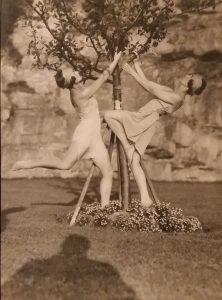
Margaret Morris dancers posing with tree
We are very pleased to announce that a new project archivist, Elaine MacGillivray, has agreed to take on responsibility for our collaborative Wellcome Research Resource-funded archives project ‘Body Language: movement, dance and physical education in Scotland, 1890-1990’. Elaine currently manages another Wellcome Research Resource-funded ‘Evergreen: Patrick Geddes and the Environment in Equilibrium’. With immediate effect, Elaine will split her time 50/50 between the two projects, which means that she will (usually) work Tues-Wed on our Body Language project and Thurs-Fri on the Evergreen Project. This means that the Body Language project will now extend to July 2020.
The extended project period provides a wonderful opportunity to continue the cataloguing work, explore and highlight the collections further and to open up research opportunities using the collections.
Elaine’s predecessor, Clare Button, has successfully completed a significant amount of work on the project. We are very grateful for the huge contribution that Clare made to the project and wish her all the very best in her new post as archivist at the London School of Medicine and Dentistry, at Queen Mary University, London.
“Clare has undertaken a tremendous amount of work on the project to date and I very much hope that I can fulfil her ambitions for the project as I take her work forward. I am also very excited to explore the commonalities between the two projects. Firstly in terms of the ideas relating to movement, health, art and culture, but also in relation to the people found in the collections material. I know Margaret Morris visited Patrick Geddes’ Château d’Assas, near Montpellier, at least once, and that they were both connected with Charles Rennie Mackintosh and Margaret Macdonald Mackintosh.” Elaine MacGillivray, project archivist.
Watch this space for the next update!
Patrick Geddes Archives project extended until March 2020
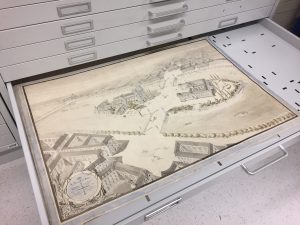
Coll-1167/A/6/8: Paris: bird’s eye view from the north of the Isle de la Cite
With immediate effect our project archivist, Elaine MacGillivray, will be looking after two collaborative Wellcome Research Resource-funded archive projects. Elaine will continue to work on our own ‘Evergreen: Patrick Geddes and the Environment in Equilibrium’ project, and has taken on responsibility for another fascinating archives project ‘Body Language: movement, dance and physical education in Scotland, 1890-1990′. Elaine will be splitting her time 50/50 between the two projects which will see her working (usually) Tues-Wed on the Evergreen project and Thurs-Fri on the Body Language project. This means that our Evergreen project will now extend until March 2020.
The extended time affords an opportunity to create and enhance even more catalogue descriptions, and to engage with more volunteers, interns and student placements. We will also be able to undertake public engagement activity up until March 2020. We are very pleased that this extended window will allow us more time to shine a spotlight on Patrick Geddes and his ideas, and to share with you some of the collection highlights uncovered during the project.
Like the recently re-discovered beautiful pencil and wash drawing shown above. It shows a ‘Bird’s Eye View of Paris from the north of the Isle de la Cite’. The eagle-eyed among you may notice Notre Dame Cathedral minus its steeple. This particular item is undated and we have yet to investigate the possible author. If any of you can shed any light as to the origin and date of this item please do get in touch. We would be delighted to hear from you.
The Westminster Confession
On Wednesday 8th May 2019, The Church of Scotland is hosting a conference, organised by the Theological Forum. The conference, Westminster, Confessions and the Church, will run at New College, Edinburgh. Speakers from Scotland and elsewhere will explore different aspects of the theology and status of the Westminster Confession.

The Humble Advice of the Assembly of Divines… (New College Library, Special Collections MH. 319)
Background
The Westminster Confession of Faith is one part of the Westminster Standards drawn up between 1643-1649 by the Westminster Assembly which consisted of over 100 participants from theological and parliamentary backgrounds, brought together to restructure the Church of England. Several Scots attended the Assembly and the Church of Scotland adopted the Assembly’s recommendations, including the Westminster Confession which, together with the Larger and Shorter Catechisms, became the standards of doctrine for many Presbyterian churches around the world.

An Explication of the Article of the Confession of Faith (New College Library, Special Collections MSS WES 3.2) – temporarily unavailable for consultation due to conservation work.
From its inception, the Westminster Confession has attracted criticism, not least because, by its nature, it has to rely on man’s interpretation of the scripture and that will always be open to question. Nevertheless, its longevity bears witness to the exceptional effort made by, and the effectiveness of, those who gathered in Westminster in the mid-17th century to offer their very human advice regarding ‘a confession of faith: with the quotations and texts of scripture annexed’.

Confession of Faith 1690 with signatures (New College Library, Special Collections MSS WES 3.1)
From 1st-31st May, an exhibition related to this conference will run in New College Library.
If you are interested in seeing specific copies of related Special Collection items which are not included in the displays, please contact staff at the Helpdesk.
Bibliography
https://en.wikipedia.org/wiki/Westminster_Assembly
https://en.wikipedia.org/wiki/Westminster_Confession_of_Faith
https://en.wikipedia.org/wiki/Westminster_Standards
An explication of the Article of the Confession of Faith of the Church of Scotland chapter 2 3 & 4th, namely that infidelity or difference in religion doth not make void the Magistrat’s just and legal authority &c. (New College Library, Special Collections MSS WES 3.2)
The Confession of Faith agreed upon by the Assembly of Divines at Westminster, with the assistance of Commissioners from the Church of Scotland – approved by the General Assembly 1647, and ratified by the Parliament of Scotland 1690. With the formula for the subscription of ruling elders. (New College Library, Special Collections MSS WES 3.1)
The Humble Advice of the Assembly of Divines, now by authority of Parliament Sitting at Westminster, concerning I. A Confession of Faith: II. A larger Chatechism. III. A shorter Chatechism. Presented by them lately to both Houses of Parliament. Westminster Assembly (1643-1652) Edinburgh : Printed at London and reprinted at Edenbrough ; MDCXLVIII [1648. (New College Library, Special Collections MH. 319)
Gina Headden, IS Helpdesk Assistant, New College Library
Trial Access to SAGE Research Methods – Additional Modules

Sage Research Methods – content from SAGE publisher (some unique to SRM) on the steps involved in a research project. Full range of qualitative, quantitative, and mixed methods for the social and behavioural sciences, as well as many methods commonly used in the hard sciences.
Topics: Key concepts in research, Philosophy of research, Research ethics, Planning research, Research design, Data collection, Data quality and data management, Qualitative data analysis, Quantitative data analysis, Writing and disseminating research.
This trial gives access to the following additional modules:
Sage Research Methods Cases Part 2
SAGE Research Methods Datasets 2
Research Methods Video: Data Science, Big Data Analytics, & Digital Methods
Title lists for the new modules can be found at – http://methods.sagepub.com/librarian#TitleLists
The trial lasts until 20th June with the individual content added to DiscoverEd as well as listed on our E-Resources Trials webpage where you can view other e-resources currently on trial as well as complete a trial feedback form.
A user guide for this resource can be found at http://sagepub.libguides.com/research-methods
Cataloguing the correspondence of Thomas Nelson & Sons (cont.)
Cataloguing the correspondence of Thomas Nelson & Sons (cont.)
Our intern Isabella has now finished her 10-week placement at the CRC, during which she was box-listing part of the records of Thomas Nelson & Sons Ltd. Her thoroughness and fine attention to details made her perfect for the job. Luckily for us, Isabella enjoyed her placement so much that she decided to keep working on the collection as a volunteer! We are delighted that she is going to keep doing excellent work on this great collection. Here are a few more of her great finds.

Isabella working in the CRC reading room.
1. Jane Borthwick Letter: While every other letter in this bundle is written in black or dark blue ink, with edits often made with red ink, Jane Borthwick writes a letter here in an aesthetically appealing purple ink. The letter concerns a manuscript which she was enlisted to read, review, and recommend for either publication or rejection. Unfortunately for the author, Ms. Borthwick found the piece too dull to be printed. On the back of the letter there is slight evidence of handling where several ink stained fingers held the letter. While the marks are slight and it cannot be determined if these are the product of Jane herself, an employee of Nelson & Sons or of a later cataloguer or archivist, it stands as evidence of this letters connection to the people that have interacted with it, carrying its handling history on its surface. 1. Jane Borthwick’s letter
2. R. Anderson Letter: A letter from R. Anderson displaying discoloration of paper, dust and dirt – Some of the correspondence we are working to catalogue requires light conservation methods before we can return them to storage. In this letter from an R. Anderson, one side shows how protected and covered paper ages as that side has been stored firmly pressed against another letter, while the other side reveals how long-term exposure to the elements of stacks can fade, damaged and color the paper. In order to attempt to combat this issue a small dry sponge is used to wipe away what dirt or dust can be wiped away, however, due to the age of the ink on the paper we must be careful not to take any of the ink off the page itself. This then becomes a conundrum of whether to maintain the precision of the ink or to treat the residue before it becomes a larger and more expensive issue.

2. R. Anderson’s letter
3. French Postcard: Here we have a postcard from Vienna written entirely in French. Unfortunately, our cataloguer does not read French and so help was requested from a fellow student from the Book History and Material Culture course, Eleanor Cambridge, as well as the cataloguer’s supervisor and resident Archivist with the Center for Research and Collections, Aline Brodin. The emersion of this postcard from the collection allowed for cooperation between postgraduates as well as Archivists to engage in a multi-national approach to decipher another element of the archive. This opportunity not only demonstrates the way archivists and cataloguers often work in tandem in order to contextualize information and collections, but it further speaks to the multi-national nature and reputation of Nelson & Sons.
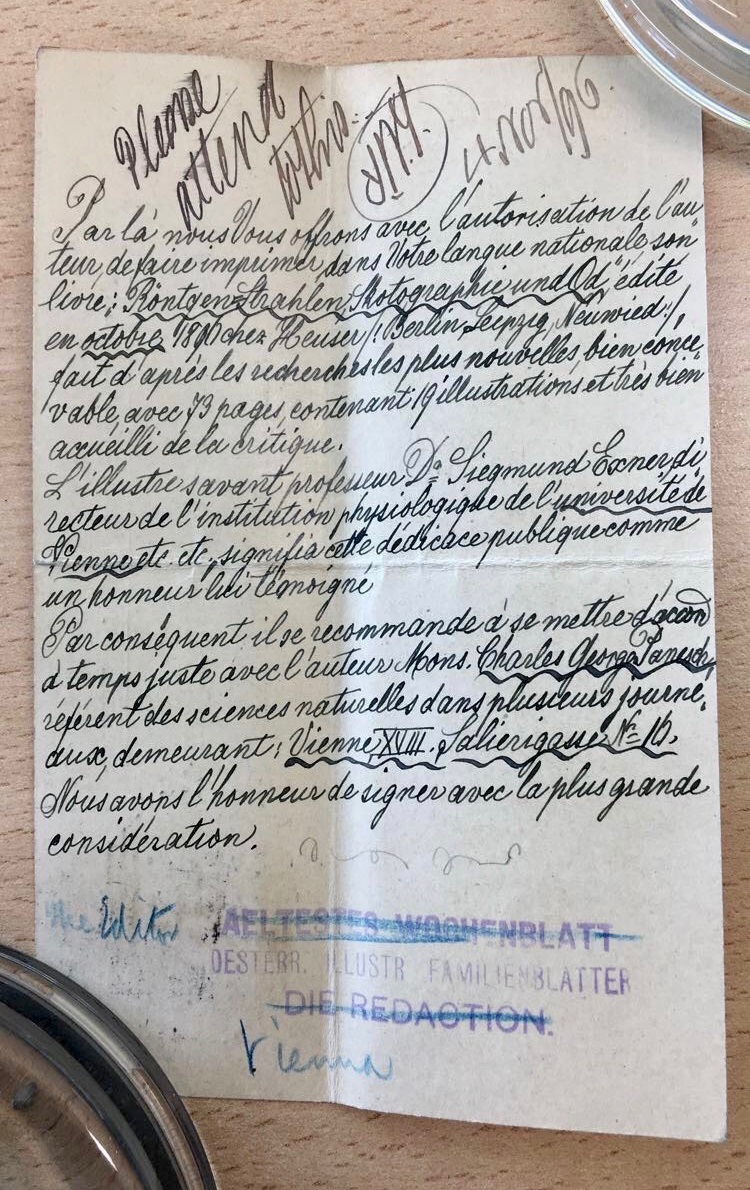
3. French postcard
4. J. A. Bains Letter: Pictured here is part of a collection of nine letters sent from one J. A. Bains on highly personalized stationery decorated with fastidiously carved print images on one side. Despite the intricacy of the prints on the stationary, their appearance is not entirely a surprise as if you look to the right-hand side of the image you will see that Mr. Bains was a bookseller as well as a Stationer. Mr. Bains interactions with Nelson & Sons was such that he had been writing a biography on the Norwegian explorer Fridtjof Nansen and was very determined to see his piece published with their company alone. This sentiment was made plain to Mr. Brown, a manager at the company, in the final line of Mr. Bains letter from May 12th, 1896 writing, ‘I am determined that Messrs. T. Nelson & Sons shall publish it – even if I have to wait for months or years! I have spent too much labor (even if amateur) too much money and wandered too many miles to gather information to let it fall through.’ Bains was a jovial correspondent, often using exclamation points in his letters, reasserting that he would have no one else publish his work but Nelson and Sons, and on two occasions joking that if Nansen, who was on expedition at the time of these letters, did not return then his book would be the first biography published and probably a roaring success. Unfortunately, Mr. Brown did not return his enthusiasm as he rejected the opportunity to publish the work, multiple times, and so Mr. Bains took his biography to Walter Scott Publishing Co. Ltd. and the book was published in 1897.

4. J. A. Bains’s letter
5. Sophia Caulfield and Audrey Curtis Letters: Many of the manuscripts sent to Nelson & Sons were full of differing content and came from a variety of people throughout a number of countries. Audrey Curtis and Sophia Caulfield were two of those authors. Ms. Curtis submitted her manuscript of ‘a tale of the Huguenot persecution in France about the date 1685’ while Ms. Caulfield wrote about ‘little-known curiosities in the department of Natural History’ of London. Each woman worked on historical and amateur scientific novels. Curtis herself had previously been published by the National Society for her short story entitled “The Artist of Crooked Alley” as well as for her story for children titled “Little Miss Curlylocks”. Each woman was a fairly accomplished author by the time they came across Nelson & Sons for their publications with Ms. Caulfield identifying herself as one of the original writers for a popular magazine aimed at young women interested in science and politics. As well Ms. Caulfield included a written resume with her manuscript to Nelson & Sons of all that she had worked on which included compiling a dictionary of needlework, textiles, and lace, as well as editing magazine articles, and her latest book which had been shown at the Chicago “World’s Fair” as well as the ‘Great Paris Exposition’.

5. Audrey Curtis’s Letter
6. Rev. F. Docker Letter: The Reverend F. Docker, pictured here, was a religious short story author who sent several stories for potential publication to Nelson & Sons in 1896. Along with his letter and his manuscripts he included a newspaper clipping from The Christian Age newspaper bearing one of the stories which he had written as well as his picture. If you peer at the heading of the paper, you will see that it is identified as No. 1,268. -Vol. XLVIII.-26. and was published in ‘London, Wednesday, December 25, 1895’ meaning that the story Reverend Docker submitted to the publishers was in fact a Christmas installment.

6. Rev. F. Docker’s Letter
7. Miss M. Douglas Letter: Here we see another example of Nelson & Sons enlisting the help of an expert for practical scientific publications. M. Douglas was a woman who worked with Nelson & Sons when producing a new book about Arctic Exploration. She was the designated reader and critic for the configuration and aesthetic design of the maps illustrated in the book. Unfortunately, this letter does not give the reader any more background as to her work but rather it does prove she showed a high proficiency for spatial relations, math, and geography in order to conceptualize and stylize maps for the Arctic which in 1896 was still a relatively unknown climate. In her letter here she shows a high understanding of Polar currents as well as a strong familiarity with the literary histories of Arctic Exploration.
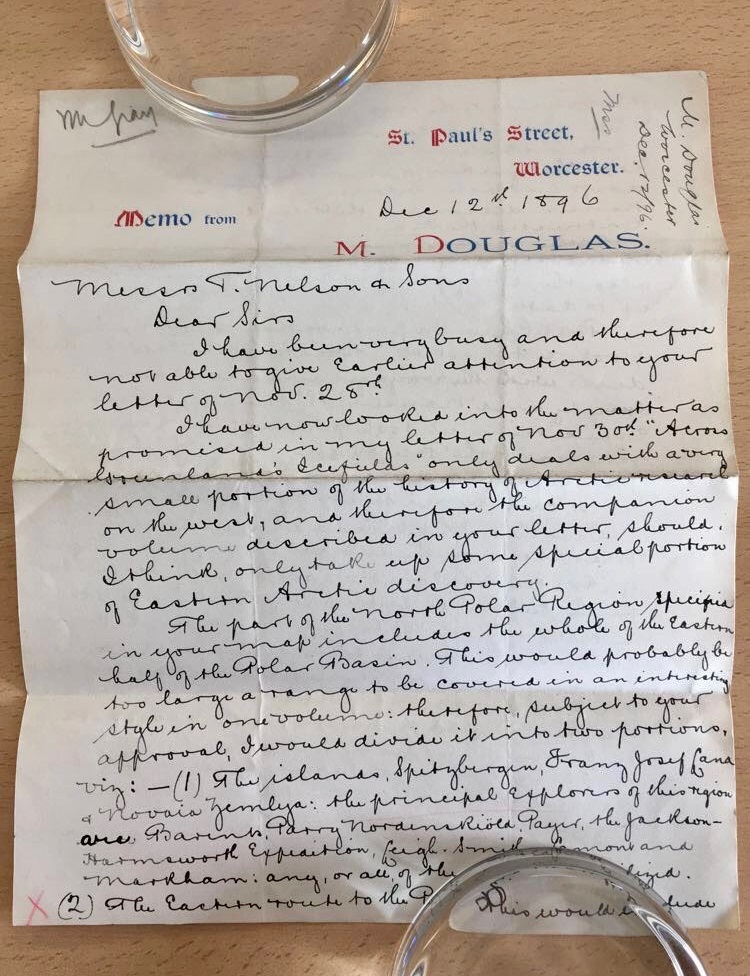
7. Miss M. Douglas’s letter
8. Ernest Ingersoll Book Submission: In 1896 Ernest Ingersoll submitted to Nelson & Sons his story entitled “A Railway Stowaway” which had previously been published in the United States by the well-known publishers of Harper & Brothers. In his letter Mr. Ingersoll offers Nelson & Sons ‘all rights outside the United States’ to the publication. While many authors include a full manuscript along with their letters, which they either request to be returned if they are rejected for publication, a gamble if the author has not written out or commissioned printed copies, Mr. Ingersoll included a small pocket copy of his story which was printed in the style of the Harper Collins 1882 edition. This particular copy was hand bound as you can see from the string threaded through the center pages and came complete with illustrations. The size of the copy enabled it to stay with the letter in this case, instead of the manuscript being returned or archived in a different location within the collection. This inclusion allowed us to not only understand the background of this submitted manuscript but also to collect the priority piece of knowledge that Nelson & Sons were offered sole rights to this piece for every publication outside of the United States. Unfortunately, Nelson & Sons decided to reject the offer. However, Mr. Ingersoll did not give up entirely and instead sent them a copy of one of his other stories entitled “The Ice Queen” which had been well received in the United States and which Harper & Brothers were willing to negotiate on copyright purchasing and illustrations expenses. While the last photo in the below series is not included in any copy of Ingersoll’s printed work, it is a wonderfully interesting example of marginalia which mimics medieval style. Referred to as a manicula, the hand design which was used to draw attention to specific passages, is used by Ingersoll here to identify the final paragraph of his letter.

8a. Ernest Ingersoll

8b. Ernest Ingersoll

8c. Ernest Ingersoll
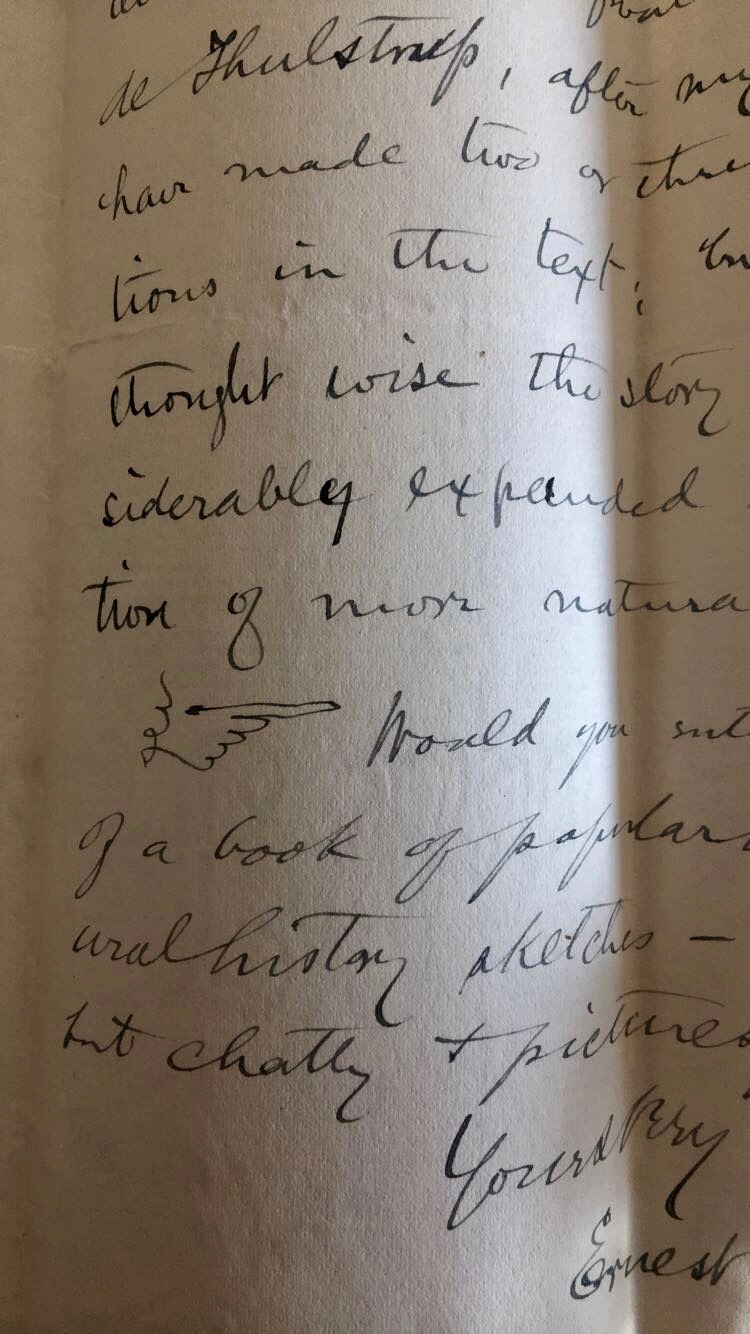
8d. Ernest Ingersoll – manicula
FAIR dues to the Research Data Alliance
It has been a while since we’ve blogged about the Research Data Alliance (RDA), and as an organisation it has come into its own since its beginnings in 2013. One can count on discovering the international state of the art in a range of data-related topics covered by its interest groups and working groups which meet at its plenary events, held every six months. That is why I attended the 13th RDA Plenary held in Philadelphia earlier this month and I was not disappointed.
I arrived Monday morning in time for the second day of a pre-conference sponsored by CODATA on FAIR and Responsible Research Data Management at Drexel University. FAIR is a popular concept amongst research funders for illustrating data management done right: by the time you complete your research project (or shortly after) your data should be Findable, Accessible, Interoperable and Reusable.
Fair enough, but we data repository providers also want to know how to build the ecosystems that will make it super-easy for researchers to make their data FAIR, so we need to talk to each other to compare notes and decide exactly what each letter means in practice.

Borrowed from OpenAire
Amongst the highlights were some tools and resources for researchers or data providers mentioned by various speakers.
- The Australian Research Data Commons (ARDC) has created a FAIR self-assessment tool.
- For those who like stories, the Danish National Archives have created a FAIRytale to help understand the FAIR principles.
- ARDC with Library Carpentry conducted a sprint that led to a disciplinary smorgasbord called Top Ten Data and Software Things.
- DataCite offers a Repository Finder tool through its union with re3data.org to find the most appropriate repository in which to deposit your data.
- Resources for “implementation networks” from the EU-funded project GO FAIR, including training materials under the rubric of GO TRAIN.
- The Geo-science focused Enabling FAIR Data Project is signing up publishers and repositories to commitment statements, and has a user-friendly FAQ explaining why researchers should care and what they can do.
- A brand new EU-funded project, FAIRsFAIR (Fostering FAIR Data Practice in Europe) is taking things to the next level, building new networks to certifying learners and trainers, researchers and repositories in FAIRdom.
That last project’s ambitions are described in this blog post by Joy Davidson at DCC. Another good blog post I found about the FAIR pre-conference event is by Rebecca Springer at Ithaka S+R. If I get a chance I’ll add another brief post for the main conference.
Robin Rice
Data Librarian & Head of Research Data Support
Library & University Collections
Collections
 Hill and Adamson Collection: an insight into Edinburgh’s past
My name is Phoebe Kirkland, I am an MSc East Asian Studies student, and for...
Cataloguing the private papers of Archibald Hunter Campbell: A Journey Through Correspondence
My name is Pauline Vincent, I am a student in my last year of a...
Hill and Adamson Collection: an insight into Edinburgh’s past
My name is Phoebe Kirkland, I am an MSc East Asian Studies student, and for...
Cataloguing the private papers of Archibald Hunter Campbell: A Journey Through Correspondence
My name is Pauline Vincent, I am a student in my last year of a...
Projects
Cataloguing the private papers of Archibald Hunter Campbell: A Journey Through Correspondence
My name is Pauline Vincent, I am a student in my last year of a...
Archival Provenance Research Project: Lishan’s Experience
Presentation My name is Lishan Zou, I am a fourth year History and Politics student....