Home University of Edinburgh Library Essentials
December 19, 2025
Dissertation Festival Blog: So… what is a systematic review?
Introduction
Welcome to the first of three blogs, where I document my Dissertation Festival Experience. For those who don’t know, the Library’s Dissertation Festival is a collaborative effort from the Library, Digital Skills department and Institute of Academic Development (IAD). They have come together to host a series of virtual sessions spanning over two weeks, providing students with the knowledge and resources to make the most out of their dissertations. Think Tomorrowland, Glastonbury and Coachella but online, free and hosted by the University of Edinburgh. So not quite the same. However, the Dissertation Festival is a fantastic opportunity to learn tips and tricks to help you write, reference and uncover what support is available to you at the University.
The Session
The first Dissertation Festival session I participated in was titled “What is a Systematic Review dissertation like?”. I decided to attend because I was interested in finding out how systematic reviews (SR) differed from other dissertation types. Luckily, this was thoroughly covered within the presentation. After the first 5 minutes of the event, I was able to explain that the goal of a systematic review; to answer a specific question in a topic area using reproducible review principles.
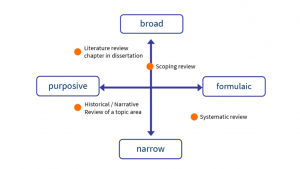
Slide from Dissertation Festival used to help illustrate where different review approaches sit
Other key points of the session include “The supporting principles of a SR” which highlighted the need for a pre-defined and detailed methodology. This was an important topic for me as I am typically more of a ‘go-with-the-flow type person when writing pieces of work. However, now knowing the aims of an SR, I am confident that is not the best strategy. Instead, you should develop a clear plan (in advance), have an inclusion criterion for studies you are considering, find ways to avoid bias and document all your SR activities.
Thoughts and Conclusion
I would recommend this session for those who are just about to carry out a dissertation or thesis and don’t know where to start. The presentation is designed to help you gain a basic level of understanding a SR and what it entails. For all, you indecisive people out there or those who don’t know what research method to use, the pros and cons list shown in the presentation can help you evaluate if this is the right research method for you! Throughout the session, there were lots of valuable pieces of advice and information given. There were also signposts for further knowledge items to help you further your understanding in your own time.
If you are interested in the session and want to check it out, you can find it HERE! Thanks for checking out the blog.
Tocher is 50
In addition to celebrating our 70th anniversary, our publication Tocher turns 50 too!
Named after the Scots word for dowry, Tocher was created in response to share fieldwork by the staff and researchers of The School of Scottish Studies (now the Department of Celtic & Scottish Studies). Material from the archive was transcribed using the interviewee’s own words; Gaelic was translated into English and regional dialects from the Scots language were also included.
We look forward to sharing some of the articles collected on the tales, songs and traditions of the last 50 years of Tocher and the recordings too. We also have some posts lined up with people who worked on the team to create Tocher.
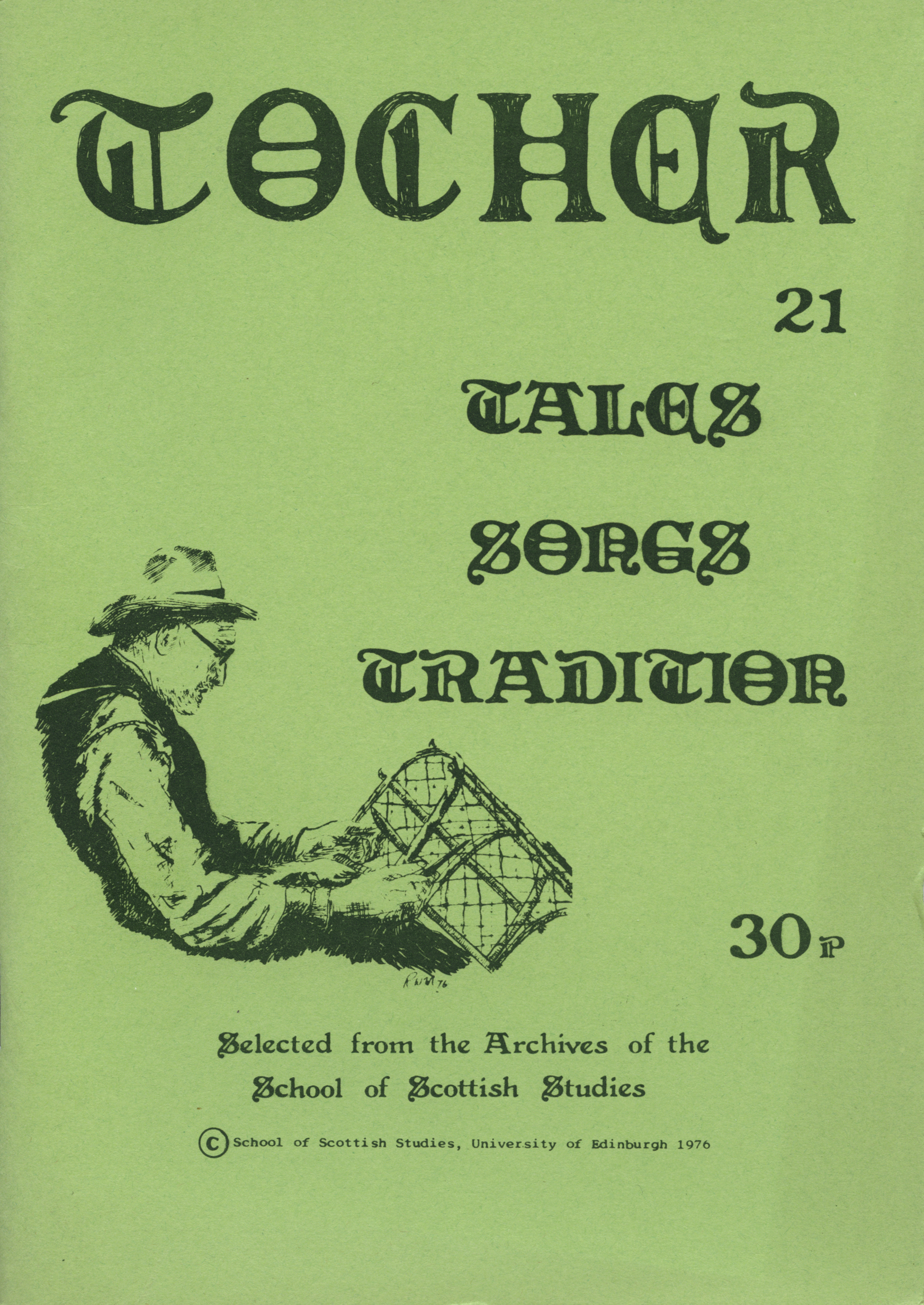
Today we wanted to draw your attention to the blog of the Volunteers in Community Engagement at UoE Collections (VOiCE).
VOiCE are a student group of volunteers, who run a monthly newsletter, podcast and blog about the different collections, people and museums at the University of Edinburgh. We are delighted that today they are highlighting Tocher’s anniversary in their newsletter and we have some exciting plans afoot to collaborate further with VOiCE this year.
Please read and enjoy their post on 50 Years of Tocher, written by VOiCE member, and Celtic and Scottish Studies Masters student, Lily Mellon.

You can sign up to the VOiCE newsletter to be kept up to date with their projects and engagement with UOE collections: https://voiceblog1.wordpress.com/join-us/
VOiCE are on social media and you can find all their links here: https://linktr.ee/voiceed
You can listen to the VOiCE podcast – We’ve Got History Between Us – on Spotify.
Training and dissertation support

Image from Hermann on Pixabay
We know it’s that time of year where dissertation research is many students’ top priority so we have scheduled some events that we hope will help you prepare for the project ahead. These are all happening over the next few months and are released for booking about three weeks ahead of the event date. The first two are now live and the others will be coming onto the system over the next few weeks.
Wednesday 5th May 12.00 to 13.00– Dissertation support: Referencing for Law (bespoke for School, 50 minute session.)
This session is designed to help students learn to reference into larger research projects such as dissertations. We discuss specific referencing systems such as OSCOLA and Edinburgh Law Review, and highlight key issues which students at the School of Law will need to be familiar with. Booking open at
https://www.events.ed.ac.uk/index.cfm?event=book&scheduleID=46811 Now Live!
Wednesday 19th May 12.30 to 13.00 – Using Law Databases (Library Bitesize, 30 minute session open to all)
This session covers selecting the appropriate database for your needs, locating sources of full text information for legislation, case law and commentary and tips and tricks for how to record and revisit searches.
This session will focus on the use of Westlaw, Lexis UK and HeinOnline.
https://edin.ac/2FXpv1q Now Live!
Thursday 3rd June 09.00-09.30– How to Reference and Avoid Plagiarism (Library Bitesize, 30 minute session open to all)
This session covers the basics of referencing and why it is important, tools to help you : Cite it Right, EndNote Online
[Please note : this is a short introductory session. For detailed help on this topic, see Managing Bibliographies with EndNote, Using EndNote Online to Manage your References Sessions]
Link will be at https://edin.ac/2FXpv1q (Not yet live on events booking)
Wednesday 16th June 12.30-13.00 – Choosing a reference manager (Library Bitesize, 30 minute session open to all)
This session covers the differences between reference management products, using with MS Word and how to create references using the software.
Link will be at https://edin.ac/2FXpv1q (Not yet live on events booking)
We also continue to offer individual research support clinic appointments which are available to book via events bookings (http://edin.ac/3bvd78B). Our next available appointment is on the 20th May, and once a fortnight thereafter.
Alternatively if you have questions or would like for us to schedule an appointment for a different day, please get in touch by emailing law.librarian@ed.ac.uk.
Edinburgh Research Archive: March 2021
Edinburgh Research Archive: March 2021 • https://era.ed.ac.uk
March saw a record number of downloads for ERA, with a 10% increase on the previous best of May 2020 and a 27% increase on the then-record of March last year. It also saw a record number of unique items downloaded, albeit just 200 up on the previous best from January.
The total downloads so far this year has seen a 40,000 increase over last year, the number of unique items downloaded this year is 1.0% higher than 2020, and the percentage of the total stock that has been downloaded has passed the 50% mark within 3 months for the first time.
We follow-up to the November 2020 report looking at the three institutional repositories, as monitored by IRUS, with the most thesis downloads in 2020. Previously, we saw that the University of Edinburgh had the third most downloads but that it is likely to be overtaken by Oxford in the not too distant future. This time we’re breaking those downloads down imto percentiles, and seeing that the other two are significantly outperforming Edinburgh all the way through the 10% divides. White Rose sees significantly bigger multiples of its downloaded titles and Manchester fares better when the figures are adjusted for the size of the active collection. ERA works its tail a lot harder: it has both a bigger digital collection and gets a much higher proportion of unique titles downloaded at least once. Overall though, ERA seems to sell the facility to its users but not the contents.
SSSA in 70 Objects : A bird living in one of the houses on St Kilda, 1938
Chosen by Stephen Willis, Library Assistant, Centre for Research Collections.
On 29th August 1930, the island of St Kilda was evacuated due to its remote location and a dwindling population. The School of Scottish Studies Archives contains a photo album of St Kilda containing some bittersweet images of an ornithological visit made in 1938 showing the changes that had occurred.
The trip was made by naturalist and writer, Robert Atkinson, along with some people who had lived on the island, Neil Gillies, Annie Gillies and Finlay MacQueen and would return for the summer months. An image that caught my eye was of a wren, which had made its home in one of the abandoned houses.
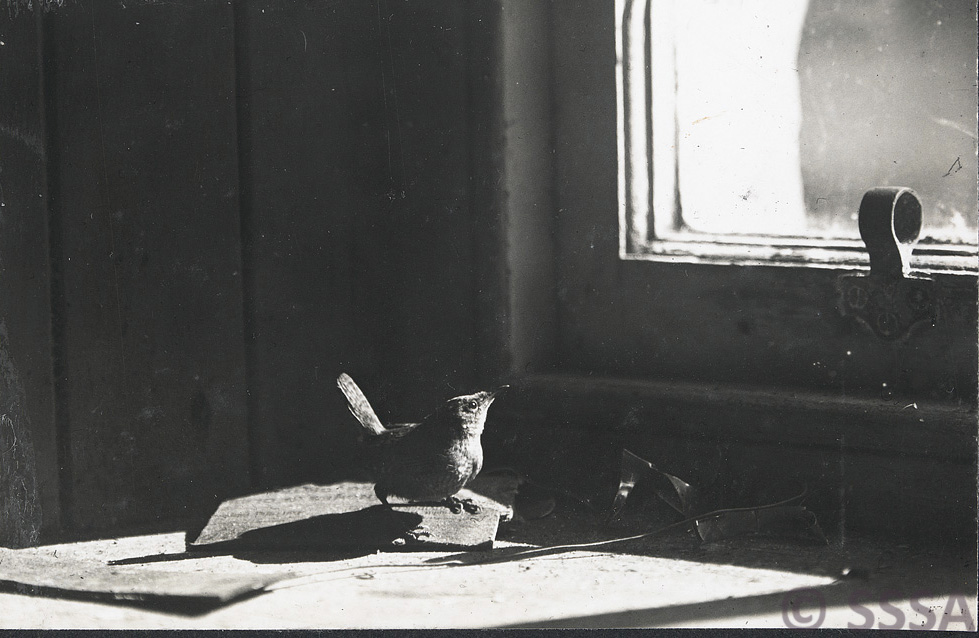
B332 Robert Atkinson Collection – © The School of Scottish Studies Archives
It is amazing to think of such a tiny bird now ruling the roost in a house made for people. It is a beautiful composition, with the sun shining through the window and the bird looking up. It is perched on what looks like debris from the house which has deteriorated without being heated and maintained for 8 years. From another image in the album it looks like one of the birds, possibly the same one was caught and is being examined, before hopefully being allowed to go on its way.
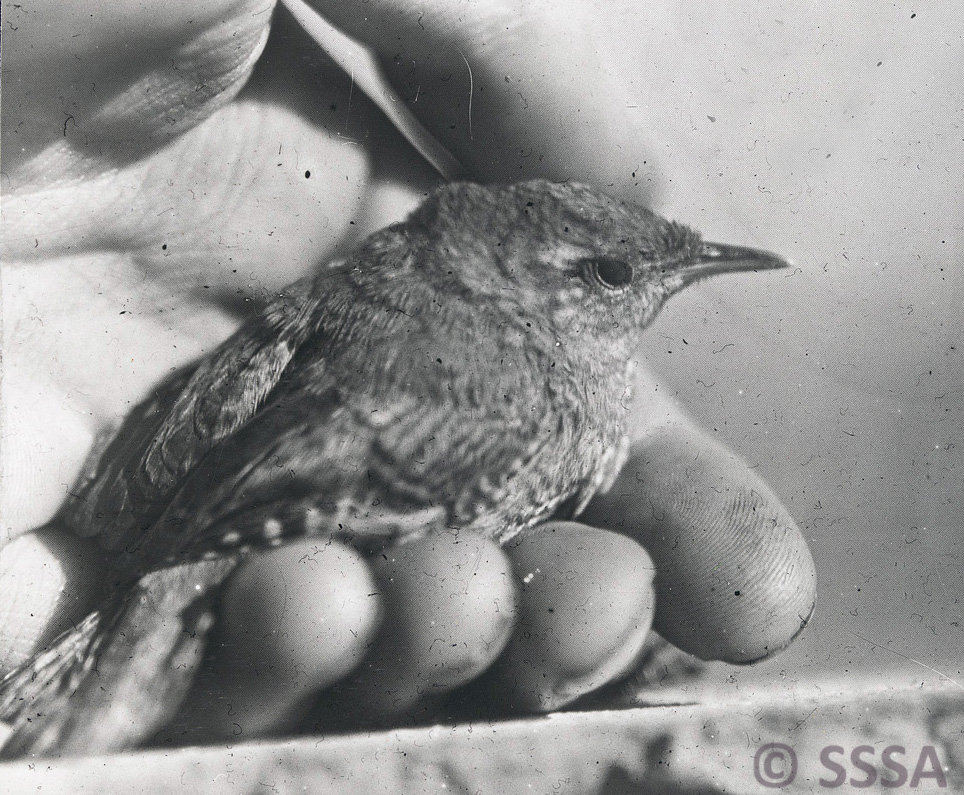
B333 – The Robert Atkinson Collection © The School of Sottish Studies Archives
(Description: St. Kilda: Wren Caught by Neil Gillies in One of the Houses, July 29th 1938)
The bird seems to be sitting fearlessly in one of the visitor’s hands so perhaps this was because it had no experience of people until that day. As Atkinson said in his book Island Going (first published in 1949),
‘St Kilda wrens left the nest for a world without natural enemies. Their only mortality was accidental’.
Like many people, I have been watching birds more during lockdown and I have noticed how quickly they look to reclaim places that they have been chased away from by human activity. I saw a bird that was walking on the road last May and a car drove over where it was standing. Fortunately, it appeared uninjured and flew away, but it had no road sense because there had been so few cars on the road to learn to be afraid.
Perhaps it is most fitting to end with some words from Robert Atkinson’s on the wrens, which complement the images well:
‘They were so near it was like examining a bird in the hand; their St Kildan characteristics of larger size and stronger, greyer markings, robuster bills and legs, were plain. Pleasant to watch the stealthy bright-eyed approach to the nest, the gabbled transfer of caterpillars, the gentle receipt of the white sac; and to hear the invisible whirr of wings amplified within the dark hollow of the cleit.’
Reference: Robert Atkinson, Island Going (Edinburgh, Birlinn, 2008), Chapter 20
You can browse images from the Atkinson Collection on The University of Edinburgh Image Collection website.
Re-Opening of the Law Library
As many of you know the rules on lockdown have begun to change. From the 26th April 2021 this means that library services can offer more access to premises – including the Law Library.
It is not a return to business as usual!
Staff and students will be able to access the premises and collections, with self-issue machines being available so that self-service borrowing can resume.
All users will need to adhere to the rules relating to Covid-19 restrictions including physical distancing, wearing a face covering (unless exempt) and the booking of study spaces before coming to the library. Full details on study spaces and how to book is available on the Study Spaces pages.

The opening hours are available at the Law Library pages.
As access to the library starts the Click & Collect service will come to an end, but any requests made before the 19th of April will still be processed.
For students who have not had the opportunity to visit the Law Library this short presentation will give you an idea of what is available during usual service: Law Library Tour
The Library staff look forward to seeing you again!
Edinburgh Research Explorer: March 2021
Edinburgh Research Explorer: March 2021 • www.research.ed.ac.uk
The dip in download numbers which seemed to inflict Research Explorer from the last quarter of 2019 onwards, due to some heavy-handed filtration implemented in an upgrade at that time, appeared to have eased following another upgrade in August 2020. ERA, which was a year ahead in its upgrade schedule, recovered from its dip and has been booming with record numbers across the board, Research Explorer though, has been somewhat subdued. The period from Sept.-March did see an overall improvement of around 4.5% over the previous year, but Jan.-March has been further behind 2019, than it is ahead of 2020.
There was also some expectation of another boost to the numbers resulting from the launch of the new interface at the beginning of March, but that is not yet apparent. March’s figures continued the general trend since October of the quieter months over-performing compared to last year and the busier months to under-perform, with none of them comparing to 2019. This parallels what we saw with the filtration, the bigger numbers being suppressed and the long tail being largely unaffected.
SSSA in 70 Objects: Bàrdachd Ghàidhlig recordings by Rev. William Matheson
The Words and the Tunes
by Dr Anja Gunderloch
Back in the mists of time, in the second year of my undergraduate degree, the highlight of my week was the Gaelic poetry class with Ronnie Black. We were working our way through songs from the sixteenth and seventeenth century, unpicking tricky bits of grammar, hunting in Dwelly’s dictionary for the best words to use in our translations, testing each word for its role in the rhymes and alliterations, discovering aspects of Gaelic history entirely unknown to us until then. The material stretched us but it was also hugely rewarding when things finally clicked into place, sometimes through our own efforts, and sometimes with Ronnie resolving the conundrum for us with a flourish. William J. Watson’s famous anthology Bàrdachd Ghàidhlig was our textbook, and I still recall my keen delight when I managed to acquire my own copy from ‘Wee Thins’ on Buccleuch Street for what was even then the quite acceptable sum of £4.20.
As we reached the end of each song, Ronnie would position a tape recorder so we could hear clearly and play a recording. Every time, it felt like a reward for our efforts in making sense of a song. Sometimes, the tune would go round and round in my head all day. Suddenly, there was another dimension that we had not quite appreciated even as we took turns to read each stanza aloud before translating. Not only did the tune show us the metre in greater clarity, each beat falling on a word that was then revealed to have a relationship with another one, it also spoke of the mood of the song, or of listeners of long ago joining in a chorus, or of a poet crafting words and tune into a whole that still resonated after so many years, as singer after singer learned and passed on the songs. The recordings we listened to came from the Archives, of course.
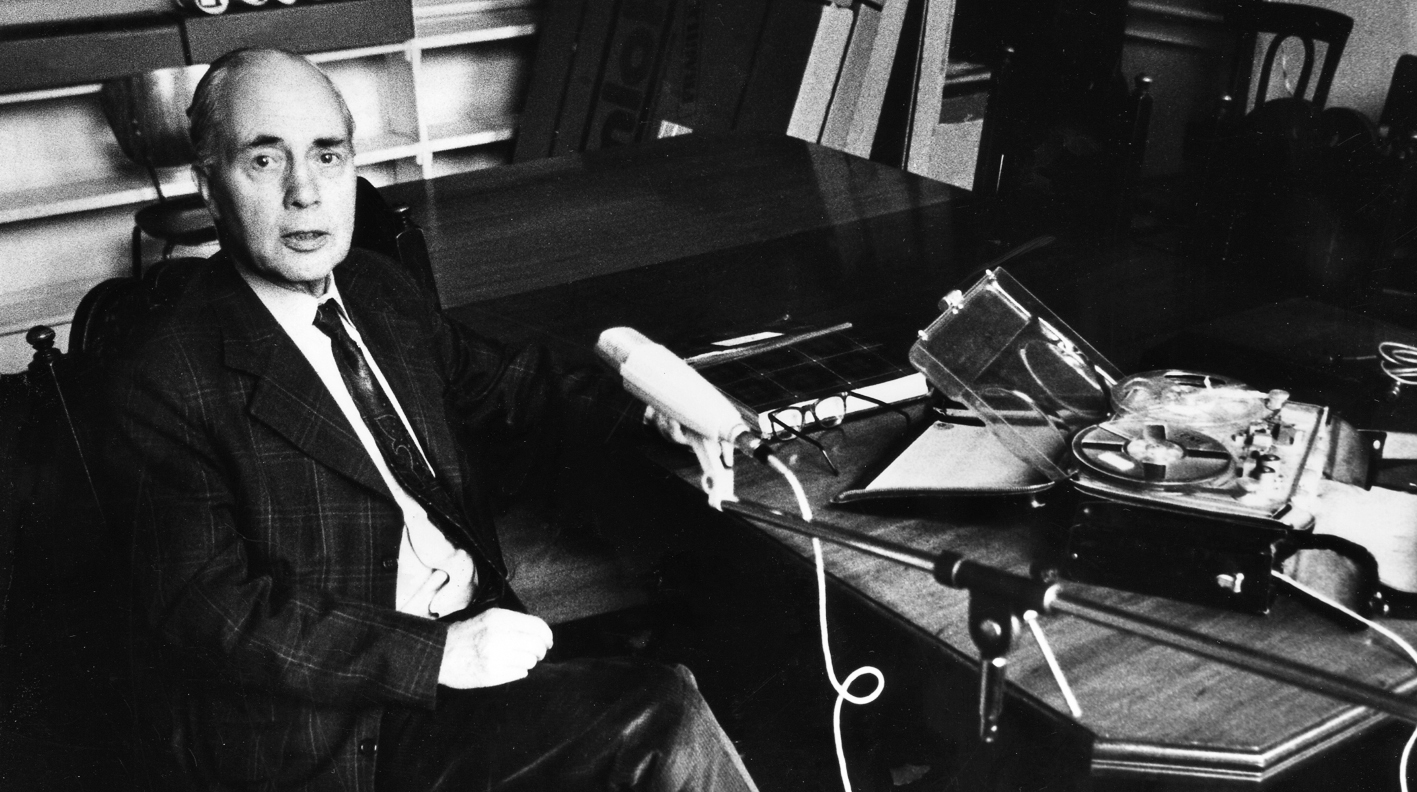
Reverend William Matheson. Image: SSSA Photographic Collection
The singer was the Rev. William Matheson, singing unaccompanied and unhurried, each word clear, important, relevant, just a few stanzas from each song, to illustrate how tunes and words interacted and complemented each other. I still have my own copy of that cassette tape, latterly transferred to a CD when technology moved on. It seems that all the songs in Bàrdachd Ghàidhlig that Matheson, a noted scholar of Gaelic song in all its manifestations, knew or tracked down a tune for are represented there. Nowadays, my first port of call for these songs is Tobar an Dualchais where there are many more recordings of Matheson’s singing. There is the pleasure of revisiting the songs as I first heard them, and then there is the thrill that comes with listening to another version that Matheson recorded, sometimes a longer one, and sometimes with subtle differences in words, tune, or emphasis, just as would happen in a ‘real’ performance. I have learned so much about these songs over the years, and I still keep learning and understanding more about the words and the tunes.
Dr Anja Gunderloch graduated with First Class Honours from this university in 1990 as the first student who took the then new degree in Scottish Ethnology and Celtic. Anja is lecturer in Celtic at the department of Celtic and Scottish Studies.
There are 750 tracks by Rev William Matheson – including material from Bàrdachd Ghàidhlig – on Tobar an Dualchais. You can listen online by following this link.
Session Cases: Celebrating 200 years of Scotland’s prestigious law report series
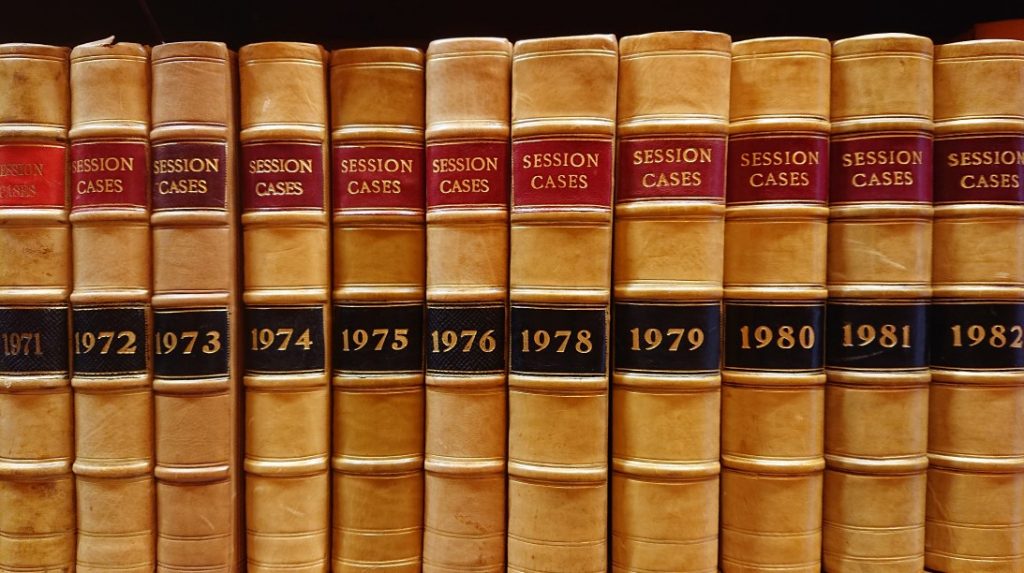
Session Cases volumes 1971-1982, image courtesy of the Supreme Court Library team, SCTS.
This year the Scottish Council of Law Reporting celebrates 200 years of publishing Session Cases, Scotland’s most authoritative law report series. From the SCLR website:
The Session Cases law report series contains all the key appellate decisions, civil and criminal, from the Court of Session and High Court of Justiciary in Scotland together with selected cases decided at first instance.
Also included in Session Cases are all decisions, as issued, on Scottish appeals to the House of Lords and to the Privy Council. All judgments are reported in full.
The judges who gave opinions (judgments) in each case have the opportunity to review the report before it is published – this gives Session Cases its unsurpassed authority in Scottish courts.
The first case ever published in Session Cases was Rev. Wm. Strang v Wm. McIntosh (1821) 1 S.5, dated 12 May 1821. You can access a copy of this case via our subscription databases Westlaw or Lexis Library UK, via the Law Databases page. If you’re not familiar with using these databases we have a recording of a session on Using Legal Databases available here (22 mins) There’s more information about SC and other law reports available via our subscription services on the Law Subject Guide ‘Law Reports’ page.
To mark this anniversary the Scottish Council of Law Reporting is running a poll to determine readers’ top three cases featured in Session Cases. They don’t have to be the most important cases, legally, but may be just a quirky case or one that has caught your interest. You can vote for your cases here: SurveyLegend Survey.
Another way SCLR marked this milestone was by creating a postgraduate research scholarship available to students in Scottish institutions studying Scots Law. The inaugural recipient of this award was Shona Warwick, a PhD candidate at Edinburgh. The scholarship will contribute to her tuition and living costs as she completes her PhD thesis on Leases and Licences in Scotland. From the SCLR headlines page describing Shona’s research:
For commercial landlords and tenants in Scotland, the common law, rather than legislation, is the source of most rules. Yet, despite its widespread practical importance, a lack of research has left the common law regarding leases and licences to occupy riddled with uncertainty. Through a historical study, this research sheds light for the first time on some of the most fundamental unanswered questions: it evaluates which occupancy agreements can be validly created, and how their formation requirements differ.
The announcement of Shona’s success featured in the Scottish Legal News bulletin in September last year. Shona is also the winner of one of the two Scottish Universities Law Institute (SULI) Scholarships. Congratulations Shona!
Queering the Archive: Drag in the School of Scottish Studies Archives
For our second blog and part two to the last blog Queering the Archive, join us as we celebrate the cultural records of ‘drag’ in the archives.
Drag is described as a gender performance artform for entertainment. The term itself developed in British theatre circles in the 19th century but drag has been around as a theatrical and performance artform since ancient history. Drag as performance in Britain is often cited back to being historically popularised in theatre and the plays of Shakespeare and his contemporaries. As was the same with performance in ancient Greek plays, male players could take the stage and thus would have to dress as women for their performance. While drag on stage was acceptable, off the stage is another story entirely. Cross-dressing was illegal and clothing was strictly regulated to gender, and arrests were made if individuals were not viewed as wearing enough articles of clothing within their perceived gender. Generally, theatric circles were one of the only places where drag was accepted in the general public sphere. LGBT+ identities were kept underground due to criminalisation and societal attitudes. Drag was kept in the sphere of performance, literature, bawdy tales, ballads and broadsheets with a few popular and break-out drag and impersonation performers. Drag itself has thrived in queer circles throughout history and has been an important aspect of queer art, performance, and transgression and identity. The first person to self identify as the ‘queen of drag’ was William Dorsey Swann. In the UK, the first drag queen is credited as Princess Seraphina and was a staple of “Molly Houses.” In British stage circles, male impersonation was popular in the Music Hall scene and elsewhere with performers such as Vesta Tilley.
Within the School of Scottish Studies Archives, we have examples of ballads, songs, and cultural tradition that describes drag as performance and entertainment. While the records I have selected are not evidence of queer transgression and identity that comes with drag and gender performance, it is evidence of what exists in the Scottish public sphere of tales and cultural life alongside the previous blog of the ‘Cross-Dressing’ ballads. These oral history accounts describe cultural aspects and accepted fluidity of performance and tradition. A kind of ‘drag’ performance was relatively popular in some Scottish cultural traditions. Through Christmas and New Year’s guising and galoshins customs, both children and adults would often dress in a form of drag for fun and fancy-dress. Guising involved groups of people going from door to door or taking part in singing, playing music, dancing and festivities. Hugh Jamieson, recorded in Gott, Shetland, describes some of the outfits when recorded by Alan J. Bruford. ‘The guisers dressed in home-made outfits with false faces [masks] bought from the shop. The men dressed as women and the women as men. They would dress in wigs and wide skirts, with whiskers made from sheepskins.’ (SA1974.216) Jamieson fondly recalls this custom when asked of dressing up and guising and the fun that was had.
Wat Ramage, recorded at Westruther, describes the songs that were sung and traditions of guising, and how as children: ‘the laddies were made to dress up in women’s clothes, and the lassies would dress in the boy’s clothes.’ (SA1977.205)
Drag and dressing up as characters and creatures was also common in galoshin’s plays themselves and drag in Scottish cultural tradition and customs can be viewed as a form of shared fun and taking part in festivities and theatrics. Of course, drag was not the term that would be used, but the theatrics of dressing up is remembered fondly and put quite simply by Jamieson and Ramage. Drag is also something that exists in many other culture’s traditions and plays outside of Scotland and can be an example of how drag has been shaped by cultural tradition and forms of theatrics and has always existed in different forms in the accepted public sphere throughout history.
Of course, this is just a brief example on the history of drag and performance as well as Scottish cultural traditions and is not a complete history. Drag goes beyond the binary and remains a transgressive artform that is a key part of queer history and the history of performance and tradition. This blog is an attempt to illustrate how our records can show fluidity and societal attitudes in Scottish cultural tradition and theatric spaces.
The records selected from our collection can be accessed via Tobar an Dualchais. This includes but is not limited to:
Hugh Jameson, ‘Guising at Old Christmas and New Year’. Recorded by Alan J. Bruford. (SA1974.216) http://tobarandualchais.co.uk/en/fullrecord/48475
Donald John MacDonald, ‘Duan na Callaig’. Recorded by John MacInnes. (SA1966.064) http://tobarandualchais.co.uk/en/fullrecord/57790
Wat Ramage, ‘Galoshins’. Recorded by Dr. Emily Lyle. (SA1977.205) http://tobarandualchais.co.uk/en/fullrecord/42571
This blog is part of the ‘Queering the Archive’ initiative, which involves intervention workshops as well as blogs of application of queer theory. See past blogs for further details of ‘Queering the Archives’. If you are interested in taking part in the workshops, or if you are interested in researching LGBT+ records, using our collections for your work, or working with us, please contact eholmes@ed.ac.uk
Written by Elliot Holmes.
Elliot is one of the Archives and Library Assistants at the School of Scottish Studies Archives and uses He/They pronouns. You can also find him on twitter @elliotlholmes
Follow @EU_SSSA on twitter for updates and sharing our collections.
Collections
 Hill and Adamson Collection: an insight into Edinburgh’s past
My name is Phoebe Kirkland, I am an MSc East Asian Studies student, and for...
Cataloguing the private papers of Archibald Hunter Campbell: A Journey Through Correspondence
My name is Pauline Vincent, I am a student in my last year of a...
Hill and Adamson Collection: an insight into Edinburgh’s past
My name is Phoebe Kirkland, I am an MSc East Asian Studies student, and for...
Cataloguing the private papers of Archibald Hunter Campbell: A Journey Through Correspondence
My name is Pauline Vincent, I am a student in my last year of a...
Projects
Cataloguing the private papers of Archibald Hunter Campbell: A Journey Through Correspondence
My name is Pauline Vincent, I am a student in my last year of a...
Archival Provenance Research Project: Lishan’s Experience
Presentation My name is Lishan Zou, I am a fourth year History and Politics student....