Home University of Edinburgh Library Essentials
June 21, 2026
New(s) to the Library : More digital newspaper archives
I’m pleased to let you know that following successful trials, the Library has been able to purchase two new digital newspaper archives. Expanding our already extensive collection of digital newspaper archives from the UK and around the world.
The Sunday Times Historical Archive, 1822-2021
Changes to Library Opening Hours
From 15 September 2025 changes will be made to the opening hours of some of our libraries, these changes are set out below. Please check the library opening hours webpage for full details of all library opening hours.
- Semester opening times of four site libraries – Law, ECA, Moray House, Noreen and Kenneth Murray – will be: Monday to Thursday 9am-8pm; Friday 9am-5pm (9am-7pm for Law and Noreen and Kenneth Murray)
- New College Library will close at 5pm Monday-Friday
- Weekend opening hours of the following libraries – Law, ECA, Moray House, Noreen and Kenneth Murray and New College – will be standardised to 12pm-5pm.
- Art & Architecture Library will close for University vacation periods.
Changes at the Western General Hospital Library
The Western General Hospital Library will convert to a self-service Student Study Area from 1 September. The EdHelp service desk and Library will close at 5pm on Friday 22 August, and the small book collection will be moved in the week of 25 August.
Changes at the Main Library
From 1 September, the EdHelp service desk in the Main Library will close at 7pm weekdays and 5pm weekends. This does not affect the opening hours of the Main Library itself, which remains open 24×7.
Feedback
These changes are being made based on analysis of library and service usage and will allow us to provide a more effective service. Comments and feedback from users (both staff and student) can be directed through the normal channel at Information Services Feedback Form | Help | Information Services
What we learned from our conferences : Academic Support Librarians and professional engagement
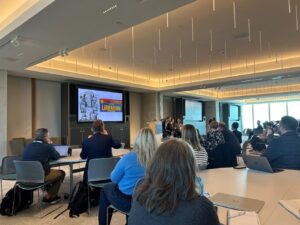
At the RLUK Conference, 2025
The Academic Support Librarians are a learning team, who have attended professional development events in line with the prioritised themes in our team workplan. Ishbel Leggat attended the RLUK conference in Liverpool in March, where she learned “how colleagues at other institutions are embedding AI skills into the curriculum, how Generative AI is changing the HE landscape and how AI could be used to optimise library-related working practices”. The AI theme in our workplan was also explored by Anna Richards at the BIALL (British and Irish Association of Law Librarians) conference, with a view on how AI tools are being used in legal practice and library-led support. Jane Furness attended the CALC online conference in May which enabled her to “build my ability to contribute to and support the work of the ASL EDI group and in my support of ECA students and staff.” In June, SarahLouise MacDonald and Rania Karoula attended the SCURL Conference in Aberdeen which had an EDI focus, where they learned about “new avenues for research based on relevant presentations (specifically on radical hospitality and supporting diverse communities).” And Ruth Jenkins attended the LILAC Library Information Literacy conference in Cardiff, bringing back notes that were shared with team colleagues “… who picked up on different talks and themes so our conversations were different every time.” We share our learning with library colleagues in the ASL blog : https://libraryblogs.is.ed.ac.uk/asl/ Read More
It’s August and induction season is here!

Image by Geralt via Pixabay
Did you know that Academic Support Librarians (ASLs) work year round, even while most students are on their summer break? Here at UoE we have courses starting at different times throughout the year so some members of our team have already been hard at work helping students get settled in and familiar with Library Services right at the beginning of their university journey in Edinburgh.
For example, we have a lot of students who arrive for pre-sessional courses such as the ‘Essentials of English for Academic Purposes’ who began in July in order to complete some language courses before their PG study begins. We like to meet these students and make sure they’re familiar with which resources will be relevant for them, and how to ask for help in the very early part of their course so the information stays with them no matter what they go on to study.
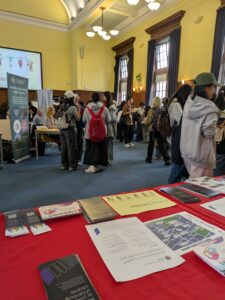
ASLs had a stall at the Community Fairs organised by The Centre for Open Learning (COL) in July
We’ve been providing library introductions for new and returning students in the College of Medicine and Veterinary Medicine, and we’ll soon be welcoming the latest cohort of Professional Graduate Diploma in Education (PGDE) students who will be arriving on the Holyrood campus on Monday 18th August. This group of students traditionally start before other cohorts and spend limited time on-campus as they go out on school placements at the start of the academic year.
To facilitate early arrival on-campus, Ishbel (ASL for Moray House School of Education and Sport) has liaised with Programme Directors for PGDE Primary & Secondary to find out how many new students are expected to arrive for the 2025-26 session (PGDE Primary: 100 approx. & PGDE Secondary: 145-160 approx.) She has liaised with the Moray House Library EdHelp Team and with Pam Wells at the Main Library to arrange for student ID cards to be sent to Moray House Library in advance, which allows PGDE students to collect cards before ‘official’ card collection events take place during Welcome Week. This year, we’ve also had assistance from Jade Fenton (Graduate Library Trainee) and Tim Gray to arrange for Library tote bags to be delivered to Moray House Library in time for PGDE student arrivals.
We’ll also welcome Access students in August. Access courses are designed for adults who are returning to learning after a break and will go on to Undergraduate work in the future – they begin almost a full month before welcome week and continue on for two semesters.
We often talk about how there’s no one-size-fits-all scenario for our students and that’s because there’s so many different courses, circumstances and timetables to account for in our planning. This is just one example of how we’re trying to make sure everyone has a valuable and meaningful library experience no matter when they join us!
Hans Christian Andersen
This month is the 150th anniversary of Hans Christian Andersen’s death. To mark the occasion, Ash Mowat, a volunteer in our Civic Engagement team, has written this blog post, exploring some of Andersen’s works. What is your favourite Hans Christian Andersen tale?
In this blog we shall be exploring two bound and illustrated edition copies of poems by the celebrated, prolific and beloved author of fairy tales the Danish writer Hans Christian Andersen, held at the University of Edinburgh’s Centre for Research Collections.
Brief biography of Hans Christian Andersen
Andersen (2nd April 1805 to 4th August 1875) was born into a modest upbringing, but had been encouraged by his father from an early age to enjoy reading literature.[1] His family situation suffered a tragic loss and further financial decline when his father died when Hans was just aged 11. He received a basic education at a school for poor children until the age of fourteen, and after this initially sought to seek employment in the theatre as an actor or singer, given his artistic talents and interests.
He later returned to more formal education at a grammar school funded by a benefactor of the Royal Danish Theatre in recognition of his talents for writing, especially in the medium of poetry. Andersen would later write record that these later years in education were a miserable time for him in that he was mistreated and discouraged from his favoured ability at creative writing, and also due to the fact that he felt an outsider and misfit due to his family’s poverty. He was also considerably older than the other pupils in his classroom.
He began writing his first stories whilst still at school in the early 1820’s but his first series of fairy tales were published in three volumes between 1835 to 1837. Although initially not very well received critically in Denmark, he would reach success and return to write several more collections of his fairy tales, in addition to authoring novels and travelogues recounting his tours of Europe.
Andersen came to befriend the fellow writer Charles Dickens as they both shared a mutual respect for each other’s work and held similar views on the prevalence and cruelty of poverty, although their friendship later came to an abrupt end to Andersen’s consternation. In his diaries and letters Andersen first wrote of his disinclination to have sexually intimate relationships, then later wrote of his sexual attraction towards men, although the exact nature of his sexual inclinations is uncertain as he was cited as having unrequited attractions for women.
The first booklet of his poetry that I viewed at the University was an illustrated edition of the Ugly Duckling from 1950, that had been created and illustrated by Ann Restall in the Book Production class at the Edinburgh College of Art, with line blocks by Messrs Hislop and Day.[2]
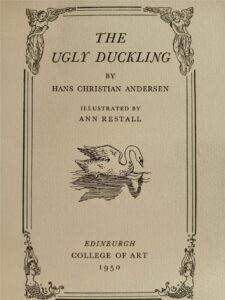
The Ugly Duckling itself was composed by Andersen in 1844, and is one of his most well-known fairy tales which includes many of his recurring themes of feelings of exclusion or the notion of being an outsider or misfit. The location is the countryside in summer and there is a delightful description of the birth of a group of ducklings, each of which are given a voice to articulate their amazement at emerging into life and the expanse of the new environment around them. “Their mother let them look as much as much as they pleased, because green is good for the eyes”, and “how wide the world is”, one of the ducks observes.
The last duckling to emerge is reluctant and also the largest and its mother grows increasingly tired and frustrated at the burden it is placing upon her. When it finally emerges from its shell it is announced as being “frightfully big”. Its mother begins at first to accept the latest arrival but in a series of encounters with other ducks and animals it is repeatedly described in pejorative terms as being ugly, monstrous, ungainly, queer, and mocked and bullied for its strangeness. The impact of the onslaught of these insults affects the ducking so much that it perceives itself as loathsome, unwanted and despised and for those reasons elects to escape and wander on its own. On its travels the duckling encounters a gaggle of Geese who address him as comrade and invite him to join them, only for the geese to be slaughtered by a group of hunters. When the hunter’s dogs’ approach but then ignore the duckling, it remarks “I am so ugly that even the dogs won’t bite me.” As winter approaches, the ducking’s sense of isolation and exclusion are emphasised in the metaphor of the water freezing over to encircle and entrap him. Further such negative encounters follow, but as if to spare the young readers anguish Andersen simply interjects “but it would be too sad to mention all the privations and misery it had to go through during the hard winter.”
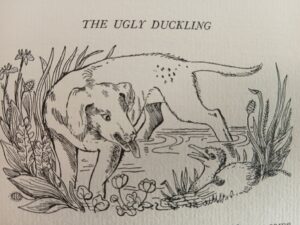
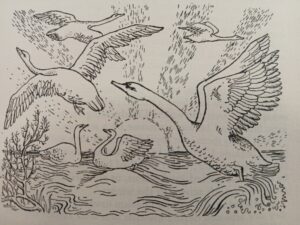
With the advent of Spring, relief and hope come to the rescue as the duckling on seeing his reflection realizes that he is in fact a Swan and he is accepted and welcomed into a family of Swans. The final moral to close the story is “he was so happy, but not at all proud; a good heart never becomes proud.” Across the story we hopefully learn not to judge one another on appearance and not to be cruel and unkind. It also reflects some of the author’s own recorded experience of being bullied at school and not fitting in because of his poverty and being much older than his classmates, and because of his own concerns about his appearance, not being conventionally handsome like many male characters in his tales.
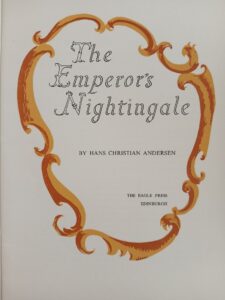
(The image above is from the cover of the second bound story “The Emperor’s Nightingale”, printed in the letterpress department of the Heriot-Watt College, designed and illustrated with lino-cuts by Margaret Jean Mackenzie).[3]
“The Emperor’s Nightingale”, or sometimes simply entitled as “The Nightingale”, was first published by Andersen in 1844. It opens with a stunning and immersive description of the grand palace and gardens of the emperor, to help ensure to ensnare young readers or listeners to the tale being read such that they are immediately transported and enchanted from the start.
As lavish as the palace is with its gold and treasures, they are nevertheless lifeless materialistic items and a gaudy and perhaps vulgar display of wealth. Even the gardens, whilst truly beautiful, were carefully manicured into unnaturally ordered designs at the emperor’s instructions, diminishing the true random assortments in which flowers and trees would form in the wild. By contrast the subject of the Nightingale surpasses all the vanity and contrived array of the palace and its grounds, simply by its natural plumage and the sweet melody of its singings which delights all who experience it. Such is the impact of the Nightingale’s song and its enchanting effects, is that people from across the world come to witness it for themselves. Not having heard of even being aware of the bird, the emperor petulantly demands that it be brought before him to sing in his palace, rather than to hear it where it thrives in the forest.
It is the humbler people working on the estate that have heard the Nightingale and know where it lives, and a kitchen maid leads a group to seek it out to bring before the emperor, although she cautions “it sounds best amongst the trees”. The Nightingale agreed to the invitation, perhaps in truth more of a summons, to sing before the emperor in his home, and when he did the emperor wept tears of joy in witnessing its voice.
Still associating true values as being prized objects and not nature or good deeds, the emperor offers the Nightingale a gold slipper to wear around its neck. The Nightingale refuses this ludicrous adornment remarking that it is reward enough that its singing brings pleasure to others. Not having yet learnt his lesson, the emperor orders the construction of a bejewelled mechanical nightingale which became a thing of worship despite its inferior voice, and the real bird returned to its life in the forest.
After some years the emperor fell gravely ill and the toy bird was no help to him. The real nightingale returned to sing again before the emperor and in doing so healed and restored him to full health. The emperor offered to destroy the toy bird and have the nightingale live at his side in the palace. The nightingale instead agreed to visit and sing before the emperor as often as needed but that he must live within the forest as that is his world and without his natural environment his voice would be stilled.
In essence therefore, this tale cautions against the coveting and valuing of material things over nature, love and simple kindness. Andersen wrote frequently of people of royalty and opulence in his fairy tales, and in this instance the emperor has an epiphany to learn that the true wealth is life and not possessions. There is at times some ambivalence in how Andersen chooses to portray people of wealth, perhaps stemming from the conflict between his own impoverished upbringing and the later fact that he benefited from a sponsor to fund his own education.
These two stories are excellent examples of why Andersen’s tales continue to be loved and read, given that in addition to delivering moral messages, they are also engrossing and entertaining so as not to become dry or dogmatic in tone. The artists’ illustrations also help bring the works to light.
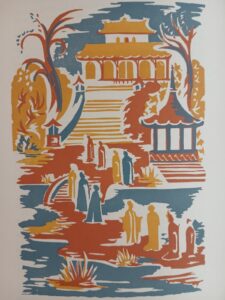
(A finely illustrated page from the book depicting the palace at the summit, leading down thought the gardens onto the sea, its muted colours and simplistic lines helping to convey the moral of the story).
I should like to thank my supervisor Laura Beattie (Community Engagement Officer, University of Edinburgh) for her advice, guidance and support, and all the staff at the University of Edinburgh Centre for Research Collections for their kindness and expertise in enabling me to view these items from the archive.
[1] Hans Christian Andersen – Wikipedia
[2] Booklet containing The Ugly Duckling (2 copies), 1950 | University of Edinburgh Archive and Manuscript Collections
[3] https://archives.collections.ed.ac.uk/repositories/2/archival_objects/29433
An ever-green collaboration: working with the University of St Andrews to identify arsenical bookbindings
In this post conservator Amy Baldwin talks about working with the University of St Andrews to help develop their new arsenic identification tool.
SCURL Conference 2025: increasing inclusion
To add to our recent schedule of conference reports, last month several members of our

The ‘Sir Duncan Rice Library’, University of Aberdeen by Stanley Howe, CC BY-SA 2.0 <https://creativecommons.org/licenses/by-sa/2.0>, via Wikimedia Commons
team attend the Scottish Confederation of University & Research Libraries (SCURL) Conference on the 19th of June, which took place in the striking Duncan Rice Library at the University of Aberdeen.
We were delighted to see that the conference had such an interesting programme focused on the great work member teams are doing across the country to promote inclusivity and diversity of access. Sessions included topics such as ‘Radical Hospitality: how can academic libraries support seekers of refuge?’ and ‘Higher Education librarians and social class background’. There were poster presentations from various member libraries taking action in their own settings, and keynotes from Dr Rachel Shanks, Interdisciplinary Director for Social Inclusion and Cultural Diversity at the University of Aberdeen as well as Beth Hellen-Montague, Head of Library & Information Services, The Frances Crick Institute and author of Practical Tips for Equality, Diversity and Inclusion in Libraries (which is available as an ebook via DiscoverEd).
While all the talks were valuable, Beth spoke very knowledgeably on the practical work of becoming an EDI focused librarian, and while much of what she had to say regarding taking action (that all actions help, we don’t need one person doing inclusion perfectly but rather to take advantage of the positions, groups and access we already have), she also introduced new-to-us concepts such as the Academic Wheel of Privilege which we plan to consider in our future work. This can help us in making assessments regarding building our collections, but also how we approach the cultures around our educational systems and student backgrounds. It also links directly to the work Darren Flynn discussed in his session on social class in academic librarianship.
For more information about the Academic Wheel of Privilege and how it can be used for research, see the FORRT website.
We love to see a strong EDI strand in any conference we attend, and look forward to bringing our learnings from this event to discussions at our ASL EDI group and the wider L&UC EDI network too.
SarahLouise McDonald & Rania Karoula
Academic Support Librarians
New resources: Elgar 2025 ebooks
You may be interested in some of the exciting new ebook packages we’ve purchased recently for use by students and staff in the School.
Edward Elgar Publishing are a well-respected publisher who produce excellent books, textbooks and journals in many subject areas. We often purchase their annual Law ebook package, and this year is no different. Some highlights include:
- Robot Law, volume II edited by Ryan Calo, A. Michael Froomkin, and Kristen Thomasen
- A research agenda for environmental crime and the law edited by Ricardo Pereira and Teresa Fajardo
- Inclusive Rule-Making by International Organisations: Innovations and Challenges edited by Rita Guerreiro Teixeira, Marianna Karttunen, Axel Marx, and Jan Wouters
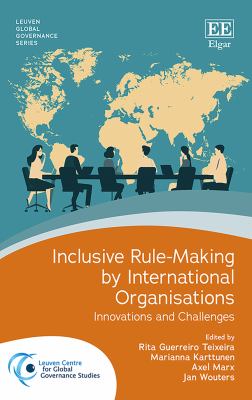
For more information about the books included in the Law 2025 package, visit the Elgar Online website, or search DiscoverEd for ‘Edward Elgar’.
If you have suggestions for books you’d like us to purchase for the library, students can use the Student Request A Book (RAB) service. Staff members can follow the procedure on the Library Support intranet page.
Approaching critical library practice : CALC25
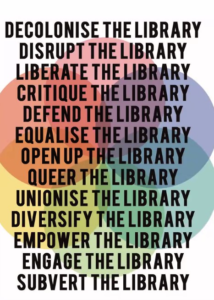
Critical Approaches to Libraries Conference poster
I attended the online CALC25 [Critical Approaches to Libraries] Conference from 13 – 15 May 2025. The programme, slides and recordings are available at https://sites.google.com/view/calcconference/calc2025 It was great to see Alice our Strathclyde placement student there too.
As you would expect from a conference on critical librarianship the programme topics were wide-ranging and diverse. Topics included professional identity, slow librarianship, supporting neurodivergent colleagues, information imperialism, and justice-orientated librarianship. I would highly recommend this affordable conference. It is £15 for 3 days and you can choose to donate a £15 entrance fee for another participant who can then attend for free. Most of the sessions were recorded and are on Youtube or the above website.
Reflections on Attending the BIALL Conference: Exploring AI and Legal Librarianship

University of Edinburgh Law Library Senate Room to Mezzanine View with Students
This year, I was lucky enough to attend the British and Irish Association of Law Librarians (BIALL) conference for the very first time—and I hope it won’t be my last! From the moment I arrived, I was struck by how welcoming and friendly the event was. Thanks to the buddy scheme, I connected with librarians from across the profession, opening doors to future opportunities for sharing knowledge and ideas.
One of the big themes at all library conferences this year is Artificial Intelligence (AI), and BIALL was no different. As one of the AI leads in our team, I was keen to learn how AI tools are being used in legal practice and library-led support. The sessions didn’t disappoint.
Collections
 Hill and Adamson Collection: an insight into Edinburgh’s past
My name is Phoebe Kirkland, I am an MSc East Asian Studies student, and for...
Cataloguing the private papers of Archibald Hunter Campbell: A Journey Through Correspondence
My name is Pauline Vincent, I am a student in my last year of a...
Hill and Adamson Collection: an insight into Edinburgh’s past
My name is Phoebe Kirkland, I am an MSc East Asian Studies student, and for...
Cataloguing the private papers of Archibald Hunter Campbell: A Journey Through Correspondence
My name is Pauline Vincent, I am a student in my last year of a...
Projects
Cataloguing the private papers of Archibald Hunter Campbell: A Journey Through Correspondence
My name is Pauline Vincent, I am a student in my last year of a...
Archival Provenance Research Project: Lishan’s Experience
Presentation My name is Lishan Zou, I am a fourth year History and Politics student....