Home University of Edinburgh Library Essentials
September 24, 2026
New College Library Library is moving August / September 2023

Inside New College Library, Mound Place
In January 2020 the majority of New College Library General Collections were relocated to 40 George Square to provide a Library service for the duration of a major Estates project. This Estates Project has now come to an end. New College Library at 40 George Square will close at 4.50pm on 9th August 2023.
Between 10 August and 10 September access to the New College Library General Collections will be unavailable as they move location. While access to collections is paused the Library will support Library users to identify alternative ways to access required Library resources.
New College Library plans to re-open at Mound Place with full access to General Collections, study spaces and Library services on 11th September 2023.
Further information about the Library is provided on the New College Library website New College Library | The University of Edinburgh
On trial: Brepolis online databases
*The Library now subscribes to both Monumenta Germaniae Historica and Archive of Celtic-Latin Literature. Find out more at New to the Library: Archive of Celtic-Latin Literature and Monumenta Germaniae Historica.”
Thanks to a request from staff in History the Library is currently trialing access to 3 Brepolis databases: Monumenta Germaniae Historica, Archive of Celtic-Latin Literature and Aristoteles Latinus. As well as trialling access to their Cross Database Searchtool which allows you to cross search all 3 of these databases, in addition to their Library of Latin Texts, which the Library already has a subscription to.

You can access all 3 databases plus the cross search database tool via the E-resources trials page.
Trial access ends 5th August 2023.
Monumenta Germaniae Historica (eMGH)
The Monumenta Germaniae Historica was founded in 1819 by the Gesellschaft für Deutschlands ältere Geschichtskunde. It is one of the most prestigious editorial undertakings for the critical publication of medieval historical texts. In more than 300 volumes, covering the widest possible range of historical documents, divided into five major Series (Scriptores, Leges, Diplomata, Epistolae and Antiquitates) and into 33 Subseries, the Monumenta not only continues its editorial programme but it has established for all Western scholarship a standard for critical editions. Read More
Library summer opening and changes to service
Although this blog mainly focuses on the work of the ASL team (who are library focused but often work remotely) we realise that many readers may associate this blog with the physical library spaces, so we wanted to highlight a few things happening over the summer in our library buildings.
Summer opening hours: Main Library
The Main Library is now operating on Summer opening hours. This means the following hours of operation apply:
| Day | Building | EdHelp Service Desk |
|---|---|---|
| Monday – Thursday | 24 hour opening | 9am – 7:50pm |
| Friday | 24 hour opening | 9am – 4:50pm |
| Saturday | 24 hour opening | 12 midday – 4:50pm |
| Sunday | 24 hour opening | 12 midday – 4:50pm |
Please note that this week new gates will be fitted to the Main Library entrance and exit, Café exit gates and the High Use Books exit gates. The works will be carried out between Tuesday 4th July-Thursday 7th, 9:00-5:00pm. You can still access the Main Library, alternate entrances and exits will be clearly marked. You can find out more about this (as well as opening hours for the Centre for Research Collections, Main Library Cafe and links to other information) on the Main Library Opening Hours page.
Summer opening hours: Site libraries
The majority of our site libraries open for reduced hours during the summer. Information can be found on the individual sites listed on the Library Opening Hours page.
The vast majority of our libraries operate from 9am to 4.50pm, Monday to Friday during the summer and are closed at weekends. Exceptions this summer are the Art & Architecture Library and New College Library, which we have detailed below.
Art & Architecture Library
Due to building works in Minto House there is currently an alternative entrance to the Art & Architecture Library. Entering Minto House either via the main reception area or the Maltings entrance, follow the signs downstairs to the temporary library entrance door in the lower ground floor (basement) corridor.
UPDATE: Due to disruption as a result of essential building works within Minto House, it will be necessary to close the Art & Architecture Library between Monday 10th July and Sunday 3rd September. Please email us at library.account@ed.ac.uk for any enquiries or if you urgently require any print resources during this time and we will endeavour to make them available within 2 working days from the Law Library in Old College. Please consult the Art & Architecture Opening Hours page for more information.
New College Library
Due to essential maintenance works all New College Library’s current services except for Special Collections were transferred to the temporary library at 40 George Square in 2020. A schedule for the move of New College Library services and collections back to New College Library, Mound Place in 2023 has now been agreed. The main expected dates are :
- 9 August 2023 : New College Library, 40 George Square closes for General Collections moves.
- 11 September 2023 : New College Library, Mound Place opens for access to services and collections.
Until 9 August 2023, NCL General Collections and Library services will remain fully available for students in the library at 40 George Square. For more information please see the New College Library page.
We hope this is useful for anyone wishing to visit our lovely libraries over the summer. The ASL team will be available throughout July and August, so please contact us if you have any queries, either by email or by leaving a comment on this post.
Launch of a New Open Access Journals Toolkit
by Rebecca Wojturska, Open Access Publishing Officer, The University of Edinburgh
On Tuesday 27th June, the OASPA (Open Access Scholarly Publishing Association) and DOAJ (Directory of Open Access Journals) announced the release of a new Open Access Journals Toolkit. I was fortunate enough to be asked to join the editorial board in my capacity as Open Access Publishing Officer within Edinburgh University Library, and would love to share my experience of helping to write the guide!
The aim of the toolkit was to “promote transparency, accessibility, and inclusivity in scholarly publishing.” As these values align with Edinburgh Diamond (the library’s journal and book hosting service), I very quickly said yes at the opportunity to get involved.
Firstly, I was very pleased to see the board was extensive and included a range of subject experts in Open Access and journal publishing. Having so many board members helped split the workload and meant there were many eyes on each section. The fact that board members are from all around the world ensured that the toolkit wasn’t just from a Global North point of view, and would be useful for anyone, no matter where they are based. It was also great to meet so many of my peers!
The journal toolkit has many topics and provides an overview of the subject, as well as references and further reading for more detailed information. Each board member was each assigned three topics to lead, involving conducting research in this area and writing a section containing everything a reader might need to know about the topic. We were under instruction not to bulk it out too much as the guide was meant to be easy to digest and not too overwhelming for a beginner. The sections then went into peer review, where another board member would look over your contributions and provide as much feedback as they could, giving you scope to revise and strengthen them. Then, a third member would give it a final look-over to catch any last minute errors or omissions. Finally, Research Consulting, who were the consultants pulling it all together, tidied up everything and ensured the toolkit read consistently throughout. Overall, the toolkit was really well-crafted and extensively peer-reviewed.
Library publishing is a growing area, and most if not all of the services and presses within libraries focus on Open Access. However, there isn’t as much guidance or resources available that are tailored specifically to Open Access, especially for under-resourced journals and initiatives, who are the core target users for the toolkit. This is extra important when you consider most teams in this area are new to it and consist of a very small amount of staff. Knowing how to even get started is incredibly daunting, and the toolkit means all those starting steps are laid out for users to follow, making the process more manageable and smooth. Also, having an easy-to-access toolkit means that everyone with an internet connection can find out all the basics they need to consider, and at no cost to them. Even better, most of the content in the toolkit is openly licensed under a Creative Commons Attribution 4.0 International License!
Our Edinburgh Diamond service will be using the toolkit for when we have a new editor looking to launch a journal or flip to Open Access. I’ll also be recommending it to our shared service partners, many of whom run their own Open Access initiatives, as the toolkit is a great way to ensure journals hit the ground running, are of a high standard, and are an attractive option for authors. For us, it helps strengthen the reputation and prestige of our service, helping cement the sustainability and viability of Diamond Open Access in the library.
The toolkit has a very sleek and user-friendly interface, so why not check it out and find out how it could be useful for you too?
Queer Photography Archive
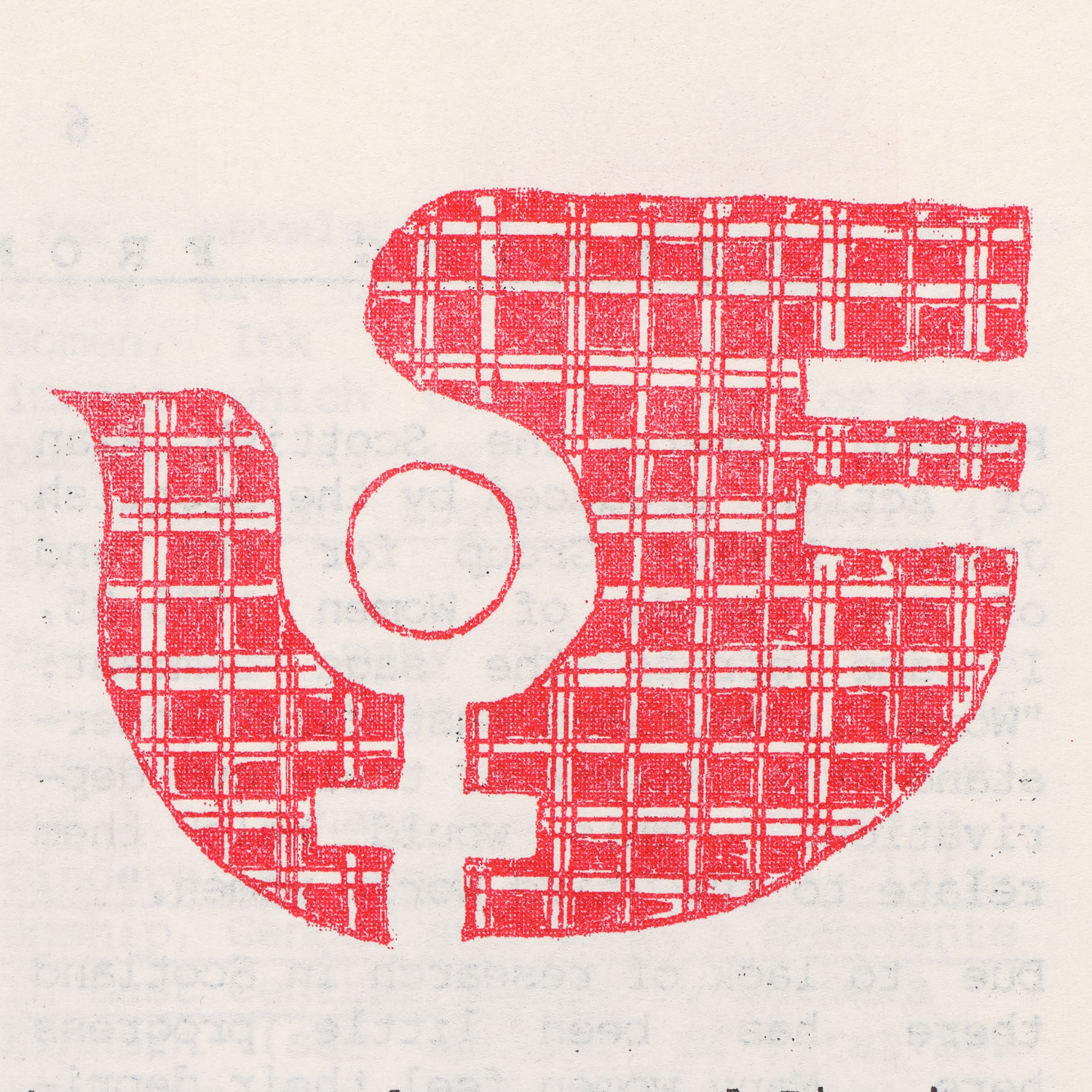
Edinburgh Women’s Liberation Newsletter. detail of Tartan dove.
For the first few months of 2023, I have been using medium format photography to document a collection of zines, posters, photographs and booklets from the Lothian Health Service Archive. The material all relates to the epic struggle to educate on the topic of gay lives and HIV at a time in Edinburgh when bigotry and fear of contracting HIV were prominent, which led to Edinburgh being described in the popular media as the “Aids Capital of Europe.” Read More
Law Library summer opening & support

‘Sunrise, The Meadows, Edinburgh’ by Jeannette King via WikiCommons (CC BY-SA 4.0)
Now that teaching and exams are officially over for the year you may be in the fortunate position of having a long summer ahead of you away from the University. If so, we hope you enjoy it!
For those of you still working or studying over the summer months rest assured that the Law Library is still open weekdays from 9am to 4.50pm. You can find more information about the Law Library and all our other campus libraries on the library opening hours webpage.
If you’re an academic looking forward to planning your next semester’s teaching we’d like to remind you to get your Resource Lists submitted before next Monday (3rd July) to be guaranteed to have your list processed and purchases made before we resume in September. Any lists received after this date will still be processed, but in the order received (so sooner is better).
You may be pleased to hear that your Academic Support Librarian team will also be available throughout the summer! Both Anna and SarahLouise can be contacted by email at any time, so please don’t be shy about getting in touch: law.librarian@ed.ac.uk
Appraisal Made Easy (If Only…): A Day in the Life of an Appraisal Archivist
Welcome to our Day in the Life Series, where each of our new team members will give you an insight into life behind the scenes at the University of Edinburgh’s Centre for Research Collections. In this post, our new Appraisal Archivist and Archive Collections Manager, Abigail Hartley, discusses what she has been up to since joining the Heritage Collections team in March. Expect one more post in this series, as we introduce our Collection Management Technician, Jasmine Hide.
You may have seen the other week my colleague Robyn upload a new blog regarding her role as Collections Care Technician. If you haven’t… Go go go! Take a look at the fantastic work she has undertaken thus far. Once you have returned, it is my turn to introduce myself and the work I’ll be tackling for the foreseeable future.
Let’s start from the beginning, shall we? My name is Abbie and I have been working at the University of Edinburgh as its Appraisal Archivist since April 2023. These past three months I have been creating an appraisal process and enacting some practice runs on smaller collections in preparation of being let loose amongst the backlog of records held at the assorted Heritage Collections sites across campus.
But what even is appraisal?
Student job opportunity!
Interested in paid business experience with a global publisher? The Gale Ambassador Library Support Program may be just what you’re looking for!
The deadline for applications has been extended, so you now have until 13 August 2023 to apply.

Through the Library you have access to a wide range of digital archives and digital primary source databases to help you with your learning and research. Read More
Edinburgh Open Research Conference 2023: in summary
This is a guest post by the Library’s new Citizen Science Engagement Officer, Neil Coleman. All of the materials from the conference may be found on the Edinburgh Open Research Journal page.
After a wonderful three days of talks, workshops, and connecting, we can now call a close to a second successful open research conference. This year, the collaborative efforts of members from the Library Research Support teams (led by the wonderful Kerry Miller) and Edinburgh ReproducibiliTea (facilitated by the talented Emma Wilson) brought together speakers and attendees from all over – allowing connections to be forged with representatives across the UK (and further afield!).
On Monday we were treated to a number of intimate workshops, ranging from a targeted discussion on the future of our very own Edinburgh Diamond, to some practical guidance on how to support good Open Research practices in the Arts and Humanities. We even had the privilege of hosting Edinburgh’s very first ‘Research Café’, where Marshall Dozier, Ruth McQuillan and Lauren Hall Hew spoke about their experiences with Open Research, leading to a delightful discussion about the future of their work, and, importantly, how we might all improve. It was a great first step in this new initiative – a chance to have an in person chat about the trials and tribulations, but also the joy and excitement found in research.
Tuesday was ‘the big day’, with over a hundred in-person tickets sold, and more than 300 online attendees throughout the day. We began with a keynote from Kirsty Wallis (Head of Research Liaison at UCL). Her talk painted a detailed picture of some of the amazing work taking place. This included some stand out discussions of the progress they have been making with their support for citizen science and community connectedness with research; the Euston Voices/Euston Young Voices were really stand out case studies of the impact open research practices can have on the world beyond research.
In depth discussions taking place at the Monday Arts and Humanities workshop.
The remainder of the day allowed us to explore the themes of the conference in depth: looking for tangible solutions to global challenges. Our lunchtime keynotes, Daisy Selematsela and Lazarus G Matizirofa gave us a tour of the current status of Open Research in South Africa and the University of Pretoria in particular. Later, Will Cawthorn (our LERU Open Science Ambassador) spoke about the structures and initiatives that are helping to realise the potential of open science. Sandwiched between these fabulous lectures, a diversity of perspectives were offered in formats including lightning talks – from a community representative of a data-focussed environmental initiative (Pauline Ward, Data 4 Climate Action) through to workflows from Xiaoli Chen (DataCite). Throughout, it was inspiring to see the levels of engagement – with a seemingly unending stream of questions and comments from the room and our online community following on from many of the talks, which continued for the in-person group in a drinks reception.
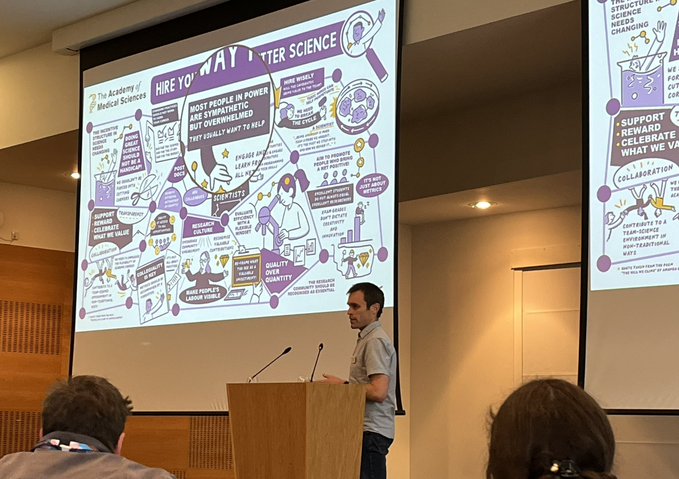
Will Cawthorne presenting on research culture, with perhaps the most beautifully illustrated slide of the day!
The Wednesday closed the workshop sandwich. Gillian Currie and Charlotte Brady worked with attendees to develop ‘Bingo’ cards to promote good academic questioning at conferences. At the same time in the Pentland Suite, the focus was on the 9th Pillar: citizen science and participatory research. Lightning talks from project leads across the colleges were followed by in-depth discussions of the challenges faced by this unique but exciting collection of approaches.
The day and the conference drew to a close in the best possible way: engaging talk with pizza. Facilitated by a wonderful team of early career researchers, the final workshop focused on the relationship between PhD researchers and open research practices. As is typical in all cases of culture change – it has to happen at every level, and there is a risk of early career researchers being left behind. The future of research is open, and so ensuring that those at the start of their careers are well equipped is at the heart of all of the work we do.
With that in mind, then, we can now look forward, where the lessons learned, discussions had, and connections made will ground our work for the coming year. With two successful conferences behind us, this will surely become a tradition with Open Research 2024!
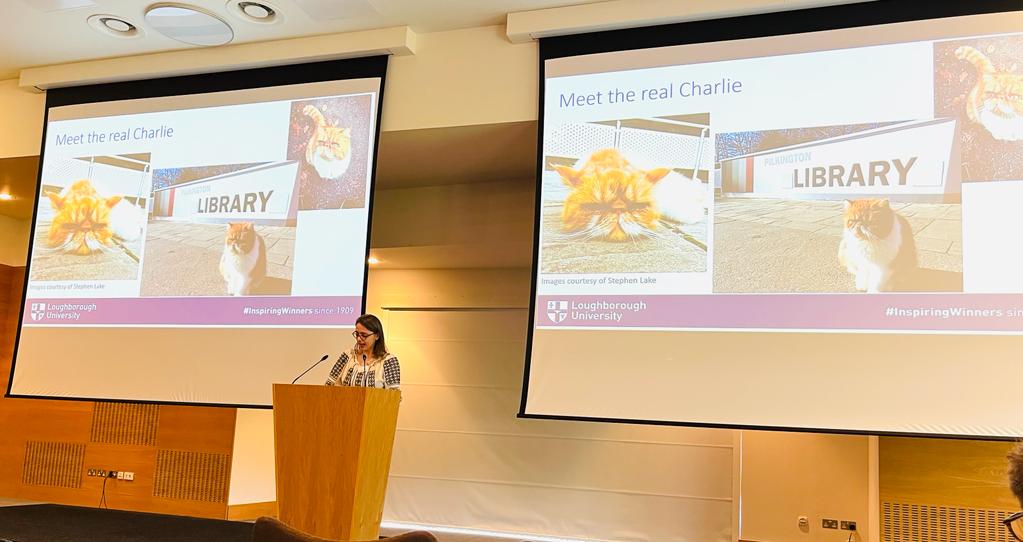
While I would of course never admit to playing favourites, I will admit to being a huge fan of Charlie the cat from Loughborough University who was an unticketed virtual attendee.
New! East African Newspapers
Following a successful trial earlier this semester at the request of staff from the Centre of African Studies I’m happy to let you know the Library now has access to East African Newspapers from EastView. This resource features key newspapers from the region from the 1940s to the early 2000s.

You can access East African Newspapers via the Databases A-Z list, DiscoverEd and the Newspapers, Magazines and Other News Sources guide. Read More
Collections
 Love, Loss, and Literature: Cataloguing the Papers of Irene Jessie Young
My name is Nancy Britten, and I’m in my fourth year of studying History at...
Hill and Adamson Collection: an insight into Edinburgh’s past
My name is Phoebe Kirkland, I am an MSc East Asian Studies student, and for...
Love, Loss, and Literature: Cataloguing the Papers of Irene Jessie Young
My name is Nancy Britten, and I’m in my fourth year of studying History at...
Hill and Adamson Collection: an insight into Edinburgh’s past
My name is Phoebe Kirkland, I am an MSc East Asian Studies student, and for...

Projects
Cataloguing the private papers of Archibald Hunter Campbell: A Journey Through Correspondence
My name is Pauline Vincent, I am a student in my last year of a...
Archival Provenance Research Project: Lishan’s Experience
Presentation My name is Lishan Zou, I am a fourth year History and Politics student....