Home University of Edinburgh Library Essentials
June 20, 2026
LibSmart: All students now automatically enrolled!

We’re very excited to let you know that from this year onwards all students at Undergraduate and Postgraduate level will automatically be enrolled in our LibSmart online information literacy course! If you’ve not encountered LibSmart before, it’s a great way to get to grips with finding and using information available to you via the Library. It’s asychronous which means you can dip in and out whenever suits you across the year, and we tend to find people use it either at the start of term when they need to start looking reading material up, or right before they start research for their assignments.
LibSmart I is our foundation level course, helping students get a good baseline in using our library catalogue, searching for reading materials for courses, and understanding the best places to go for help. We also talk about referencing and plagiarism, something students will need to understand at every level of university life.
LibSmart II is a bit more specialised – it takes a subject-specific look at different topics that people find tricky to work with, such as systematic reviews, data mindfulness and digital news sources. We walk you through different types of resource and processes for working with this information, and hopefully leave you feeling confident of where to start with your assignment or research project. We recommend you complete LibSmart I first, but if you’re feeling confident and ready to dive in to LibSmart II then you’re welcome to start wherever you like!
And if the achievement of completing a module alone doesn’t bring you joy, we also award you some lovely digital badges for each module you complete. You can save them and use them as evidence of the self-directed learning you’ve completed via LibSmart – something that could look very attractive to future employers!

Earn digital badges for every module you complete in LibSmart I and II.
To access LibSmart, simply follow these steps:
- Visit www.learn.ed.ac.uk
- Log in using your UUN (normal university username and password)
- On the left hand navigation, select ‘Organisations’
- Locate LibSmart I: Your Library Research Starts Here (2023/24) from the list, or LibSmart II: Advance your Library Research (2023/24).
- Click into the course and start working your way through!
If you would like some further information on LibSmart you can find out more on our LibSmart webpage which includes information about the modules available and a look at what previous students have found most useful about the course. Of course if you have any questions please leave us a comment or email us.
Giving Decorated Paper a Home … Rehousing Books and Paper Bindings
In the first post of this two part series, our Collection Care Technician, Robyn Rogers, discusses her Decorated Paper rehousing project. If you want to learn about the uses, production, and trade of decorated paper, you can visit the online exhibition on this collection, curated by Elizabeth Quarmby Lawrence, here. Look out for the second post in this series soon, in which Robyn will discuss mounting loose leaf papers.
Things I’ve learnt from working with the BITS Magazine by Digi Pres Intern Jasmine Patel
Re-blogged from Information Services Group: Student Employee Blog
Programme of Study and Year: 1st Year German
Intern Position: Digital Preservation Intern
Hobbies: Piano, a sprinkling of violin (and soon flute!), running and tea

“Don’t assume you’ll be able to read your email if you go to the States” and other things I’ve learnt from working with the BITS Magazine this summer.
New ebooks: Hart Law 2023 collection
Welcome to the Law School to all our new students and welcome back to our returning students! You’ll be glad to know that the library has expanded it’s ebook collection ahead of the new academic year and we now have access to Hart’s 2023 Law collection.
Some highlights include:
- Agency, Morality and Law, written by Joshua Jowitt
- Public Health Crisis Management and Criminal Liability of Governments: A Comparative Study of the COVID-19 Pandemic, edited by Michael Bohlander, Gerhard Kemp, and Mark Webster
- Self-Determination in the International Legal System: Whose Claim, to What Right? written by Tom Sparks
If you have suggestions for books you’d like us to purchase for the library, students can use the Student Request A Book (RAB) service. Staff members can follow the procedure on the Library Support intranet page.
A Scottish Witness of the Great Kantō Earthquake
To mark the centenary of the Great Kantō Earthquake of 1923, we are publishing a blog by Ash Mowat, a volunteer in the Civic Engagement Team, which explores the archives of a Scottish survivor. The composer Sheena Tennant Kendall was resident in Japan from 1919 to 1924 and lived through the catastrophe, describing its impact in her diary and photographing the ensuing devastation. Read More
Image to Text: Exploring Text Extraction Processes in L&UC
 Since April I have been an intern with the University of Edinburgh’s Cultural Heritage Digitisation Service (CHDS) and the Centre for Data, Culture and Society (CDCS), looking into text extraction processes at the University, both in library practice and thinking about how this is taught within digital scholarship. Throughout the internship I have had the opportunity to do both independent research and discussions with staff across the Library and University Collections (L&UC) to get a more in-depth understanding of text recognition processes. Read More
New trial: Oxford Encyclopedia of EU Law
You may be interested to know about a trial we have currently running for the Oxford Encyclopedia of EU Law. From the publishers’ website:
A year ago, the Oxford Encyclopedia of EU Law (OEEUL) was launched as a new product within the Oxford Public International Law (OPIL) family. Providing high-level analysis of European Union law by specialized distinguished contributors, OEEUL articles define, explain, and analyze EU law’s key legal concepts in an accessible yet profound way. It is a source of great pride for the OEEUL team that in its first year, the encyclopedia has grown from the initial 100 entries to its current 131 articles – with the team dedicated to increasing this content by tenfold in the coming years to eventually cover the entire EU legal order.
This database is offered via the Oxford Public International Law (OPIL) platform, where we also subscribe to the Max Planck Encyclopedias of International Law, and the Oxford Reports on International Law; both key resources for research and study.
The trial for the Oxford Encyclopedia of EU Law runs from 16th August to 16th October 2023, and the databases can be accessed via the E-resources trials page. Please have a look at the content provided and let us know what you think using the Trial feedback form. All comments will help us decide whether to subscribe to this resource going forward.
Coming full circle
The ins, outs and upside downs of Digital Research Services and lessons learned in the process.
I’ve spent the past three months working as a Researcher-in-Residence for Digital Research Services (DRS) at the University of Edinburgh, marking a transition from the completion of my PhD in which I stumbled my way through digital techniques, to the next exciting step in my career pathway as a training fellow for the Centre of Data, Culture and Society. This progression was greatly assisted by the experiences I acquired during my time with DRS, brief though it was. In particular, through reflection, awareness and facilitation of digital services and the research lifecycle in general, I developed a greater understanding of what digital research can offer, but also the roadblocks we’re slowly overcoming to get everyone there.
I came into this role as an emerging scholar in digital humanities, still getting to grips with the possibilities out there and slowly recognising the value the digital world harbours – a value I had previously dismissed or simply wasn’t aware of during my undergraduate studies. It is of course very easy to stand safely on solid ground, and reject the gleaming digital world over on the other side. Yet, over the weeks I’ve spent with DRS, I’ve seen various toolkits and techniques come past that could have been so useful, if I’d only known or gone looking for them. More than once, I’ve had a ‘wait, you can do that?’ moment when investigating different options available to the academic community. We are very fortunate to have so many amazing resources available right at our fingertips, thanks to the wide range of services the University provides access to, and I can strongly encourage anyone pondering the choice to go digital to give it a try! After all, there’s nothing to lose, and in the process you might discover that there are more effective ways to share your data with others (i.e. DataShare), safer and more secure ways to store and archive it (e.g. DataStore or DataVault), and faster and more reliable methods to analyse it that won’t destroy your personal device (meet Eddie or Eleanor some time).
This however alludes to the second major realisation I acquired, which is the importance of outreach and engagement to bring researchers over to the digital side. There’s no escaping the fact that researchers won’t go looking for digital assistance if they’re unaware that it’s available in the first place. This has been a major part of my role over the summer, and I’ve come to appreciate just how difficult this is within an organisation that is as multi-layered, complex and vast as the University service support system. Not only do we want to highlight our services to the target users themselves, but we also want to facilitate beneficial bridges between various organisational teams within the University network and DRS. Yet incorporating our events, trainings and seminars into their training centres, Learn pages and SharePoint sites is no small task! Nonetheless, by doing so we can provide the missing links or training that research communities are seeking, and augment pre-existing frameworks to develop a more holistic programme, that addresses needs across the diverse spectrum of applied research. This goal has been gaining traction, so watch this space (or rather, your inboxes) for more information in the coming academic year.
Finally, the third major insight I acquired concerned the current lack of digital equity within the research community. There is a certain reluctance that particular research communities or individuals have towards digital techniques. Yet, why people would avoid using tools that could make their research easier, faster, replicable and more statistically powerful? After all, despite the higher risk, most of us would opt for motorised transport these days rather than a horse and cart. Through cross-disciplinary discussions and peer-to-peer feedback, it became clear this reluctance didn’t stem from dislike or disinterest, but rather a lack of the right skillset and knowledge to approach digital tools. I myself was fortunate to have had enough of a digital background to take the necessary steps for my own PhD project, as some of the foundational stepping-stones had already been laid for me. For those coming from zero however, this is not so much a step as a leap of faith, and nobody likes ending up stuck in the mud. Adequate information and tailored training that speaks to these concerns, introduces researchers to the tools available, and guides them through digital services is a keystone in our aim to create a ‘DRS for everyone’. This will also be reflected in the calendar of DRS events for the upcoming academic year, and if you’re curious or keen to develop your digital skillset, then make sure to check out our webpage, and social media (X and LinkedIn) for updates and information about these events.
And so finishes my three months with DRS. A great opportunity to bring a little more attention to this fantastic service within the University, a chance to help other academics push their research into new territory, and a catalyst for changing the way I will approach research in the future. In the process, I can only hope this position has facilitated a few more bridges between various CAHSS communities within the University and the world of digital research on the other side. Hopefully, with time there will be fewer wet socks and more digital successes in the future.
Sarah Van Eyndhoven
Researcher-in-Residence
Digital Research Services
Pseudoscience and the supernatural: from phrenology and eugenics to ghosts, deceptions and mistakes, UFOs and conspiracy theories (Part 3)
Ash Mowat is one of our volunteers in the Civic Engagement Team. Ash has been looking into the relationship between pseudoscience and unexplained phenomena. In Part 1 of this blog post, Ash explores the science of pseudoscience and the papers of the Eugenics Society held in the University of Edinburgh Archives. In Part 2, he looks at a letter in the University Archives from Arthur Conan Doyle, describing ‘psychic disturbances’. In this final part, he looks at UFOs and some material in the archives about ‘retrievals of the third kind’.
UFOs and extra-terrestrials
It is perfectly reasonable to apply scientific processes to conclude that is likely or at least probable for there to be intelligent and technologically advanced life elsewhere in the universe, even if we have as yet no evidence of even microbiological life outside of our own planet.
NASA research starting with an estimated of some 300 million potentially habitable planets in our galaxy, is using the Kepler telescope to filter through these. Some 2800 exoplanets have been identified, and by using the Drake equation a few hundred possible earth like planets calculated to have better potential for facilitating the development of intelligent life and scope for technological advances. [1]
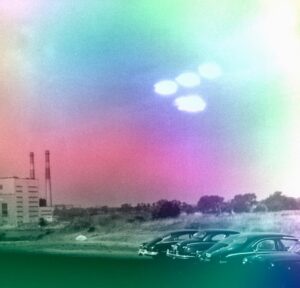
(Image above from https://www.newyorker.com/magazine/2021/05/10/how-the-pentagon-started-taking-ufos-seriously )
The problems posed to any communication with, let alone a visitation from, any alien life out there is complicated by issues of distance and timelines. The very nearest located potential earth like planet in over 30 light years away, and most of them farther still. Current technology and known physics prevent travel of such distances. The lightweight unmanned NASA vehicle Voyager travels at tens of thousands of miles per hour yet would still take tens of thousands of years to make such a journey. [2] Even if a piloted ship could travel at such a speed, how vast must the crew and vehicle be to avoid inbred genetic collapse over such long a time, where would all the food fuel and water come from, and what physical and psychological harms would be suffered by any such crew living their entire life on a cramped spaceship in the depths of space. Werner Herzog’s faux documentary film the Wild Blue Yonder explores some of these conflicts in an entertaining and provoking piece of art.
Aliens or indeed humans may develop better travelling technologies, but one other barrier are timelines not matching between distant worlds. Our earth is some 4.5 billion years old, yet modern humans first emerged out of Africa around 70,000 years ago. Further, we’ve only had the ability to send radio waves and later vehicles into space for some decades. Other planets may have intelligent life and technology but only for periods of time that precede or come after our own.
Perhaps the most likely, if still improbable, communication from another planet may be detected as a radio signal via NASA SETI project, and not in an actual visit to our earth by some hopefully benign aliens. Sadly, even were such a signal received it would be so old in origin as not to permit a response to a civilisation and planted that may now be dead and gone.
To assert that UFOs have actually visited our planet is another matter, and one that requires serious evidence.
A visit to the University of Edinburgh archives on UFOs
I visited the library to view ‘Retrievals of the third kind: a case study in alleged UFO’S and occupants by military history, dated 1978’. [3]
The case study itself was forwarded with a covering letter to the then Prime Minister of Canada, the letter sent from Andrew Michrowski. The letter proposes consideration to establish a global scientific group to be established to investigate all reported UFO, and devolve this from a military jurisdiction over allegations of secrecy. The letter boldly declares “there is a vast number of scientists and technical persons (probably in the tens of thousands) who either have had contact with UFO phenomena, or who have been able to come out convinced of their existence”. There is no supporting evidence of this level of scientific belief in UFOs either in the letter or case study.
The letter also reports the former United Nations secretary general Mr U Thant to have publicly stated “aside from the proper redistribution of food, the UFOs present the most important problem in the world”.
The case study itself was written by Leonard H Stringfield, a published author on UFO events. In it he outlines that those involved in UFO research mainly adopt one of two positions as to what they are, either they’re a psychical or parapsychal event, or alternatively they are an actual visitation from an alien race with the advanced technology to develop vehicles that can make the immense journeys required to reach us. The author of the case study favours the latter. He misuses, at least in the scientific sense, the word theory: “there are many other provocative splinter theories…theories are free and a dime a dozen”. That might be a harsh observation to make, as theory is used more loosely in general conversation, nevertheless this is from someone calling for scientific research.
He refers to around 13 thousand reports of alleged UFO’S held with air force base in Washington but available for the public to study. Air force base established “project blue book” in 1957 to specifically investigate reports of UFOs. It closed in 1969 during when they concluded “nothing has come from the study of UFOs in the past 21 years that has added to scientific knowledge.” [4]
There was a flurry of public interest in UFOs in the USA in the 1950s[5], the period focused on in these case studies. Interest had waned in the 1960s, perhaps because of the interest from the developments in US and USSR manned space travel missions. However, the year before this case study was written, the blockbuster movie Close Encounters of the Third Kind, had been released and rekindled interest in UFOs.
The 22 examples in the case study are termed “retrieval of the third kind”, a term coined by its author to mean examples when crashed alien spacecraft were found and taken into storage by US military, often with the bodies of aliens themselves that had died in the incidents. The cases all focus on the US military in terms of witnesses, and occur in remote desert areas often near military bases. The author is suspicious of a conspiracy of silence “we must also take a new look at the possibility of a grand official cover up”. He includes the military, secret service agents, and the media of being involved in this.
Before detailing his twenty or so alleged incidents he states “I cannot refute the credibility of any of my informants”, but also “I do not possess single affidavit to prove that any one of my informants has seen a retrieved craft or its occupants. I only have their testimony.”
All the testimonies are quite short and quite loosely detailed. They often share a lot of similarities, for example the space crafts are widely described as metallic, something like aluminium, and about 30 feet in length. The aliens themselves are commonly recorded as being of small stature, between 4 to 5 feet tall. Similarity could indicate consistency, but equally it could be suggest copycat reporting, or the influence of images of UFOs and aliens in popular science fiction books, television or movies.
The testimonies are a mixture of anonymous and named individuals, often employed or connected with the military. They all report senior staff firmly warning all witnesses to remain entirely silent. Craft and, where discovered, alien bodies, were removed and placed into storage in US army bases, one testimonial citing that up to 30 aliens were held from various crash episodes. The author includes two rudimentary drawings (see below) he made of an alien face and hand, based on a description given to him by one of the witnesses of an alleged encounter with one.
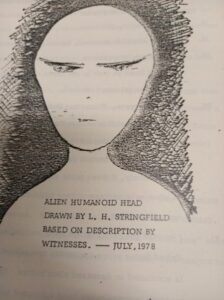
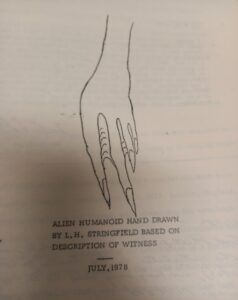
There’s a lack of independent witnesses, i.e. members of the public. There’s a description of film footage taken of an alien craft, but no film itself, no photographs, no physical evidence provided of any UFO’S or their occupants. That lack of proof does, of course, fit with the author’s stance of a conspiracy of secrecy and cover ups.
Ultimately, I’m reminded of the quote by the late, great cosmologist Carl Sagan[6]: “extraordinary claims require extraordinary evidence”. It seems, to me at least, that for then and know, the UFO and alien visitations to earth are best confined and enjoyed within the realms of science fiction.
Conspiracy theories
Conspiracy theories purport to identify and expose instances such as when powerful people, governments or institutions, abuse power, exert harm, and evade punishment (my definition). Sometimes genuine conspiracies do occur, consider the decades of the tobacco industry burying and suppressing evidence of the medical harm of cigarettes in an effort to evade responsibility and retain their profits.[7] Or equally actions by the Catholic and other churches to deny the existence of child sexual abuse and to protect rather that report perpetrators.
The term conspiracy theory now mostly alludes to improbable events that overlook evidence that refutes them.[8]
As an example, I was brought up to believe in an early and popular example, that JFK was not assassinated by Lee Harvey Oswald alone or at all, but that he was a victim of an internal US political conspiracy to end his presidency due to his liberal views on racial equality and wishes to have dialogue with opposing Communist Russia and end the Vietnam war. [9]
Such conspiracy theories can be a form of comfort or escapism, where it is harsh and hard to accept that in a random act, a lone and unspectacular individual killed a person of power, influence and renown. There can be a desire to import that some wider actors and influences must have been involved, to make sense of such a national loss. (Not that JFKs personal, political or pioneering legacy has uniformly lived up in biographies and testimonies, but that’s another subject well explored elsewhere).
My perhaps biased and certainly uninformed beliefs in this area were further instilled after watching Oliver Stone’s JFK movie in 1991. This film presented a dizzying array of plots involving the CIA, the mafia, anti- Castro Cuban groups, and revealed a colourful array of likely involved assassin cohorts. It’s a very entertaining movie, mostly due to the performances, but since I’ve read further into the crime, I now totally accept the view that the film is entirely bogus, harmful as false history, befuddled with implausible nonsense, and of the opinion that Lee Harvey Oswald alone killed JFK and was not connected with any others in a conspiracy to do so.
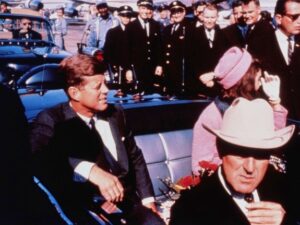
(Image above from https://fivethirtyeight.com/features/the-one-thing-in-politics-most-americans-believe-in-jfk-conspiracies/ )
Two books in particular, American Grotesque by James Kirkwood (1970) and Case Closed by Gerald Posner (1993) convinced me, at least, to accept Oswald acted alone. Firstly, the premise of all the conspiracy theories seem wholly implausible (how many hundreds or thousands of people would have to be involved in and stay silent on an event involving US Government, the Mafia, ballistic and other investigators, the majority of the actual crime witnesses, hospital and autopsy staff etc.).
Secondly, the investigator Jim Garrison who took the conspiracy case to the US courts, was exposed in both these books to have been unprofessional in dealing with often unreliable and prejudiced witnesses, in poorly asserting evidence, bias towards members of the gay community, and prone to personal grandeur and paranoia. Case Closed also meticulously, at least to me, dismisses all evidence beyond reasonable doubt that Oswald alone committed the murder, eliminating convoluted preposterous plots and distilling the facts forensically.
This is my view. Clearly, I have not seen or ready anything like all the evidence on all sides on the JFK killing, therefore it’s entirely valid for others to still pursue and doubt the official findings of the case.
More recently, Covid virus origins and related issues such as Government responses and vaccine and other interventions have become rife. The tone and views expressed in Covid debates can themselves illustrate the bridge between genuine scepticism and concerns, aside from the more unhinged and unfounded discussions. For example, Covid vaccine pioneer Dame Sarah Gilbert, has correctly asserted the right to question scientific progress without by doing so being necessarily irrational or deluded.[10]
For example, some people question the safety and long-term efficacy of Covid vaccines, given how rapidly these were developed and deployed. To have such doubts is not evidence of uninformed thinking, as with HIV and AIDS we’re yet to have a vaccine after over 40 years (although fortunately we’ve an effective virus suppressing treatment). Distinct from such rational questioning, beliefs in a laboratory created virus deliberately spread and endorsed by Bill Gates or others, deserve neither serious attention nor credence. Worse still are the grotesque and deeply damaging conspiracy theories denying School Shootings or terrorist events despite overwhelming evidence of their occurrence, often monetising for the purveyors of such lies, and always an appalling insult to the victims and families affected.
Finally, I’d like to end on an entirely personal view on debating opposing views with others. Personally, I love to converse with those whose opinions differ from mine, and indeed relish when a point I’d not considered is raised and I consequently revise my position.
There are two categories of debate, however, that I’m reluctant to engage in: the hateful and the ludicrous. The hateful includes white supremacists and holocaust deniers, the ludicrous flat earth society believers. It can prove a draining and damaging pursuit to be exposed to discussions with such fervent believers of nonsense, especially where confronting someone wholly indisposed to change their mind. That said, we’ve a collective duty as people to always inform and educate always against all mistruths, and happily there are experts and journalist dedicated and equipped to help inform and re-educate people, who may have been groomed by others into adopting such beliefs.
[1] https://www.seti.org/press-release/how-many-habitable-planets-are-out-there (accessed 3.1.2023)
[2] https://voyager.jpl.nasa.gov/mission/status/ (accessed 2.1.2023)
[3] https://archives.collections.ed.ac.uk/repositories/2/archival_objects/66302 (accessed 5.1.2023)
[4] https://en.m.wikipedia.org/wiki/Project_Blue_Book (accessed 4.1.2023)
[5] https://www.bbc.com/culture/article/20220714-the-ufo-sightings-that-swept-the-us (accessed 4.1.2023)
[6] https://en.m.wikipedia.org/wiki/Sagan_standard (accessed 5.1.23)
[7] https://en.m.wikipedia.org/wiki/Tobacco_Master_Settlement_Agreement (accessed 5.1.2023)
[8] https://en.m.wikipedia.org/wiki/Conspiracy_theory (accessed 4,1,2023)
[9] https://en.m.wikipedia.org/wiki/John_F._Kennedy_assassination_conspiracy_theories (accessed 4.1.2023)
[10] https://www.google.com/amp/s/amp.theguardian.com/society/2022/jun/26/vaccinologist-sarah-gilbert-vaxxers-astrazeneca-we-need-to-be-better-prepared-for-a-new-pandemic (accessed 6.1.2023)
New Resource: Law Library of Congress Reports (HeinOnline)

Recently HeinOnline has added the Law Library of Congress Reports to its online databases offerings. From Hein’s website:
The Law Library of Congress was established in 1832 as a separate department of the Library of Congress. Its mission is to provide authoritative legal research, reference and instruction services, and access to an unrivaled collection of U.S., foreign, comparative, and international law. To accomplish this mission, the Law Library has assembled a staff of experienced foreign and U.S. trained legal specialists and law librarians, and has amassed the world’s largest collection of law books and other legal resources from all countries, now comprising more than 2.9 million items, including one of the world’s best rare law book collections and the most complete collection of foreign legal gazettes in the U.S.
The Law Library produces reports on foreign, comparative, and international law in response to requests from Members of Congress, Congressional staff and committees, the federal courts, executive branch agencies, and others.
This database includes more than 3,500 reports from the Law Library of Congress on foreign, comparative, and international law—all in one easy-to-navigate collection. HeinOnline offer a helpful LibGuide which can help you explore the content further, and you can access the database itself via the Library Databases pages.
Collections
 Hill and Adamson Collection: an insight into Edinburgh’s past
My name is Phoebe Kirkland, I am an MSc East Asian Studies student, and for...
Cataloguing the private papers of Archibald Hunter Campbell: A Journey Through Correspondence
My name is Pauline Vincent, I am a student in my last year of a...
Hill and Adamson Collection: an insight into Edinburgh’s past
My name is Phoebe Kirkland, I am an MSc East Asian Studies student, and for...
Cataloguing the private papers of Archibald Hunter Campbell: A Journey Through Correspondence
My name is Pauline Vincent, I am a student in my last year of a...

Projects
Cataloguing the private papers of Archibald Hunter Campbell: A Journey Through Correspondence
My name is Pauline Vincent, I am a student in my last year of a...
Archival Provenance Research Project: Lishan’s Experience
Presentation My name is Lishan Zou, I am a fourth year History and Politics student....