Home University of Edinburgh Library Essentials
April 13, 2026
New to the Library: Migration to New Worlds
I’m happy to let you know that the Library now has access to the fascinating online resource Migration to New Worlds due to a collaboration between Jisc and the publishers Adam Matthews.

You can access Migration to New Worlds via the Databases A-Z list.
This unique collection brings together varied primary source material recounting the many and varied personal experiences of migration from the ‘Century of Immigration’ (1800-1924), though you will find some material from pre-1800 and post-1924. Read More
Highlights from the RDM Programme Progress Report: November 2015 – January 2016
Data Seal of Approval have awarded DataShare Trusted Repository status; their assessment of our service can be read at https://assessment.datasealofapproval.org/assessment_175/seal/html/. In addition a major new release of DataShare was completed in November, this makes the code open in Github as well as making general improvements to the look and feel of the website.
The ‘interim’ DataVault is now in final testing and will be rolled out on a request basis to those researchers who can demonstrate an urgent need to use the service now rather than waiting until the final version is ready later this year. The phase three funding for development of the DataVault has been received from Jisc, this runs from March to August, so the final version should be ready for launch sometime after this. The project was presented at the International Digital Curation Conference in February 2016.
Over the three month period a total of 328 staff and postgraduate researchers have attended a Research Data Management (RDM) course or workshop.
Work on the MANTRA MOOC (Massive Open Online Course) was expected to be finalised in February and launched on 1st March, at the following URL: https://www.coursera.org/learn/data-management.
University of Edinburgh wrote the Working with Data section (one out of 5 weeks of the course) and with the help of the Learning, Teaching and Web division of Information Services completed two video interviews with researchers and a ‘vox pop’ video clip of clinical researchers at the EQUATOR conference in Edinburgh in autumn, 2015. The content is open source and videos can be added to our YouTube channel to help with promotion. There will be some income from this, but a smaller portion than our partner, the University of North Carolina, based on certificates of completion priced at $49 or £33.
The need to create a dataset record in PURE for each dataset published, or referenced in a publication, is now being emphasised in all Research Data Service communications, formal and informal, and to staff at all levels. Uptake is understandably low at this point but we hope to see a steady increase as researchers and support staff begin to see the benefits of adding datasets to their research profile. In the case of DataShare records, a draft mapping of fields between DataShare and PURE has been produced as a start of a plan for migrating records from DataShare to PURE.
By the end of January 2016, 69 records had been created and published on Edinburgh Research Explorer.
Four interns have been employed using funding from Jisc as part of the UK Research Data Discovery Service (UKRDDS) project which aims to create a national aggregate register of data sets. A trial site is available at: http://ckan.data.alpha.jisc.ac.uk/. The UKRDDS interns will help to create PURE records and upload open data into DataShare, and raise awareness of RDM generally within their schools. There are currently three PhD interns in place in LLC, SOS, and Roslin, two more in LLC, & DIPM will start in February. The approach each intern takes will depend on the nature and structure of their school and will, in some cases, be mediated by research administrators.
An innovation fund grant has been received to fund the delivery of an exhibition “Pioneering Research Data”. Each college will be represented by a PhD intern, the recruitment of these has already begun and they should be in post by the end of March. The Exhibition is due to be delivered in November of this year.
National and International Engagement Activities
Robin Rice led a panel at the IPRES conference, Chapel Hill, North Carolina, on 3rd November called ‘Good, better, best’? Examining the range and rationales of institutional data curation practices’.
Robin Rice had a proposal accepted for the forthcoming Force11 (2016) conference, on Overcoming Obstacles to Sharing Data about Human Subjects, building on the training course we are delivering, Working with Personal and Sensitive Data.
Kerry Miller
RDM Service Coordinator
The DataVault sprints ahead
Phase three of the DataVault project is now earnestly underway. Two weeks ago we held the first of our monthly DataVault project meetings, with Mary McDerby and Thomas Higgins (University of Manchester) visiting us in Edinburgh. One of the changes we are making to this final six month phase is to move to fortnightly development sprints.
We’re now almost at the end of the first sprint, so reviewed the outputs during a Skype call today. We use Trello to manage a backlog of tasks, which then get selected for the next sprint. Most of the development tasks are now completed or almost finished. We also started planning the stories to be tackled in the next sprint, however due to Easter, this will be a little shorter than normal:

In the first sprint (sprint 1) we undertook some rationalisation of the API (as it has grown arms and legs over time), added an enhanced auditing feature (using the PREMIS ontology), added an improved runtime configuration option, and provided better error reporting for a problem that occurs when the CSRF tokens timeout. As always, all of this can be seen in the project’s github account.
In the next sprint we’ll be fixing a few bugs and some of the terminology used (replacing ‘restore’ with ‘retrieve’ when getting some data from the DataVault), and adding better application logging.
Open access journal showcasing undergraduate research publishes second issue
 A journal dedicated to featuring top undergraduate research has published its second issue today.
‘Lifespans & Styles: Undergraduate Working Papers on Intraspeaker Variation’ is an online, open access journal for students who have conducted a study in a specific area of linguistics known as ‘intraspeaker variation’, which models patterns in how a single person uses language from one moment to the next.
The current issue features seven papers on a range of topics, several of which present novel findings that speak to some of the most cutting-edge issues in the field.
For more on the specific content of the issue, check out the Editorial and papers here:
http://journals.ed.ac.uk/lifespansstyles/issue/current
Lifespans & Styles is supported by the Library’s Open Journals service. The service is offered free to academic staff and students who are interested in publishing new Open Access journals or migrating existing journals to the Library’s OJS (Open Journal Systems) platform. You can find out more about the service on the Information Services website or email Library.Learning@ed.ac.uk
What’s new in the Library for Social and Political Science?
Thanks to recommendations from members of staff and requests via RAB from students the Library is continually adding new books to its collections both online and in print. Here are just a (very) small number of the books that have been added to the Library’s collections since the beginning of January for the School of Social and Political Science and these demonstrate the wide range of subjects being taught, studied and researched within School. Find even more via DiscoverEd.
The great transition : shifting from fossil fuels to solar and wind energy by Lester R. Brown with Janet Larsen, J. Matthew Roney, and Emily E. Adams (shelfmark: TJ808 Bro.)
“Drawing insights from lost European explorers, clever chimpanzees, mobile hunter-gatherers, neuroscientific findings, ancient bones, and the human genome, Joseph Henrich demonstrates how our collective brains have propelled our species’ genetic evolution and shaped our biology”
No One Expects the Spanish Inquisition
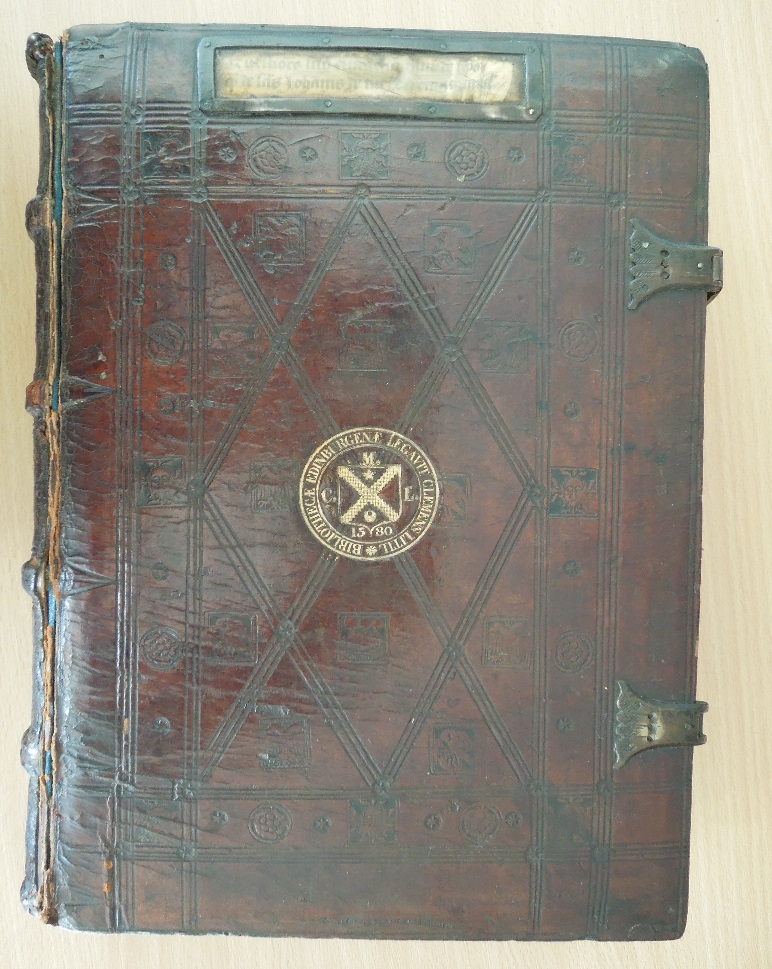
And nor should they in this case! Although the author of the above volume is a Torquemada he is, in fact, Juan de Torquemada, uncle to Grand Inquisitor Tomas de Torquemada.
What makes this item interesting then? Well it’s not often the complete provenance of a book is known, especially one dating from 1485, however Questiones evangeliorum tam de tempore quam de sanctis from the Clement Litill collection is one such item.
It was first owned by William Scheves, second Archbishop of St Andrews from 1478 until his death in 1497. He gifted it to the friary library of the Domincans of Edinburgh. It was likely there that the horn title label, on the front of the book was added. This label strongly suggests that the book was held in a lectern library where the book would have been stored on a long, sloped reading desk with the cover upper most.
After the looting of the friaries of Edinburgh in 1559 it found its way into the hands of Clement Litill. His reputation as a collector would have seen the looters making a profit from their salvage of the libraries.
From there it went to the Kirk and Town Council of Edinburgh in 1580 along with the 275 other volumes that Litill bequeathed. This collection formed the first library of the University of Edinburgh, where it has been held ever since.
All this means that since the book was gifted to the Dominicans it has not moved more than a mile for almost five centuries!
OER16: Open Culture
A great conference and always a friendly crowd.
OER16, the 7th Open Educational Resources Conference, will be held at the University of Edinburgh on the 19th-20th April 2016.
Bonnes nouvelles – French language journals for PPLS!
You might wish to check out the Cairn.Info database, which offers online access to the full text of over 400 French language journals published in France and Belgium since 2001. Read More
The Gloves Are Off!
I was recently asked to rehouse a new accession to the CRC special collections; a beautiful belt previously belonging to a Scottish Suffragette made from a strip of ribbon, embroidered with enamelled motifs, with a metal buckle. You can find out more about this belt in this blog post.
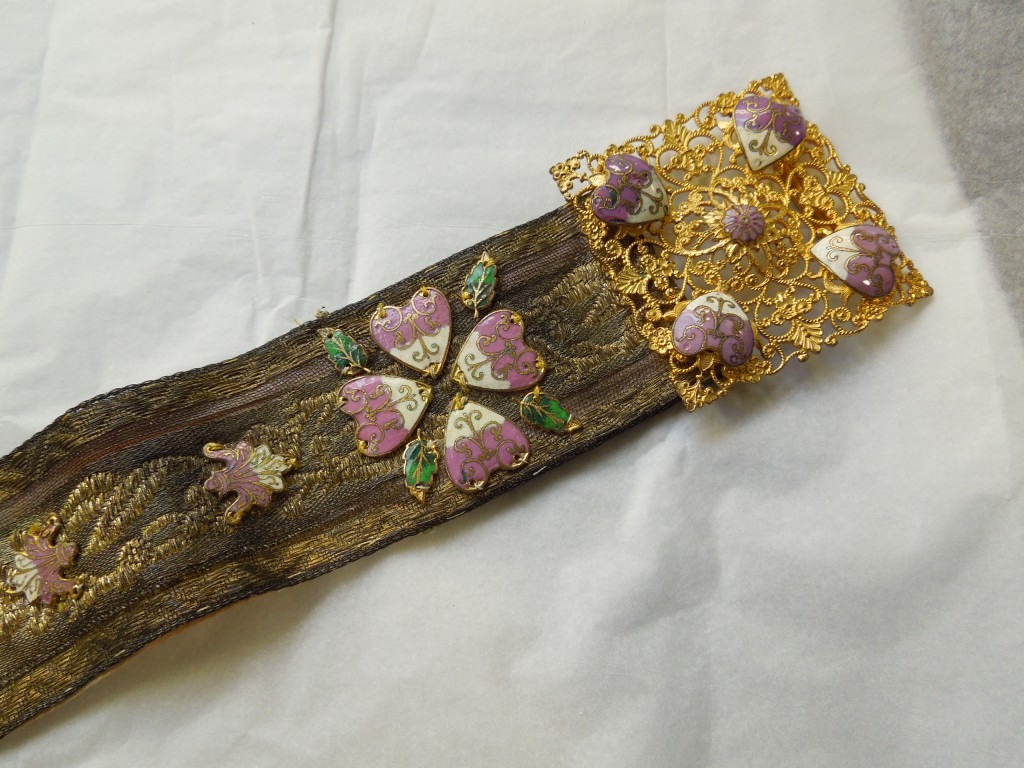
Suffragette Belt
Due to the huge amount of attention this item received on social media, I knew that it would be very popular, and likely to be requested multiple times for seminars, tours and researchers. As such, I wanted to create a housing solution that would reduce the handling of this item, as well as protect it whilst in storage.
Repeated handling can be very damaging to objects as the bending and flexing causes mechanical stress, which can lead to fractures at stress points. It is often assumed that white cotton gloves are worn when moving all archival collections. But that is not the case. Cotton gloves tend to reduce manual dexterity, and can get caught on tears on paper. Here is an excellent article on the misperceptions of wearing white gloves.
Handling certain objects, such as gilt frames, photographs and bronze sculptures without gloves, however, can be detrimental as the salts and oils on our fingertips can cause metals in corrode and leave marks on photographs. Normally nitrile gloves are worn when touching these items. Clean, dry hands that are free of creams and lotions are usually the best for most other objects, but ideally they should be handled as little as possible.
To reduce handling of the belt, I made a box with from unbuffered card and two rigid base boards that were padded with domett wadding and calico cotton. One base board can be used to lift out the belt from the box. The other can be placed on top and used to flip the belt over, so that the reverse can be viewed without touching it at all.
 The slide show below shows the stages of taking the belt out of the box.
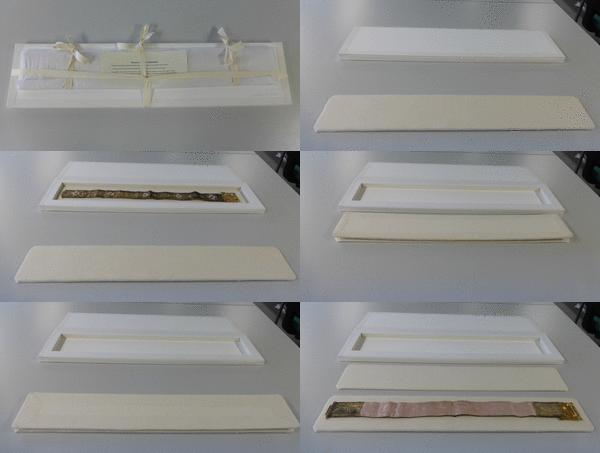
This new storage will allow the Suffragette belt to be safely consulted for years to come.
Emily Hick
Special Collections Conservator
New video on SCH demolition and building progress
Latest time lapse video from Malcolm Brown from the Digital Imaging Unit at the Centre for Research Collections captures the progress of works at St Cecilia’s Hall.
For those who know our location, the building site is tight, so Malcolm has had to be creative in capturing his videos and images. Malcolm has persevered through hours of standing on the pavement of Niddry Street and South Bridge as well as eating countless roasted chicken dinners at Zuhus restaurant in order to capitalise on various views of our building.
Look for more videos to come of the construction of the new entrance to St Cecilia’s Hall.
Collections
 Hill and Adamson Collection: an insight into Edinburgh’s past
My name is Phoebe Kirkland, I am an MSc East Asian Studies student, and for...
Cataloguing the private papers of Archibald Hunter Campbell: A Journey Through Correspondence
My name is Pauline Vincent, I am a student in my last year of a...
Hill and Adamson Collection: an insight into Edinburgh’s past
My name is Phoebe Kirkland, I am an MSc East Asian Studies student, and for...
Cataloguing the private papers of Archibald Hunter Campbell: A Journey Through Correspondence
My name is Pauline Vincent, I am a student in my last year of a...
Projects
Cataloguing the private papers of Archibald Hunter Campbell: A Journey Through Correspondence
My name is Pauline Vincent, I am a student in my last year of a...
Archival Provenance Research Project: Lishan’s Experience
Presentation My name is Lishan Zou, I am a fourth year History and Politics student....