Home University of Edinburgh Library Essentials
October 26, 2026
Architectural monuments of Belgium, 1915 – ‘Opulence in the worst distress’
A LOST BUT RECONSTRUCTED HERITAGE… FROM THE LIBRARY OF SIR ROBERT STODART LORIMER (1864-1929), ARCHITECT
 In the book collections curated by the CRC is the work entitled La Belgique monumentale: 100 planches en phototypie by Karel Sluyterman (1863-1931), the Dutch architect, designer and illustrator, and Jules Jacques van Ysendyck (1836-1901) the Belgian architect and propagandist for the neo-Flemish Renaissance style.

Title-page, ‘La Belgique monumentale’, by the architects Karel Sluyterman and Jules Jacques van Ysendyck, published by Martinus Nijhoff, 1915.
The work published in 1915 in the neutral Netherlands by Martinus Nijhoff – a prestigious publishing house in The Hague (La Haye) – contains dozens of collotype prints (a salts based photographic process) showing gems of Belgian architecture.
A foreword to the collection of prints states that: ‘As Belgium suffers the devastating horrors of war, it seemed appropriate to circulate images of some Belgian monuments already irreparably damaged and destroyed, and those which are threatened with destruction’.

The 15th century Church of Notre Dame in Anvers (Antwerpen), Belgium… its tower and spire.
It goes on in very high-flown style: ‘In a very small space, Belgium offers an unparalleled accumulation of ancient cities and monuments, all standing witness to past greatness, offering the evidence of, and paying tribute to, the hard work always known in the country, and showing opulence in the worst distress’.

Old buildings in Tournai (Doornik), Belgium. 12th century Romanesque houses (Maisons Romanes).
The plates listed include important buildings in the towns and cities of Aerschot (Aarschot), Anvers (Antwerpen), Courtrai (Kortrijk), Dinant, Dixmude (Diksmuide), Louvain (Leuven), Malines (Mechelen), Tournai (Doornik), and Ypres (Ieper).

15th century Town Hall, Louvain (Leuven), Belgium.
Some of these towns and cities escaped major damage but others suffered catastrophic destruction inflicted by massive bombardment by both sides in the Great War.

In 1914 the University in Louvain (Leuven) was destroyed. This was the 14th century University Library.
In Louvain, for example, on the 25 August 1914, the University Library was destroyed using petrol and incendiary devices. Some 230,000 volumes were lost in the destruction, including Gothic and Renaissance manuscripts, a collection of 750 medieval manuscripts, and more than 1,000 incunabula (books printed before 1501). The city lost one fifth of its buildings during the War.

In 1914 the University in Louvain (Leuven) was destroyed. This was the original 14th century Hall.
In Ypres too, massive destruction was suffered, with the 13th century Cloth Hall – Lakenhalle – being reduced to rubble.

The Cloth Hall (Lakenhalle) in Ypres (Ieper), Belgium, which during the course of the War was reduced to rubble. Reconstructed after the conflict, the original building was constructed between 1200 and 1304.
A label on the inside of the front cover of the portfolio of prints reads: ‘From the library of the late Sir Robert Lorimer. Presented by his Family February 1934’.
Lorimer was a prolific Scottish architect and furniture designer noted for his sensitive restorations of historic houses and castles, for new work in Scots Baronial and Gothic Revival styles, and for promotion of the Arts and Crafts movement.

This new addition to the Cloth Hall, called Nieuwerck, dated from the 17th century. This too was reconstructed during the 1920s.
La Belgique monumentale: 100 planches en phototypie can be accessed by contacting the CRC and quoting shelfmark: RECA.FF.116.

Merchants Houses in Ypres (Ieper), Belgium, originally dating from 16th-17th centuries.
Dr. Graeme D. Eddie, Assistant Librarian Archives & Manuscripts, Centre for Research Collections
18th Century Drama and other resources for trial

The Library has organised a free trial, until 29th Nov 2016, of several literature-related databases of digitised archives and manuscripts:
Eighteenth Century Drama A unique archive of almost every play submitted for licence between 1737 and 1824, and hundreds of documents that provide social context for the plays.
London Low Life is a full-text searchable resource, containing colour digital images of rare books, ephemera, maps and other materials relating to 18th, 19th and early 20th century London. It is designed for both teaching and study, from undergraduate to research students and beyond. In addition to the digital documents, London Low Life contains a wealth of secondary resources, including a chronology, interactive maps, essays, online galleries and links to other useful websites.
Medieval Travel Writing provides direct access to a widely scattered collection of original medieval manuscripts that describe travel – real and imaginary – in the Middle Ages. The project combines:
- Multiple manuscript sources, detailing the journeys of famous travellers from Marco Polo to John Capgrave, and the stories of legendary figures such as Prester John and Sir John Mandeville.
- Translations and supporting materials (all of which are fully searchable).
- Maps showing the routes of the travellers.
- Introductory essays by leading scholars.
Popular Culture in Britain and America (Module I & II) explores the dynamic period of social, political and cultural change between 1950 and 1975. The resource offers thousands of colour images of manuscript and rare printed material as well as photographs, ephemera and memorabilia from this exciting period in our recent history.
Shakespeare in Performance showcases rare and unique prompt books from the world-famous Folger Shakespeare Library. These prompt books tell the story of Shakespeare’s plays as they were performed in theatres throughout Great Britain, the United States and internationally, between the seventeenth and twentieth centuries. *Please note that PDF download options are not available during trials.
The trials are also accessible from the Library’s E-Resources Trials website.
New College Collections: The Expected and the Unexpected (I)
On Saturday 22 October, I was delighted to be able to present a paper to the Scottish Church History Society at their one day conference in the Edinburgh Theological Seminary. With very few of the catalogues for New College manuscripts online, it seemed like the ideal time to draw attention to some of our valuable holdings.
For those of you unable to attend what was a fascinating conference here are my top ten of the “expected” collections that are available to researchers in New College Library. I shall blog my “unexpected” list another time.
1. The papers of Thomas Chalmers (1780-1847) and his family (ref. MS CHA). Thomas Chalmers is regarded as the leader of The Disruption, which saw the formation of the Free Church of Scotland. A major figure in his lifetime, the collection contains, about 15,000 letters to and from leaders in society as well as ordinary parishioners. There are family papers, sermons and files on large bodies of work such as Church Extension, Irish Famine, The Convocation, within this extensive collection.
2. The records of New College itself (c.1700-present) (ref. AA) including Senate minutes and committees, annual photographs of staff and students; the records relating to New College Library and the records of many student associations.
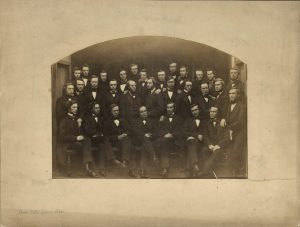
Staff and students at New College, Edinburgh, 1874
3. The papers of Joseph H. Oldham (1874-1967), regarded by many as the father of modern ecumenism. Included are papers relating to The Moot, a Christian think-tank which met regularly to discuss issues of post-war reconstructions. Individuals involved included John Baillie and T S Eliot. (ref. MS OLD).
4. Church of Scotland papers (1638- ) (ref. CHU). Many of the manuscripts were originally part of the General Assembly of the Church of Scotland Library, which was donated to New College in 1958. The records are largely committee papers such as those looking at baptism or elements of doctrine. Most Kirk records are held by the National Records of Scotland.
5. Papers of the Westminster Assembly (1643-1830) (ref. MS). These are manuscript copies of proceedings at the Westminster Assembly of the Divines between 1643 and 1653. There are also signed copies of the Westminster Confession of Faith (ref. MS WES 3.1).
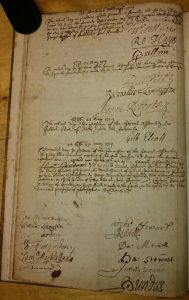
Signed copy of the Westminster Confession of Faith showing the signature of Duncan Forbes of Culloden, amongst others (ref. MS WES 3.1).
6. New College Library holds five copies of the National Covenant (1638- ), a number of which used to be displayed on the walls of New College. They are distinguished by provenance: one bequeathed by Dr Thomas Guthrie; one signed by Edinburgh hammermen; one signed only by nobles; one signed by people in Kinneil and Bo’ness; and one signed by the inhabitants of North Leith (ref. MS BOX 52.2.2 & 3, et al).
7. Manuscript sermon notebooks (c1648-c1819) (ref. MS SER). It should be no surprise that divinity students would want to see examples of sermons and sermons by well-known figures such as Thomas Boston, Samuel Rutherford, James Renwick or Robert Wodrow. This series of over 40 notebooks is complemented throughout the collection by other sermon notebooks, the earliest being around c.1648 up to the 20th century.
8. Returns for the Annals of the Free Church of Scotland and for Fasti Ecclesiae Scoticanae (MS BRO and MS SCO). It should be noted that these rarely provide much more information than that which is contained in the published volumes.
9. Papers of the Very Reverend Professors. New College has collections for many eminent preachers and theologians, some of whom held the office of Moderator. Some of the individuals include: Alexander Whyte (1836-1921) (ref. MS WHY); James Denney (1856-1917) (ref. MS DEN); Alexander Martin (1857-1946) (ref. MS MAR); John White (1867-1951) (ref. MS WHI); Archibald C. Craig (1888-1985) (ref. MS CRA or GD 30); William Manson (1882-1958) (ref. MAN); James S Stewart (1896-1990) (ref. MS STE); John McIntyre (1916-2005) (ref. AA4); James Whyte (1920-2005) (ref. AA5); and Alec C. Cheyne (1924-2006) (ref. AA7).
10. The papers of Rev Robert Murray McCheyne (1813-1843) (ref. MS MACCH). Although he died tragically young, McCheyne was a well-respected and gifted minister. His collection contains personal letters, poems, diaries and sketches including those from his time in Palestine when he participated in the Church of Scotland’s Mission of Inquiry to the Condition of the Jews.
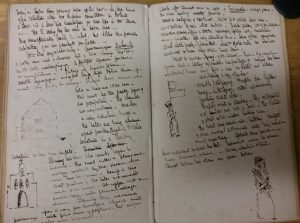
Robert Murray McCheyne’s diary from his trip to Palestine, 1838 (ref. MS MACCH1.8)
Copies of the current catalogue are in the process of being added to the University of Edinburgh’s online catalogue Archives Online but until the preparation and upload of these catalogues has been completed please refer all enquiries regarding New College Collections to new.college.library@ed.ac.uk.
Kirsty M Stewart, New College Collections Curator
More e-resources trials available in November
*The Library now subscribes to Archives Unbound giving access to all collections within this. The Library has also subsequently purchased British Library Newspapers Part V.*
The Library currently has trial access to two databases from Gale Cengage, British Newspapers Part V and Post-War Europe: Refugees, Exile and Resettlement, 1945-1950.
You can access both of these online archives via the E-resources trials page. Access is available both on and off-campus.
Both trials end on 30th November 2016.
Post-War Europe: Refugees, Exile and Resettlement, 1945-1950.

Thomson-Walker Internship – Round 2!
This week’s blog come from Victoria Haddock, a recent graduate, and our second Thomson-Walker intern….
I am currently approaching the end of my fourth week of a ten-week internship working on the Thomson-Walker collection of medical portrait prints at the CRC conservation studio here at the University of Edinburgh.
I graduated earlier this year from the MA paper conservation course at Camberwell College of Arts and have been fortunate to have been quite busy over the summer with various short term contracts and was overjoyed to have been offered this opportunity here. It has been quite a whirlwind of new people to meet, things to learn and see in the last month and I’m sad to think it has already passed by so quickly.

Victoria in the conservation studio
There is certainly no fear of me running out of work to do though, with a collection of approximately 2500 prints to work through! I’m the second of a planned series of interns who will have to remove these prints from their current storage, where some anonymous person decades ago lovingly spent hundreds of hours taping all of these prints onto board and paper which has now become very acidic and brittle and prevents further conservation work or digitisation projects taking place. Like many conservation projects, I have to undo all of this work done with the best of intentions previously, and throw the unsuitable board unceremoniously into the recycling bin. You can read about the importance of good housing in this blog by Special Collections Conservator, Emily.

Boxes of prints, before treatment in acidic boxes

Boxes of prints, after treatment in acid-free boxes
Following the procedures outlined by Samantha Cawson, the first Thomson-Walker intern (here is a link to her blog where she explains everything – with puns!), most of the adhesive tape (a paper gummed tape mainly) can be easily removed by applying lens tissue packages containing CMC (carboxymethyl cellulose) for anything up to 30 minutes, and peeling away the carrier.

Prints, during treatment
It has been a great experience so far, and I have been fortunate to have gone on a tour of the National Library of Scotland’s conservation studio, be part of some of the studio tours here and the conservation taster days run for the students. It is a great place to work as there is always something amazing being brought in to the studio and there is also a fabulous view, which as many conservators will know, that not being consigned to a cold basement is a rare and wonderful thing!

Print, after treatment
Databases on trial!
Some news of a few more databases currently on trial from ProQuest until the end of November.  While not directly related to PPLS subject areas, there is still much that will be of general interest to many of you, with lots of great reading on offer!
USC Shoah Foundation Visual History Archive
I’m pleased to let you know that the Library currently has trial access to the USC Shoah Foundation Visual History Archive®.

You can access this online archive via the E-resources trials page. You must register with the site to get access. Access is available on-campus or off-campus if using VPN.
Trial access ends 30th November 2016.
The Visual History Archive® is a collection of audiovisual interviews with witnesses and survivors of the Holocaust and other genocides and it allows users to search through and view more than 50,000 of these video testimonies. Read More
Los Angeles Times Archive on trial
For the month of November the Library has trial access to the Los Angeles Times Historical Archive, 1881-1992, from ProQuest.
You can access this online archive via the E-resources trials page. Access is available both on and off-campus.
Trial access ends 30th November 2016.
**Trial has now been extended until 31st December 2016**

Luther’s Werke (Weimarer Ausgabe)
 Martin Luther (1483-1546) is a central figure in the development of European culture, not only as a result of his religious influence but also for his contribution to the establishment of the High German language.
The Library now has trial access – until the end of November – to Luthers Werke (Weimarer Ausgabe). Read More
Three Japanese e-resources for trial
The Library has arranged a free trial for the following three e-resources from Japan:
- Fuzoku Gaho (風俗画報,1889 – 1916)
- Toyo Keizai Digital Archive(東洋經濟, 1895 – 1945)
- Mainichi Newspaper Maisaku(每日新聞, 1872 – 1999)
To access the trial, go to the Library’s E-Resources Trials website. The trial ends on 30 November 2016.
Fuzoku Gaho and Toyo Keizai Digital Archive are to be accessed on the JapanKnowledge platform which is in our Databases A-Z list. See the screenshot below:

Collections
 Love, Loss, and Literature: Cataloguing the Papers of Irene Jessie Young
My name is Nancy Britten, and I’m in my fourth year of studying History at...
Hill and Adamson Collection: an insight into Edinburgh’s past
My name is Phoebe Kirkland, I am an MSc East Asian Studies student, and for...
Love, Loss, and Literature: Cataloguing the Papers of Irene Jessie Young
My name is Nancy Britten, and I’m in my fourth year of studying History at...
Hill and Adamson Collection: an insight into Edinburgh’s past
My name is Phoebe Kirkland, I am an MSc East Asian Studies student, and for...
Projects
Cataloguing the private papers of Archibald Hunter Campbell: A Journey Through Correspondence
My name is Pauline Vincent, I am a student in my last year of a...
Archival Provenance Research Project: Lishan’s Experience
Presentation My name is Lishan Zou, I am a fourth year History and Politics student....