Category Archives: women

Love, Loss, and Literature: Cataloguing the Papers of Irene Jessie Young

My name is Nancy Britten, and I’m in my fourth year of studying History at the University of Edinburgh. From January to April 2026, I had the wonderful opportunity to work with the Heritage Collections Team as an Archive Cataloguing Assistant. During this internship, I was working closely with the fascinating personal archive of Irene Jessie Young. I was especially excited to take on this role because it brought together two areas of interest for me within my own history studies: women’s history and modern European history, particularly the Second World War.
Nancy working on the collection in the Heritage Collections office.

The collection contains the personal papers of Irene Jessie Young (1919–2017), who was born in Edinburgh and later appointed to the Foreign Office at Bletchley Park during the Second World War. What makes this archive so interesting is the sheer range of material it includes, covering almost every stage of her life. Within the papers are personal letters, school records and certificates, university notes, diaries, autobiographical writing, and documents connected to her wartime memoir Enigma Variations. The collection also includes notebooks of verse, drafts and manuscript material, examples of Irene’s creative development as a writer.
Graduation photograph of Irene J. Young, 1942

In October 1937, Irene matriculated at the University of Edinburgh and later graduated with an M.A. (Hons) in English Language and Literature on 3 July 1942. As an Edinburgh student myself, reading her lecture notes alongside her correspondence, particularly her descriptions of student life and the experience of working through papers and exams during the early years of the Second World War, was eye-opening.

Later in her life, Irene published a memoir about her wartime experiences. Enigma Variations: A Memoir of Love and War was published in 1990 and was one of the earlier accounts to describe what life was like at Bletchley Park. In the memoir, Irene describes her role in wartime intelligence, working as a codebreaker in Hut 6 and paints a vivid picture of everyday life at “Station X.” This is particularly valuable given how long Bletchley Park’s work remained classified, and it is striking to compare the frankness of her later memoir with her wartime correspondence in the archive, where only subtle references, and a great deal of reading between the lines, offer any indication of what she was involved in at the time. It is also a reminder of how much of Bletchley’s workforce consisted of women, who made up roughly three-quarters of staff at the peak of operations, but were often overlooked for decades in popular historical narratives.

Throughout the internship, my main responsibility was to create a detailed resource list of the collection using Excel. I worked from an earlier inventory as a starting point but updated and expanded it in line with current archival cataloguing standards, adding greater detail and clarity to the existing descriptions. After this, I worked in ArchivesSpace to create authority records for the key individuals and organisations that appear throughout Young’s papers, helping make the collection easier to navigate and more accessible for future researchers. One aspect of the training that I particularly enjoyed was the handling session, where I learned the correct way to work with fragile documents, bound volumes and photographs. It was especially interesting to discuss the practical steps involved in preserving these materials, and to gain a better understanding of the work carried out by preservation teams to protect and care for collections like this one.

My observations and themes from the collection:

One of the first things that stood out to me about this collection was that it had clearly already been thoughtfully organised before it reached us. Irene’s son, Dr Iain Gordon Brown, formerly Principal Curator of Manuscripts at the National Library of Scotland, had added a wealth of contextual information through printed labels, pencil annotations, and guiding notes throughout the papers. This proved helpful during the cataloguing process, particularly when trying to untangle nicknames, identify friends or understand the background to certain items. More than anything, it was a clear reflection of the time and care that had gone into preserving his mother’s papers.

A particularly good example of this can be seen in one of my favourite items in the collection: a bound volume of handwritten manuscript transcripts of Irene’s verse, which she created for her cousin, Gilbert Young Kennedy (1916–2020):
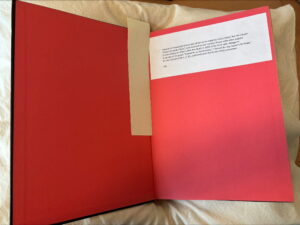
The printed white label in the front was added by Dr Iain Gordon Brown and provides helpful context.
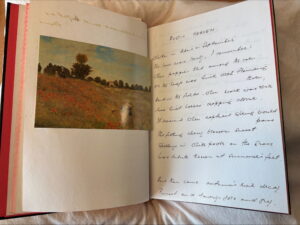
Some examples of the manuscript verse inside this volume.

Gilbert was Irene’s first cousin, and the two appear to have been extremely close. He later became Head of Cancer Research at the University of Sheffield, and during the Second World War he also played an important role working at the chemical warfare establishment at Porton Down. Despite their very different professional paths, Irene and Gilbert shared a creative streak and an appreciation for the arts—poetry in Irene’s case, and music (particularly organ-playing) in Gilbert’s. This volume of verse is a wonderful example of that shared interest, and includes a poem entitled, “Sonnet for my Cousin’s Birthday (for G.Y.K.)”  written for Gilbert.

Love during the war:

Another significant part of the collection is the correspondence between Irene and her first husband, Leslie George Cairns, who was later reported missing in action while serving with the Special Air Service (SAS) in France. Irene J. Young married Lieutenant Leslie George Cairns on 29 December 1943. Like Irene, Cairns had studied at the University of Edinburgh, graduating with an M.A. (Hons) in History (Unclassed War Privilege) in January 1944. He was commissioned into the Royal Artillery and served in the United Kingdom, Egypt, Libya, and Tunisia, before transferring to the Parachute Regiment and then to the Special Air Service Regiment (Army Air Corps). He was presumed killed in action in June 1944, aged 24, when the aircraft carrying him and his unit on a mission to east-central France was lost in circumstances that remain unclear.
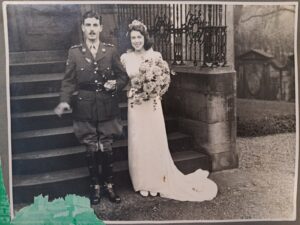
Irene and Leslie’s wedding photograph, 29 December 1943.

The archive contains hundreds of letters written from Leslie to Irene. Reading through these letters was one of the more distinctive aspects of the collection, not only because of their volume, but also because of what they leave unsaid. For the most part, the correspondence survives only on one side. Aside from a small number of unsent or returned letters, Irene’s replies are largely absent, which means that her side of the exchange has to be inferred from Leslie’s responses.

There are also noticeable limits to what is discussed in the letters themselves. Wartime censorship, as well as the nature of the work both were involved in, shaped what could be written. Leslie refers to this directly in one letter, noting, “I have to censor my men’s letters,” and, in another written early in the war while he was still serving as an army volunteer, he acknowledges the risks of disclosure:

“I am breaking rules by writing on this particular subject, and I don’t want you to have to burn this letter, so I know you’ll keep it well hidden and won’t even tell your mother and father the contents.”

Some letters bear censor markings, as demonstrated below, while others contain only brief or indirect references to his movements and activities. At the same time, there is little indication in the letters that Leslie fully understood the nature of Irene’s own wartime work, which remains relatively unspoken within their correspondence.
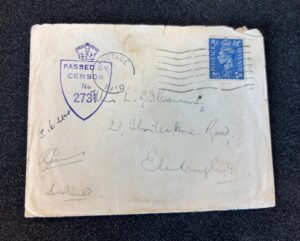
An example of an envelope in the collection that has been stamped to identify it as having been “passed by censor”
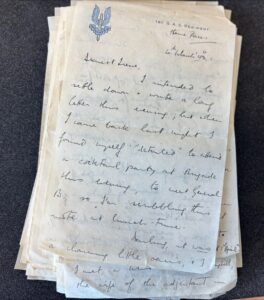
2. Some of the last letters written from Leslie G. Cairns to Irene J. Young in 1944, with the SAS letterhead.

One of the ways we are able to see more of Irene’s side of the relationship is through one of my favourite items in the collection: a small notebook kept by Irene as a record of things said by Leslie between the summer of 1938 and the spring of 1940, before he joined the army. She titled these recorded expressions “Words to remember always.” The notebook also contains other handwritten material, including poems and what appears to be an outline for an autobiography.

The entries themselves preserve brief fragments of conversation. For example, Irene records Leslie as saying, “I won’t go into the airforce if there’s a war, if you don’t want me to,” and “I can’t imagine you as anything but very much alive; we’re both alive and we know it too.”
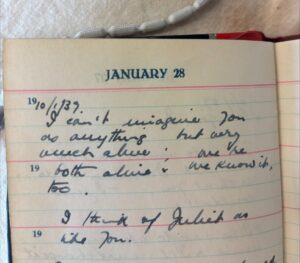
Page from the notebook kept by Irene J. Young to record things said by Leslie G. Cairns between 1938 and 1940.

The importance of literature:

I have briefly mentioned Irene’s appreciation of the arts and her own verse, but the prominence of literature throughout the collection deserves further attention, as it appears so consistently across different parts of her life and relationships.

Leslie and Irene frequently describe in detail the books they are reading at particular moments and often exchange books as gifts. A number of these volumes are preserved in the collection; some still bearing SAS ownership stickers, which I particularly liked as small traces of their shared history. On one occasion, Leslie decides to teach Spanish to fellow officers, prompting Irene to send him Spanish grammar books. In other letters, Irene includes quotations from poetry, often at moments when words of reassurance or encouragement seem needed.

These kinds of literary exchanges are not limited to Leslie. They appear in Irene’s correspondence with others across her life. For example, the collection includes a French encyclopedia sent to her by Dr Jean Ika Fiegelson, a French physician who assisted Irene in her search for Leslie. Similarly, books and reading form part of her correspondence with her Polish friend Roza Niedzwiedz, whom Irene had tutored in English towards the end of the war and who later became one of her closest friends. In a draft of one of her final letters to Roza in 1975, Irene includes a few lines of verse.

Later in life, Irene’s correspondence with Dr William J. Abel between 1995 and 1999 also centres in part on shared reading. In their letters, they reflect on questions of Christian faith and spirituality, and Dr Abel recommends a wide range of texts, from the selected poems of Rudyard Kipling to The Confessions of St Augustine and the seventeenth-century poem “The Desiderata.”

What all of these exchanges seem to show is how literature remained a steady part of Irene’s life, rooted in her background in English studies but continuing through her friendships and correspondence over many years. If I had the time, I would have loved to make a list of all the books, poems, and titles mentioned in the collection and start working my way through them.

Overall, working with this collection has been a really rewarding experience. It has been a privilege to spend time with Irene’s papers in such detail, and to play a small part in making them more accessible for future researchers.

The full catalogue of Irene J. Young’s Papers (Coll-1657) is available on ArchivesSpace: https://archives.collections.ed.ac.uk/repositories/2/resources/85781

Hill and Adamson Collection: an insight into Edinburgh’s past

My name is Phoebe Kirkland, I am an MSc East Asian Studies student, and for the last 4 months, I have been a Digital Collections Assistant working on digitising and improving information available regarding the Hill and Adamson Collection. Although my own research does not deal with conservation or Scottish heritage, I have a lot of experience working with archives and archival documents. Further, as my research area is based in East Asia, many of the documents I need are stored in archives that would require a long and expensive flight, thus the power of digitisation in conservation is very valuable to me personally as it allows me access to vital documents. Therefore, I was thrilled to be able to improve the metadata of and help facilitate access to the digitised images from the Hill and Adamson Collection as part of my role as Digital Collections Assistant.

Phoebe at work in the CRC office.

The Hill and Adamson Collection is made up of 701 calotype photographs that were taken between 1843-1847 by photographers David Octavius Hill and Robert Adamson. They are some of the earliest photographs in history. As calotypes, they are different in their process from the more famous daguerreotypes which became the chosen process for photography. Calotypes are negatives which are made using paper coated with silver iodine, and specifically for Hill and Adamson, they used a type of ‘silver salted’ paper created by William Henry Fox. These calotypes in our collection are mostly of the 1843 Disruption, an event in which the Church of Scotland split, and the Free Church of Scotland was founded. The ministers who signed the Act of Declaration and Deed of Demission that signified this split are showcased in the portraits in this collection.

Other photographs in the collection include scenery of Edinburgh, such as Calton Hill and the Scott Monument, and laypeople of Edinburgh such as fishwives. It is an incredible collection that provides a snapshot into both the lives of clergymen, academics and laypeople in the 1840s in Edinburgh. Particularly, as photography was extremely expensive, and usually portraiture was at the expense of the subject, it is rare to find older photographs of laypeople. Therefore, this collection is very special in providing rare insight into these lives. Hill and Adamson were a powerful duo in the field of photography, but unfortunately Hill’s untimely death at the age of 26 in 1847 prematurely ended their partnership. Other collections of their works are kept at many different archives and museums around the world, further signifying the importance of their work to the fields of photography and history.

The aim of the project was to help provide better access to the digitised images of the Hill and Adamson Collection on the Library’s digital collections platform by providing fuller metadata for each photograph. The photographs’ descriptions were incomplete, and needed expanding upon. Creating information about the provenance and the people in the photographs, and then connecting this information to the existing digitised copy of the photograph was required. This was accomplished by looking through the physical collection, which is made up of 6 bound volumes, 4 loose-leaf collections kept in boxes, and one further box of photographs reproduced from the negative calotypes at a later time, from 1906 to 1920.

Most of the photographs were of white, upper-class men, who were members of the gentry, clergy, academia, or any combination of all three. Furthermore, the women in these photographs were very rarely identified by name, or even by relation to the man in the photograph, leading to confusion over their identities. Therefore, I made it my mission to identify as many of the women in the photographs as possible. However, within the collection, there were certain photographs that stood out to me as particularly interesting or novel, or providing key insight into politics and religion in the 1840s.

The Scott Monument

Coll-1073/7/45: Photograph of the Scott Monument in the 1840s.

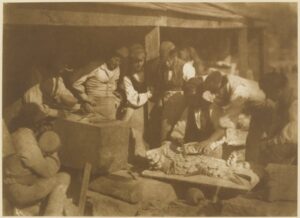
Coll-1073/6/9: Group portrait of workers building the Scott Monument, Edinburgh.

These photographs show the Scott Monument, and the masons working on carving a griffin for the construction of the Monument. These are beautifully shot and composed photographs that show a snapshot of 1840s Edinburgh, particularly the photograph of the Scott Monument, which we can see shortly after its completion in 1845, but before its inauguration in 1846. Many of the masons who worked on the construction of the Monument passed due to incredible back-breaking labour or respiratory issues from the stone dust. It is estimated that the monument killed half of all the masons that were employed to construct it due to lung disease.[1] Therefore, it is incredible to be able to see a photograph of those who worked on the construction, so they can be identified in some small way as those who contributed to such an iconic Edinburgh landmark.

Isabella (Burns) Begg

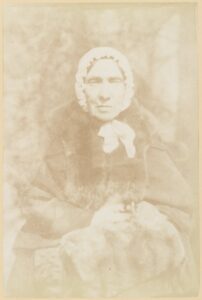
Coll-1073/1/24: Portrait of Isabella Begg (Burns).

This calotype shows Isabella Begg (Burns), youngest sister to Robert Burns, national poet of Scotland. She was born on 27 June 1771 and died on 4 December 1858, aged 87. She married John Begg at age 22, and had nine children with him. He died in 1813, leaving Begg a widow for 35 years.

Isabella was a valuable source of information into Burns as a poet, clarifying details of obscurity around his poems and stories, and identifying individuals in question. Her brother died when she was 25 years old. Begg has been identified as being 72 in this photograph, meaning it was taken around 1843.

This photo is one of the few photographs of women in the collection, especially one that has already been identified by the compiler. This portrait reveals a continued interest in Begg, despite the fact that Robert Burns had died nearly 50 years prior, and showed that she remained relevant to the Edinburgh community, as her photo was one of the first taken in the period of Hill and Adamson’s partnership.

Fishwives

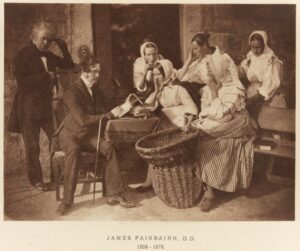
Coll-1073/3/8: Group portraits of James Fairbairn, James Gall Sen.r, and fishwives.

This group portrait is one of a number in the collection which showcases the fishwives of Edinburgh. As previously expressed, it is rarer to find photographs of the laypeople from this period due to the expense of photographic production. Fishwives were women who helped catch, prepared (i.e. cleaned and gutted), and sold fish. They were not always married, as wife here meant ‘woman’ and not ‘wife’. They were famed for being loud and outspoken, often swearing and presenting ‘uncouth’ behaviour that was not expected from women of the period. They were often self-sufficient as men were away fishing for long periods, therefore needing to help provide for themselves by successfully selling their wares. The Newhaven Fishwives (as shown in these photographs) were famous, even known to royalty. They were admired by Queen Victoria, and George IV thought they were ‘handsome’ (in the historical sense).[2]

Incredibly, four of the five women in this photograph are identified by name – Carnie Noble, Bessy Crombie, Mary Combe, and Margaret (Dryburgh) Lyall. The two men are identified as Reverend Dr James Fairbairn and James Gall. The calotype has been named ‘The Pastor’s Visit’ for this reason. This photograph potentially showcases James Fairbairn reading a pamphlet, perhaps religious, to the women, who sit in contemplation around him – focused? Or perhaps bored? – we cannot tell exactly. The posing for these photographs took around 3 minutes, a dramatic improvement from daguerreotypes which could take up to 15 minutes plus for exposure.[3]

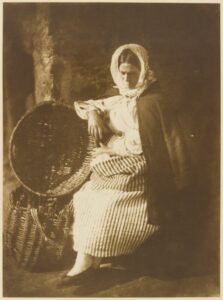
Coll-1073/5/34: Portrait of a fishwife.

Another portrait of a fishwife, this time an individual, also remarkably identified as Mrs Elizabeth Hall (Johnstone). This portrait, although posed again, provides insight into the typical clothing of fishwives of the 1840s. Although the photos are in black and white, we know that the Newhaven fishwives wore blue duffle coats and striped colourful petticoats, as well as a cap or headdress, and carried a creel which would have their fish.[4] All these items can be seen in this photograph, although unfortunately not in their striking colour.

[1] Tomlinson, Charles, “Stone”, in The Cyclopaedia of Useful Arts. Mechanical and Chemical, Manufactures, Mining and Engineering. Vol 2 Hammer to Zirconium, edited by Charles Tomlinson (London: James S. Virtue, 1854), pp.741–52.;
Donaldson, Ken, et al. “Death in the New Town: Edinburgh’s Hidden Story of Stonemasons’ Silicosis.” The Journal of The Royal College of Physicians of Edinburgh, 47.4 (2017), pp.375-383, doi:10.4997/JRCPE.2017.416.

[2] Bertram, James Glass, The Harvest of the Sea; a Contribution to the Natural and Economic History of the British Food Fishes, with Sketches of Fisheries & Fisher Folk (London, 1869), p.424.

[3] The Editors of Encyclopaedia Britannica (ed.), “Calotype”, Encyclopædia Britannica. Available at: <https://www.britannica.com/technology/calotype> [Accessed: 08 July 2025].

[4] Bertram, James Glass, The Harvest of the Sea; a Contribution to the Natural and Economic History of the British Food Fishes, with Sketches of Fisheries & Fisher Folk (London, 1869), p.429.

Link

Re-discovering a forgotten songwriter: the archive of Louisa Matilda Crawford.

Daisy Stafford, CRC intern who catalogued the papers of Louisa Matilda Crawford, talks about her experience.

This summer I was offered the opportunity to undertake an archiving internship in the Centre for Research Collections, cataloguing the personal papers of Louisa Matilda Crawford, a nineteenth century songwriter. Other than her name and occupation, little information about Louisa was known. Through two months of close examination of her archive, I was able to stitch together a narrative of Louisa’s life. Here’s what I found…

Louisa Matilda Jane Crawford was born on the 27th September 1789 at Lackham House in Wiltshire. She was the daughter of Ann Courtenay (d. 1816) and George Montagu (1753-1815), an English army officer and naturalist. Louisa was related to nobility on both sides of the family; her maternal grandmother, Lady Jane Stuart, was the sister of Scottish nobleman John Stuart, 3rd Earl of Bute and Prime Minister to George III. Her father, meanwhile, was a descendent of Sir Henry Montagu, the first Earl of Manchester and also the great-grandson of Sir Charles Hedges, Queen Anne’s Secretary.

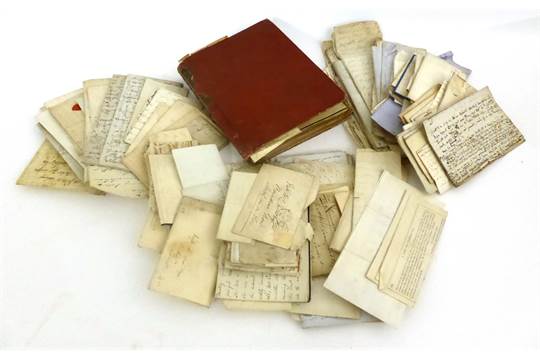
Papers of Louisa Matilda Crawford. Coll-1839 (picture from the seller’s catalogue)

Louisa had three older siblings; George Conway Courtenay (b. 1776), Eleanora Anne (b. 1780) and Frederick Augustus (b. 1783). Little direct information is known about Louisa’s childhood, but it must have been turbulent; in 1798 Montagu left his wife and family and moved to Kingsbridge in Devon to live with his mistress Elizabeth Dorville, with whom he had four more children. It is here that he wrote his two pioneering works, the Ornithological Dictionary; or Alphabetical Synopsis of Birds (1802) and Testacea Britannica, a History of British Marine, Land and Freshwater Shells, which saw several bird and marine species named after him, most notably Montagu’s harrier. The family’s disapproval of his relationship with Dorville ultimately cost him his ancestral home. On the death of his unmarried brother, James, the will stipulated that he would not inherit Lackham House, but had only “a rent charge of £800 a year subject to which the estates were left to his eldest son, George, for life.” The ensuing lawsuit between the pair resulted in huge debts which cost the family the estate; as Louisa wrote in The Metropolitan Magazine in 1835; “The thoughtless extravagance of youth, and the unwise conduct of mature age, caused the estates to be thrown into chancery” (vol. 14, pp. 308-309). Louisa reflected on seeing the native woods of her family home cut down upon its sale in a later poem (Coll-1839/7 pp.415-416):

Those brave old woods, when I saw them fall,

                Where they stood in their pride so long,

The giant guards of our ancient hall,

                And the theme of our household song;

I wept, that one of my Father’s race

                Could forget the name he bore,

And turn the land to a desert place,

                Where an Eden bloom’d before.

Louisa began courting Matthew Crawford, a barrister of Middle Temple, in 1817. Many of the papers consist of love letters and poems exchanged between the pair during this early period of their relationship, including three locks of hair, presumably Louisa’s. In 1822 the couple were married and Louisa moved to London, although their continued correspondence evidences that Matthew spent much of their marriage away working in the North of the country. It is then that Louisa began to earn an income through song writing and poetry, although the couple always struggled financially and frequently appealed to their wealthier relatives for aid.

Much of Louisa’s work appeared, often anonymously, in magazines and journals, was sold to publishers, and was set to music by composers Samuel Wesley, Sidney Nelson, Edward Clare and others. She frequently contributed both poems and prose, including several “autobiographical sketches”, to London literary journal The Metropolitan Magazine (which has subsequently been digitised by the HathiTrust and can be fully searched here). Many of her songs and poems related to historical events and persons; songs titled “Anne Boleyn’s Lamentation” (Coll-1839/7 p. 285) or “Chatelar to Mary Queen of Scots” (Coll-1839/7 pp. 381-382) are written from the point of view of famous queens. One poem (Coll-1839/3/1/9) tells the story of Frederick the Great (1712-1786), King of Prussia, who, in order to deceive his enemies as to his position during the Seven Years’ War, commanded that no light should be kindled throughout his encampment. However, a young soldier lit a taper to write a letter to his new bride. The second stanza reads:

His head was bent in act to write,

                The memories gusting o’er him –

When through the gloom of gathering night,

                Stood Frederick’s self before him!

Oh sternly spoke the Monarch then

                His doom of bitter sorrow

“Resume the seat – Resume the pen

                And add “I die tomorrow.”

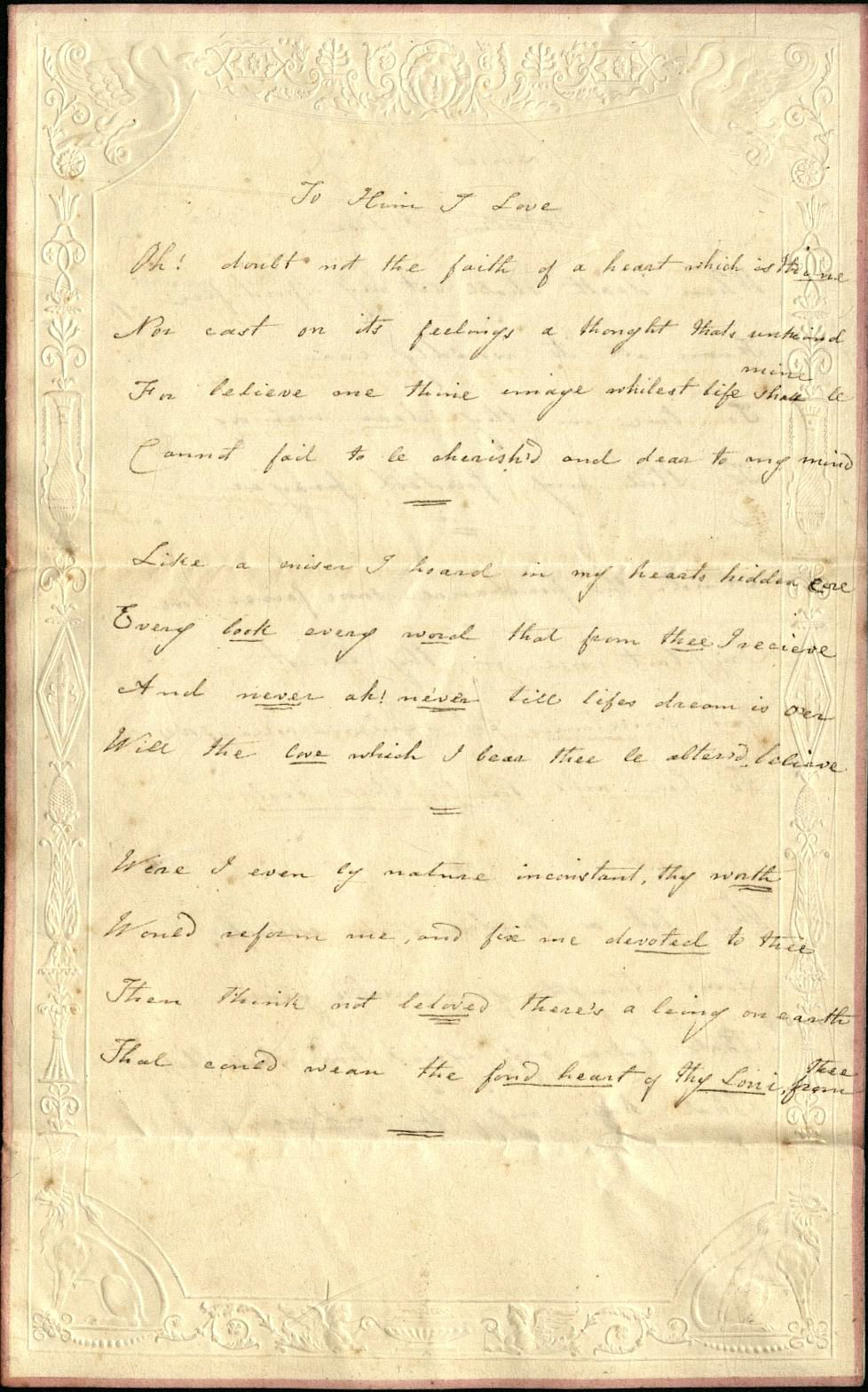
Other poems in the collection are more personal, including reflections on her childhood and family, such as “The Home of Our Childhood” (Coll-1839/7 pp. 17-18) and “On the Death of a Sister” (Coll-1839/7 p. 394). Many verses are addressed to her husband Matthew; one poem (Coll-1839/1/2/5) dated 23rd July 1817 and titled “To Him I Love”, begins:

Oh! Doubt not the faith of a heart which is thine

Nor cast on its feelings a thought thats unkind

For believe me thine image whilest life shall be mine

Cannot fail to be cherish’d and dear to my mind

Like a miser I hoard in my hearts hidden core

Every look every word that from thee I receive

And never ah! never till lifes dream is o’er

Will the love which I bear thee be alter’d believe

Coll-1839/1/2/5. Poem addressed to Matthew Crawford titled “To Him I Love” in the hand of Louisa Matilda Crawford, 23 July 1817.

Matthew often responded with poems of his own, and seems to have played a collaborative role in Louisa’s writing. She frequently included stanzas of her work in letters to him, asking him to look over and edit them.

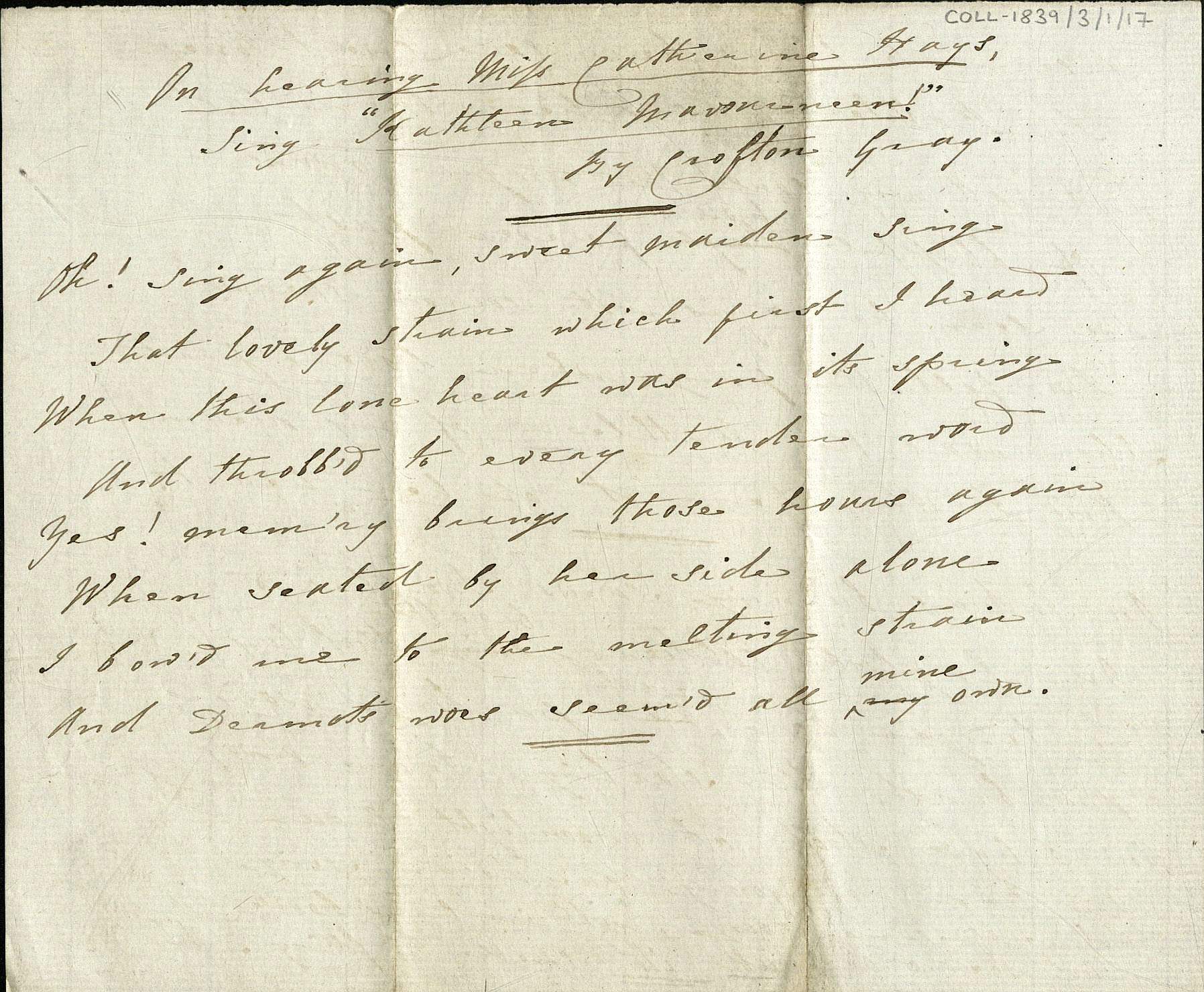
Louisa’s most successful song, “Kathleen Mavourneen,” was set to music by composer Frederick Crouch and enjoyed wide success in America where it was popularised by Irish Soprano Catherine Hayes on her international tours. Recordings of it still exist, and a version by Irish tenor John McCormack (1884-1945) can be found on youtube here. No original version of the song is amongst her papers, although there is a poem titled “On hearing Miss Catherine Hays [sic] sing “Kathleen Mavourneen!”” (Coll-1839/3/1/17). However, the song was frequently attributed solely to Crouch, or erroneously to Annie, Julia, or Marion Crawford.

Coll-1839/3/1/17. Poem titled “On hearing Miss Catherine Hays, sing “Kathleen Mavourneen!” by Crofton Gray” in the hand of Louisa Matilda Crawford, 1837-1857.

Louisa arranged her poems into small series, and the collection includes ten stitched booklets with titles such as “Irish ballads” and “Scotch songs”. Attempts to track down her work can be seen in correspondence with her publishers. In an undated later to magazine editor Mr Emery (Coll-1839/1/1/22) she requests copies of her published songs, writing; “I am not wanting them to give away, but to have them bound up in a volume since I find it impossible to keep single songs…I am going to beat up for recruits in all quarters where my bagatelles have been published, in order that I may have a little memorial to leave to those that will value the gift when I am gone.” A notebook containing 165 poems and songs neatly written in Louisa’s hand seems to be the result of these efforts.

Some outlying items in the collection initially seemed not to relate to Louisa at all, including a 17th century indenture on vellum, recording the sale of a messuage or house between waterman Thomas W Watson and master mariner Josiah Ripley of Stockton-on-Tees. However, a bit of biographical research revealed the answer. Many of these miscellaneous items reference Bayley and Newby, a firm of solicitors operating out of Stockton-on-Tees in the 19th century, which may explain the presence of the indenture. Matthew Crawford’s first cousin, William Crawford Newby (1807-1884) worked at the firm, and it seems that, since the couple were childless, their papers passed to him upon their deaths and thence on to his heirs. The latest item in the collection (Coll-1839/1/3/16) is a 1930 letter by William’s son, who writes:

I enclose a manuscript book written by Mrs Crawford including many well-known songs…Mrs Crawford was a Montagu of the Duke of Manchester family and died in 1857. She was married to Matthew Crawford a barrister. They had independent means which however they frittered away. My late father who was a 1st cousin of Matthew Crawford’s assisted them from time to time and their M.S.S. came to him on their death and through him to me. I am not anxious to part with them, but I am an old man and my family may not attach the same importance to their possession.

This would seem to account for how the papers came to be in the possession of the bookseller and for the few items relating to the Newby’s present in the collection.

Louisa died in 1857, the cause unknown, although Matthew refers to a long affliction of heart disease supplemented by attacks of Bronchitis in an 1846 letter (Coll-1839/2/6). Despite her obvious talent, and the clear enjoyment she derived from her work, she received little notoriety for her song writing during her lifetime and even less so after her death. Alongside gaining invaluable archival skills during this project it has been a pleasure to think that I have been able to increase the visibility of Louisa’s work and make her collection available to interested researchers. Although separated by over two centuries, I have come to know more about Louisa than any person living, and that is a great privilege.

You can see the catalogue of the papers on ArchivesSpace: https://archives.collections.ed.ac.uk/repositories/2/resources/86789

References:

Cleevely, R. J. “Montagu, George.” Oxford Dictionary of National Biography Online, 23 Sep. 2004, https://doi.org/10.1093/ref:odnb/19017. Accessed 19 Jul. 2018.

Crawford, Louisa Matilda Jane. The Metropolitan Magazine. Accessed 19 Jul. 2018.

  • “An Auto-Biographical Sketch. Lacock Abbey.” Vol. 12, Jan-Apr. 1835, pp. 400-402, https://babel.hathitrust.org/cgi/pt?id=nyp.33433081737904;view=1up;seq=412.
  • “Autobiographical Sketches Connected with Laycock Abbey.” 14, Sept-Dec. 1835, pp. 306-318, https://babel.hathitrust.org/cgi/pt?id=nyp.33433081737888;view=1up;seq=322.
  • “Autobiographical Sketches.” Vol. 22, 1838, pp. 310-317, https://babel.hathitrust.org/cgi/pt?id=umn.319510007530342;view=1up;seq=325.
  • “Autobiographical Sketches.” Vol. 23, Sept-Dec. 1838, pp. 189-194, https://babel.hathitrust.org/cgi/pt?id=nyp.33433081737839;view=1up;seq=203.

Cummings, Bruce F. “A biographical sketch of Col. George Montagu (1755-1815).” Zoologisches Annalen Würzburg, vol. 5, 1913, pp. 307–325, http://www.zobodat.at/pdf/Zoologische-Annalen_5_0307-0325.pdf. Accessed 19 Jul. 2018.

“Kathleen Mavourneen.” Wikipedia, https://en.wikipedia.org/wiki/Kathleen_Mavourneen. Accessed 19 Jul. 2018.

Pratt, Tony. Two Georgian Montagus: the manor of Lackham. Wiltshire College, second edition, 2015, https://tinyurl.com/y7tpp39h. Accessed 19 Jul. 2018.

Urban, Sylvanus. “Obituary – Rev. George Newby.” The Gentleman’s Magazine, vol. 26, 1846, pp. 100-101, https://tinyurl.com/yatonw6n. Accessed 19 Jul. 2018.

Written by Daisy Stafford, July 2018.

Elizabeth Wiskemann, First Woman Professor and War-Hero

A university figure that deserves far greater recognition is our first woman professor Elizabeth Wiskemann (1899-1971), who held the Montague Burton Chair of International Relations from 1958 to 1961. Although her name is absent from subsequent published histories, the University Journal for May 1958 certainly grasped the significance of her arrival. Announcing ‘the first woman to be appointed to an Edinburgh Chair’, it presented her as ‘a writer of authority on international affairs’, who had held appointments as a ‘press attaché to the British Legation at Berne, as a correspondent of The Economist at Rome, and as Director of the Carnegie Peace Endowment for Trieste’.

While these are major achievements, her personal contribution to 20th-century history ran much deeper. From 1930, Wiskemann (whose grandfather was German) worked as a political journalist in Berlin for the New Statesman and other publications, and was among the first to warn of the dangers of Nazism. So effective were her articles in alerting international readers to the true nature of Hitler’s regime that she was expelled from Germany by the Gestapo in 1937. She continued to expose Nazi plans for German expansion in her influential books Czechs and Germans (1938) and Undeclared War (1939).

Wiskemann did indeed spend the war as a press attaché in Switzerland, but this was cover for her true job of secretly gathering non-military intelligence from Germany and occupied Europe via the contacts she had made as a journalist. In May 1944, British Intelligence learned that the hitherto unknown destination to which Hungarian Jews were being deported was Auschwitz. When the allies turned down a request to bomb the railway lines (due to limited resources), Wiskemann hit on a cunning ploy. Knowing that it would be seen by Hungarian intelligence, she deliberately sent an unencrypted telegram to the Foreign Office in London. This contained the addresses of the offices and homes of the Hungarian government officials best positioned to halt the deportations and suggested that they be targeted in a bombing raid. When, quite coincidentally, several of these buildings were hit in a US raid on 2 July, the Hungarian government leapt to the conclusion that Wiskemann’s telegram had been acted upon and put an end to the deportations.

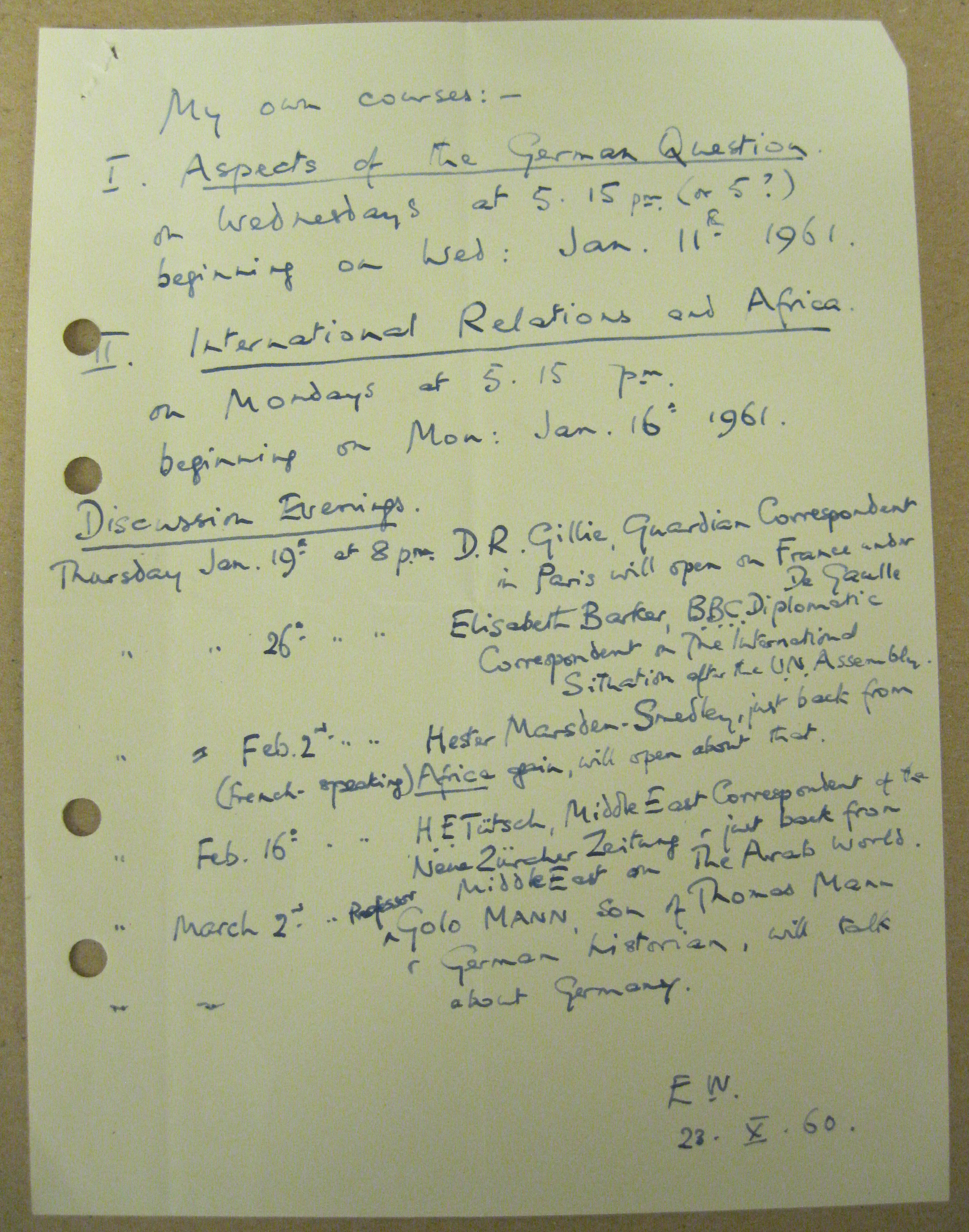
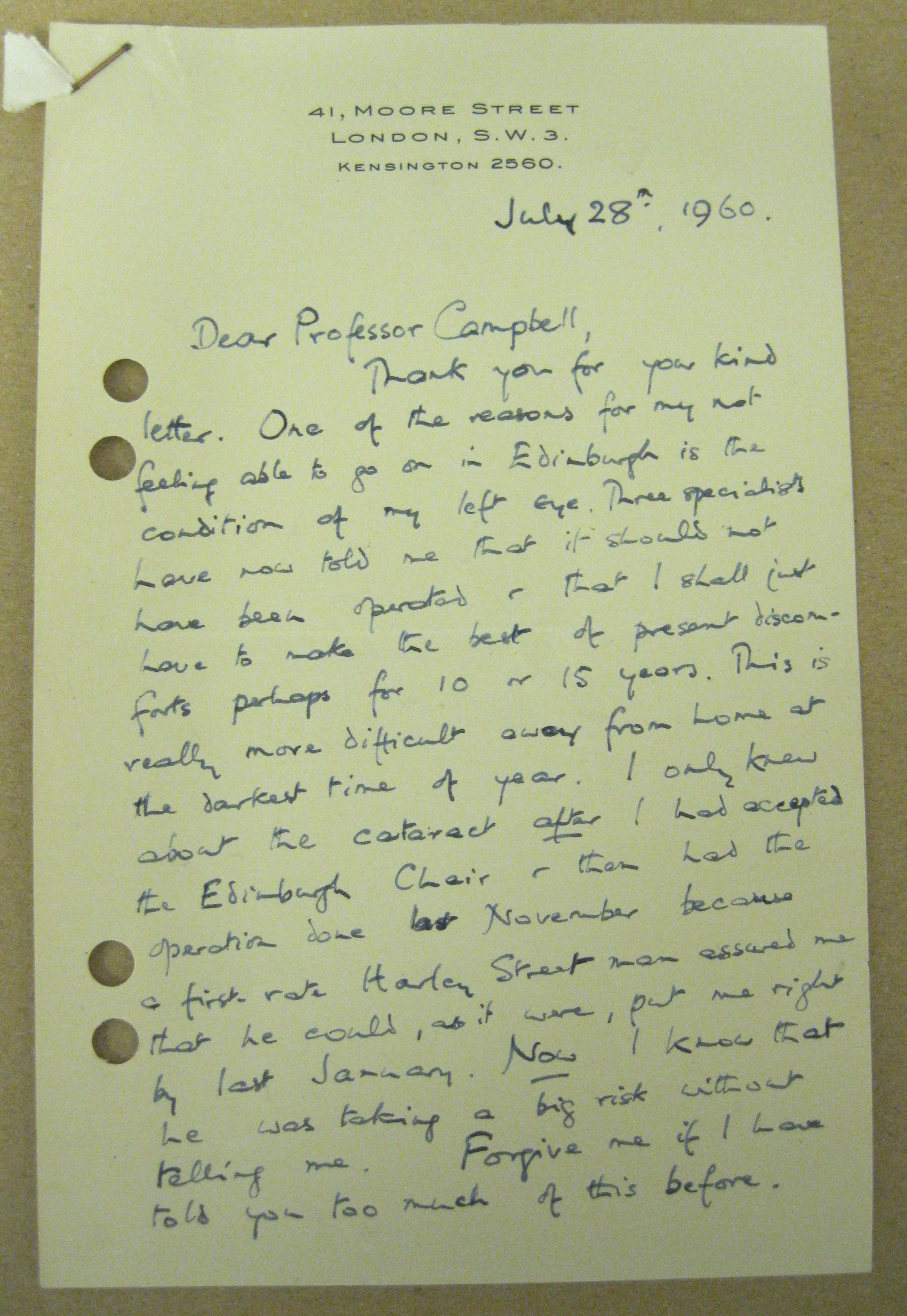
IMG_1726Wiskemann continued to publish on German and Italian politics after the War. She was appointed to the Edinburgh Chair on the recommendation of William Norton Medlicott (1900-1987), Professor of International History at the London School of Economics, who described her as ‘a pleasant, active, middle-aged woman’ who would ‘be a very suitable choice’. Lectures by previous holders of the Chair had been poorly attended as they formed part of no degree course. Wiskemann, however, did much to boost the profile of her post by inviting national and international experts to lead discussion groups on issues of the day. The focus of her own teaching increasingly moved away from European issues to developments in post-colonial Africa. Click on the image, right, to see a handwritten list of lectures and discussion groups for 1961.

IMG_1725The Montague Burton Chair (endowed by Sir Maurice Montague Burton, founder of the men’s clothing chain) was a three-year appointment, at the end of which holders were eligible to apply for re-election. Wiskemann chose not to stand for re-election, much to the University Court’s dismay, as the Chair had proved difficult to fill. In a letter of 28 July 1960 (click right) Wickemann explained that deteriorating eyesight, exacerbated by a recent unsuccessful operation, had led to her decision. Tragically, this condition would eventually lead Wiskemann to take her own life in 1971.

Paul Barnaby, Centre for Research Collections

1906 female medical graduates

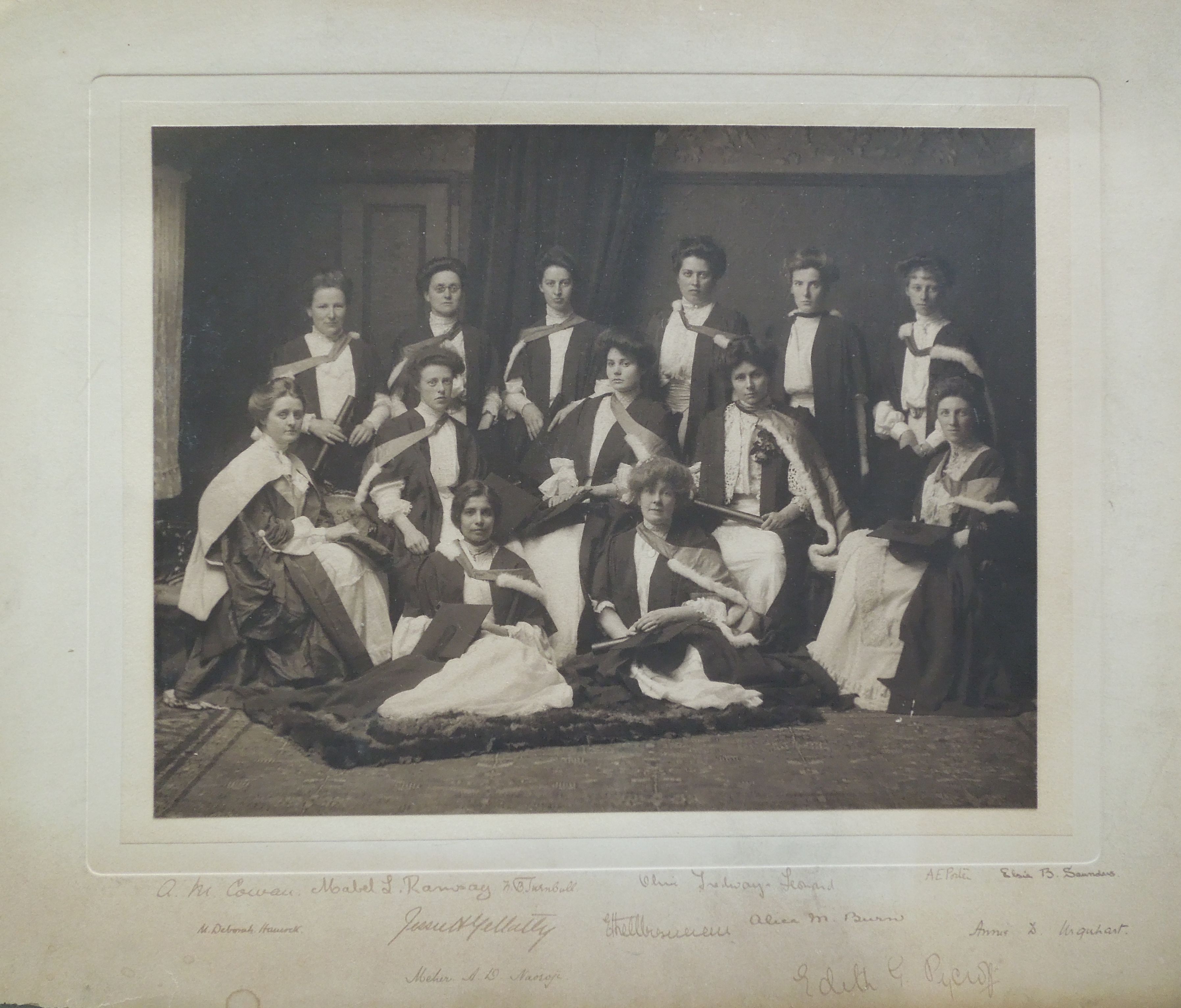
One of our earliest group photographs of female medical graduates depicts the MBChB class of 1906.  It shows 13 women and bears their signatures.

Female MBChB graduates 1906

Female MBChB graduates 1906

Alice Meredith BURN, New Zealand
Agnes Marshall COWAN, Scotland
Jessie Handyside GELLATLY, Scotland
M Deborah HANCOCK / Marjorie DUAKE-COHEN *
Olive TREDWAY-LEONARD, India
Meher Ardeshir Dadabhai NAHOROJI, India
Agnes Ellen PORTER, Scotland
Edith Gertrude PYCROFT, England
Mabel Lida RAMSAY, England
Elsie Blair SAUNDERS, England
Nettie Bell TURNBULL, Scotland
Annie Davidson URQUHART, England
Ethel WISEMAN, England

There was a further female MBChB graduate that year; Isabel HILL, Scotland, graduated in absentia.

* The signature for the student front row, furthest left, is given as M. Deborah Hancock (it may say Harcourt).  However no student of that name graduated.  The remaining student who whose name appears in the list of graduates is Marjorie Duake Cohen.  Her graduation record notes this as being her married name and has her also as Miss Averyl Harcourt.

Some online research has located a reference in the London Gazette, 31 Jan. 1930, to a Mrs Simha Duake Cohen, otherwise Marjorie Averyl Harcourt, who died in 1929.  It also refers to an Anthony Dowling, aka Vernon Harcourt.  The precise circumstances of name changes have not been determined but it does look likely that the remaining graduate in the photograph is Mrs. Duake Cohen.  Why her hood is a different colour to the others has not (yet) been determined.

UPDATE, 28 Nov.

The woman in the photograph is now thought to be Mary Deborah Hancock. Although not a MBChB graduate (which would account for her different hood), this is clearly a perfect match with the signature.

Further research into Marjorie Duake Cohen continues and, if sufficient information comes to light, she may feature in a future blog post.